How to grow Weigela in pots: spring is the best time, and the soil must drain well
Weigela is a highly ornamental flowering plant that can be seen in many gardens across China. Besides being planted on a large scale, this plant can also be grown in pots, but growing it in pots requires careful attention. So how do you grow Weigela in a pot? Let me walk you through it below.
How to grow Weigela in pots
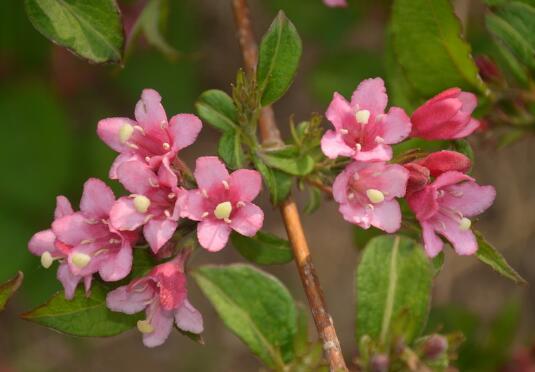
There are many things to pay attention to when it comes to growing Weigela in pots, such as the timing of potting, the choice of flower pot and the soil mix, all of which are fairly important. The details are covered below, so friends who want to grow a Weigela at home can take a look.
1. Potting time
When it comes to how to grow Weigela in pots, timing is very important. Choosing a suitable time to pot it will greatly increase the survival rate. Sprouting vigor is strong in spring, and this season is also the growing period for Weigela, so this is the best time both for potting it and for repotting it.
2. Choosing a flower pot
When choosing a flower pot, remember: don't pick the fancy one, pick the suitable one. Generally we can choose an unglazed clay pot, as this kind of pot has excellent breathability and drainage, allowing Weigela to grow more vigorously. When choosing a pot, it is best not to pick a plastic pot, as this kind of pot is not suitable for Weigela.
3. Soil mix
When it comes to how to grow Weigela in pots, choosing the soil is a fairly important step. We can use 1 part rice-husk ash plus 3 parts garden soil, mix and stir the two evenly, then before potting, place some crushed stones or fairly hard plastic foam at the bottom of the pot. This can increase the breathability and drainage of the soil.
4. Potting method
The potting method for Weigela is actually very simple. We can generally pot it in spring when repotting the plant. After digging the whole plant out, divide it into several plants for potting. The divided branches must have complete roots so they can survive. After dividing, we need to clean the soil off the roots, then trim the roots according to the size of the pot, and after trimming, simply plant them directly.
5. Follow-up care
After potting, we need to place the Weigela in a shady spot for about 3 days, after which it can be moved into the sun for normal care. If you don't know how to care for it, you can refer to the article on Weigela growing methods, which has detailed care instructions, so I won't go into too much detail here.
Summary: After reading the above, I believe you now have some understanding of how to grow Weigela in pots. As long as you follow the methods above, the survival rate will be very high. Here I also wish your Weigela lush growth with thriving branches and leaves.
Weigela Weigela florida (Bunge) A. DC. Weigela illustrated guide: how to grow Weigela / how to propagate Weigela
Weigela profileWeigela Weigela florida (Bunge) A. DC.
Weigela growing methods and precautions, an introduction to Weigela
Weigela is a shrub, 3 m tall and 3 m wide, with spreading branches and a somewhat cylindrical shape; some branches bend down to the ground, and the twigs are slender and weak, with 2 rows of soft hairs when young. Leaves are elliptical or ovate-elliptical, 5-10 cm long, sharply pointed at the tip, rounded to wedge-shaped at the base, serrate along the margin, with hairs on the veins on the upper surface and especially dense hairs on the underside. The corolla is funnel-shaped and bell-like, rose red, with 5 lobes. The capsule is columnar; seeds are wingless. The flowering period is April to June. Weigela has dense branches and leaves and brilliant flower color, and its flowering period can last more than two months. In garden applications it is a major early-spring flowering shrub in North China. It is suitable for group planting at courtyard wall corners and lakesides; it can also be used as a flower hedge or in group plantings along forest edges; and it can accent rockeries and slopes. It is native to the vast areas of China along the Yangtze River basin and to the north, and is also found in Japan, Korea and elsewhere.
The leaves of Weigela are elliptical or ovate-elliptical, and the flowers are very beautiful, with high ornamental value. It is often planted in gardens, parks, backyards and other places, and has the effect of beautifying the environment. It also has high value on the market, is loved by many flower enthusiasts, and often appears as a favorite subject in the works of artists, thus appearing in various literary works.
Morphological characteristics of Weigela
Weigela is a deciduous shrub, up to 1-3 m tall; young branches are slightly four-angled, with 2 rows of short soft hairs; the bark is gray. The buds are pointed at the tip, with 3-4 pairs of scales, often smooth. Leaves are oblong, elliptical to obovate-elliptical, 5-10 cm long, gradually pointed at the tip, broadly wedge-shaped to rounded at the base, serrate along the margin, sparsely covered with short soft hairs above, with denser hairs on the veins, and densely covered with short soft hairs or down beneath, with a short stalk to no stalk.
Flowers are solitary or in cymes borne in the leaf axils of short lateral branches or at the branch tips; the calyx tube is long and cylindrical, sparsely covered with soft hairs, and the calyx teeth are about 1 cm long, unequal, reaching deep into the middle of the calyx limb; the corolla is purple-red or rose red, 3-4 cm long and 2 cm in diameter, sparsely covered with short soft hairs on the outside, with irregular, spreading lobes and light red on the inside; the filaments are shorter than the corolla, and the anthers are yellow; the glands on the upper part of the ovary are yellow-green, and the style is slender with a 2-lobed stigma.
Young branches have soft hairs. Leaves are simple and opposite, with short stalks; the blade is elliptical or ovate-elliptical, gradually pointed at the tip, rounded at the base, and serrate along the margin. The upper surface of the leaf is dark green, the underside is pale bluish-white, and the veins have short soft hairs or down. Flowers are borne 1 to 4 together in corymbs, at the tips of small branches or in the leaf axils; the corolla is funnel-shaped and bell-like, about 3 cm across, purple-red to pale pink, rose red, lighter on the inside, with a green calyx tube.
The fruit is 1.5-2.5 cm long, with a short stalk-like beak at the tip, sparsely covered with soft hairs; seeds are wingless. The capsule is columnar and the seeds are tiny.
The flowering period is April to June, and the fruiting period is October.
Ecological habits of Weigela
It grows in moist valleys and shady or semi-shady places at an altitude of 800-**** m. It likes light, tolerates shade and tolerates cold; it is not demanding about soil and can tolerate poor soil, but grows best in deep, moist soil rich in humus, and it fears waterlogging. It has strong sprouting ability and grows rapidly.
It is native to the vast areas of China along the Yangtze River basin and to the north, and is also found in Japan, Korea and elsewhere. It grows in moist valleys and shady or semi-shady places at an altitude of 800-**** m. It likes light, tolerates shade and tolerates cold; it is not demanding about soil and can tolerate poor soil, but grows best in deep, moist soil rich in humus, and it fears waterlogging. It has strong sprouting ability and grows rapidly.
As a deciduous shrub, Weigela can reach up to 3 m tall. Its young branches are slightly four-angled, and the bark is gray. The buds are short and pointed at the tip, with scales, and smooth; the leaves of Weigela are rectangular, obovate-elliptical or elliptical, gradually pointed at the tip, broadly wedge-shaped to rounded at the base, and serrate along the margin; its flowers are solitary or in cymes borne in the leaf axils of short lateral branches or at the branch tips; the corolla is rose red or purple-red, sparsely covered with short soft hairs on the outside; the lobes are irregular and spreading, and light red on the inside. The flowering period of Weigela is April to June. It likes light and is not demanding about soil, but soil that is moist, deep and rich in humus is preferable.
Cultivation techniques for Weigela
Weigela has strong adaptability, tillers vigorously and is easy to cultivate. Choose well-drained sandy loam as the nursery site. 1-2 year old seedlings or cuttings can all be planted on ridges to grow large seedlings, with a spacing of 50-60 cm. After planting, cut back to 10-15 cm above the ground. Three years after planting, when the seedlings are over 100 cm tall, they can be used for landscaping.
Fertilizing
For potted Weigela, use 3 parts garden soil mixed with 1 part rice-husk ash, plus a small amount of barnyard manure and the like as a base fertilizer. When planting, apply well-rotted compost as a base fertilizer, and afterward apply fertilizer once every 2 to 3 years during the dormant period in winter or early spring by digging a trench around the roots. During the growing season, fertilize 1-2 times a month.
Watering
Pay attention to watering during the growing season of Weigela. After it breaks dormancy in spring, gradually increase the amount of watering and keep the soil moist regularly. High temperatures and drought in summer can easily cause the leaves to turn yellow and shrivel and the branches to wither, so keep sufficient moisture and spray water to cool it down, or move it to a semi-shady, moist place for care. Water thoroughly 1 to 2 times a month to meet its growth needs.
Pruning
Because Weigela has a long growing period, the small branches at the tips often do not grow fully before winter sets in and are very likely to dry up over winter. Therefore, before bud break each spring, the dried branches at the top of the plant as well as other old, weak, diseased and pest-damaged branches should be cut off, and long branches should be shortened. If seed is not wanted, the spent flowering branches should be cut off promptly after flowering so as to avoid consuming too many nutrients and affecting growth. Branches that have grown for 3 years should be cut off from the base to promote vigorous growth of new branches. Because the new shoots that bear the inflorescences mostly sprout on 1-2 year old branches, it is not advisable to prune the previous year's branches heavily in early spring; generally only dead branches are thinned out.
Propagation methods for Weigela
Weigela can be propagated by cuttings, layering, division, sowing and other methods.
Sowing
Seeds can be collected from September to October. After collection, dry the capsules, rub them apart, and winnow away the debris to obtain pure seeds. The thousand-grain weight is 0.3 g, and the germination rate is 50%.
Seed treatment (to promote germination): For direct sowing or 1 week before sowing, soak the seeds in cold water for 2-3 hours, take them out and keep them indoors, wrap them in a damp cloth to promote germination, and then sow; the effect is better.
Sow when there is no wind and no heavy rain in the near forecast, and the bed surface should be leveled and finely prepared. The sowing method can be broadcast sowing on the bed surface or drilling. The sowing rate is 2 g per square meter, and after sowing the covering soil must not exceed 0.3 cm in thickness. Keep the bed surface moist for 30 days after sowing, and seedlings emerge in about 20 days.
Seedling stage management: When the seedlings have grown 3-4 fibrous roots, the first thinning can be carried out, and loosen the soil and weed promptly. The seedling yield is 200 plants per square meter, and the seedlings reach 30-50 cm tall in the first year. 1-2 year old seedlings can be lifted from the nursery for planting.
Cuttings
For variant types of Weigela, the cutting method should be used for propagation, as seed propagation makes it difficult to maintain the traits of the variant. The practice in Heilongjiang Province is to cut 1-2 year old dormant branches in early April, cut them into 10-12 cm long cuttings, dip the cuttings in a 2000 mg/kg solution of α-naphthaleneacetic acid, and then insert them into an open-field sandy cutting bed covered with film and shade. It is best to place a layer of well-rotted horse manure at the bottom of the sand bed to raise the ground temperature. The ground temperature is required to be 25-28°C, the air temperature 20-25°C, the air humidity inside the shed 80%-90%, and the light transmittance around 30%. They root in 50-60 days, with a survival rate of about 80%.
In summer, the current year's semi-lignified branches can be cut as cuttings, inserted halfway into the soil, then watered thoroughly, and afterward just keep the soil moist regularly. In the plum rain season, softwood cuttings can be used, and the survival rate is also high. In March of spring or during the plum rain season, hardwood or softwood cuttings can be used, that is, cut the cuttings into 15 cm lengths and insert them into a sterilized nursery bed with a shade shed; or after leaf fall, take 1-year-old branches and insert them in the open field, and they all root easily.
Layering
During the growing season, bend the branches down into the soil for layering propagation. Usually after flowering, select lower branches to layer down; the lower branches tend to be creeping, and they root and survive easily at the nodes. Division is carried out in early spring and in autumn and winter. It is mostly done around the time of bud break in spring together with transplanting: dig out the whole plant, divide it into several clumps, and replant them separately. It is carried out in early to mid-April. After sowing, water by the soak-irrigation method; do not use a watering can to spray water on the soil surface, so as not to wash the seeds out of the soil. Seedlings emerge about 15 days after sowing. However, the sowing method takes a long time to grow, so it is generally not used for small-scale propagation.
Layering can be done throughout the year, usually by selecting lower branches and bending them down after flowering. The lower branches of Weigela tend to be creeping, so during the growing season bend them down into the soil for layering propagation, and they root and survive easily at the nodes.
Division
Division is carried out in early spring and in autumn and winter. It is mostly done around the time of bud break in spring together with transplanting: dig out the whole plant, divide it into several clumps, and replant them separately. In February-March of spring, use one-year-old mature branches and insert them in the open field, or in June-July use semi-lignified softwood and insert them under a shade shed. Layering can be done in June. When transplanting seedlings in spring and autumn, the original soil must be kept with the roots; in summer, a soil ball is needed. After planting, apply well-rotted compost once every early spring, and prune away aging branches.
Sowing: Carry it out in early to mid-April. After sowing, water by the soak-irrigation method; do not use a watering can to spray water on the soil surface, so as not to wash the seeds out of the soil. Seedlings emerge about 15 days after sowing. However, the sowing method takes a long time to grow, so it is generally not used for small-scale propagation.
Pest and disease control for Weigela
Weigela has few pests and diseases. Occasionally aphids and red spider mites cause damage, which can be killed by spraying dimethoate.
Distribution range of Weigela
Weigela is native to the vast areas of China along the Yangtze River basin and to the north, and is also found in Japan, Korea and elsewhere.
It is distributed in Heilongjiang, Jilin, Liaoning, Inner Mongolia, Shanxi, Shaanxi, Henan, northern Shandong, northern Jiangsu and other places in China. It grows under mixed forests or in hilltop shrub thickets at an altitude of 100-1450 m. It is also distributed in the Soviet Union, Korea and Japan.
Variety classification of Weigela
Through cross-breeding, Weigela now has numerous varieties, including the white Weigela, whose flowers are white with a slight fragrance; the color-changing Weigela, which is white-green when it first opens and turns red as it matures; the variegated-leaf Weigela, which has white, red and other colors and is very colorful; the purple Weigela, whose leaves have a purple tinge and whose flowers are purple-pink; the hairy-leaf Weigela, which flowers earlier, is hairy on the outside, and is rose red or pink; the spotted-leaf Weigela, which has dense flowers and white spots on the leaves; and the Red Prince Weigela, which has dense flowers and a carmine-red corolla that is gorgeous and pleasing to the eye.
After a century of cross-breeding, more than a hundred horticultural types and varieties have been selected. Those seen in cultivation include:
1. Beautiful Weigela: flowers light pink, leaves relatively small.
2. White-flowered Weigela: flowers white. Flowers nearly white, with a slight fragrance.
3. Color-changing Weigela: white-green when it first opens, later turning red.
4. Variegated-leaf Weigela: plant height 2 m to 3 m. The clump is compact, plant height 1.5-2 m, crown width 2-2.5 m, leaf margins cream-yellow or white, leaves opposite, long ovate, leaf tips gradually pointed. Cymes are borne at the branch tips, the calyx tube is green, the corolla is trumpet-shaped, and the flower color gradually changes from white to pink. Because the flowers open at different times, some are white and some are red, making the whole plant show two colors of flowers, and set off by the variegated leaves, it is especially colorful.
5. Purple-leaf Weigela: leaves with a purple tinge, flowers purple-pink, etc.
6. Hairy-leaf Weigela: similar to Weigela, with the important characteristic that both sides of the leaves have soft hairs; the calyx lobes overlap, are united at the base, and are very hairy; the corolla is narrowly bell-shaped, suddenly narrowing below the middle, hairy on the outside, rose red or pink, with a yellow throat; 3-5 flowers are borne on short lateral branchlets; it flowers earlier (April-May).
7. Spotted-leaf Weigela: leaves have white spots.
8. Red Prince Weigela: the plant is relatively short, 1 m to 2 m tall, with a crown width of 1.4 m. Young branches are light red, and old branches are gray-brown. Leaves are long elliptical, and the foliage is golden yellow throughout the growing season. It flowers in early summer, with the flowering period lasting from April through to October, and the branches spread out in an arching shape. Cymes are borne in the leaf axils or at the branch tips, the corolla is funnel-shaped and bell-like, the flowers are dense, and the corolla is carmine red, gorgeous and pleasing to the eye.
9. Japanese Weigela Weigela japonica Thunb.
10. Japanese Weigela (original variety) Weigela japonica Thunb. var. japonica
11. Banbianyue (variety) Weigela japonica Thunb. var. sinica (Rehder) L. H. Bailey
The role and uses of Weigela: purifying the air
The flowering period of Weigela coincides with the time when spring flowers are fading and summer flowers are scarce, and its flower colors are brilliant and varied, so it is one of the important flowering shrubs in Northeast and North China. Its branches and leaves are dense and its flower colors are brilliant, and the flowering period can last more than two months. In garden applications it is a major early-spring flowering shrub in North China. It is suitable for group planting at courtyard wall corners and lakesides; it can also be used as a hedge or in group plantings along forest edges; and it can accent rockeries and slopes. Weigela has strong resistance to hydrogen chloride and is a good pollution-resistant tree species. Flowering branches can be used for vase arrangements.
Ornamental value
The value of Weigela is mainly reflected in its ornamental value and economic value. Weigela has a long flowering period, and its flower colors are brilliant and varied. It is one of the important flowering shrubs in many regions. Its branches and leaves are luxuriant, and it is the earliest spring flowering shrub in North China. It is suitable for planting in parks, flower beds and other places, and can accent rockeries, slopes and green belts, giving it a certain ornamental value. At the same time, Weigela can also resist pollution and beautify the environment; as a good flowering shrub, Weigela also has a certain economic value on the market, and its market prospects are quite considerable.
Garden uses of Weigela
Weigela is suitable for group planting at courtyard wall corners and lakesides; it can also be used as a flower hedge or in group plantings along forest edges; and it can accent rockeries and slopes.
Weigela has strong resistance to hydrogen chloride and is a good pollution-resistant tree species.
The flowering period of Weigela coincides with the time when spring flowers are fading and summer flowers are scarce, and its flower colors are brilliant and varied, so it is one of the important flowering shrubs in Northeast and North China. Its branches and leaves are dense and its flower colors are brilliant, and the flowering period can last more than two months. In garden applications it is a major early-spring flowering shrub in North China.
Cultural background of Weigela
Weigela has long branches and abundant flowers, bright as a brocade belt.
A poem by Wang Yu of the Song Dynasty: "In what year was it transplanted to the monk's home, a cluster of supple branches adorned with rosy clouds...." It describes how the Weigela's branches are supple and long, with flowers clustered like brocade.
A poem by Yang Wanli of the Song Dynasty: "The heavenly maiden's wind shuttle weaves on a dew loom, on the green silk ground the madder branches; how could it ever tie the feet of returning spring, it only knows how to entwine the traveler's grieving brows; even a small tree with faint fragrance can inspire poetry." It describes Weigela as a brocade belt woven by a fairy with a wind shuttle and dew loom, its branches slender and supple, covered with red flowers. Although the flowers are beautiful, they cannot keep the spring light, and only leave flowers like gems inlaid on a jade belt for people to admire.
A poem by Yang Xunzhai of the Song Dynasty: "The swan robe turns green as the original vow is fulfilled, soon granted silver and crimson and purple gold. One cannot help thinking of the bustling seekers of fame and profit; facing the flowers, they should sigh at the passing of time."
A poem by Fan Chengda of the Song Dynasty: "Bright red like the makeup of the cherry-apple, delicate green like the branches of the rose. A little breeze comes again and again, fluttering along with the dancing dress. In Wu the fair flower railings, in the gorge the wild slopes are full. A beauty fallen into an empty valley, bright as the white colt poem."
The flower language of Weigela
Weigela flower: a bright future, splendor and beauty.
Because Weigela begins flowering in spring and continues until summer, a cluster of supple branches covered with flowers like rosy clouds, just like a brocade belt. Yang Wanli of the Song Dynasty wrote in a poem: "The heavenly maiden's wind shuttle weaves on a dew loom, on the green silk ground the madder branches; how could it ever tie the feet of returning spring, it only knows how to entwine the traveler's grieving brows; even a small tree with faint fragrance can inspire poetry." And the sea fairy flower: "In what year was it transplanted to the monk's home, a cluster of supple branches adorned with rosy clouds. Though the name Weigela is humble and common, for you I call it the sea fairy flower." Therefore the flower language implies a bright future, splendor and beauty.
Weigela pictures
Propagation and cultivation techniques for Weigela
Weigela is a deciduous shrub, up to 1-3 m tall; young branches are slightly four-angled, with 2 rows of short soft hairs; the bark is gray. The buds are pointed at the tip, with 3-4 pairs of scales, often smooth. Leaves are oblong, elliptical to obovate-elliptical, 5-10 cm long, gradually pointed at the tip, broadly wedge-shaped to rounded at the base, serrate along the margin, sparsely covered with short soft hairs above, with denser hairs on the veins, and densely covered with short soft hairs or down beneath, with a short stalk to no stalk. Flowers are solitary or in cymes borne in the leaf axils of short lateral branches or at the branch tips. Today I will briefly introduce the propagation and cultivation techniques for Weigela.
Propagation and cultivation techniques for Weigela
Sowing propagation:
After collecting seeds in September-October, dry the capsules, rub them apart, and winnow away the debris to obtain pure seeds. The thousand-grain weight is 0.3 g, and the germination rate is 50%. Seed treatment (to promote germination): For direct sowing or 1 week before sowing, soak the seeds in cold water for 2-3 hours, take them out and keep them indoors, wrap them in a damp cloth to promote germination, and then sow; the effect is better. Sow when there is no wind and no heavy rain in the near forecast, and the bed surface should be leveled and finely prepared.
The sowing method for Weigela can be broadcast sowing on the bed surface or drilling, with a sowing rate of 2 g per square meter, and after sowing the covering soil must not exceed 0.3 cm in thickness. Keep the bed surface moist for 30 days after sowing, and seedlings emerge in about 20 days. When the seedlings have grown 3-4 fibrous roots, the first thinning can be carried out, and loosen the soil and weed promptly. The seedling yield can reach 200 plants per square meter, and the seedlings reach 30-50 cm tall in the first year. 1-2 year old seedlings can be lifted from the nursery for planting.
Cutting propagation:
For variant types of Weigela, the cutting method should be used for propagation, as seed propagation makes it difficult to maintain the traits of the variant. The practice in Heilongjiang Province is to cut 1-2 year old dormant branches in early April, cut them into 10-12 cm long cuttings, dip the cuttings in a 2000 mg/kg solution of α-naphthaleneacetic acid, and then insert them into an open-field sandy cutting bed covered with film and shade.
It is best to place a layer of well-rotted horse manure at the bottom of the sand bed to raise the ground temperature. The ground temperature is required to be 25-28°C, the air temperature 20-25°C, the air humidity inside the shed 80%-90%, and the light transmittance around 30%. They root in 50-60 days, with a survival rate of about 80%. In addition, the layering method can also be used for propagation.
Layering propagation:
During the growing season, bend the branches down into the soil for layering propagation. Usually after flowering, select lower branches to layer down; the lower branches tend to be creeping, and they root and survive easily at the nodes. Division is carried out in early spring and in autumn and winter. It is mostly done around the time of bud break in spring together with transplanting: dig out the whole plant.
Divide it into several clumps and replant them separately. It is carried out in early to mid-April. After sowing, water by the soak-irrigation method; do not use a watering can to spray water on the soil surface, so as not to wash the seeds out of the soil. Seedlings emerge about 15 days after sowing. However, the sowing method takes a long time to grow, so it is generally not used for small-scale propagation.
Soil requirements:
Weigela has strong adaptability, tillers vigorously and is easy to cultivate. Choose well-drained sandy loam as the nursery site. 1-2 year old seedlings or cuttings can all be planted on ridges to grow large seedlings, with a spacing of 50-60 cm. After planting, cut back to 10-15 cm above the ground. Three years after planting, when the seedlings are over 100 cm tall, they can be used for landscaping.
Fertilizing method:
For potted plants, use 3 parts garden soil mixed with 1 part rice-husk ash, plus a small amount of barnyard manure and the like as a base fertilizer. When planting, apply well-rotted compost as a base fertilizer, and afterward apply fertilizer once every 2 to 3 years during the dormant period in winter or early spring by digging a trench around the roots. During the peak growing season of Weigela, fertilize 1-2 times a month to ensure the needed nutrients.
Watering method:
Pay attention to watering Weigela during the growing season. After it breaks dormancy in spring, gradually increase the amount of watering and keep the soil moist regularly. High temperatures and drought in summer can easily cause the leaves to turn yellow and shrivel and the branches to wither, so keep sufficient moisture and spray water to cool it down, or move it to a semi-shady, moist place for care. Water thoroughly 1 to 2 times a month to meet its growth needs.
Pruning and shaping:
Because Weigela has a long growing period, the small branches at the tips often do not grow fully before winter sets in and are very likely to dry up over winter. Therefore, before bud break each spring, the dried branches at the top of the plant as well as other old, weak, diseased and pest-damaged branches should be cut off, and long branches should be shortened. If seed is not wanted, the spent flowering branches should be cut off promptly after flowering.
Because long branches consume too many nutrients and affect growth. Branches that have grown for 3 years should be cut off from the base to promote vigorous growth of new branches. Because the new shoots that bear the inflorescences mostly sprout on 1-2 year old branches, it is not advisable to prune the previous year's branches heavily in early spring; generally only dead branches are thinned out.
The above is my introduction to the propagation and cultivation techniques for Weigela. I hope it is helpful to you!