How to Propagate the Kapok Tree: Two Propagation Methods for Bombax ceiba (Grafting/Sowing)
As a plant that is both beautiful and highly effective, the kapok tree (Bombax ceiba) is not only good-looking but can also be used medicinally to treat illnesses. In recent years, as the city flower of Guangzhou, the kapok has become known to more and more people, and many regions have begun growing it, so kapok trees are being propagated in large numbers. So how do you propagate the kapok? Below are two propagation methods for the kapok; let's take a look together.
I. How to Propagate the Kapok: Grafting/Sowing
For the average flower enthusiast, mastering how to grow the kapok is enough, but if you are an old hand, understanding the propagation methods of the kapok is very necessary, as it can add to your growing enjoyment. It is understood that the kapok prefers high temperatures and dry conditions and has strong drought tolerance. The main propagation methods suited to it are two: grafting and sowing. Let's take a look at the specific operations next.
II. Two Propagation Methods for the Kapok
(1) Sowing Propagation of the Kapok
After the kapok blooms, it produces fruit, and with seeds you can naturally carry out sowing propagation. It is understood that kapok seeds can be harvested in April-May, but because they are high in oil and easily spoil and lose their germinating power, it is generally required to sow them immediately after collection so that the success rate is high. The specific method is as follows:
Sowing propagation of the kapok can use drilling, with a row spacing of 20 cm and a depth of 5 cm, sowing the kapok seeds in the furrows. After sowing, cover with 2 cm of soil, cover the surface soil with grass, and generally after 6-7 days they will germinate, and after 13-15 days they will basically all emerge. When the seedlings are 4-5 cm tall and have 2 or more primary leaves, they can be moved into nutrient bags, and when the seedlings are about 40 cm tall they can be transplanted to cultivate large seedlings.
(2) Grafting Propagation of the Kapok
1. Rootstock Selection
When it comes to the propagation methods of the kapok, the first thing everyone probably thinks of is cuttings, but kapok cuttings are not easy to keep alive; it generally uses the grafting propagation method. The first step in grafting propagation is to select the rootstock, and at this point you can refer to the sowing propagation above, because when the seedling's diameter at breast height is about 100-115 cm, it can be grafted.
2. Grafting Time
After the rootstock is prepared, you then need to find a suitable time to graft. For the grafting time of the kapok, the editor recommends carrying it out in February-March or June-July. In February-March the temperature rises quickly, the kapok begins to sprout and send out shoots, and at this time the grafting survival rate is high; if you choose June-July, the grafting survival rate is also good, but you should avoid rainy days.
3. Scion Selection
In grafting propagation, the rootstock and scion are extremely important. The rootstock has already been selected, so let's now talk about the selection requirements for the scion: two-year-old current-year non-flowering branches that are robust, full, with plump buds and free of pests and diseases, with a diameter between 0.17 cm-1.2 cm, and bud eye spacing of 1-2 cm.
After the scion is selected, corresponding treatment should be done: cut off the leaves to reduce water loss from the branches, and wrap the branches in a wet towel and place them in a cool place; it is best to use them as soon as they are collected. If the scion needs to be stored, you can seal both ends with paraffin and bury it in a sand bed, covering with a sand layer 4 cm-6 cm thick, and pay attention to moisture retention and ventilation.
4. Grafting Method
With the above preparations done, the grafting propagation of the kapok can formally begin. The method is as follows:
① Scion treatment: Select a plump bud on the scion, and on its opposite side, at 0.15 cm from the lower end, use a knife to cut a flat surface 1.5-2 cm long with little or no xylem; then on the opposite side cut a 45° slanted cross-section, cut off 1 cm above the bud, and the scion length is 4 cm.
② Rootstock treatment: Cut the rootstock at a height of 15 cm from the ground, make a vertical cut on the smooth surface of the rootstock, length 115 cm-200 cm, preferably with a little wood.
③ Grafting method: Insert the prepared scion into the graft union, align and closely join the cambium on both sides, and let the upper end of the scion show white. Then use a plastic film strip to bind it tightly from bottom to top, wrapping only one layer of grafting film at the scion's bud eye, so that it is easy for the graft to automatically break through the film after surviving.
Overall, kapok propagation is not difficult; both grafting and sowing can survive, but when it comes to survival rate, grafting is the best. Of course, methods are fixed while people are flexible; everyone can choose a method to propagate according to the actual situation. Regarding the propagation methods of the kapok, the editor will introduce them here, hoping to help everyone.
Kapok Tree Grafting Technique, Propagation Methods of the Kapok
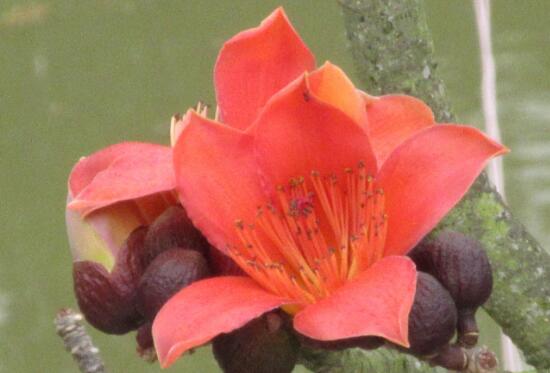
Image: Kapok flower
[Common Questions] Kapok Tree Grafting Technique, Propagation Methods of the Kapok
[Expert Answer]
Rootstock Cultivation
In the Panzhihua City area, kapok seeds mature in April-May and can be harvested then. Because the seeds are high in oil and easily spoil and lose their germinating power, it is generally required to sow them promptly in the same year after collection. For seedbed seedling raising, drilling and broadcasting are used; for drilling, the row spacing is 20 cm and the depth is 5 cm, sowing the seeds in the furrows. Cover with 2 cm of soil, cover the surface soil with grass; after sowing, germination begins in 6-7 d, and they basically all emerge in 13-15 d. After the seedlings emerge, loosen the soil and weed promptly, and thin and weed appropriately, paying attention to pest and disease control. When the seedlings are 4-5 cm tall and have 2 or more primary leaves, they can be moved into nutrient bags, and when the seedlings are about 40 cm tall they can be transplanted to cultivate large seedlings. When the seedling's diameter at breast height is 1 m-115 cm, it can be grafted.
Grafting Time
In the Panzhihua area, it is suitable to graft the kapok in February-March and June-July. In February-March the temperature rises quickly, the kapok begins to sprout and send out shoots, and at this time grafting is easy to survive. In April-May the temperature is high, which easily causes the scion to dry up. June-July is the period when the rainy season is more concentrated in the Panzhihua area, and the temperature drops somewhat; rainy days should be avoided when grafting.
Selecting the Scion
From mother kapok trees that have already flowered, select two-year-old current-year non-flowering branches that are robust, full, with plump buds and free of pests and diseases as the scion. The selected scion is required to have a diameter between 0.17 cm-1.2 cm and bud eye spacing of 1-2 cm. The collected scion branches must be immediately stripped of leaves to reduce water loss from the branches, and the branches should be wrapped in a wet towel and placed in a cool place; it is best to use them as soon as they are collected. When the scion needs to be stored for several days, both ends can be sealed with paraffin and buried in a sand bed, covering with a sand layer 4 cm-6 cm thick, and pay attention to moisture retention and ventilation.
Grafting Method
For kapok grafting, single-bud cut grafting is better. Experiments have found that no matter how many buds are left on the scion, after the first bud sprouts and sends out shoots, the germination of the remaining bud eyes is all inhibited. When grafting, first cut the scion. The method is: select a plump bud on the scion, and starting the knife at 0.15 cm from the lower end on the opposite side, cut a flat surface 1.5-2 cm long with little or no xylem, cut a 45° slanted cross-section on the opposite side, cut off 1 cm above the bud, and the scion length is 4 cm. For the rootstock seedling, it is required to cut the rootstock at a height of 15 cm from the ground, make a vertical cut on the smooth surface of the rootstock, length 115 cm-2 m, preferably with a little xylem, insert the prepared scion into the graft union, align and closely join the cambium on both sides, and let the upper end of the scion show white. Finally, use a plastic film strip to bind it tightly from bottom to top, wrapping only one layer of grafting film at the scion's bud eye, so that it is easy for the graft to automatically break through the film after surviving.
[Editor's Comments] Kapok propagation has three methods: sowing, cuttings and division. The above is what the First Agricultural Economics editor introduces to you about kapok tree grafting and kapok propagation methods. For more related materials, such as"How to Sow and Raise Kapok Seedlings" and "Common Pest and Disease Control of the Kapok", please follow the related columns or special topic channels of First Agricultural Economics; we will wholeheartedly provide you with more comprehensive and more professional materials!
Kapok Bombax ceiba Kapok Illustrated Guide: How to Grow the Kapok / How to Propagate the Kapok
Kapok ProfileKapok Bombax ceiba
Growing Methods and Precautions of the Kapok, Introduction to the Kapok
The kapok is a specialty of Guangdong and the city flower of Guangzhou. Five petals with strong curves surround a bundle of dense yellow stamens, gathered into a firm receptacle. Each one is as big as a rice bowl, spreading downward from the top of the tree to meet the spring. The kapok is also called the hero flower; even its falling is extraordinarily bold. When it falls from the tree, it still maintains its original form in the air, spinning all the way down, then landing on the ground with a "smack." Under the tree the fallen flowers lie scattered; the flowers do not fade or wither, bidding farewell to the mortal world in a very heroic way.
Features Introduction
The kapok is a specialty of the south and the city flower of Guangzhou. Five petals with strong curves surround a bundle of dense yellow stamens, gathered into a firm receptacle. Each one is as big as a rice bowl, spreading downward from the top of the tree to meet the spring. The kapok is a flower belonging to spring, and it always does not enter its full flowering period until March-April after the warmth of spring arrives.
The kapok tree is a very peculiar tree: although the whole tree is full of red flowers, not a single green leaf can be found. It always seizes the time to drop its leaves in winter, bloom in spring, and grow leaves again after the flowers fade. In nature, many flowering plants, even though their branches and leaves cannot stay with the flowers for a lifetime, still have intersections; but what about the kapok? Its flowers and green leaves appear at two different times, rarely intersecting. They perhaps have never set each other off, yet each has its own beauty.
The kapok tree, a tropical plant, although its flowers do not fall as delicately as cherry blossoms, nor will the ground be covered with fallen flowers from wind or rain, the kapok, which enjoys the title of "hero tree," although its flowering period is not long, has an excellent bird-attracting effect. While enjoying the flowers you can also enjoy the birds; in the early spring season you might as well go under the kapok tree to feel the birdsong and the fragrance of flowers.
[Kapok Flowering Period] It blooms every year in March and April, with a flowering period of about 15 days.
Morphological Characteristics of the Kapok
The kapok belongs to the family Bombacaceae; it is a large deciduous tree native to India. It is 10-20 m tall. The base of the trunk is densely covered with knobby thorns, the branches are whorled, and the leaves are alternate. Every year in February-March it first blooms, then grows leaves. The corolla has five petals, orange-yellow or orange-red. The calyx is dark brown, leathery. After flowering it bears oval large fruits, containing ovate seeds and white cotton fluff. The tree is tall and majestic, with spreading branches, and the flowers are red as blood, as large as cups. The base of the trunk is densely covered with knobby thorns to prevent animals from intruding. The branches are whorled, and the leaves are alternate. Although the kapok's trunk is thick and large, its wood is too soft, so its use is limited.
It is often taller than neighboring trees, hence the name hero tree. The trunk is upright with obvious knobby thorns; palmately compound leaves are alternate, and the petioles are very long; it flowers before the leaves emerge in early spring, and the flowers are clustered at the branch tips. The corolla is red or orange-red, about 12 cm in diameter, with 5 petals, fleshy, elliptical-obovate, about 9 cm long, curved outward, with margins curled inward, both sides covered with stellate pubescence; the stamens are numerous, united into a tube, arranged in 3 whorls, the outermost whorl gathered into 5 bundles; the capsule is very large, woody, oblong, up to 15 cm, and after maturity it splits open automatically, and the inside is full of cotton fluff; the cotton wool can be used as filling material for pillows, quilts, etc. The seeds are numerous, obovate, black, smooth, hidden within the white hairs. The appearance of the kapok changes a lot: in spring, the whole tree is orange-red; in summer, green leaves form shade; in autumn, the branches and leaves are bleak; in winter, the branches are bare and the tree is cold. It displays different charms in the four seasons. The flowers are orange-red, blooming in March-April, flowering before growing leaves, and the tree shape has a masculine beauty.
Kapok Flowers, Cotton Fluff and Seeds
Every year in February-April it first blooms, then grows leaves. The corolla has five petals, obovate, with stellate hairs on both sides, orange-yellow or orange-red, usually emerging in early spring, appearing earlier than the leaves. The calyx is dark brown, leathery. The kapok can also be used as medicine; drying the freshly fallen kapok flowers makes one of the main materials of the cooling tea "five-flower tea." After flowering it bears oval large fruits, and around May the fruit splits open, and the ovate seeds inside together with the white cotton fluff extending from the cells of the inner wall of the pericarp scatter with the wind. Kapok seeds contain 20 to 25% oil and can be pressed for oil to make soap and machine oil; the cotton cake after oil pressing can be used as fertilizer or livestock feed. Because South China does not produce cotton, local residents over the years would collect the cotton fluff when it drifts, to use instead of cotton as filling for cotton-padded jackets or woven into cloth. The trunk is upright with obvious knobby thorns; the lateral branches are whorled and spread out horizontally; palmately compound leaves with very long petioles; the flowers are large, orange-yellow or orange-red; the fruit is a capsule, which splits open automatically after maturity, and the inside is full of cotton fluff; the cotton wool can be used as filling material for pillows, quilts, etc.
Ecological Habits of the Kapok
It is a tropical tree species, liking a high-temperature and high-humidity climate environment, with relatively low cold resistance. When encountering a long-term low temperature of 5-8℃, the branches suffer cold damage; it fears frost. In places such as Guangzhou and Nanning in southern South China, in normal years it can overwinter safely in the open ground; in cold years there is frost damage. In the vast areas from northern South China to North China, it can only be potted, moved into a warm shed or indoors in winter, and the room temperature should not be lower than 10℃. It likes light and does not tolerate shade; it tolerates scorching sun and high temperature, and is suitable for planting in places with sufficient sunlight.
It is not demanding about soil; both sandy soil and heavy clay soil are suitable. It likes acidic soil, is relatively drought-tolerant, and also slightly tolerant of waterlogging. Its demand for fertility is not very high. Generally, in soil with medium fertility and relatively high phosphorus and potassium fertilizer, it blooms profusely and the color is also bright; in soil with sufficient water and relatively high nitrogen fertilizer, the branches and leaves are lush and it also blooms more, but the color is less bright. When planting, it is suitable to apply decomposed cake fertilizer or garbage as base fertilizer, and before flowering and at the peak of flowering, apply additional phosphorus and potassium fertilizer. The tree shape is not very attractive, but it has sprouting ability; in management you can use trunk truncation or pruning and shaping to promote a fuller crown, and you can also plant 3-5 plants in one place to improve the ornamental effect.
Distribution Areas of the Kapok
[Place of Origin] The tree's place of origin is unknown, but it most likely originated in India. It was widely planted in South China, Taiwan, China, Indochina and the South Seas Islands with migrants. According to ancient Chinese records, Zhao Tuo, King of Nanyue, once presented a kapok tree to the Han imperial court in the 2nd century BC. Kapok also comes in white kapok and red kapok!
[Main Planting Places in China] In China, it is planted in Guangzhou, Zhuhai, Kunming, Shenzhen, Fuzhou, Xiamen and other places. In particular, in Guangzhou and Xiamen, kapok trees are planted along the whole streets as street trees. Every year just after the Lantern Festival, the kapok tree begins to bloom!
Origin of the Kapok's Name
Fenghuo (beacon fire) originates from Zhao Tuo, King of Nanyue, who named it because the tree full of red flowers resembled beacon light; Gubei originates from the transliteration of the Sanskrit Karpassa; Jibei is believed to originate from the transliteration of the South Seas native language Ceiba, and this name originally referred to the Java kapok Ceiba pentandra and was confused because of the similar shape; the name Qiongzhi refers to the tree growing on Hainan (Qiong) Island, hence the name. In the forest, the top of the kapok tree often surpasses other trees, so it is called the hero tree.
Because the kapok usually blooms in March and April, April 11 was designated as the day of the kapok.
As early as 1931, the kapok was once designated as the city flower of Guangzhou. In June 1982, the Guangzhou Municipal People's Government once again designated the kapok as the city flower, further deepening the favor and respect of Guangzhou citizens for the kapok.
Uses and Purposes of the Kapok
Besides its high ornamental value, the kapok's flowers, bark and roots all have medicinal value. Cooking congee or making soup with dried kapok flowers can detoxify, clear heat, dispel cold and remove dampness; boiling kapok bark in water also has effects such as clearing heat, promoting urination and detoxifying, and has significant efficacy for chronic gastritis, gastric ulcer, diarrhea, dysentery, etc.
In addition, the kapok has a wide range of uses. Its stamens are very good textile material. Ancient books record: "The kapok tree is two or three zhang tall, quite like the tong tree; in February-March the flowers fade, and the core becomes cotton. The people there weave it into blankets, white as snow, incomparably warm." The kapok's wood is soft and can be made into packing box boards, matchsticks, wooden boats, buckets and basins, etc., and is also a raw material for papermaking.
Medicinal Dietary or Medicinal Value of the Kapok
The medical information and healthy dietary information on HuaHuWang (Flower Protection Network) is for reference only and cannot be used as a basis for diagnosis or medical treatment. Any health problems should be consulted with professional medical personnel, and the treatment of any disease should follow doctor's orders.
Ultimate flower-protecting task: To love yourself, start from reality and strictly follow doctor's orders. For illness, do not be careless, do not delay, do not give up hope; face it bravely, warm the silent world with love, and care for the flower field in your heart with your heart.
The medical content on HuaHuWang is for reference only and cannot be regarded as professional advice. For any health problems, you should consult professional medical personnel. Medicinal Information (I)
[Chinese Name] Mumian, Yingxiongshu, Hongmian, Banmangmian, Banmangshu, Haitong, Jibei, Guangdong Haitong, Panzhihua, Mian, Molian
[Chinese Pinyin] Mumian
[English Name] Tree Cotton, Common Bombax, Wood Cottontree, Cotton Tree, Silk-cotton Tree, Bombax, Red Silk-cotton Tree
[Latin Scientific Name] Bombax malabaricum DC.
[Family and Genus Classification] Family Bombacaceae, Genus Bombax
[Plant Morphology] Large deciduous tree, up to 25 m tall. Bark dark gray, trunk often with conical thick thorns, branches spreading. Palmately compound leaves; total petiole 10-20 cm long; leaflets 5-7, oblong to oblong-lanceolate, 10-16 cm long, 3.5-5.5 cm wide; petiolules 1.5-4 cm long. Flowers borne in the leaf axils near the branch tips, opening before the leaves, red or orange-red, about 10 cm in diameter; calyx cup-shaped, thick, 3-5 shallowly lobed; petals fleshy, obovate-oblong, 8-10 cm long, both sides covered with stellate pubescence; stamens numerous, the lower part united into a short tube, arranged in 3 whorls, the inner whorl's filaments partly forked in the upper part, the middle 10 stamens shorter, not forked, the outermost whorl gathered into 5 bundles, anthers 1-locular, kidney-shaped, peltately attached; the style is longer than the stamens; ovary 5-locular. Capsule oblong, woody, 10-15 cm long, covered with gray-white long pubescence and stellate hairs, splitting open with 5 valves along the back of the locules, with silky wool inside. Seeds numerous, obovate, black, hidden within the wool. Flowering in spring, fruiting in summer.
[Habitat and Distribution] It grows in dry-hot river valleys, savanna, rainforest valleys, low mountains, secondary forests, and by village edges and roadsides below 1400-**** m altitude. It is distributed in South China, Southwest China and Jiangxi, Fujian, Taiwan, China and other places. The medicinal material is mainly produced in Yunnan and Guangdong. The medicinal material is mainly produced in Yunnan and Guangdong.
[Medicinal Parts] The flowers, bark, roots or root bark are used as medicine. Chinese medicine names: Flower: Mumianhua. Bark: Mumianpi. Root, root bark: Mumiangen.
[Harvesting and Processing] Flowers: harvested in late spring, dried in the shade. Bark: can be collected all year round; peel off the bark and dry in the sun. Roots, root bark: can be collected all year round, those collected in autumn and winter are of better quality. Dig up the roots, wash clean, use fresh or slice; or peel off the root bark and dry in the sun.
[Main Components] The calyx contains protein, carbohydrates, ash and other components. The seeds contain various amino acids and fatty acids; they also contain carotenoid, β-sitosterol, α-tocopherol, n-hexacosanol, octadecyl palmitate, gallic acid and other components.
[Pharmacological Effects] Flowers: liver-protecting effect. Bark: anti-inflammatory, analgesic, antibacterial. Roots, root bark: anti-inflammatory, anti-liver-injury.
[Nature, Flavor and Functions] Flowers: sweet, bland, cool. Bark: pungent, bitter, cool. Roots, root bark: bitter, cool. Flowers: clear heat, promote diuresis, detoxify, stop bleeding. Bark: clear heat and detoxify, dissipate stasis and stop bleeding. Roots, root bark: dispel wind and dampness, clear heat and detoxify, dissipate nodules and relieve pain.
[Main Indications and Usage] Flowers: diarrhea, dysentery, hemoptysis, metrorrhagia, bleeding from metal wounds, sore toxins, eczema. Roots, root bark: rheumatic arthralgia, stomach pain, red dysentery, postpartum edema, scrofula, bruises and sprains. Flowers: internal use: decoct in water, 9-15 g, or take as powder. Bark: internal use: decoct in water, 15-30 g. External use: appropriate amount, pound and apply. Roots, root bark: internal use: decoct in water, 15-30 g. External use: appropriate amount, soak in wine and rub, or pound and apply.
1. Bacillary dysentery, acute and chronic gastroenteritis: fresh kapok flowers 60 g. Decoct in water, take with winter honey. (Fujian Medicinal Records)
2. Sweating and restlessness in summer heat: appropriate amount of kapok flowers, brew in boiling water and take. (Sichuan Chinese Materia Medica Records)
3. Gastric cancer: kapok tree bark 1150 g, lean pork 150 g, add 5 kg of water, cook for 7-8 hours, decoct thickly to 1 bowl, take once daily. If after taking continuously for 1 week the pain is felt to gradually decrease, it should be continued until recovery, without interruption. (Anti-Cancer Materia Medica)
4. Rheumatic arthritis: kapok root 30-60 g. Decoct in water or soak in wine and take. (Fujian Medicinal Records)
Medicinal Information (II)
Source: The dried flowers of the Bombacaceae plant kapok Gossampinus malabarica (DC.) Merr.
The original plant, the kapok, is a large deciduous tree, up to 25 m tall; the stem and large branches have short, thick conical hard thorns, and the bark is grayish-white. The leaves are alternate, palmately compound with 5-7 leaflets; the leaflets are oblong or elliptical, 10-20 cm long, 5-7 cm wide, with acuminate tips, broad or slightly narrow bases, and entire margins. The flowers open before the leaves in early spring, red, about 10 cm in diameter or larger, clustered near the top of the branches; the calyx is cup-shaped, 3-4.5 cm long, with 5 shallow lobes at the top, the lobes broad and blunt; the petals are 5, fleshy, oblong, 8-10 cm long, both sides covered with stellate pubescence; the stamens are numerous, arranged in multiple whorls, the filaments united at the base. The fruit is large, woody, 10-15 cm long, and the inner side of the fruit valves has abundant wool; the seeds are numerous, obovate, black.
It likes to grow in dry-hot mountainous areas. It is distributed in Hainan, Taiwan, China, Guangxi, Yunnan and southern Sichuan; it is widely cultivated in Guangdong and south of central Fujian. It is also found in India, Indochina, Malaysia and tropical Australia.
Harvesting and Processing: In spring, pick or gather the fully bloomed flowers. Dry in the sun.
Medicinal Material Traits: The whole flower is 5-8 cm long, shrunken when dry, in irregular blocks, mostly without ovary and pedicel. The calyx is cup-shaped, 2.5-4 cm long, 2-3 cm in diameter, with 3-5 lobes at the top, thickly leathery, very brittle, the outer surface brown-black with longitudinal wrinkles, the inner surface covered with grayish-yellow short tomentum. The petals are 5, shrunken or broken, the surface brown-yellow or dark brown, covered with stellate hairs, the inner surface red-brown with fewer stellate hairs; the stamens are numerous, arranged in multiple rows, united at the base, the anthers kidney-shaped, curled. The odor is slight, and the taste is bland and slightly sweet. Those with large, complete flowers and brown-yellow color are better.
Nature, Flavor and Functions: Bland, astringent, neutral. Clear heat, promote diuresis, detoxify. Used for diarrhea, dysentery, metrorrhagia, sore toxins. Common dosage 5-10 g.
Note: The bark of the kapok is used as Haitongpi in Guangdong and is called Guangdong Haitongpi. It tastes bitter, is neutral in nature, and functions to diffuse wind and dampness.
Functions: Clear heat, promote diuresis, detoxify. Used for diarrhea, dysentery, metrorrhagia, sore toxins.
Nature and Flavor: Bland, astringent, neutral.
Various Authors' Discussions
1. "Shengcaoyao Xing Beiyao": Treats dysentery; the white ones are even better.
2. "Bencao Qiuyuan": The red ones remove red dysentery, the white ones treat white dysentery; decoct with Wuyi tea and drink regularly.
3. "Lingnan Caiyao Lu": Relieves summer heat.
4. "Zhongyao Xinbian": Diuretic and stomachic.
5. "Nanning Shi Yaowu Zhi": Removes damp-heat. Treats metrorrhagia and metal wounds.
6. "Guangxi Zhongyao Zhi": Removes damp toxins; treats malignant sores.
7. Guangzhou Military Region "Commonly Used Chinese Herbal Medicine Manual": Clears heat and promotes diuresis; treats enteritis and bacillary dysentery.
Medicinal Material Source
It is the dried flowers of the Bombacaceae plant kapok Gossampinus malabarica (DC.) Merr.
Harvesting and Processing
In spring, pick or gather the fully bloomed flowers. Dry in the sun.
Medicinal Material Traits
The whole flower is 5-8 cm long, shrunken when dry, in irregular blocks, mostly without ovary and pedicel. The calyx is cup-shaped, 2.5-4 cm long, 2-3 cm in diameter, with 3-5 lobes at the top, thickly leathery, very brittle, the outer surface brown-black with longitudinal wrinkles, the inner surface covered with grayish-yellow short tomentum. The petals are 5, shrunken or broken, the surface brown-yellow or dark brown, covered with stellate hairs, the inner surface red-brown with fewer stellate hairs; the stamens are numerous, arranged in multiple rows, united at the base, the anthers kidney-shaped, curled. The odor is slight, and the taste is bland and slightly sweet. Those with large, complete flowers and brown-yellow color are better.
Nature, Flavor and Functions
Bland, astringent, neutral. Clear heat, promote diuresis, detoxify. Used for diarrhea, dysentery, metrorrhagia, sore toxins. Common dosage 5-10 g.
Notes
Extracts from the root and stem of the kapok can be used as astringents, analgesics, etc. Its sap can be used to treat dysentery, and its root bark, stem bark and thorns, ground into powder and made into an ointment, can be used to treat acne. Also, the kapok flower is truly a feast for the eyes! It is said that whenever the kapok blooms, many elderly people and children in the village, seeing fallen flowers, pick them up and then dry them in the sun, and they can be used to make tea, cook soup and use as medicine.
The bark of the kapok is used as Haitongpi in Guangdong and is called Guangdong Haitongpi. It tastes bitter, is neutral in nature, and functions to dispel wind-dampness, unblock the meridians and kill parasites. It treats rheumatic arthralgia, dysentery, toothache and scabies.
① "Haiyao Bencao": Mainly treats inability to walk due to waist and leg problems, stubborn arthralgia with pain in the legs and knees, cholera, red and white diarrhea and dysentery, bloody dysentery, scabies.
② "Rihua Zi Bencao": Treats numbness and pain of the blood vessels, and can be decocted for washing red eyes.
③ "Kaibao Bencao": Mainly treats cholera and sudden turmoil, chronic red and white dysentery, removes ganfei and scabies. For tooth worm pain, decoct and take as well as hold in the mouth; soak in water and wash the eyes to remove skin redness.
④ "Gangmu": Can move through the meridians and reach the site of disease, and also enters the blood aspect and dispels wind and kills parasites.
⑤ "Lingnan Materia Medica": Promotes tissue regeneration, relieves pain, disperses blood stasis, cools the skin, and is applied for bruises and injuries.
⑥ "Nanning City Drug Records": Reduces swelling, disperses blood stasis, and relieves pain. Treats cough and stops postpartum blood stasis pain.
⑦ "Guizhou Herbal Medicine": Relieves fever and removes blood stasis, detoxifies and promotes tissue regeneration. Treats breast abscess and fractures.
Medicinal Effects and Actions
Kapok flower is the dried flower of the kapok tree (Bombax ceiba) of the family Malvaceae (Bombacaceae). Also known as ban zhi shu, hero tree, or panzhihua, kapok flower has the effects of clearing heat and draining dampness, detoxifying and stopping bleeding. Kapok flower is used to treat diarrhea, dysentery, uterine bleeding, and sore toxins. The bark of the kapok tree is used in Guangdong as sea mallow bark (Hibiscus tiliaceus bark) and is called Guangdong sea mallow bark; it is bitter in taste, neutral in nature, and has the effect of dispelling wind-dampness.
Medicinal Information (III)
Name: Kapok flower
Aliases: Ban zhi shu, hero tree, panzhihua
Family and genus: Malvaceae (Bombacaceae), deciduous large tree
Nature and taste: Bland, astringent, neutral.
Effects: Clears heat, drains dampness, detoxifies.
Indications: Used for diarrhea, dysentery, uterine bleeding, and sore toxins.
Dosage and usage: Common dosage 5-10 grams.
Source: Kapok flower is the dried flower of the kapok tree (Bombax ceiba) of the family Malvaceae (Bombacaceae).
Note: The bark of the kapok tree is used in Guangdong as sea mallow bark and is called Guangdong sea mallow bark. It is bitter in taste, neutral in nature, and functions to dispel wind-dampness.
Folk Remedies
1. To treat dysentery: Kapok flower, honeysuckle flower, and Chinese brake herb, 15 grams each, decoct in water and take.
2. To treat dysentery with red and white mucus: Kapok flower and tea leaves, 15-30 grams each, decoct in water and take.
3. To treat damp-heat dysentery: Kapok flower 15 grams, houttuynia 12 grams, prickly amaranth root 30 grams, decoct in water and take.
4. To treat postpartum wind in women: Kapok root inner bark 60 grams, safflower and cocklebur root 30 grams, decoct in water and take with wine.
5. To treat lung cancer and intestinal cancer: Kapok root 15-30 grams, decoct in 3 bowls of water until reduced to about half a bowl, take warm.
6. To treat stomach pain: Kapok root or bark 30 grams, prickly ash 6 grams, decoct in water and take.
7. To treat bleeding after bowel movement: Kapok bark 30 grams, lean pork 90 grams, simmer as soup and take.
8. To treat arthralgia: Kapok root 30 grams, decoct in water and take.
Dietary Nutrition: Kapok and Tangerine Peel Porridge
[Ingredients]: Fresh kapok flowers 30 grams, tangerine peel 10 grams, japonica rice 100 grams, honey to taste.
[Preparation]: Wash the kapok flowers and tangerine peel, add water and decoct to extract the juice, strain and set aside; wash the japonica rice, add water and the kapok-tangerine peel juice and cook into porridge; when the porridge is nearly done, add an appropriate amount of honey and cook briefly, and it is ready.
[Effects]: Strengthens the spleen and eliminates dampness, cools the blood and stops bleeding, moistens the lungs and relieves cough.
Kapok flower has the effects of clearing heat and draining dampness, detoxifying and stopping bleeding; tangerine peel and honey can moisten the lungs and relieve cough; japonica rice can strengthen the spleen and benefit the stomach. Used together, the three further enhance the functions of strengthening the spleen and draining dampness and moistening the lungs and relieving cough, and are especially suitable for the elderly with qi deficiency.
Kapok Three-Flower Drink
[Ingredients]: Dried kapok petals 15 grams, honeysuckle flower 10 grams, white chrysanthemum 10 grams.
[Preparation]: Wash the kapok petals, honeysuckle flower, and white chrysanthemum; add water and bring to a boil; can be drunk as a tea substitute.
[Effects]: Clears heat and detoxifies, cools the blood and stops dysentery.
Kapok flower, honeysuckle flower, and white chrysanthemum all have heat-clearing effects. Kapok flower clears heat and cools the blood, honeysuckle flower clears heat and detoxifies, and white chrysanthemum clears the liver and brightens the eyes. Used together, the three further enhance the effects of clearing heat, cooling the blood, and stopping dysentery. In hot summer weather, drinking this beverage regularly also has the effect of relieving summer heat.
Kapok Crucian Carp Soup
[Ingredients]: One crucian carp (about 250 grams), fresh kapok petals 30 grams, mushrooms 50 grams, bamboo shoot tips 30 grams, scallion white, ginger, yellow wine, salt, pepper, and monosodium glutamate to taste.
[Preparation]: Remove the gills and internal organs of the crucian carp, wash clean, and drain the water; wash the kapok petals and drain; slice the mushrooms and bamboo shoot tips; when the oil in the wok is hot, first add ginger and scallion white and stir-fry until fragrant, then put the crucian carp into the wok and fry thoroughly, add water, and add the mushrooms, bamboo shoots, kapok petals, yellow wine, and pepper, and cook together; finally season with monosodium glutamate and salt and transfer to a plate.
[Effects]: Strengthens the spleen and nourishes the stomach, clears heat and drains dampness, cools the blood and stops bleeding.
Both kapok flower and crucian carp can clear heat and drain dampness; crucian carp can also strengthen the spleen and nourish the stomach. With the addition of mushrooms and bamboo shoots, the flavor is even more delicious. The polysaccharides in mushrooms also have the effects of increasing the body's immunity and fighting cancer.
Kapok Shrimp and Tofu
[Ingredients]: Fresh kapok petals 30 grams, tofu 500 grams, shrimp 100 grams, bamboo shoot tips 50 grams, ham 30 grams, green peas 50 grams, chicken broth, salt, monosodium glutamate, pepper, ginger, and scallion white to taste.
[Preparation]: Wash the kapok petals and drain; wash the shrimp and drain for later use; dice the bamboo shoots and ham, and cut the tofu into small pieces; when the oil in the wok is hot, first stir-fry the ginger and scallion white until fragrant; then add the shrimp, diced bamboo shoots, ham, and green peas and stir-fry together; then put the shrimp, diced bamboo shoots, and tofu together into a clay pot, add the kapok petals, pour in the chicken broth and cook together, and season with salt, monosodium glutamate, and pepper, and it is ready.
[Effects]: Clears heat and drains dampness, relieves depression and restlessness. Kapok flower has the function of clearing heat and draining dampness; tofu can relieve heat and restlessness; bamboo shoots can moisten the intestines. Simmered together with shrimp, ham, and chicken broth, it is not only fragrant and delicious but also further enhances the effects of clearing heat, draining dampness, and cooling the blood. The isoflavones in tofu also have antioxidant and anti-aging effects.
Kapok Mushroom Soup
[Ingredients]: Fresh kapok petals 20 grams, fresh oyster mushrooms 30 grams, fresh mushrooms 30 grams, fresh king oyster mushrooms 30 grams, bamboo shoot tips 30 grams, salt, monosodium glutamate, and chicken broth to taste.
[Preparation]: Wash the fresh kapok petals, blanch in water, and set aside; thinly slice the oyster mushrooms, mushrooms, king oyster mushrooms, and bamboo shoots; put the oyster mushrooms, mushrooms, king oyster mushrooms, bamboo shoots, and kapok flowers into a pot, add chicken broth and water and cook together, and season with monosodium glutamate and salt.
[Effects]: Clears heat and cools the blood, strengthens the spleen and harmonizes the stomach.
Kapok flower has the effect of clearing heat and cooling the blood, and bamboo shoots have the effect of removing stagnation and reducing food accumulation. The polysaccharides in oyster mushrooms, mushrooms, king oyster mushrooms, and other mushrooms have the function of regulating human immunity and fighting cancer. Used together, they are not only delicious but also have enhanced effects.
Simmering Fine Kapok Soup
[Materials]: Kapok flower 30 grams, gorgon nut and coix seed 35 grams each (available at Chinese medicine shops), candied dates 4 pieces, crucian carp 1 fish, lean pork 50 grams, ginger 4 slices.
[Preparation]: Wash each item separately. Soak the medicinal herbs briefly, remove the pits from the candied dates; slaughter and wash the crucian carp, fry until slightly yellow, and splash in a little clear water. Put everything together into a clay pot, add 2000 milliliters of clear water (about 8 bowls), bring to a rolling boil over high heat, then reduce to low heat and simmer for about 1.5 hours, add salt and it is ready. Serves 3-4 people.
[Effects]: Eliminates dampness and promotes urination, strengthens the spleen and soothes the liver. Kapok flower is often a good ingredient for eliminating dampness among the people of Guangdong. It has the effect of eliminating dampness and is mild and clearing-moistening, making it most suitable for use in early spring.
Cultivation Techniques of Kapok Flower: Cultivation Overview
[Biological Characteristics] Prefers a warm climate; it is a representative tree species of tropical monsoon forests. Not cold-tolerant, light-loving, drought-tolerant, fast-growing, with strong sprouting ability, deep-rooted, and strong wind resistance. Grows best in deep, fertile acidic and neutral soils.
[Cultivation Techniques] Propagated by sowing, cuttings, and division. Collect the capsules before they split open; the seed germination capacity has a short storage life, so it is mostly sown immediately after collection, or it can be stored short-term in moist sand. Drill sowing, cover with 2 cm of soil, average temperature above 20°C, generally seedlings emerge completely in 4-5 days; cuttings are mostly done in February-March or during the rainy season, using large branches 80-100 cm long and 1-2 cm in diameter, inserted into the seedbed 10-15 cm deep, keeping the bed moist regularly; division is done from the sprouting shoots at the base of the mother plant, cutting off a section of the mother root and fibrous roots for replanting, which makes it easier to survive.
[Field Management] Seedling plants do not need transplanting; when the seedlings are too dense, after one thinning, they can be left to grow, with topdressing 1-2 times per month. Seedlings are afraid of frost; in the first year when winter comes, the small seedlings should be watered and covered with grass to prevent frost damage. After planting, cutting seedlings should be shaded and sprayed with water; after recovery, thin fertilizer can be applied half a month later, and thereafter regular cultivation and weeding should be carried out.
Cultivation of Rootstock
In the Panzhihua city area, kapok seeds mature in April-May and can be harvested. Because the seeds have high oil content and are prone to deteriorating and losing germination capacity, it is generally required to sow them promptly in the same year after collection. Seedbed seedling cultivation uses drill sowing and broadcast sowing; drill sowing has a row spacing of 20 cm and a depth of 5 cm, with seeds sown in the furrows. Cover with 2 cm of soil, cover the surface soil with grass, and germination begins 6-7 days after sowing, with basically complete emergence in 13-15 days. After the seedlings emerge, loosen the soil and weed promptly, and thin and weed appropriately, paying attention to pest and disease control. When the seedlings are 4-5 cm tall and have more than 2 primary leaves, they can be moved into nutrient bags; when the seedlings are about 40 cm tall, they can be transplanted to cultivate large seedlings. When the seedling trunk diameter is 1 m-115 cm, grafting can be carried out.
Grafting Time
In the Panzhihua area, it is suitable to graft kapok in February-March and June-July. In February-March, the temperature rises quickly, and the kapok begins to sprout and send out shoots, so grafting at this time is easy to survive. In April-May, the temperature is high, which can easily cause the scion to dry up. June-July is a period when the rainy season is more concentrated in the Panzhihua area, and the temperature drops somewhat, so rainy days should be avoided when grafting.
Selecting Scions
From mother kapok trees that have already flowered, select two-year-old current-year non-flowering branches that are robust, full, with plump buds and free of pests and diseases as scions. The selected scions are required to have a diameter between 0.17 cm and 1.2 cm, with bud spacing of 1-2 cm. The collected scion branches should immediately have their leaves removed to reduce water loss from the branches, and the branches should be wrapped in a wet towel and placed in a cool place, preferably used immediately after collection. When the scions need to be stored for several days, both ends can be sealed with paraffin and buried in a sand bed, covered with a sand layer 4-6 cm thick, and attention should be paid to moisture retention and ventilation.
Grafting Method
For kapok grafting, single-bud cut grafting is better. Experiments have found that regardless of how many buds are left on the scion, once the first bud sprouts and sends out shoots, the germination of the remaining buds is inhibited. When grafting, first cut the scion; the method is: select a plump bud on the scion, and on the opposite side at the lower end 0.15 cm from the bud, start the knife to cut a flat surface 1.5-2 cm long with little or no wood, cut a 45° slanted cross-section on the opposite side, and cut off 1 cm above the bud, with the scion length being 4 cm. For the rootstock seedling, it is required to cut the stock at a height of 15 cm from the ground, make a vertical cut on the smooth surface of the rootstock, with a length of 115 cm-2 m, preferably with a little wood, insert the prepared scion into the grafting incision, align and closely join the cambium on both sides, and leave the upper end of the scion exposed. Finally, use a plastic film strip to tie it tightly from bottom to top, and wrap only one layer of grafting film at the bud eye of the scion, so that it is easy for the graft to automatically break through the film after survival.
Daily Management
[Re-grafting]: Check the survival situation 10-15 days after grafting. If the bud body is fresh and the leaf petiole falls off at a light touch, it indicates survival; if the scion turns brown, the petiole is not easy to fall off, and the scion feels soft when pinched by hand, it indicates that the grafting has not survived, and re-grafting should be carried out immediately.
[Loosening the band]: After the graft survives, let the scion bud eye automatically break through the film. The new shoots of the graft sprout relatively slowly; the first few new leaves are all pink, and after about 2-3 weeks the leaf color begins to turn tender green and unfold. When the young leaves have completely turned green and flattened, the plastic film band can be loosened to avoid affecting the growth of the new shoots. However, the binding at the graft union should not be removed immediately, in order to protect the scion from damage.
[Removing sprouts]: For grafted seedlings that have survived, the sprouts on the rootstock should be removed at any time, so that nutrients are concentrated and supplied to the new shoots that have already survived grafting.
[Other Management]:
Timely cultivation and weeding and reasonable watering, emphasizing frequent application of thin fertilizer and heavy nitrogen fertilizer. New shoots are often damaged by leaf beetles and geometrid moths and other phytophagous insects, such as alder leaf beetles and Chinese pistache geometrid larvae. When the damage is minor, manual capture and killing can be used; when the damaged area is relatively large, chemical control is used: commonly selected are 80% dichlorvos or 50% fenitrothion 800-fold solution, 25% phosmet emulsifiable concentrate 800-1000-fold solution, 80% chlordimeform 1000-fold solution, etc.
Cultural Background of Kapok Flower: Cultural Meaning
The kapok tree is the city flower of Guangzhou, Chaozhou, Panzhihua, and Chongzuo in China, and Kaohsiung in Taiwan, China. Because its trunk is tall and sturdy, it is compared to a hero in South China, and is also called hero wood. The late Hong Kong, China pop music giant Roman Tam had a song "Red Cotton," using the kapok tree as a metaphor for the proud spirit of Chinese people. In addition, it is also the county tree of Kinmen County, symbolizing the local people's resolute character and bright future prospects.
In addition, there is also a Cotton Tree Road in Admiralty on Hong Kong Island, China, and the Cotton Tree Road Marriage Registry located in Hong Kong Park is also a popular wedding spot for Hong Kong, China people.
The song "Kapok Road" is a folk song related to kapok flower, composed by Taiwan, China folk singer Ma Zhao-jun. The first line of the lyrics is "Red flowers bloom all over Kapok Road, the long street seems to be burning," describing the scene of kapok flowers blooming along the road.
The logo of China Southern Airlines is composed of an abstract large red kapok flower set against a sapphire blue airplane vertical tail pattern. Kapok flower is a flower unique to southern China and has been the city flower of Guangzhou since 1982, symbolizing an honest and enthusiastic style.
Documentary Records
Kapok was first recorded in Ge Hong's "Miscellaneous Records of the Western Capital" of the Jin Dynasty: During the Western Han Dynasty, Zhao Tuo, King of Nanyue, presented a beacon-fire tree as tribute to the Han emperor, "one zhang and two chi tall, one trunk with three branches, and at night its light seemed about to burn." It is said that this beacon-fire tree was the kapok tree. The people of Guangzhou have a special affection for kapok because kapok has always benefited Lingnan.
The Cantonese people used kapok as cotton wadding to make cotton garments, quilts, and pillows. The Tang Dynasty poet Li Cong wrote the line "cut cloth from the cotton on the tree." Song Dynasty Zheng Xiong's "Panyu Miscellaneous Records" states: "The kapok tree is two or three zhang tall, very much like the tong tree; in the second and third months the flowers have already fallen, and the core becomes cotton. The people there weave it into blankets, white as snow, incomparably warm." Kapok flower can also be used as medicine; it is collected at the end of spring every year, sun-dried, cleaned of impurities and made clean, then decocted in water and taken, and can clear heat and remove dampness.
Kapok flowers are relatively large, orange-red in color, extremely beautiful, and can be enjoyed for appreciation. In ancient Guangzhou, kapok trees were widely planted, among which the more than ten trees in front of the Nanhai God Temple were the oldest. Every year in the second month of the lunar calendar, kapok flowers bloom in full, and thousands of people come to view them each day, making the scene lively. Qing Dynasty Qu Dajun praised it with "Song of the Ancient Kapok Flower at the Nanhai God Temple." Now there are still two ancient kapok trees at the Nanhai God Temple, having endured wind and frost for a long time, still standing tall and upright.
The kapok tree belongs to a fast-growing, strongly heliophilous tree species. Its crown always rises above the surrounding tree groups to strive for sunlight and rain. This upward-striving spirit of kapok and its bright red flowers like fire have been praised as the hero tree and hero flower. The earliest person to call kapok "hero" was the Qing Dynasty person Chen Gongyin. In 1959, Guangzhou Mayor Zhu Guang wrote 50 poems in "Gazing at Jiangnan: Guangzhou is Good," among which there is the line: "Guangzhou is good; people say kapok is heroic. Leaves fall and flowers bloom, flying fire phoenixes; towering to the sky and holding the sun, dancing red dragons. March is just the spring breeze."
Cultural Inheritance: Cultural Symbol
Kapok flower is currently the city flower of Guangzhou in Guangdong Province, Chongzuo in Guangxi Zhuang Autonomous Region, Panzhihua in Sichuan Province, and Kaohsiung in Taiwan, China. At present, the logos used by the Garden Hotel, China Southern Airlines, and Guangzhou Television feature the kapok flower pattern, and Guangdong Television also used the kapok flower logo in the past.
Related Poems
To whom can one borrow the Yao yellow and Wei purple, and there is not even any plum or cherry. Yet the spring colors of the south are different; the whole city is filled with kapok flowers. - Song Dynasty, Yang Wanli
Remember the Shangsi day in the south of the city, when kapok flowers fell and coral trees bloomed. - Song Dynasty, Su Shi
Several trees half the sky red as if dyed; the residents say it is kapok flower. - Song Dynasty, Liu Kezhuang
In the second and third months the Yue River comes, and thousands upon thousands of trees bloom with vermilion flowers. Like Yao shooting ten suns emerging from the blue sea, and like the Wei palace with ten thousand torches surrounding the high terrace. Covering like bells, upturned like goblets, the red petals blazing with star-like points. Thick beard and broad face, a fine hero; majestic spirit and high crown, how lofty. The later pomegranate in the hall is famous in vain; at the same time peach and apricot are ashamed of their frivolity. Zhurong and Yandi rule the southern land; is this flower not the lord of all flowers? Nesting birds must bear red phoenix chicks; fallen flowers are meant to transform into coral trees. Year after year among the Five Ridges, northerners have no road to gaze upon the vermilion face. I wish to become flying catkins clothing the world, not speaking of frontier winds and northern snows' cold. - Qing Dynasty, Chen Gongyin
Ten zhang of coral is the kapok; when its flowers bloom, their red is fresher than morning clouds. Every tree in the southern sky is a beacon fire, yet none can compare to the loveliness of panzhihua! Towering ancient trunks vie in twisting and grasping; at flowering time there are no leaves, how profuse the blossoms! White dots on each branch like butterfly cocoons; red-burning each blossom like lotus sand. - Qing Dynasty, Qu Dajun
[Tang Dynasty] Bai Juyi
A patterned jacket of water-wave design newly made, silk soft and cotton even, warm yet light.
Rising in the morning, one loves to sit facing the sun; going out in the evening, it is suitable to wear while treading snow.
Crane down and fine wool are sparse and have no substance; kapok flowers are cold and gain only an empty name.
In ease and comfort one often sighs as night encroaches; lying stable and drowsy, one sleeps until dawn.
The common people suffer much cold with no means of rescue; if one body alone is warm, what feeling is that?
In my heart I think of the hardships of farming and sericulture; in my ears I seem to hear sounds of hunger and cold.
How can I get a great fur robe ten thousand zhang long, to cover all of Luoyang city together with you?
Bamboo Branch Song [Tang Dynasty]
Huangfu Song
Betel nut flowers bloom and partridges cry; the male flies through miasma, the female also flies.
Kapok flowers are gone and lychees hang low; a thousand flowers and ten thousand flowers await my lord's return.
Lotuses paired on one stem, one heart connected; flowers invade the lattice, eyes should pierce through.
In the banquet the candle tears are pearl-red; the joy-sharing peach pit is shared by two people.
Slanting river wind rises and stirs cross waves; splitting open the lotus seed, the bitter heart is much.
Peach blossoms on the hilltop, apricots in the valley bottom; the two flowers, graceful and fair, reflect each other from afar.
Li Weigong
[Tang Dynasty] Li Shangyin
The crimson-sashed disciples' sound and dust are cut off; the phoenix-mirror beauty's former meetings are rare.
Today one arrives at the land of song and dance; kapok flowers are warm and partridges fly.
[Tang Dynasty] Li Shangyin
In the front pavilion the rain curtain sorrows and will not roll up; in the rear hall the fragrant trees are seen dimly in the shade.
The scenery of Stone City is like the Yellow Springs; at midnight the wandering young man vainly shoots his mulberry-wood pellet.
The silk fan summons wind from the heaven of Changhe; light curtains and green screens swirl like deep waves.
Is the Shu soul lonely and has it a companion or not? For several nights the miasma flowers have bloomed on the kapok.
In the cassia palace the lingering shadow is hard to capture; delicate fragrance and broken orchids speak softly.
One would make the Silver River fall into the bosom, and not send the star consort to come and go at will.
Muddy water and clear waves, how are their sources different? The Ji River is clear and the Yellow River is turbid.
How can one get thin mist to rise from the pale-yellow skirt, and with hands receive the cloud carriage and call the Great Lady?
Golden Thread Song / Congratulations to the Bridegroom
[Song Dynasty] Liu Chenweng
Leaf by leaf, leaping pearl rain. The inner lake connects, ten li of red fragrance, painted oars all raised. Last night I dreamed of heavenly wind high with yellow swans, looking down on the human world, where is it? But earth-shaking, the tide sounds like drums. Bamboo pavilions and terraces, green green grass; ask the kapok, has the traveler's soul returned or not? The plate weeps dew, the temple bell speaks. Waking from the dream is exactly like Qu Yuan's bitterness. Sighing at the spirit's wandering, former times are all no more; tomorrow is the Double Fifth. Filled with Li Sao yet no one composes it; forget your sorrow and mourn antiquity. Let it be in drunkenness, vague and threadlike. Far, far away, the old man Anqi of Maoling, together at Hao Pond, parting at night and still in Chu. Gathering the green of the ravine, long I stand waiting.
Song of the Kapok Flower [Qing Dynasty] Chen Gongyin In the second and third months by the Guangdong River, Thousands upon thousands of trees burst into crimson bloom. Like Yao shooting down ten suns rising from the vast sea, Or like Wei Palace's ten thousand torches encircling the high terrace. Drooping like bells, upturned like wine cups, Crimson petals blazing, stars with horns. Thick whiskers, broad face, a fine hero, Majestic spirit, high crown, how lofty! The pomegranate of later bloom is vainly famed, While peach and apricot blush for their frivolity. Zhurong, the Flame Emperor, rules the southern land, Is this flower not then the sovereign of all blooms? Nesting birds must bear vermilion phoenix chicks, Fallen blossoms would turn to coral trees. Year after year among the Five Ridges, Northerners find no road to gaze upon its crimson face. I wish to become drifting catkins clothing all under heaven, Heedless of border winds and northern snows so cold.
Related Songs
Kapok Flower
Singer: Chen Haibin | Lyricist: Zhou Weiyin | Composer: Chen Haibin | Arranger: Chen Haibin | Post-production mixing: Huanyin Studio | Album: Immortal Flowers Bloom Lyrics: You gaze at the kapok, do you miss me Escaping my sight, guarding forever But the kapok, the kapok never yearns for The past, the past, old scenes Late autumn's kapok, a ground full of longing The cold wind blew away the fair face But the kapok, the kapok never fulfilled Lost, lost all vows A kapok leaf drifts down, I lie awake all night Erasing from memory your world But year after year it is still that kapok flower Kapok flower, that kapok tree
Flower Language and Symbolism
Flower language: Cherish the people around you, cherish the happiness before your eyes.
It is said that the eleventh day of April is the day the kapok flower blooms.
The kapok flower is relatively large, orange-red in color, extremely beautiful, and suitable for appreciation. In ancient Guangzhou, kapok trees were widely planted, among which the dozen or so in front of the Nanhai God Temple were the most ancient. Every year in the second month of the lunar calendar, kapok flowers bloom in full, and as many as several thousand people come to view them each day, making for a lively scene, which the Qing dynasty poet Qu Dajun celebrated in his "Song of the Ancient Kapok Flower at the Nanhai God Temple." Today the Nanhai God Temple still has two ancient kapok trees, long weathered by wind and frost, yet still standing tall and upright.
"It is called eerie because in spring, autumn, and winter it is always green, growing luxuriantly in dark green, emerald green, and pale green. When summer comes, everything changes again. It begins to release its magic, little by little, freeing its most wicked and most bewitching essence, wiping out every trace of green, and on its bare branches suddenly burst forth vivid, seductive blossoms, blazing with abandon like dry wood meeting fierce fire, burning wildly, monotonous in color yet never understated."
Folk Legend
Legend has it that on Wuzhi Mountain there was an old Li hero named Jibei, who often led the people to defeat invasions by other ethnic groups. Once, because a traitor informed on him, the old hero was captured, and the enemy tied him to a kapok tree and tortured him severely; the old hero remained unyielding, and was finally cruelly killed. Later the old hero transformed into kapok trees, so the kapok tree is called "Jibei" in memory of this old ethnic hero. How did the name "Hero Tree" come about then? Well, look at its trunk: the tall, self-standing trunk is covered with thorny growths, forbidding any random person from climbing it, and the branches extend in whorls, as if declaring sovereignty to the sky. When it blooms there are no leaves, and after the flowers all fall, leaves grow again; it truly has bold spirit, hence it also has the fine name "Hero Tree." However, the first person to call the kapok a hero was the Qing dynasty man Chen Gongyin, who in his "Song of the Kapok Flower" described the kapok flower as "thick whiskers, broad face, a fine hero; majestic spirit, high crown, how lofty!" From then on people called the kapok tree the Hero Tree. As for how the name "kapok flower" came about, it is more pictographic: after the kapok flower withers, it produces cotton fluff, and the cotton fluff is attached to the large tree. Cotton on the tree, hence "kapok flower" (wood-cotton flower). Kapok, a peerless hero among trees unique to the Southland: its tree form is tall and upright, its wood tough and resilient; when it blooms it is fiery red and ardent, needing not the slightest foil of green leaves; once its flowering season passes it falls decisively to the earth, allowing not the least decline and wilt; the flowers can be used in food and can also clear heat and detoxify, giving people gentle, kindly care.
The kapok was first recorded in Ge Hong's "Miscellaneous Records of the Western Capital" from the Jin dynasty: during the Western Han, Zhao Tuo, King of Nanyue, presented to the Han emperor a Beacon Fire Tree, "one zhang and two chi tall, one trunk with three branches, and at night its radiance seemed about to ignite"; it is said this Beacon Fire Tree was the kapok tree.
The kapok tree is a fast-growing, strongly heliophilous species, and its crown always rises above the surrounding trees to strive for sunlight and rain. This striving, upward spirit of the kapok, together with its fiery-red large blossoms, has earned it the names Hero Tree and Hero Flower. The first person to call the kapok a "hero" was the Qing dynasty man Chen Gongyin, who in his "Song of the Kapok Flower" once described the kapok flower as "thick whiskers, broad face, a fine hero; majestic spirit, high crown, how lofty!" A large expanse of kapok in full bloom is quite imposing. Just in time for the New Year, choosing the fiery-red Hero Tree, Teeth wishes everyone a Merry Christmas and a Happy New Year, cherish the happiness before you, and may next year be even more prosperous!
The Flower Language of the Kapok Flower
Cherish the people around you, cherish the happiness around you.
Kapok Flower Pictures