How to grow Rosa rubus? Master the methods and precautions for growing it in a sunny spot
Rosa rubus is a variety of the hollow-berry bramble in the genus Rubus of the rose family. It has good ornamental value, and it can be seen in many regions of our country, but if you want to grow it well, there are many points that need attention. How to grow Rosa rubus? What are the cultivation methods and precautions for Rosa rubus? Let the editor take you through them below.
1. How to grow Rosa rubus: understand its habits
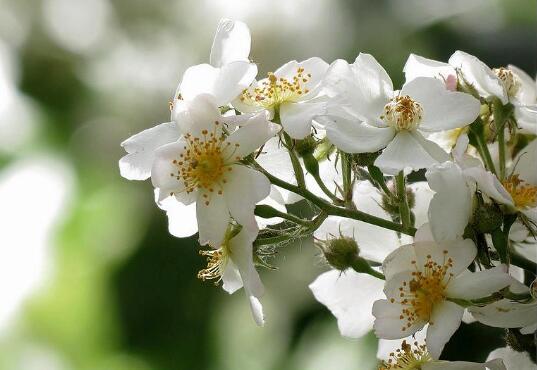
If you want to know how to grow Rosa rubus, first we need to understand its growth habits. This plant likes a warm, sunny environment and is fairly drought-tolerant, but it fears waterlogging, so during cultivation we must remember to control the amount of watering. In addition, daily fertilizing and lighting also need attention, so that Rosa rubus can grow better.
2. Cultivation methods and precautions for Rosa rubus
1. Soil: well-drained
Before growing Rosa rubus, we first need to choose the soil. This is like laying the foundation when building a house; it is a very important step. Generally it is best to choose fairly loose, fertile sandy soil. This kind of soil has good drainage and aeration, allowing the plant to breathe better and absorb nutrients, and it is also less prone to waterlogging.
2. Fertilizing: once every 15-20 days
Fertilizer is one of the main nutrients in the growth process of Rosa rubus. Especially after it enters its peak growing season, its demand for fertilizer is very high, and it basically needs fertilizing once every 15-20 days. For fertilizer choice, it is best to choose diluted cake fertilizer water, which can ensure better flower color and a more stable flowering period when it blooms.
3. Temperature: 20-28°C
Temperature management is also a point we need to pay attention to when growing Rosa rubus, because only when the plant grows at a suitable temperature will it grow better. The suitable growing temperature for Rosa rubus is between 20-28°C. In winter, make sure the temperature is above 10°C, otherwise the plant is very likely to suffer frost damage.
4. Water: once a week
Watering is an indispensable part of the growth process of Rosa rubus, but the frequency of watering is a point we need to pay attention to. This plant fears waterlogging fairly easily, so we should not water too frequently. Generally, under normal conditions, we can water once a week. If the weather is hotter, we can increase the watering frequency; if it is colder, we can lengthen the watering interval.
5. Light: pay attention to shading in summer
Rosa rubus is fairly light-loving. Only in an environment with sufficient sunlight can it grow vigorously. So in spring and autumn, because the light is fairly suitable, we can grow it outdoors with full-day light. However, after summer arrives, because the light is stronger, we still need to provide appropriate shade, otherwise strong light can easily cause it to dry out and turn yellow.
6. Pests and diseases: deal with them promptly
Pests and diseases are problems no plant wants to encounter, and Rosa rubus is no exception. Once Rosa rubus has such problems, the harm is very great, so when we discover pests and diseases, we must deal with them promptly. However, because the treatment methods for various pests and diseases are different, the editor will not introduce them one by one here. For specific details, everyone can refer to the article on pest and disease control for Rosa rubus, which has a detailed introduction.
3. How to prune Rosa rubus: pruning should be moderate
Besides daily care, we also need to know how to prune Rosa rubus. This is also a fairly important step in the cultivation process, so we need to master certain techniques. When pruning, do not cut off too many branches; it should be moderate. Generally, the main branches of Rosa rubus can be pruned, keeping a length within 1.5 m, and the rest can be cut off. This can increase the plant's light penetration and also promote branching.
What is the flower language of Rosa rubus? Cultivation methods for Rosa rubus
Rosa rubus (scientific name: Rosa rubus H. Lév. & Vaniot), also known as tumi and Rubus rosifolius. In Buddhist terminology, Rosa rubus is the flower of the other shore, the last flower to bloom in the flowering season. Now let's take a look with the editor at what the flower language of Rosa rubus is, the cultivation methods for Rosa rubus, and related knowledge.
What is the flower language of Rosa rubus?
The flower language of Rosa rubus is “the beauty of the end of the road”. Although it cannot compare in beauty with the hundred flowers, it can stand alone in splendor. So proud, and yet so delicate and elegant.
When Rosa rubus blooms, it indicates the end of a relationship
Loving to the point of Rosa rubus means the brightest, most prosperous, or most unforgettable love in life is about to be lost
What remains after the flourishing may be a scene of decline, or perhaps a return to plainness
The final beauty is always soul-stirring
The loneliness of Rosa rubus is, among all flowers
The most enduring, the deepest, and also the most unique
In Buddhist terminology, Rosa rubus is the last flower to bloom in the flowering season
When it blooms to Rosa rubus, the flowering season is over, leaving only the flower of the other shore blooming in forgotten past lives.
Rosa rubus always blooms in summer when the other flowers are almost withering, so when Rosa rubus finishes blooming, the entire flowering season has passed, which is why people now often say “when it blooms to Rosa rubus, the flowering season is over”.
Introduction to Rosa rubus
Rosa rubus (scientific name: Rosa rubus H. Lév. & Vaniot), also known as tumi and Rubus rosifolius. A deciduous or semi-evergreen trailing shrub. Branchlets have hooked prickles. Pinnately compound leaves, with 5-7 leaflets, ovate-elliptic or obovate, with soft hairs on the underside, stipules adnate to the petiole, entire. Corymbose inflorescence. Flowers white, fragrant. Fruit nearly spherical, dark red. Flowering period April-May, fruit ripening period September-October.
Rosa rubus has dense branch tips, abundant flowers and strong fragrance, and the fruit color turns red after autumn. It is suitable for hedges, and can also be planted alone at the edge of lawns. The fruit can be eaten raw or processed for brewing wine. The roots contain tannins and can be used to extract tannin extract. The flowers are a very good nectar source and can also be used to extract essential oil. It grows in areas at altitudes of 250 m to 2200 m, often in mountain thickets, among grasses, in mixed woods, by streams, on mountain roadsides, in shady places, and at forest edges. Drought-tolerant, fears waterlogging.
Rosa rubus is produced in the southern slope of the Qinling Mountains in Shaanxi, China, as well as in Hubei, Sichuan, Guizhou, Yunnan and other provinces and regions. Rosa rubus is the last flower to bloom in spring; when it opens, it means the end of spring. “Rosa rubus does not contend for spring, and blooms lonely at the latest.” In "Dream of the Red Chamber" there is a saying: when it blooms to Rosa rubus, the flowering season is over -- after Rosa rubus, spring is no more.
1. Morphological characteristics
Branches: Rosa rubus is a creeping shrub, up to 5-6 m tall; branchlets cylindrical, usually covered with soft hairs, denser when young, falling off when old; prickles short, thick, and curved.
Leaves: Rosa rubus usually has 5 leaflets, occasionally 3 near the inflorescence, 8-15 cm long including the petiole; leaflets ovate-elliptic, obovate, or rounded, 3-6(-9) cm long, 2-4.5 cm wide, apex caudate-acuminate, acute, or gradually acuminate, base nearly rounded or broadly cuneate, margins with sharp serrations, shallower and sparser toward the base, dark green above, usually hairless or occasionally with soft hairs, densely soft-hairy or sparsely soft-hairy below; petiolules and rachis have soft hairs and scattered small groove-like prickles; stipules mostly adnate to the petiole, the free part lanceolate, apex gradually acuminate, entire and often with glands, hairy.
Flowers: Rosa rubus has 10-25 flowers arranged in a paniculate corymbose inflorescence; pedicels 1.5-2 cm long, the common peduncle and pedicels both covered with soft hairs and sparse glandular hairs, flower diameter 2.5-3 cm; hypanthium spherical to obovoid, externally covered with soft hairs and glandular hairs; sepals lanceolate, apex long-acuminate, usually entire, both surfaces densely covered with soft hairs; petals white, obovate, apex slightly concave, base broadly cuneate, styles united into a column, slightly longer than the stamens, externally covered with soft hairs. The flowering period of Rosa rubus is April-June.
Fruit: The fruit of Rosa rubus is nearly spherical, 8-10 mm in diameter, scarlet to purplish brown, glossy; after flowering the sepals bend back and later fall off. The fruiting period of Rosa rubus is July-September.
2. Ecological habits
Rosa rubus likes warmth and sunlight. It mostly grows on mountain slopes, roadsides, grassy slopes, or in thickets at altitudes of 500-1300 m. Drought-tolerant, fears waterlogging. Rosa rubus has dense branch tips, abundant flowers and strong fragrance, and the fruit color turns red after autumn.
Cultivation techniques for Rosa rubus
1. Propagation
Propagate by layering or cuttings. Cultivating Rosa rubus has many similarities with growing other roses and Chinese roses, but it is more extensively managed than Chinese roses. The planting spacing should not be less than 2 m. From early spring sprouting to the flowering period, water 3-4 times as appropriate according to weather conditions to keep the soil moist. If it suffers drought at this time, the number of flowers will be greatly reduced. During summer drought, water 2-3 more times. In the rainy season, pay attention to timely drainage and waterlogging prevention. Because roses fear waterlogging, and waterlogging easily causes root rot. In autumn, water 2-3 more times as appropriate. When watering throughout the year, be careful not to let water accumulate at the roots of the plant. During the bud stage, apply 1-2 times of thin cake fertilizer water, and the flower color will be good and the flowering period lasting.
2. Pruning
Pruning is an indispensable and important procedure in shaping Rosa rubus for landscaping. If pruning is poor, it grows into a pile of thorny tangles, uneven, not only with many pests and diseases, but also unattractive in appearance. Generally, mature plants are pruned once each year before spring growth begins. The pruning amount should be moderate. Generally, the main branches (main canes) can be kept to a length within 1.5 m, and the rest cut off. Each side branch only needs to retain 3-5 buds at the base. At the same time, remove dead branches, thin and weak branches, and diseased and pest-infested branches, and cut off overly old and overly dense branches, to promote the sprouting of new branches and constantly renew the old plant, so that it can bloom abundantly year after year.
Cultural background of Rosa rubus
1. History of botany
On page 450 of Chen Rong's "Taxonomy of Chinese Trees", Rosa rubus H. Lév. & Vaniot, this species has the Chinese name “Rosa rubus”, quoted from the book "Flower Mirror". Checking the original book, there are written records and illustrations, stating that Rosa rubus is also called Fo Jian Xiao, and also has several names such as Du Bu Qing, Bai Yi Zhi, and Xue Mei Dun. “Trailing and thorny, with green leaves and green stems; if supported with a trellis, it becomes lush. There are three kinds of flowers: large double-petaled, white and fragrant, each flower bearing three leaves like the character pin. Green calyx base and red calyx, and when fully open, pure white. There is a honey-colored one, not as good as the yellow rose, with many thorny branches and fragrant. Rosa rubus is a woody plant in the rose family.
2. Buddhist allusion
Rosa rubus is mentioned in many Buddhist works, but it is not the “flower of the other shore” (that is, Manjusaka). Buddhist scriptures also say it is a flower that blooms in heaven, white and soft; those who see this flower have their evil removed. It is an auspicious sign sent from heaven, but this auspiciousness is not necessarily a good thing for people in the mortal world. Just like the flower of the other shore, the flower blooms on the other shore; when the flower blooms, no leaves can be seen, and when there are leaves, no flower can be seen; flower and leaf never see each other, generation after generation missing each other. In such cases, a Rosa rubus and a flower of the other shore are both signs of separation. Without that incomparable transcendence, even if one claims to be free of emotion, one cannot help but shed tears for her. Although in the deepest part of one's wish, one does not hope for you and me to become Rosa rubus, does not hope to see the sorrowful flower of the other shore, one still prays that through your hand, she may sprout and bloom.
3. Classic textual annotations
"Flower Mirror": There are three kinds of Rosa rubus flowers: large double-petaled, white and fragrant, each flower bearing three leaves like the character pin. Green calyx base and red calyx, and when fully open, pure white. There is a honey-colored one, not as good as the yellow rose, with many thorny branches and fragrant. There is also a red one, commonly called foreign Rosa rubus, and it is also not fragrant.
Chao Wujiu even said that tumi should replace the peony as the king of flowers. Reading Yuan Zhonglang's "Flower Curse", there is the line “tumi is suited to sinking in water”, but the details are unknown. The annotation says: tumi, also written as Rosa rubus, tumi, etc., a deciduous small shrub in the rose family, indeed blooms in late spring and has fragrance.
In the Qing Dynasty, Chu Rendi's "Jianhu Xu Ji" contains a piece "Tumi Dew", saying that tumi dew is produced in the countries along the Atlantic coast. Dew condenses on tumi flowers, “like beautiful jade, crystal clear, with fragrance assailing the senses, like sweet dew; foreign women use it to moisten their bodies and smooth their hair, and the fragrance does not fade for months.” “Foreigners” collect the dew from this flower, put it in bottles, and sell it far away to other places.
"Qing Yi Lu": “Rosa rubus is called White Trailing Gentleman, because it opens white flowers.”
Mao Pang's "Nan Ge Zi - Toasting Prefect Li Shiwen of Quzhou at a Banquet" says: “Green shade hides the city, clear fragrance rushes the wine cup, thin mist and sparse rain chill the dusk. Falling Rosa rubus petals damage the traces of spring. Moisture enters the sheng and xiao, making them sleek; the lingering spring, laughter and words are warm. Deeper into the night, the gate of the drunken land is not locked. First send the song to keep the cloud that wants to return.”
In the chapter "A Night Banquet for the Fragrant Flowers of the Emerald Red Pavilion" in "Dream of the Red Chamber", Cao Xueqin uses the technique of using flowers to represent people to hint at the fates of several characters, among them Rosa rubus. The maid Sheyue draws a flower lot, which is “Rosa rubus -- the prime of youth at its peak”. “The prime of youth at its peak” means the flowering season has reached its end, after which naturally the many flowers wither, carrying the meaning of conclusion; Rosa rubus blooms at the end of spring and the beginning of summer, and after it withers it indicates the end of the flowering season, so it has the meaning of conclusion.
4. Related poetic lines
1. "Classic of Poetry - Bin Feng - Owl": My hands are toil-worn, I gather the tu. “Tu” refers to miscanthus, the flower of a plant similar to reeds.
2. Lu You: In Wu the spring cold delays the flowers, and all the way north I pick fragrance as I return.
3. Yang Wanli: Taking wine as a name yet slandering it, with ice as flesh and bone and the moon as home.
4. Wu Shuji's ci: Rosa rubus has faded and the spring affair is over. Not many petals remain, dotting the branch tips.
5. Zhu Shuzhen's "Partridge Sky": Still wanting a thousand cups to get drunk with spring, fortunately there are Rosa rubus and crabapple.
6. Zhao Mengjian's "Thinking of Home While Away": Where the breeze passes there is a clear fragrance, and I know it is Rosa rubus beyond the low wall.
7. Fang Yue's "Rosa rubus": Not because the weather is wholly unreliable, but to protect Rosa rubus and follow the peony.
8. Chen Pu's "Harmonizing with Rosa rubus": Kneaded and cut from frost and snow, it deserves a glass cup of glass and purple jade. In the midst of disturbance when it blooms, one misses the chance to admire it; in haste it falls away, and one vainly lingers. The bewildered dream of the butterfly stays in the snail kingdom, and time slips by as the dragon pearl enters the clam womb. Quickly make a soul-summoning toast and pour the cassia wine; there is still half a face left on the green moss.
9. Wang Qi's "Spring Evening Stroll in the Small Garden": A clump of plum powder fades its lingering makeup, and newly painted red is applied to the crabapple. When it blooms to Rosa rubus, the flowering season is over, and slender thorns emerge from the mossy wall.
10. Qing Dynasty poet Li E: Casually taking off spring clothes rinsed with wine red, in Jiangnan in the second month there is the most wind. After the pear blossom snow comes the tumi snow, and a person is in layered windows in a shallow dream.
11. Li Qi's "Qing Yu An": On returning, keep the imperial fragrance on collar and sleeves, and drink tumi wine together
12. Ouyang Xiu's "Yu Jia Ao": Even more so when the peonies are about to open everywhere, tumi presses the trellis and clear fragrance disperses. Beneath the flowers, who can persuade over a cup. Adding lingering attachment, the east wind turns late and is ruthlessly entangled
13. Song Boren's "Two Poems on Late Spring": Wind blows over the ruined flowers, the ground red all over, and parting over wine and dishes is in vain hurried. Spring light is not yet willing to withdraw its heart, but instead remains in the delicate shadow of Rosa rubus.
14. Nalan Xingde's "Jiu Quan Zi - Thanking Rosa rubus": Thanking Rosa rubus, a stretch of moonlight like water.
How to grow Jade Plant: Jade Plant flower pictures
JadeThe plant is now often artificially cultivated as bonsai material. Jade Plant bonsai has its unique advantages, such as being very tolerant of pruning, tolerant of poor soil, tolerant of dry environments, and growing very rapidly. Below we will talk about how to grow Jade Plant.
How to grow Jade Plant: Jade Plant flower pictures
——————————————————————————————————————————————
[Plant profile]
——————————————————————————————————————————————
Chinese name:Jade Plant (Jade Plant flower)
Scientific name:Crassula arborescens
Aliases:Jade Plant, Sedum tree, Wannianqing, Glass Jade
Family:Crassulaceae
Genus:Crassula
Origin and distribution:Southern Africa
Morphological characteristics:Succulent fleshy subshrub. Plant height 1-3 m. Stem fleshy, thick and strong, bark grayish white, light in color, much branched, branchlets brownish green, darker in color. Leaves fleshy, ovate, about 4 cm long, 3 cm wide, leaves grayish green, with a red tinge at the margins. Flowering period late spring and early summer, tubular flowers 2 cm in diameter, white or pale pink.
Growth habits of Jade Plant
——————————————————————————————————————————————
Jade Plant flower refers to the Jade Plant itself, not just the flowers it produces. The growth habit of Jade Plant is that it likes a warm, dry natural environment with abundant sunlight. Jade Plant flower fears strong light, is slightly shade-tolerant, and is not cold-tolerant; the winter temperature must not be lower than 7°C. The growing soil is best as fertile, well-drained sandy loam.
How to grow Jade Plant
——————————————————————————————————————————————
▲ Propagation method: Jade Plant is usually propagated by the cutting method. In the growing season of Jade Plant, cut 8-10 cm long thick top branches, let them dry slightly, then insert them into potting soil; they root in about 3 weeks.
▲ Light and temperature control: Spring and autumn are the suitable growing seasons for Jade Plant, and the suitable growth temperature is 20-30°C. In summer high temperatures, shade it to avoid direct sunlight. When the temperature exceeds 38°C, growth slows. In winter, place it indoors in a sunny spot and maintain a room temperature environment of 7-10°C. If the temperature drops below 0°C, it will freeze and die.
▲ Water and fertilizer management: During the growing period, water Jade Plant once every 2-3 days, but it must not become waterlogged. In hot summer, strictly control watering and strengthen ventilation, otherwise leaf drop is easily caused. Reduce watering in winter, and keep the potting soil slightly dry. During the growing period, apply topdressing, generally 2-3 times a month with fully decomposed thin cake liquid fertilizer. To keep the Jade Plant full in shape, fertilizer and water should not be excessive, so as to avoid leggy growth.
▲ Pest and disease control: The main pests and diseases of Jade Plant include leaf spot, anthracnose, scale insects, brown soft scale, and other damage.
“ Conclusion:After looking at the snow-white Jade Plant flower pictures inserted in the article, do you think Jade Plant is a very beautiful shrub plant? For lazy people, Jade Plant is truly one of the easiest potted plants to grow. Use Jade Plant to decorate your living room.
【More plant encyclopedia】
Opium poppy Night-blooming cereus Rose Azalea Lavender Pothos Asparagus fern Peperomia Hyacinth Anthurium Cherry blossom Calla lily
African jasmine Rose Spring Festival flowers Succulents Tropical plants Rosa rubus Agave Canna Flower of the other shore Forget-me-not Dandelion
Dendrobium officinale Yew Kapok Osmanthus Crabapple Hydroponic plants Home feng shui plants Bedroom feng shui plants Plum blossom Aloe
Jasmine Radiation-proof plants Copper coin grass Potted plants Bonsai making Drug plants Mistletoe Indoor flowers Money tree Wannianqing Lucky bamboo
Potted plant making Anthurium Mint Lithops Geranium Garden Christmas cactus Peace lily Snake plant Kunlun snow chrysanthemum Water lily Blue enchantress