How to grow a fiddle-leaf fig? Care methods and precautions: it loves light but hates strong light
The fiddle-leaf fig is an ideal indoor potted plant. Its leaves are large and attractive, and growing it indoors can even improve home feng shui, so it is deeply loved by plant enthusiasts. In daily life, once people discover the benefits of the fiddle-leaf fig, many want to grow it, so how do you grow a fiddle-leaf fig? Below is a carefully compiled guide to the fiddle-leaf fig's care methods and precautions, very detailed, so anyone who wants to grow one should definitely take a look~
I. How to grow a fiddle-leaf fig: understand its habits
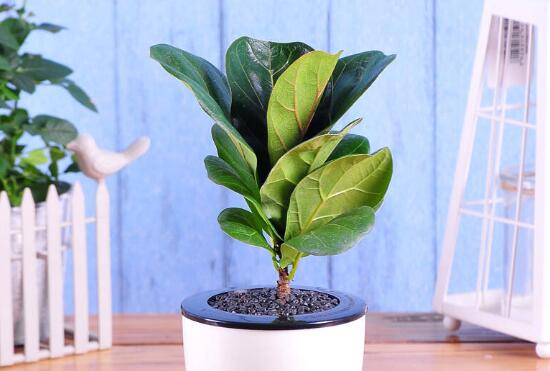
The fiddle-leaf fig likes a warm, humid environment with plenty of sunlight. It dislikes strong light and is not cold-tolerant. When grown indoors, it should be placed in partial shade, watered regularly but not excessively, and kept warm in winter. As for the potting soil, it is best to give it a loose, breathable, well-draining, slightly acidic soil. So how do you grow a fiddle-leaf fig? It is very simple, just meet its growing habits.
II. Care methods and precautions for the fiddle-leaf fig
1. Pot and soil
To grow a fiddle-leaf fig, the first thing to do is reconsider the pot and soil. Nowadays, plant enthusiasts' potted plants are basically bought online, very cheaply, but this also has drawbacks. Because the pot and soil are very cheap, normal care can keep the plant growing, but if you want the fiddle-leaf fig to grow well, it is best to choose a new pot and soil.
Pot selection: The pot for a fiddle-leaf fig must be chosen appropriately. First, the bottom of the pot must have holes to ensure good drainage; second, the pot must not be too large. For small plants, choose a pot with a diameter of 20-25 cm, and for large plants, choose a pot with a diameter of 30-35 cm.
Soil selection: According to the fiddle-leaf fig's growing habits, we know it likes loose, breathable, well-draining, slightly acidic soil. For this, the editor recommends using a soil mixed from leaf mold, potting soil and coarse sand, and it is best to add a small amount of decomposed base fertilizer.
2. Light
As a foliage plant, the fiddle-leaf fig has a great demand for light. Under normal circumstances, we should place it in a ventilated spot with bright, indirect light, and it is best if it can receive about 4 hours of light per day.
Precautions: The growth of the fiddle-leaf fig requires sufficient light. Once light is insufficient, it is not conducive to the plant's growth. In winter, light can be appropriately increased; but the fiddle-leaf fig dislikes direct strong light. If it is exposed to the strong summer sun, its leaf surface will be scorched.
3. Temperature
To grow a fiddle-leaf fig, adjusting the temperature in good time is also very important. The fiddle-leaf fig likes a warm environment. Its suitable growing temperature is 25-35°C. It is not cold-tolerant. To help it overwinter safely, the indoor temperature in winter should be kept above 5°C.
4. Watering
Water is the source of life, so in the fiddle-leaf fig's care methods and precautions, watering is a very important part. The fiddle-leaf fig likes a humid environment, especially in spring and summer, when its water requirements are particularly high, and the soil must be kept moist at all times.
Precautions: Although the fiddle-leaf fig likes water, it dislikes waterlogging, so watering should follow the principle of watering when dry and stopping when wet. Water only after the potting soil has completely dried out, and water thoroughly when you do. In addition, if the temperature is low, watering should not be excessive, and it is better to keep the soil slightly dry, otherwise it can easily cause the plant's death.
5. Fertilizing
Having covered watering, let's talk about fertilizing, which is also indispensable in the fiddle-leaf fig's growth process. Looking at the fiddle-leaf fig's large leaves, we know it likes fertilizer. During the growing season, we should apply liquid fertilizer once every 2 weeks. But in winter, the fiddle-leaf fig enters a dormant state, and at this time fertilizing should be stopped.
6. Do not move the pot
When growing a fiddle-leaf fig indoors, many plant enthusiasts like to move it around everywhere, but this is actually a wrong practice. Because the fiddle-leaf fig is a rather home-loving plant, it does not like being moved around, so once you place it in a bright spot with indirect light, do not move it again. However, when growing it, we can rotate it 90 degrees each week so that it can fully receive the sun's rays.
7. Pruning
Since it is a foliage plant, timely pruning is certainly indispensable. To maintain the fiddle-leaf fig's beauty, we should prune it once a year, cutting off rotten roots, dead leaves and old diseased branches when repotting, and trimming it into various shapes according to our own preferences.
Care methods and precautions for the weeping fig
Chinese scientific name: weeping figLatin scientific name: Ficus benjaminaOther names: long-leaf fig, Yalita fig, Yali weeping figKingdom: PlantaeFamily: MoraceaeGenus: FicusDistribution area: Guangdong, Guangxi, Hainan, Yunnan and other provinces (regions) of ChinaPropagation technique: mostly propagated by cuttings, and can also be grown from seedThe weeping fig is an evergreen large tree. The tree can reach more than 30 m tall, with a trunk diameter of more than 3 m, dense branches, aerial roots, obvious lenticels and a broad crown, giving excellent shade. It is one of the representative tree species of the South China landscape. The leaves are relatively small, lanceolate, about 5 cm long, with a pointed tip, thinly leathery, smooth and glossy. Potted plants are often kept within 2 m in height. The twigs droop slightly. The leaves are ovate or elliptical, 5-10 cm long, with a slender pointed tip, dark green and glossy. The petioles are slender and often droop. The fruit is spherical, about 1.2 cm in diameter, and black when ripe.1. Ecological habits
1. Native to tropical and subtropical regions of Asia. It is distributed and cultivated in Guangdong, Guangxi, Hainan, Yunnan and other provinces (regions) of China. It likes a semi-shaded, warm and humid climate. It is relatively cold-tolerant and can withstand short periods of low temperatures of 0°C. It grows faster at temperatures of 25-30°C, and tends to produce aerial roots when air humidity is above 80%.2. It likes light, but direct strong light should be avoided. It has strong adaptability, vigorous growth, is easy to shape, has few pests and diseases, and can generally be grown in ordinary soil.
3. As a tropical tree species, from south to north in China, as the temperature decreases, the tree shape correspondingly decreases. In northern South China, it is generally only more than 20 m tall, with a trunk diameter of 150 cm.
4. It can be grown indoors for a long time. It can adapt to many kinds of soil; sandy soil, clay soil, acidic soil and calcareous soil are all suitable. It relatively likes fertilizer and tolerates waterlogging. Whether planted in the open ground or in pots, it is suitable to apply sufficient base fertilizer. It has very strong vitality and tolerates pruning quite well. Potted plants can undergo various horticultural treatments according to ornamental requirements, while open-ground plantings are generally allowed to grow naturally.
There are about 1000 species in this genus, distributed in tropical and subtropical regions. There are about 120 species in China.
2. Care methods
Propagation technique
It is mostly propagated by cuttings, and can also be grown from seed.Cuttings are taken after temperatures rise in spring and root relatively easily. Either old branches or young branches can be used as cuttings. They can be cut into sections about 20 cm long each, or into sections about 1 m long each, and inserted directly into the nursery field. Keep them moist, and roots can develop in about 1 month. After 2-4 years of cultivation in the nursery, they can be lifted for open-ground planting. Thick trunks about 2 m long and about 6 cm in diameter can also be used: cut off the branches and leaves, wrap the top in mud, and insert the trunk directly for planting without raising seedlings. The weeping fig roots very easily from cuttings. Branches from any part can be used as cutting material, and cuttings can be taken in all three seasons of spring, summer and autumn. Cut cuttings 8-10 cm long, retain 2-3 leaves, use fine sand as the cutting medium, and cover with a shade net. 20-25°C is the best temperature for rooting. After insertion, spray water frequently during the day to maintain air humidity. Generally, rooting begins in about 15 days, and they can be transplanted after one month. Seedlings rooted in a sand bed have relatively fragile roots and dehydrate very easily, so once lifted they must be planted immediately.
Young seedling care
Before young seedlings are potted, they should first go through a period of field planting so that the root system grows better and the above-ground branches and leaves form a dense crown in a relatively short time. Seedlings can be planted in any season, but winter planting should be covered with plastic film to prevent frost and increase the survival rate. The planting bed is 1 m wide and not less than 30 cm high. Holes are dug in double rows, with a plant spacing of 25-30 cm, and 3 plants are planted closely together in each hole. It is best to put burnt soil ash at the bottom of the hole to help the seedlings quickly grow new roots and also to provide conditions for carrying more soil when lifting seedlings for potting. After planting, if the seedlings have not yet put out new leaves, care should be taken to keep the soil moist.Growing specimen bonsai
Mostly dig up old stumps from rocky mountains, and after they survive planting, carry out horticultural processing.Seed propagation is increasingly used. The fruit ripens in October, and a small amount also ripens from November to the following January and in other seasons. After the fruit is harvested, pile it up to ferment, then put it into a tightly woven cloth bag and rub and rinse it in water to wash out the seeds. The 1000-seed weight is about 0.4 g. The germination rate differs among seeds collected in different years, reaching as high as 40%, and in some years the seeds do not germinate. Seeds dislike losing water, so it is best to store them wrapped in moist filter paper or mixed with fine sand, or to sow them immediately after collection. According to the sowing requirements for small seeds, first scatter the seeds on a sowing tray or on carefully leveled nursery ground, and protect them from rain impact.
They can germinate in about 1 day after sowing, can be transplanted to the nursery field for cultivation in about 2 months, and can be lifted for planting after 2-5 years. Seedling branches are soft and the root system is well developed, making them suitable for various shapes such as curved stems, approach grafting and exposed roots, and the crown can also be pruned into many forms.
3. Landscape uses
Young trees can be curved at the stem, have exposed roots and be approach grafted, and made into various shapes as artistic bonsai.Old stumps can be trimmed into ancient, vigorous specimen bonsai, and it is one of the tree species with the most uses in horticultural landscaping. It can also be heavily pruned from a young age and gradually trained year by year into a spherical or broadly ovate crown.
Bonsai are suitable for display in exhibition halls, museums, high-end hotels and other places, and are expensive. Large trees have a strong ability to resist harmful gases and smoke and dust, and are suitable for planting as street trees, for greening industrial and mining areas, squares, forest parks and other places, majestic and magnificent. One old banyan tree can shade several qing and provide space for hundreds of people to gather.
It has roles in purifying air, providing shade, and contributing to the scenery.
Whether in shops, meeting venues, public places, or family rooms, living rooms and other places, using it as an accent makes the space full of vitality.
In addition, the weeping fig can also form the ecological wonder of "one tree becoming a forest." It often grows many aerial roots from tall branches. At first they are as thin as wire and flutter in the wind. Once they touch the ground, they insert deeply into the earth and grow rapidly, gradually becoming cylindrical prop roots, then slowly spreading in all directions, finally forming "one tree becoming a forest."
4. Common varieties
Sacred fig (Ficus religiosa): leaves heart-shaped, 15-20 cm long, with a slender, tail-pointed apex, drooping, entire, dark green, with slender petioles.Fiddle-leaf fig (Ficus lyrata): leaves resemble a violin, larger than a palm, 20-30 cm long, with thick leaf flesh and thick veins.
Variegated triangular fig: a variety of the triangular fig, with leaves nearly triangular and pale yellow or milky white variegated bands along the leaf margins, brightly colored and with a peculiar leaf shape.
5. Pest and disease control
White wax scale: once white wax scale appears, it will not only greatly affect its growth but also seriously affect its ornamental effect. It will also cause a large number of its leaves to fall. Even if insecticide is sprayed, although the insects die, the insect corpses generally do not fall off on their own. Therefore, prevention should generally be the main approach, that is, every 2-3 months, spray the whole tree once with Decis diluted 2500 times. This can basically ensure no white wax scale for the whole year. If it has already appeared, spray the whole tree with diluted Lebaycid, once a week, and it can be completely eliminated after three consecutive times.Care methods and precautions for the rubber plant
Chinese scientific name: rubber plantLatin scientific name: Ficus elasticaOther name: round-leaf rubber tree (F. diversifolia)Kingdom: PlantaePhylum: MagnoliophytaClass: MagnoliopsidaSubclass: HamamelidaeOrder: UrticalesFamily: MoraceaeGenus: FicusSpecies: rubber plantDistribution area: native to India and Malaysia, and relatively widely distributed in China, with about 120 species.The rubber plant (scientific name: Ficus elastica) is a plant of the genus Ficus in the family Moraceae, commonly known as "round-leaf rubber tree" or "Indian rubber tree." It is an evergreen large tree. Potted plants are 1-2 m tall, with smooth bark and white latex. The leaves are broad, oblong or elliptical, dark green, glossy, thickly leathery, with pointed tips and entire margins. The young buds are red and have bracts. The fruits are borne in pairs in the leaf axils, oblong, and orange-red when mature. Cultivated varieties include: golden-chain rubber tree, whose leaves have golden yellow margins that become more obvious in autumn; and variegated rubber tree, whose leaves have yellow-white markings. Medium and large potted plants are used for decoration and are widely used for greening and decoration in hotel courtyards, theater foyers, large shopping mall entrances, offices and other places. In rooms, they can be placed along the living room wall, in corners, or on both sides of the sofa.1. Morphological characteristics
The rubber plant (a name given by florists) is an evergreen small tree that has risen in popularity not long ago, and its scientific name is round-leaf rubber tree. The rubber plants sold on the market are not true rubber plants; they all use the trunks of other flowers and trees as rootstock, graft rubber plant branches onto them, and then prune and bend them into the shape of the character "" for sale.Round-leaf rubber tree (F. diversifolia): an evergreen small shrub, 50-80 cm tall, with many branches. Leaves broadly obovate, broadly rounded at the tip, 1.5-5 cm long, leathery; the upper leaf surface is deep green and the lower leaf surface is pale yellow; the leaf margins have dark glands. The syconium is spherical to pear-shaped, solitary, yellow or slightly red when mature. It generally grows in mountain sparse forests at altitudes of 400 m-2500 m and 600 m-900 m, and also grows in hilly land and beside villages at 100 m-300 m.
Basic information
Engler systemPhylum Angiospermae
Class Dicotyledoneae
Subclass Archichlamydeae
Order Urticales
Family Moraceae
Genus Ficus
Introduction to Ficus plants
Also known as the fig tree, an evergreen tree or shrub of the family Moraceae. It has latex, and the leaves are usually alternate, mostly entire. The stipules are connate, envelop the apical bud, and leave an annular scar after falling. The flowers are monoecious and borne inside a spherical hollow receptacle. It is native to tropical and subtropical regions. It likes a high-temperature, humid environment with sufficient light, and can also tolerate partial shade. It requires loose, fertile, well-draining, slightly clayey soil.2. Growth habits
The rubber plant likes a warm, highly humid, well-ventilated environment. In winter it needs to be placed indoors with heating equipment, but the potted plant must not be placed too close to the radiator. In summer, when temperatures exceed 30°C, it can be moved to a ventilated room on the north side. Do not water if the surface soil in the pot is not dry; when watering, water thoroughly, with water seeping out as the standard. Relatively high air humidity must be maintained, and leaf spraying can be used. If using tap water for irrigation, it is best to let the tap water sit in the sun for half an hour; light helps break down oxides in tap water. Ensure that there is no water on the leaf surface at night. Keep the leaf surface clean often, and wipe the leaves regularly with a dry soft cloth.The rubber plant likes a warm, humid environment and needs sufficient sunlight. It is relatively cold-tolerant and also shade-tolerant. The soil should be fertile and well-draining. The winter temperature should not be lower than 5°C. Because the rubber plant grows relatively quickly, it needs repotting every spring, adding fertile soil, and pruning and shaping. In summer high temperatures, it should be watered more, and the leaf surface should be sprayed frequently. During the growing season, fertilize once every half month, and avoid strong direct sunlight.
3. Geographical distribution
Native to India and Malaysia, and relatively widely distributed in China, with about 120 or more species.4. Cultivation techniques
Propagation and cultivation of Ficus plants
Ficus plants are mainly propagated by cuttings, and layering can also be used; those that can even produce mature seeds can also be propagated by sowing. Variegated rubber trees are best propagated by layering. Greenhouse propagation is not affected by season, but the most suitable season for cuttings is spring. One-year-old terminal or side branches can be selected, generally with 2-3 leaves. To prevent white sap from flowing out, after cutting the cuttings they should be dipped in plant ash or coated with paint, then inserted into sand, vermiculite or perlite, or water-rooted. Keep the temperature at 25-30°C, and they will root in about 3 weeks. For layering, first peel off a ring of bark from the stem, then wrap it with sphagnum moss or peat soil to keep it moist. After rooting in 3-4 weeks, cut it off from the mother plant and plant it separately. For potting soil, a mix of 1 part peat soil, 1 part garden soil and 1 part river sand can be used, with cake fertilizer and other materials applied as base fertilizer. During the growing season, water and fertilizer should be sufficient, and the potting soil should be kept moist. In summer, in addition to keeping the substrate moist, water should also be sprayed on the leaf surface and the ground, and a dilute fertilizer solution should be applied once a month, mainly nitrogen fertilizer. In summer, provide appropriate shade and avoid direct strong light. The overwintering temperature must be kept above 10°C; long-term low temperatures will cause root rot. However, it can recover.Key care points
1) Light, water, soil, fertilizerThe rubber plant likes light, and in northern regions it can receive direct light all year round. After Qingming each year, it can be moved outdoors and placed in the open without shading. In winter, it is best to place it under a window facing the sun. If conditions are suitable, this period is the rubber plant's peak growing season.
For watering, still water thoroughly only after it has dried out. Fertilizing can be done together with watering, for example in summer using soaked liquid of cake fertilizer (sesame paste residue), organic fertilizer and the like. In summer, if the rubber plant is placed outdoors, it can receive rain and dew, and there is no need to worry about the acidity or alkalinity of the water. In winter, more attention is needed, because tap water is weakly alkaline. Generally, after every 2-4 waterings with tap water, it is better to use a diluted solution of soaked orange peel once. In winter, it is best to spray water once a day, because under a sunny window indoors at noon the temperature can reach more than 30 degrees, and after heating the room becomes even drier.
As for soil, there are no special requirements; ordinary soil is fine, and loose, breathable soil is even better.
2) Flowering and fruiting
In this respect, the rubber plant is very similar to the fig: it also flowers and fruits, but the syconium is green, very small and hidden in the leaf axils, so it is not easily noticed, and only becomes visible after it turns into a fruit and grows larger.
The fruit of the rubber plant is very small, only about half the size of a soybean. When mature it is slightly red, and the fruit is fibrous, making it very difficult to distinguish fruit pulp, seeds (pits) and so on.
After repeated experiments, it has been proven that the fruit of the rubber plant cannot be used for propagation. Therefore, if you do not want to admire its fruit, it is best to snap it off as soon as it appears or pierce it with a needle (it will fall off on its own after two or three days), so as to avoid consuming too many nutrients and let the rubber plant focus wholeheartedly on development and concentrate its energy on growing branches and leaves.
3) Pruning and cuttings
The rubber plant grows relatively quickly and needs pruning from time to time; otherwise it will keep growing vertically, especially newly rooted cuttings, which will grow into a bare pole if not topped and pruned. The cut branches can be used for cuttings, otherwise they are wasted - the easiest way to propagate the rubber plant is by cuttings.
One of the keys to the cutting survival rate is the selection of branches: the branches are required to be lignified. Semi-lignified branches have more water and fewer nutrients, and even in clean vermiculite they rot very easily, and rooting is difficult. Newly grown branches generally need to grow for more than another 8 months before they are suitable for cuttings; of course, the longer the safer.
Another key to the cutting survival rate is the cutting medium, and vermiculite is very good. Vermiculite bought at the flower market for 2 yuan per jin can be washed clean and used. Then buy a one-yuan packet of rooting powder. If the branches are qualified, the cutting survival rate can basically reach more than 90%. Amorphous granular activated carbon, treated sawdust and the like can also be used as cutting media.
After cutting, it is best to cover the pot with a white or transparent plastic bag to keep it warm and moist. Generally, roots can form in 2-6 weeks, and after rooting, seedlings can be moved in 1-2 weeks. When moving seedlings, plant them in flower pots with loose, fertile soil, also cover them with plastic bags to keep them warm and moist, and place them under a sunny window where they can grow rapidly.
Finally, there are pests and diseases. The only insect the rubber plant may attract is probably scale insects. Often in shaded, poorly ventilated environments, the rubber plant is somewhat prone to scale insects, and they can be picked off one by one with a bamboo stick. Prevention comes first, and simply paying attention to ventilation is enough.
5. Precautions
The rubber plant likes a warm, humid environment and a well-ventilated environment, needs sufficient sunlight, is relatively cold-tolerant and also shade-tolerant, and the soil should be fertile and well-draining. The winter temperature should not be lower than 5°C. Because the rubber plant grows relatively quickly, it needs repotting every spring, adding fertile soil, and pruning and shaping. In summer high temperatures, it should be watered more, and the leaf surface should be sprayed frequently. During the growing season, fertilize once every half month. In summer, when temperatures exceed 30°C, it can be moved to a ventilated room on the north side. In autumn and winter, in some places the rubber plant will shed leaves. This is a normal situation, and in the following spring it will still sprout and grow new leaves.6. Main categories
Species of Ficus plants
There are about 1000 species in the same genus. Varieties commonly cultivated in horticulture include: 1. rubber tree (also known as Indian banyan) (F. elastica) (N words omitted here, same below) 2. round-leaf rubber tree (F. diversifolia) 3. sacred fig (F. religiosa) 4. fiddle-leaf fig (F. lyrata) 5. small-fruited fig (F. microcarpa) 6. creeping fig (R. pumila) 7. weeping fig (F. variolosa) 8. Benjamin fig (F. benjamina) 9. long-leaf fig (F. binnendijkii) 10. rooting fig (F. radicans)Money tree
Also known as the money tree, it belongs to the genus Zamioculcas in the family Araceae and is a perennial herbaceous flower introduced from abroad. The plant is 50 cm to 80 cm tall. On the underground corm grow pinnate compound leaves resembling those of Zamia cycads or ferns, with fleshy petioles and 7 to 10 pairs of leaflets. The leaflets are elliptical, like pairs of neatly arranged copper coins. The spathe is reddish brown.The money tree (Pachira aquatica) is native to Tanzania and can grow well in both bright and dimmer locations. In summer, maintain relatively high air humidity and provide shade; in winter, it can be kept in a relatively dry environment but needs bright light. The best growing medium is a fertile, loose, slightly acidic soil rich in organic matter, with good aeration and strong water- and fertilizer-holding capacity, but which does not become waterlogged. Apply a compound fertilizer once a month during the growing season. It can be propagated by sowing seeds, rooting leaf cuttings, or tissue culture.