What are banyan aerial roots and how do you cultivate them? 3 tricks to grow perfect aerial roots
The beauty of a banyan bonsai lies in its unusually well-developed root system and in its leafy upper half; whether placed indoors or grown in the open air, it is highly ornamental. In daily life, people often say that a banyan looks very beautiful when its aerial roots are well grown, so what exactly are banyan aerial roots? How do you cultivate banyan aerial roots? Today the editor will solve this problem for everyone.
I. What are banyan aerial roots, exposed roots
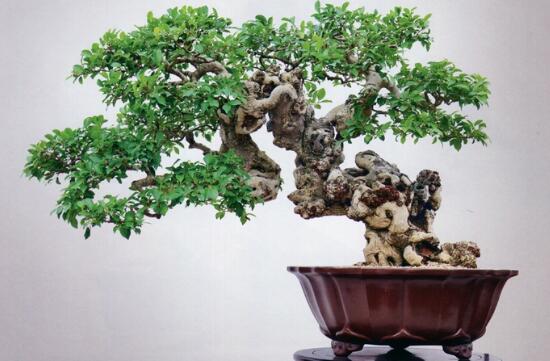
As for banyan aerial roots, they are actually easy to understand: they refer to roots exposed to the air. Banyan aerial roots grow in order to adapt to the rainy, hot and humid environment of the south, and they serve to assist respiration. Whether made into a bonsai or planted in the open air, the banyan will have aerial roots, and they can enhance the ornamental value of the banyan. Let us now look at the methods for cultivating banyan aerial roots.
II. How to cultivate banyan aerial roots, ways/methods
(1) How banyan aerial roots form
1. Natural formation
When it comes to the formation of banyan aerial roots, they will actually form naturally without any attention. Some of these aerial roots grow vertically downward, some hang in the air, and some, after reaching the ground, insert themselves into the soil, serving a supporting and absorbing function. Of course, many naturally formed aerial roots are not attractive, and this is also the reason for artificially cultivating banyan aerial roots.
2. Artificial cultivation
The aerial roots that banyans form naturally are always hard to make people feel are beautiful, so in order to increase their beauty, people often use physical root forcing or chemical root forcing at the places where roots are needed to force the banyan to grow aerial roots. As for how to cultivate banyan aerial roots, there are three methods: the approach grafting method, the half-broken branch method and the binding method. For exactly how to do them, let us continue reading below.
(2) Cultivation methods for banyan aerial roots
1. Time
Before cultivating banyan aerial roots, we need to do some preparatory work, such as timing. Generally speaking, banyan aerial roots can be cultivated in all four seasons, but spring is the most suitable. This is because in spring the temperature gradually rises and rainfall increases, which is favorable for plant growth.
2. Methods
① Approach grafting method
Approach grafting, the key lies in the word "approach": bring a small banyan with a well-watered root system close to the branch or trunk of the banyan that needs aerial roots, then connect them together as in grafting. After success, remove the small banyan's pot and soil, and the cultivation of the aerial root is complete.
② Half-broken branch method
On the branch or trunk of the banyan where aerial roots need to be cultivated, cut a small opening, cutting down to the woody part, then gently break it by hand and plug the wound with mud. After a period of time, some fine aerial roots will grow at the break; afterward, guide the lateral roots to grow downward, and a very good effect can be achieved.
③ Binding method
Tie wire around the banyan branch where aerial roots need to be cultivated so that the sap cannot circulate, then apply moss to the binding site. Before long, milky-white root buds will emerge at the binding site; then we use soil to make these bud roots gradually grow and lengthen until they grow down to the ground, and thus we have completed the cultivation of the aerial root.
How to cultivate banyan aerial roots
Selecting the banyan species and the cultivation time
If we want to cultivate banyan aerial roots, the choice of banyan variety is also very important. Not every kind of banyan is suitable for cultivating aerial roots; we should choose those banyan varieties that are naturally prone to growing aerial roots, such as the small-leaved banyan (Ficus microcarpa), the Yunnan banyan (Ficus hookeriana) and so on. In fact, banyan aerial roots can be cultivated in all four seasons, but the most suitable time is the humid and warm spring.
Cultivating banyan aerial roots by the approach grafting method
We can directly graft a small potted banyan with many roots onto the banyan, planting it together with its pot directly onto the banyan where aerial roots need to be cultivated. After the small potted banyan has grown onto the aerial-root banyan, the pot can be removed, and thus the cultivation of the aerial root is complete.
Cultivating banyan aerial roots by the half-broken branch method
We need to cut a small opening on the long trunk where aerial roots are to be cultivated, cutting down to the woody part, slightly break it, then smear mud on this small opening. After a period of time, some fine aerial roots will grow; afterward we only need to guide these aerial roots downward, and a very good effect can be achieved.
Cultivating banyan aerial roots by the binding method
To cultivate aerial roots by this method, we need to tie wire tightly around the branch where aerial roots are to be cultivated, tightening the wire so that the banyan's sap cannot circulate, then cover the wire-bound area with moss. In this way, after a period of time, small white bud roots will grow where the wire has wounded the bark; then we use soil to make these bud roots gradually grow and lengthen until they grow down to the ground, and thus we have completed the cultivation of the aerial root.
Cultivation of banyan aerial roots and tuberous roots
The cultivation of aerial roots and tuberous roots must have a correct direction and purpose. One must not make the aerial roots thick and hard, straight as bamboo poles, or braid them, or wind them up and down the trunk; this is a vulgar practice. Blindly pursuing many and large tuberous roots, without asking whether the plant's form can match them, out of mere curiosity, is also not good. When cultivating aerial roots, they should be fine, and preferably few and refined, not thick, many and messy. Aerial roots are the banyan's "aerophilic" trait; they grow when the water demand of the branches and leaves exceeds the water supply of the trunk. This rule should be used for shaping.For example, to cultivate aerial roots on the main branch of the top node, one can let the branches and leaves grow fully luxuriant so that aerial roots arise on their own. One can also supplement this artificially: besides making the branches and leaves luxuriant on one side, at the same time place a small water bottle beside the plant and use a gauze strip to lead water to the branch or trunk where aerial roots are being cultivated, so that part of the branch or trunk always has moisture, and aerial roots can then grow quickly. If, because the plant is weak, aerial roots still do not grow, one can also adopt the method of scoring: that is, 1 mm below the point where aerial roots are needed, use a knife to score a wound deep to the xylem, with the wound 1 mm wide, and keep the other measures as above, and aerial roots should then grow. This method can be carried out in summer when the branches and leaves are at their most luxuriant, and the aerial roots will certainly grow downward attached to the gauze strip. But once an aerial root touches the soil, it very easily grows thick, which in turn makes the branches and leaves even more luxuriant, forming a cycle of promoting growth, so the branches and leaves should be controlled in good time; when necessary, cut off the part of the aerial root that has entered the soil, and never let the aerial root grow too thick.
If it cannot be controlled after repeated attempts, then split this aerial root away by half or cut it off entirely. If one carelessly lets an aerial root grow too thick, then that section of branch swells along with it, shaped like a "crane's knee", which is extremely ugly. The opposite situation is when the aerial root's thickness is very appropriate and it does not continue to thicken, but at the next spring pruning, after all the fine branches and leaves are cut away, the relatively fine aerial root quickly becomes naturally obsolete because it has lost its function. Aerial roots produced by the scoring method are even more likely to die. Therefore, cultivating this kind of aerial root is best done from Qingming to Lixia, because at this time, after cutting away the fine branches and leaves, new leaves soon sprout, and the aerial roots will not be eliminated so quickly. In addition, a transitional method can also be used: cut off part of the branches and leaves before Qingming, and after Guyu or at Lixia when new leaves have grown, cut the remaining part. Cultivating aerial roots attached to the main trunk can be thicker than those at the top node, and they can be kept in the soil for a long time and made to merge with the main trunk into one body, increasing the main trunk's aged appearance and enhancing the beauty of the potted plant; they should also be allowed to extend naturally. When they are truly messy or too numerous, they can be guided or cut away artificially, but one should not deliberately twine them around or braid them, because once such aerial roots are attached to the main trunk, it will later be difficult to remedy. Cultivating tuberous roots: banyan seedlings dug from the mountains, because of poor growing conditions, very few have tuberous roots, whereas seedlings cultivated in a seedbed mostly have tuberous roots.
For saplings with tuberous roots, after pruning, the cultivation methods during the temporary planting period and the shaping period are as follows: for plants dug from the mountains that have relatively complete tuberous roots, are thirty or forty years old, and have fairly good tuberous root shapes, when potted, six tenths of the tuberous roots can be exposed above the soil surface, so that the tuberous roots are not easily deformed. For those dug from the mountains whose tuberous roots are seriously injured or ugly in shape, before potting, the wounds on the tuberous roots need to be coated with plant ash and air-dried (the leaves, branches and trunk should be sprayed with water), then potted, and one tenth can be exposed or even all buried in the soil. After they survive, one should always observe carefully and not let roots grow from the base, so that the injured tuberous roots can continue to grow and can easily produce tuberous roots. For those with ugly tuberous roots, when potting, a stone of appropriate size can be placed against the protruding and not quite flat part of the tuberous root, and the soil appropriately pressed firm, so that the other parts of the tuberous root continue to grow while the part with the stone, being pressed, does not easily grow. In this way the tuberous root is deformed and made more beautiful. For saplings with tuberous roots taken from the seedbed, if the tuberous root shape is poor, handle them as above; if the tuberous root shape is good, then seven or eight tenths should be buried in the soil, so that the tuberous root continues to grow.
For any plant with tuberous roots, never let it frequently lack water, or prune heavily or fertilize excessively, otherwise the tuberous roots will dry-rot or rot. During cultivation, always pay attention to the coordination between the tuberous roots and the trunk. With multiple tuberous roots, they should be set tightly, and aerial roots should be few and fine, showing that the tuberous roots are the main feature. If the tuberous roots are like mountains or rocks and the trunk seems to grow from a stone, then the two must not be disconnected; otherwise, not only does it not add beauty, but it is instead vulgar.