How to Grow Potted Erica (Heath) and Key Precautions, Avoid Strong Light
Erica is a flowering plant native to Africa and has high ornamental value. Today it is cultivated in various places across our country, but there are many points to pay attention to if you want to grow it well. How do you grow potted Erica? What are the growing methods and precautions for Erica? Let's take a look below.
I. How to Grow Potted Erica: Understand Its Habits
To know how to grow potted Erica, we first need to understand its growth habits. It is a light-loving plant, so we should maintain sufficient light when growing it, so that it can grow better. In addition, daily water and fertilizer management is also something we need to pay attention to. The details are below, so let's take a look.
II. Growing Methods and Precautions for Erica
1. Soil: Humus-rich soil
Before growing Erica, we first need to choose the soil. This is the foundational step, so it is very important. Generally, it is best to choose loose, fertile, slightly acidic humus-rich soil. This kind of soil has good drainage and aeration, allows the plant to absorb nutrients better, and is less prone to waterlogging.
2. Fertilizing: Apply diluted fertilizer
Fertilizer is one of the main nutrients in Erica's growth process, especially after it enters the growing season, when its demand for fertilizer is very high. Basically, it needs to be fertilized once every month. However, before fertilizing, there is one thing we need to pay attention to: we must apply diluted fertilizer. If the fertilizer concentration is too high, it can easily burn the plant.
3. Water: Avoid waterlogging
When growing Erica, the watering frequency should change according to the climate. In spring and autumn, because the climate is relatively mild, we generally only need to water once every 2-3 days; after summer arrives, because the climate is hotter and drier and water evaporates faster, we need to water every day, but the amount of water does not need to be too much. Just keep the soil somewhat moist. It is best not to cause waterlogging, otherwise it can easily lead to root rot.
4. Light: Avoid strong light
Erica is a light-loving plant, but it is not tolerant of strong light. In spring and autumn, when the light is not too strong, we can place it outdoors to receive light all day. After summer arrives, because the light is stronger, we need to move it indoors to a semi-shaded place for growing, so as to avoid sunburning the plant and causing the leaves to dry out and turn yellow.
5. Pests and diseases: Prevent and control them promptly
When growing Erica, if we are not careful enough, pests and diseases can easily take advantage of the situation. Such problems are very harmful to the plant, and if we discover them, we must deal with them promptly. The specific treatment methods are introduced in detail in the article on pest and disease control for Erica, which you can look up.
Growing Methods and Precautions for Erica
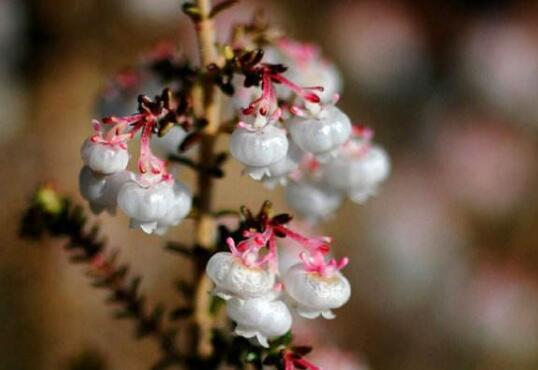
Chinese scientific name: EricaLatin scientific name: EricaKingdom: PlantaeDivision: AngiospermsClass: DicotyledonsOrder: EricalesFamily: EricaceaeOrigin: FranceFlower language: Loneliness · Betrayal, happy loveFlower colors: White · Peach red · PurpleErica (scientific name: Erica) refers to plants in the genus Erica of the family Ericaceae. There are about more than seven hundred species of Erica worldwide, most of which are native to South Africa and are called the "queen of South African endemics"; in addition, there are more than seventy species distributed roughly in other parts of Africa, the Mediterranean region and Europe. Erica is also the birth flower of December 6. The "Christmas Erica (Erica canaliculata)" shown in the image is called "snake-eye heath flower" in Japan because its form resembles the famous Japanese pattern "snake's eye" (commonly seen in family crests, Japanese umbrellas, etc.).1. Morphological characteristics
Erica is a shrub-type plant with fine leaves. It is an evergreen plant, with a height of about 20-150 cmor more, but some species such as E. arborea and E. scoparia can reach 6-7 m in height. The most famous existing concentrated growing area of Erica is the Luneburg Heath nature reserve in northern Germany.
2. Growth habits
It likes sufficient light, is relatively cold-tolerant, and likes acidic, loose soil rich in humus.Erica Erica pictorial guide: how to grow Erica / how to propagate Erica
Erica profileErica
Alias: Scottish heather
Classification: Shrub flower
Family and genus: Plantae, Angiosperms, Dicotyledons, Ericales, Ericaceae, Erica
Full bloom period: Spring
Erica (scientific name: Erica) refers to plants in the genus Erica of the family Ericaceae. There are about more than seven hundred species of Erica worldwide, most of which are native to South Africa and are called the "queen of South African endemics"; in addition, there are more than seventy species distributed roughly in other parts of Africa, the Mediterranean region and Europe. Erica is also the birth flower of December 6.
Growing Methods and Precautions for Erica, Introduction to Erica
Erica (scientific name: Erica) refers to plants in the genus Erica of the family Ericaceae. There are about more than seven hundred species of Erica worldwide, most of which are native to South Africa and are called the "queen of South African endemics"; in addition, there are more than seventy species distributed roughly in other parts of Africa, the Mediterranean region and Europe. Erica is also the birth flower of December 6.
Morphological characteristics of Erica
Erica is a shrub-type plant with fine leaves. It is an evergreen plant, with a height of about 20-150 cm, but some species such as white Erica and E. scoparia can reach 6-7 m in height. It is much branched, with leaves usually in whorls of 4, smooth, needle-like, and flowers small, red, often drooping, bell-shaped.
Erica's flower colors include white, peach red and purple.
Erica's flowering period is spring.
Ecological habits of Erica
Erica likes sufficient light, is relatively cold-tolerant, and likes acidic, loose soil rich in humus.
Cultivation techniques for Erica
Plants of the genus Erica differ from other kinds of potted plants in that they require a fairly long cultivation period. Erica should begin cultivation from January to March, and from June to July the cuttings are moved into pots 5 to 8 cm in diameter filled with clay. From November to March of the following year, the cuttings are then moved into pots 11 cm in diameter. During the winter of the 1st to 2nd years of cultivation, Erica plants should be stored in a greenhouse at 3°C. In the following spring, when the weather warms up and Erica plants enter the development stage, prepare to place them outdoors. By then Erica plants will go through 3 growth periods outdoors.
These 3 growth periods can be defined by accumulated temperature:
The first stage outdoors is the general growth period, requiring a total accumulated temperature of 810°C;
The second stage is the growth period, and the plants require an accumulated temperature of 1210°C;
The third stage is the flowering period, generally at the end of September, with an accumulated temperature of 1770°C.
Because they grow in northern Germany, the above total accumulated temperatures are calculated according to the climate of northern Germany. When cultivating Erica plants in other countries, the time to move them to outdoor nurseries can be slightly earlier or slightly later according to the local geographical location.
Cultivating Erica plants also requires considering the nitrogen content in the soil; the nitrogen content in the soil for each plant is 600 to 1800 mg. Another traditional practical technique for cultivating Erica plants is to move the potted seedlings to an outdoor nursery in the second spring, rather than placing the Erica plants grown in pots outdoors.
It should be noted that when transplanting Erica plants into the nursery, there should be a 2% slope to ensure that excess water drains away, and then they should be covered with polyethylene or polypropylene film.
Disease control for Erica: root rot
Main symptoms
It occurs at the roots, starting from the root tips. In the early stage, the root tips turn yellowish brown, gradually becoming dark brown; the outer cortex rots and falls off, and the disease spreads upward to part of the root system, causing it to become dark brown and rot. In severe cases, the entire root system rots, and the aboveground branches and leaves wilt and dry up.
Causes of onset
It is a fungal disease. The pathogen survives in the growing medium, spreads with water, and infects and causes damage from the root tips. Long-term excessive water content in the medium, poor drainage, and a closed environment make the disease likely to occur. Erica has strict requirements for water quality; higher mineralization and pH can both cause the plant to grow weakly, thereby inducing disease. The presence of pathogens in the medium is the main factor in severe disease.
Control methods
(1) The growing medium should be strictly disinfected. A soil disinfectant such as Basamid can be used to fumigate the medium, which is then covered with film and sealed for several days before use.
(2) In the early stage of the disease, the medium and container should be replaced promptly, and the plant should be soaked in a 600-fold dilution of chlorothalonil fungicide for 2-3 minutes before replanting.
(3) Regularly drench the medium with a 1000-fold dilution of quintozene fungicide.
Distribution area of Erica
Erica originates from southern Africa, northern Europe and the Mediterranean region. The most famous existing concentrated growing area of Erica is the Luneburg Heath nature reserve in northern Germany.
Medicinal or dietary therapeutic value of Erica
The medical information and health dietary information on Huahua.com is for reference only and cannot be used as a basis for diagnosis or medical treatment. Any health problem should be consulted with professional medical staff, and the treatment of any disease should follow a doctor's advice.
Ultimate flower-protecting task: To love yourself, start from reality and follow a doctor's advice. Toward illness, do not be careless, do not delay, do not give up hope; face it bravely, warm the silent world with love, and care for the flower field in your heart with care.
The nectar of the small pink flower native to northern Europe, Erica, is what can best give bees a full meal. Some slightly acidic substances in the nectar can reduce fatigue, and the essence in its rhizome is even an excellent product for beautifying and nourishing the skin. Its unique pure natural ingredients can effectively relieve skin fatigue, regulate microcirculation, and enhance the skin's own resistance. It has a great effect on relieving the red blood vessel phenomenon of the skin and can restore healthy brightness and whiteness to the skin; maintain gastrointestinal function, help smooth urination, and regulate physiological functions. The honey collected by bees attracted by Erica is honey with very high nutritional value. Soaking in it for bathing can relieve fatigue and prolong life. The small pink flowers are like baby's breath, and the floral fragrance is very fresh and pleasant, making it an excellent enjoyment when bathing. It can promote urination and intestinal peristalsis, so it has effects such as aiding digestion, helping smooth urination, accelerating the elimination of waste substances from the body, and beautifying the skin. Because it contains arbutin A, it also has an antibacterial function for the urinary system. Because it is rich in minerals, in the 1st century AD, the famous Greek physician Galen used Erica for smooth urination for internal purification. Soaking in bathwater with Erica can relieve fatigue and also has a relieving effect on diseases such as arthritis and rheumatic pain. Erica's small pink flowers, like baby's breath, are very fresh and pleasant, making it an excellent enjoyment when bathing. The honey collected by bees attracted by Erica has very high nutritional value.
Dietary value
Brewing
Erica (about 6-8 flowers), hot boiled water (about 400 cc), honey or sugar (to be used as needed). Put Erica into a pot, add hot boiled water, brew for 3-5 minutes, add honey or sugar and it is ready to drink.
Best partners
Rose, German chamomile, lemongrass, verbena, raspberry leaf, mint leaf, linden, juniper berry, fennel seed.
Functions
Erica has diuretic and sterilizing effects, and is especially effective for urinary tract infections. This tiny pink flower stamen, when used to make tea, has a slightly sour taste that can reduce fatigue, beautify and nourish the skin, maintain gastrointestinal function, help smooth urination, and regulate physiological functions. It is rich in minerals and has astringent, diuretic, sterilizing and sedative effects, and can treat kidney disease and urinary tract infections. When soaked in water for bathing, it can relieve fatigue and prolong life, and at the same time can also relieve rheumatism and eliminate facial acne.
Brewing method
One teaspoon of dried petals, brewed with a cup of boiling hot water, left to steep for about ten minutes; brown sugar or honey may be added as desired for drinking.
Similar species to Erica
Heather (Calluna) and Erica are plants of the same family. Although they are so similar that people often confuse them, they are actually not in the same genus. The biggest difference between Calluna and Erica is that its sepal lobes cover the petals, while Erica's petals cover the sepals (the sepals are the outermost layer of the flower bud and serve to protect the bud). Calluna is a perennial evergreen shrub. It is very short, sometimes only a few centimeters tall, and can grow to nearly 1 m in shaded places. Calluna is cold-tolerant and tenacious in survival, and is the main vegetation in some desolate regions of Europe. In past eras, Calluna had many uses; people used its branches to make brooms, brushes, blue baskets and even thatched roofs. Its young branches and leaves and seeds are the main food of many birds. Calluna's flowers have rich nectar and can be used as a good drink. In 2014, Calluna was widely planted as an ornamental flower and many new varieties were bred. The scientific name Calluna comes from Greek, meaning "to sweep," referring to a plant used to make brooms, and it is therefore translated into Chinese as "broom heath." In English there are two names for heath flowers, "Heath" and "Heather," among which "Heather" actually refers to Calluna. Calluna is the national flower of Norway, and it is also an important symbol easily associated with Scotland.
National flower and city flower of Erica
Norway's national flower - Calluna, commonly known as Scottish heather, has a beautiful translated name - Erica. Its flower language is loneliness and betrayal.
It is a cold-tolerant small shrub of the cold zone, in the family Ericaceae. In order to adapt to the environment, its leaves have evolved to be thin and small, and its flowers are also surprisingly miniature. Each flower is bell-shaped, less than half a centimeter in diameter, exquisitely delicate beyond compare. In the ice-and-snow Nordic region, where leaves fall and flowers fade, the small Erica holds up its delicate little body and grows stubbornly on the frozen wilderness, all over the mountains and plains, never withering, bringing warm food to reindeer amid the severe winter on the polar ice fields where all things are withered. Brave and selfless, its small white, peach and purple flowers bloom in the snow, decorating the vast ice fields with spring colors.
The flower language of Erica
Loneliness, happy love. Erica's flower language is loneliness. Looking out over the Scottish wilderness covered with Erica, you can personally experience Erica's desolation. In Emily Bronte's novel Wuthering Heights, the lonely protagonist Heathcliff is buried on the wilderness covered with Erica. Macbeth in Shakespeare also hears the witch's prophecy on the wilderness full of Erica... Erica, the lonely flower.
Erica pictures