When does the African violet bloom? With proper care, the flowering period can last all four seasons
The African violet, also known as Saintpaulia, has emerald-green leaves with vivid color and is a perennial herbaceous plant often grown indoors in pots. In everyday life, many people grow African violets, and they all look forward to it blooming, so when does the African violet bloom? How long is the flowering period of the African violet? How can the African violet bloom all four seasons? Here, the editor will answer these questions for you.
1. When does the African violet bloom, all four seasons
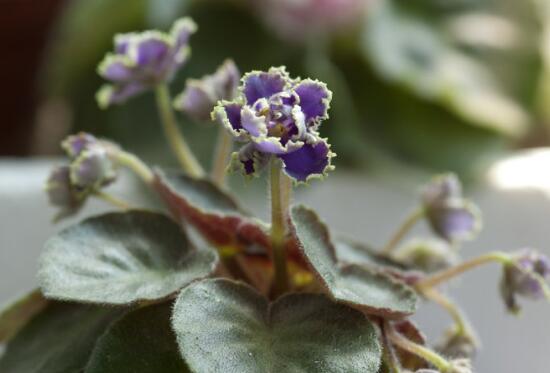
First of all, the African violet can certainly bloom, but as for when it blooms, the time is actually not fixed, because it is related to the time of cutting. It is understood that the African violet is usually propagated by leaf cuttings, and depending on the time of leaf cutting, the blooming time also differs, as follows:
Because it takes 4-6 months from cutting to blooming, if cuttings are taken in June-July, they bloom in October-November; if cuttings are taken in September-October, they bloom in March-April of the following year. If propagation is not by cuttings but by sowing, it is usually sown in February and blooms in August-September. So when does the African violet bloom? The answer can be said to be that it blooms all four seasons.
2. How long is the flowering period of the African violet, 2 months
According to the editor's research, no matter when it blooms, the flowering period of the African violet is quite long. If you care for it strictly according to the African violet cultivation methods, its blooming time can last as long as 2 months, which is completely enough for everyone to admire it carefully! It is worth mentioning that by controlling the temperature, the African violet can be made to bloom all four seasons!
3. How can the African violet bloom all four seasons, temperature control
Generally speaking, the flowering period of the African violet can be all four seasons, but this is difficult to achieve with normal care, so we need to create the conditions. It is understood that as long as you can ensure the environment stays at around 20°C, you can make the African violet bloom all four seasons. Of course, besides temperature, there are several points that everyone needs to pay attention to:
1. Light
If you want the African violet to bloom all four seasons, besides temperature, light also needs attention: give it bright light during the day, controlled to about 8 hours; keep it in complete darkness at night, and it is best to cover it with a large box. Many people only focus on temperature and ignore light, which is unwise.
2. Nutrition
For the African violet to bloom, water and nutrients are essential factors. If the soil lacks water and nutrients, the African violet will find it hard to bloom. For watering, follow the African violet watering method, and it is best to use rainwater, followed by purified water and distilled water; for fertilizing, follow the African violet fertilizing method.
How to make Saintpaulia bloom more?
[Common question] How to make Saintpaulia bloom more?
[Expert answer] Saintpaulia, also called African violet, is a perennial herbaceous flowering plant and a common indoor potted flower variety. Saintpaulia has small flowers, rich and vivid colors, and high ornamental value. So how to make Saintpaulia bloom more?
Image: Saintpaulia
● Choose a good flowerpot.
Saintpaulia is a short plant with a not widely spread root system. A pot that is too large hinders viewing, while one that is too small affects growth and development, so choose a flowerpot that matches the size of the plant.
● Fertilize lightly.
During the growth and development period, apply a thin, well-rotted liquid fertilizer combining nitrogen and phosphorus once about every 10 days, and a nitrogen-phosphorus-potassium ratio of 1:1:1 is best. After flower buds appear, adding 1-2 applications of 0.5% superphosphate will make the flowers larger and more vividly colored.
● Pay attention to humidification methods.
The leaf surface of Saintpaulia is densely covered with fine hairs, so when watering and applying liquid fertilizer, do not let water droplets or fertilizer liquid splash onto the leaf surface. Otherwise it will cause the leaf surface to rot, especially in hot summer weather, and you must not use spraying to mist the air or the leaf surface.
● Light requirements.
Saintpaulia most fears direct sunlight. If the sunlight is too strong, sunburned spots will appear on the leaves, and the plant will stop growing. So in summer, shade it 50%-80%; in winter, place it on a sunny windowsill so it can absorb sufficient sunlight.
● Thin the leaves appropriately.
In the peak growing season, when the leaves are too luxuriant, you may remove some of the overly dense leaves at evenly distributed positions, to appropriately improve ventilation and light penetration. And insert the removed leaves into plain sandy soil for leaf-cutting propagation, which can encourage the plant to produce more flowers.
[Editor's summary]
Saintpaulia has the reputation of "queen of indoor plants" and is a world-famous small indoor flower. Saintpaulia has a long flowering period and, with proper care, can bloom all four seasons. In this article, the First Agricultural Economics editor has introduced five tips on how to make Saintpaulia bloom more, and hopes they are helpful to you.
How to grow Saintpaulia that blooms all four seasons?
[Common question] Saintpaulia is a type that can bloom continuously all four seasons. Many friends ask how to grow Saintpaulia?
Today the editor will use their own cultivation as an example to introduce the cultivation method of Saintpaulia.
I kept a pot of Saintpaulia at home. When I first bought it at the nursery, I chose it because it was delicate and exquisite enough, plus the shopkeeper repeatedly stressed: this flower is not cold-tolerant and dislikes high temperatures, but grows most easily under indoor lights. Although the leaves break very easily, you just need to be careful not to spray water directly on the leaves when watering. With proper care, it can bloom continuously all four seasons.
Moved by her line "can bloom continuously all four seasons," I bought a pot and placed it in the living room, watering it once every two or three days, and indeed it did not require much thought. But after half a month, the blooming small purple flowers slowly withered, shrinking into purple-black dried flower stems, and the originally emerald-green, thick leaf flesh also turned ink-black, drooping down, lifeless.
I could not help but feel disgust toward these declining flowers and leaves, wishing the newly sprouted small leaves in the middle of the pot would quickly grow up, replace these old flowers and leaves, and once again give off delicate beauty. Sure enough, it was very obedient, and within a few days, the new leaves began to grow thick, and once again showed vigorous vitality as they grew.
Today, when pruning the dried old leaves and carefully putting them into the trash can, I suddenly discovered that they were not as ugly as I had previously thought. Only then did I realize that my disgust toward them actually came from a deep inner resistance to imperfection. Just because this flower can "bloom continuously," I assumed it could be eternally beautiful, but I forgot that within its "continuous blooming," there must be continuous death and rebirth, and it must also go through changes between what the world sees as beauty and ugliness. And death and rebirth, beauty and ugliness, are not opposites; rather, because of their constant replacement, they make this flower's "all four seasons, continuous blooming" possible.
Some time ago, my body and mind sank into a low ebb, and even small things affected me deeply, making me doubt that my energy was completely gone. Lying awake late at night, after getting up I could not read half a word under the light either, and could only repeatedly ask myself: "I have learned a lot and experienced a lot, so why can I not resist the fragility of body and mind at this moment?"
Some friends around me have had similar experiences: they have taken many courses, read many books, and know many truths, yet still have times when they fall to the bottom. Sometimes when talking about these things, they use "went back" to describe returning to the state before they had read any course. In the past, I did not agree with this way of speaking, because I believed that "the only constant in the world is change," and nothing can "go back"; from any angle, the me of this second and the me of the previous second are absolutely not the same, so how could I "go back"? Now, I am even more firm in this view, and I have a new understanding: not only is it impossible for us to "go back," but, like the flowering period of Saintpaulia, we experience the continuous death and rebirth of body, mind, and spirit through continuous blooming. Every time we are tired and weary, it is preparation for the next rallying and inspiration; every time we are low and helpless, it brings courage and persistence for the next moment. Those seemingly less beautiful or even ugly pauses or frenzies help us clear out negative energy that has accumulated for a long time and expand the depth and breadth of our lives. Thanks to them!
African violet Saintpaulia
After venting and after resting, I begin to accept the self that is sometimes fragile, to accept the self that is imperfect, and it is exactly at this moment that energy returns to its origin; it is ready to burst forth even more powerfully, and optimism is even more stable. This is precisely "all four seasons, continuous blooming."
Saintpaulia (scientific name: Saintpaulia ionantha), also known as African violet, is a perennial herbaceous plant in the Gesneriaceae family, genus Saintpaulia. It has no stem, and the whole plant is covered with hairs. The leaves are ovate, and the petioles are thick and fleshy. The flowers are one or several together, light purple. There are many cultivated varieties, including large-flowered, single, semi-double, double, and variegated-leaf types, and the flower colors include purple-red, white, blue, pink, and bicolor, etc. It likes a warm climate, dislikes high temperatures, is relatively shade-tolerant, and is suitable for growing in scattered light. It prefers fertile, loose, neutral or slightly acidic soil. It originates from the tropical regions of East Africa. The plant is small and exquisite, with colorful flowers and blooms all four seasons, and is an excellent indoor flower. It is a world-famous potted flower and is especially popular in Europe and America.
Saintpaulia
The flower language of Saintpaulia -- luxuriance and beauty. People who prefer Saintpaulia admire elegance and angel-like holiness in their hearts, but it also represents her fragility and vulnerability, and her longing for an ideal place to belong.