What to do when Pilea peperomioides gets pests? Control methods for 2 pests and 2 diseases
When growing Pilea peperomioides, the last thing we want to encounter is problems like pests and diseases. Such problems are extremely harmful to the plant, not only affecting its ornamental value, but in severe cases even causing the plant to wither and die. So what should you do when Pilea peperomioides gets pests? How should pest and disease control for Pilea peperomioides be done? Below, the editor will walk you through it.
I. What to do when Pilea peperomioides gets pests: find the cause
II. Pest and disease control for Pilea peperomioides (pests)
1. Root-knot nematode
The root-knot nematode is a pest with separate male and female sexes. If Pilea peperomioides is infested by this pest, the plant's growth will become very slow, the leaf color will gradually become abnormal, and in severe cases it can even cause the plant to die prematurely.
Control method: When dealing with the root-knot nematode, a pest and disease problem of Pilea peperomioides, we can use 3% carbofuran to treat the plant.
2. Scale insect
Scale insects are a pest found on many plants, and Pilea peperomioides is no exception. This pest mainly feeds on the sap inside the plant, gradually sucking it out, which causes the plant to lose a large amount of nutrients and wilt.
Control method: When controlling scale insects, we can use a 40% omethoate 1000-fold solution to spray the affected plants, generally once every 7-10 days; 2-3 applications can completely eliminate this pest.
III. Pest and disease control for Pilea peperomioides (diseases)
1. Leaf spot disease
Leaf spot disease is one of the more frequently occurring pest and disease problems of Pilea peperomioides. Its peak period is from August to September each year, so everyone should pay extra attention at this time. Leaf spot disease mainly threatens the plant's leaves. When it strikes, many round lesions appear on the leaves, and as time goes on the lesions gradually expand, eventually causing the leaves to gradually fall off.
Control method: When controlling leaf spot disease, we can use a 38% oxadixyl-fosetyl-copper fungicide 800-1000-fold solution to spray the affected plants, once every 5-7 days; 2-3 applications can bring a full recovery.
2. Root rot
Root rot is a disease caused by fungi. When it strikes, it gradually weakens the ability of Pilea peperomioides to absorb water and nutrients, eventually causing the plant to gradually rot and die. The peak period of this disease is from March to May each year, so everyone can take note.
Control method: When controlling root rot, we can use a 1000-fold solution of thiophanate to drench the roots of Pilea peperomioides, generally once every 12-15 days; 1-2 applications can bring a full recovery.
Cultivation and growing methods for Pilea peperomioides and pest and disease control
Pilea peperomioides is also known as mosaic nettle and snow-white grass. It belongs to the family Urticaceae, genus Pilea. It is native to Vietnam and is mostly distributed in tropical regions.
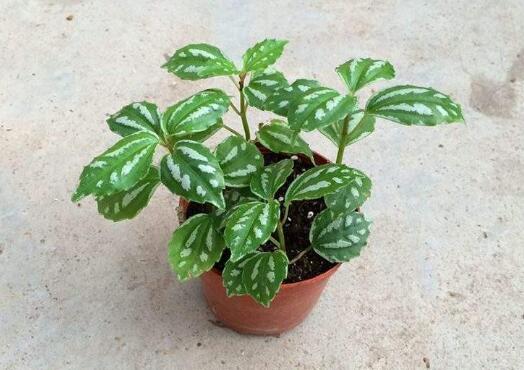
Morphological characteristics: A perennial evergreen herb, 15-40 cm tall. Leaves are opposite, elliptical, 4-8 cm long. The upper part of the leaf margin has sparse blunt serrations, while the lower part is often entire. The base color of the leaf surface is green, with three longitudinal main veins, and the vein areas are slightly sunken. Between the main veins are interspersed silver-white markings, and the striped areas are slightly raised; the leaf underside is green. Common cultivated varieties include: Pilea cadierei cv. Nana: branches and leaves densely arranged, the plant is relatively small, less than 20 cm.
Common cultivated species in the same genus include: Pilea involucrata: leaves are cross-shaped and opposite, veins are brown-red, the leaf surface is yellow-green with wrinkles and serrated margins, the veins are tea-brown, and the leaf color and markings closely resemble those of iron cross begonia.
Pilea nummulariifolia: the plant is creeping and trailing, with fine and numerous branches, and the whole plant is covered with short, fine hairs. Leaves are round, with a heart-shaped base, thin in texture, with semicircular serrations along the leaf margin, and the mesophyll between the veins is raised. Pilea 'Silver Tree': stems are upright and much branched. The petioles are short, and the leaves are ovate-lanceolate, dark green, with blunt serrations, and there is a beautiful silver-white stripe in the center of the leaf running from the leaf base all the way to the tip.
Habits: It prefers a warm, humid and semi-shaded environment, avoids direct sunlight, and has fairly strong shade tolerance. It tolerates both rich soil and poor soil, and prefers to grow in loam rich in organic matter. It is not drought-tolerant and has a certain degree of cold tolerance, able to withstand short-term low temperatures of 5°C.
Cultivation management: Pilea peperomioides is not strict about soil requirements; ordinary garden soil mixed with sand can be used as growing medium. To make the plant grow vigorously with dense, deep-green foliage, the potting soil can be prepared by mixing 5 parts leaf mold or peat soil, 3 parts perlite and 2 parts river sand, plus a small amount of base fertilizer, and the plant should be kept under warm and humid climatic conditions.
During the growing period, pay attention to timely watering to keep the potting soil moist. In hot summer, increase the watering frequency, watering once a day, keeping the potting soil at medium moisture, and frequently water the leaf surface and the ground to maintain sufficient air humidity. In autumn and winter, reduce the watering frequency, otherwise black spots may appear on the leaf surface. Watering should follow the principle of "water when dry, stop when wet", and waterlogging should be avoided. During the growing season, apply a dilute liquid fertilizer once every 2-3 weeks, but do not apply too much nitrogen fertilizer. Granular fertilizer can also be used, but do not let the fertilizer touch the leaf surface; it is best to lightly sprinkle water on the leaf surface after fertilizing to wash off any fertilizer that accidentally falls on the leaves.
In summer, it should be placed in a shaded spot for care, avoiding strong direct light. However, if the light is too dim, the leaf color will fade. In a lightly shaded environment, the leaves are distinctly white and green, the internodes are short and compact, and the leaf surface is translucent and glossy. In a fully [shaded] environment, it often grows leggy, with longer internodes, soft stems, easy lodging, and a loose plant shape. To enhance the potted ornamental effect of Pilea peperomioides, regular pruning is needed during the growing period to encourage branching and maintain a full plant shape. If you want to dwarf the plant, you can prune appropriately or pinch the tips 2-3 times. Be careful not to prune excessively, otherwise it easily leads to many small leaves, which affects the appearance. When the plant grows to about 40 cm, the stems begin to lodge outward. It should be cut back promptly to encourage the lower axillary buds to sprout and grow branches, making the branch cluster dense and compact. You can also plant 3-5 plants in one pot for a lush green look. The suitable growing temperature for Pilea peperomioides is 18-22°C, and the overwintering temperature should not be lower than 7°C. The plant grows very fast, so it is best to repot it every April; the pot should be slightly larger but somewhat shallow, with good drainage. Potted plants should be renewed every 2-3 years. Propagation: generally done by cuttings, and division can also be used.
1. Cuttings can be taken in both spring and summer. The high-temperature summer season is not suitable for cuttings, while winter cuttings grow more slowly. Select robustly growing branches, cut 5-8 cm from the stem tip as the cutting, keep a few leaves at the tip, and insert it directly into a sand bed with vermiculite or plain sand as the substrate, or insert it into potting soil mixed with peat and soil; the insertion depth should not exceed 2 cm. Place it in a semi-shaded spot, keep the soil temperature at 18-20°C, and when dry, spray water with a watering can. It will root in about 2-3 weeks, and after 1-2 months it can be transplanted or potted up.
2. Division propagation: Pilea peperomioides has a very strong clumping habit. When repotting and changing the soil, you can divide the whole clump into several portions and pot them separately. At the same time, cut back the old stems, keeping 2-3 nodes at the base of the stem; after they survive, the axillary buds will quickly sprout and send out new side branches.
Pests and diseases: In the high-temperature summer season, pests and diseases such as scale insects and aphids are prone to occur. They should be scraped off promptly or washed off with soapy water, and in severe cases pesticides can be sprayed for control. In addition, poor management can lead to leaf spot disease, which should be controlled promptly.
Control of the main pests and diseases of Pilea peperomioides
The common pest isthe scarab beetle, and diseases rarely occur.
Control methods:
① In the morning or evening, pick off the adult insects from the flowers and kill them in a central place.
② Spray with a 20% fenvalerate emulsion 3000-fold solution.