What to do when hollyhocks get infested with pests? 2 pest control methods and 2 disease control methods
When growing hollyhocks, the last thing we want to run into is problems like pests and diseases. These problems are extremely harmful to the plants, not only affecting their ornamental value, but in severe cases even causing them to wither. So what should you do when hollyhocks get infested with pests? How should pest and disease control for hollyhocks be done? Let's take a look together below.
I. What to do when hollyhocks get infested with pests - find the cause
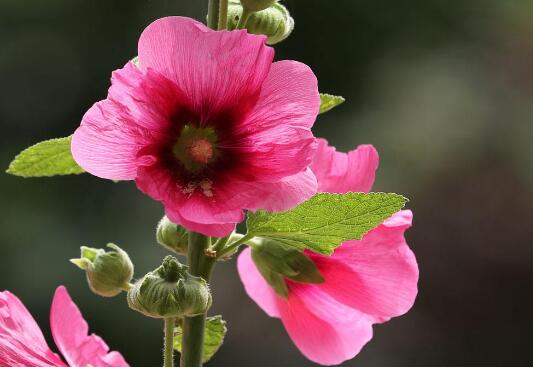
To know what to do when hollyhocks get infested with pests, we first need to know what kind of pest it is, so that we can deal with it in a targeted way, because the control methods for each pest and disease are different. We need to use different treatments according to the different pests and diseases. The details are below; let's take a look.
II. Pest and disease control for hollyhocks (pests)
1. Red spider mite
Among the pests and diseases of hollyhocks, the red spider mite is one of the more common ones. This pest is red in color and very small. It mainly feeds on hollyhock leaves, causing many pitted little holes to appear on the leaves, which greatly affects their appearance.
Control method: When dealing with the red spider mite, we can use a 2500-3000 times dilution of 15% pyridaben emulsifiable concentrate to spray and kill it. It is best not to use pyrethroid pesticides, because they have no effect on mite pests.
2. Borer
The borer is a pest belonging to the order Lepidoptera. This pest is generally more common in southern regions. It mainly harms hollyhock leaves, causing them to gradually curl and wither, and finally drop off.
Control method: When controlling this hollyhock pest, we can directly use a 500-700 times dilution of Bt wettable powder with a potency of 16000 IU/mg to spray and kill it.
III. Pest and disease control for hollyhocks (diseases)
1. Rust
Rust is a disease that appears on many plants, and hollyhocks are no exception. This disease mainly threatens the plant's leaves, stems and fruits. When it occurs, many small blister-like spots appear on the affected parts. In severe cases, the spots densely merge into patches, and the plant rapidly dies as a result.
Control method: When controlling this hollyhock disease, we can use a 1000-1500 times dilution of 70% thiophanate-methyl wettable powder to spray the diseased plants, generally once every 7-10 days. After 2-3 times, they can recover.
2. White spot disease
White spot disease is a relatively common disease that appears on many plants. It mainly threatens hollyhock leaves. When it occurs, many small brown spots appear on the leaves. Over time, the center of the spots turns grayish-white, while the outer edge turns reddish-brown. In humid environments, a grayish-brown mold layer also grows on the spots.
Control method: When controlling this hollyhock disease, we can use an 800 times dilution of 75% chlorothalonil wettable granules to spray it, generally once every 10 days. After 3-4 times, they can recover.
What to do when hollyhocks develop pests and diseases, and the control of hollyhock pests and diseases
Hollyhock is a common ornamental flower in China. Hollyhock originated in Sichuan, China, and is therefore called "Shu kui" (Sichuan mallow). Later, because hollyhocks can grow several zhang tall and their flowers are mostly red, they are also known as "yi zhang hong" (one zhang red). Hollyhocks bloom in June when the wheat ripens, and are also affectionately called "da mai shu" (barley ripe). Hollyhocks are easy to grow, but also prone to pests and diseases. What should you do when hollyhocks develop pests and diseases? This article gives you a detailed introduction to the control of hollyhock pests and diseases.
What to do when hollyhocks develop pests and diseases, and the control of hollyhock pests and diseases
During the growth period, hollyhocks can be harmed by red spider mites. When the infestation is severe, use a 7000 to 9000 times dilution of 1.8% abamectin emulsifiable concentrate for uniform spray control; or use a 2500 to 3000 times dilution of 15% pyridaben emulsifiable concentrate, both of which have good control effects. Do not use dichlorvos to kill mites; dichlorvos has the effect of stimulating mite reproduction. Do not use pyrethroid pesticides; they are basically ineffective against mites.
Sometimes the cotton leaf roller also harms hollyhock leaves. When it occurs, spray a 500 to 700 times dilution of Bt wettable powder with a potency of 16000 IU/mg, or a 1500 to 2000 times dilution of 25% diflubenzuron suspension concentrate, or a 1500 to 2000 times dilution of 20% mipafox suspension concentrate, etc.
Older perennial hollyhock plants are prone to hollyhock rust. The leaves of infected plants turn yellow or die, and brown, powdery spore masses can be seen on the undersides of the leaves. Spraying Bordeaux mixture on the plants in spring or summer, or disinfecting the seeds before sowing, can achieve a control effect. In the early stage of the disease, spray a 1000 times dilution of 15% triadimefon wettable powder, or a 1000 to 1500 times dilution of 70% thiophanate-methyl wettable powder, or a 600 times dilution of 75% chlorothalonil wettable powder, etc., once every 7 to 10 days, for 2 to 3 consecutive sprays, all with good control effects.
Hollyhock white spot disease
Hollyhock white spot disease (hollyhock white spot) is also called leaf spot disease, and mainly harms hollyhock leaves. In the early stage of hollyhock white spot disease, small brown spots appear on the leaf surface of the hollyhock. As the disease develops, the spots gradually expand into round, oval or irregular shapes. The center of the spots is grayish-white, and the outer edge is reddish-brown. In humid environments, a grayish-brown mold layer can grow on the spots.
Control methods for hollyhock white spot disease:
1. Remove diseased leaves promptly, and pay attention to the density of the branches and stems so that the plant maintains ventilation and light penetration.
2. Increase the application of phosphorus and potassium fertilizer for hollyhocks, and apply little or no nitrogen fertilizer.
3. In the early stage of the disease in hollyhocks, spray an 800 times dilution of 75% chlorothalonil wettable granules, or a 500 times dilution of 50% carbendazim wettable granules, or a 1200 times dilution of 70% thiophanate-methyl wettable granules for control, once every 10 days. Spraying 3-4 times in a row can effectively bring the disease under control.
The above is a brief introduction to what to do when hollyhocks develop pests and diseases, and the control of hollyhock pests and diseases. The most important thing in hollyhock pest and disease control is to understand their growth habits. Hollyhocks like an environment with ample light and good ventilation. Hollyhocks are not tolerant of waterlogging, so avoid being battered by heavy rain. At the same time, hollyhocks like loose, fertile, well-drained sandy soil rich in organic matter.
Hollyhock pest and disease control, solved with pesticides
Hollyhocks are cold-resistant, like environmental conditions with ample sunlight, tolerate partial shade, fear waterlogging, and have strong salt-alkali tolerance. Hollyhocks have well-developed root systems and alternate leaves. Hollyhock pests and diseases are also one of the main killers threatening their growth.
Older perennial hollyhock plants are prone to hollyhock rust. The leaves of infected plants turn yellow and eventually die, and brown, powdery spore masses appear on the undersides of the leaves. In spring and summer, spraying Bordeaux mixture on the plants or disinfecting the seeds before sowing can play a preventive role. In the early stage of hollyhock pests and diseases, you can use a 1000 times dilution of 15% triadimefon wettable powder, or a 1000 to 1500 times dilution of 70% thiophanate-methyl wettable powder, or a 600 times dilution of 75% chlorothalonil wettable powder, etc., once every 7 to 10 days, for 2 to 3 consecutive sprays, and there will certainly be a noticeable effect.
During the growth period, hollyhocks can be harmed by spider mites, affecting their growth. In severe cases, spray a 7000 to 9000 times dilution of 1.8% abamectin emulsifiable concentrate for uniform spray control; or use a 2500 to 3000 times dilution of 15% pyridaben emulsifiable concentrate, which has a good control effect. Do not use dichlorvos to kill mites; dichlorvos has the effect of stimulating mite reproduction.