What to do when Calathea makoyana gets pests? Pest and disease control and leaf spot prevention
The beauty of Calathea makoyana lies in its evergreen leaves all year round, and also in the peacock-tail pattern on its leaves. In daily life, many people like to keep Calathea makoyana as a potted plant at home, but for certain reasons, it can get pests and diseases, which completely ruins its ornamental value. So what should you do when Calathea makoyana gets pests? The following are 4 types of pest and disease control for Calathea makoyana; follow along with the editor to take a look.
1. When Calathea makoyana gets pests, spray with pesticide
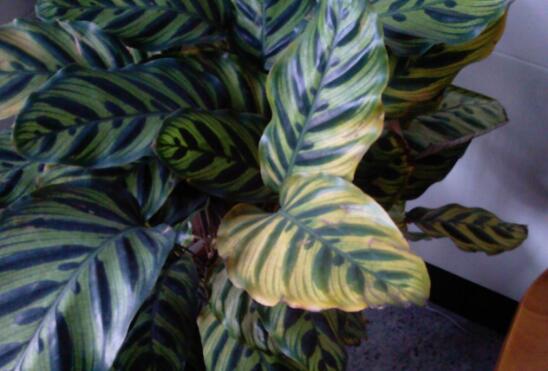
As a common indoor potted plant, the cultivation method of Calathea makoyana can be said to be very simple; you only need to place it in a warm, ventilated, semi-shaded environment and water it frequently to keep the potting soil moist. But because most people are beginners, they often cause pest and disease problems due to improper cultivation, which affects the plant's ornamental value. Next, let's take a look at how many diseases and pests Calathea makoyana has.
2. Pest and disease control for Calathea makoyana
1. Calathea makoyana leaf spot
Calathea makoyana has strong adaptability and can be said to rarely get sick, but under high temperature and poorly ventilated conditions, it can also suffer from leaf spot.
Symptoms: In the early stage, small yellowish-brown spots appear on the leaves of Calathea makoyana, and halos also appear at the edges; in severe cases, the spots spread rapidly to every branch and leaf of Calathea makoyana, and finally cause Calathea makoyana to wither and die.
Control method: After discovering leaf spot on Calathea makoyana, in order to reduce the source of disease, all diseased branches should be cut off, and then relevant chemicals should be sprayed. You can choose 38% oxadixyl-cymoxanil-copper fungicide 800-1000 times dilution, or 4% flusilazole 1000 times dilution, spray once every week, and three consecutive sprays can be effective.
2. Scale insects
In addition to diseases, Calathea makoyana can also be disturbed by pests, and the most common one is scale insects, which attach to the leaves and absorb nutrients and water from them.
Symptoms of infestation: Calathea makoyana will grow poorly, and the leaves eaten by scale insects can also cause other diseases, and in severe cases can directly cause Calathea makoyana to wither and die.
Control method: When there are only a few scale insects, you can use a brush for manual treatment; if a large number of scale insects are found, pesticide spraying is needed for control. Optional chemicals include 50% malathion 1500 times dilution, or 255 imiphos 1000 times dilution for control, spray once a week, and two consecutive sprays are sufficient.
3. Red spider mites
A mite pest of the arachnid class, it is one of the common pests harming Calathea makoyana. This pest often occurs when ventilation is poor and harms the top of the plant.
Symptoms of infestation: The top of Calathea makoyana turns reddish-brown and has spider webs, affecting the plant's growth and development.
Control method: After discovering the pest, you can treat it with decamethrin, or use sprays such as 25% anti-mite emulsifiable concentrate 800 times dilution, 73% propargite 2000 times dilution, and other chemicals.
4. Aphids
If you find that Calathea makoyana has pests, it is very likely to be aphids. They generally appear on young leaves and newly grown buds, and live by sucking the sap from the leaves.
Symptoms of infestation: The leaves of Calathea makoyana turn yellow, and black or yellow disease spots also appear.
Control method: In the early stage of aphid occurrence, you can spray 40% omethoate 1500 times dilution or 90% trichlorfon solution for control. Usually pay attention to reasonable watering and fertilizing to improve its resistance to pests and diseases.
In the process of growing Calathea makoyana, due to various reasons, it is unavoidable to encounter pest and disease problems. At this time, everyone should not panic, but should calmly find the cause and then solve it according to the above control methods. That is all the editor has introduced about pest and disease control for Calathea makoyana, and I hope it can help everyone.
How to treat pests on Calathea ornata: pest and disease control for Calathea ornata / 3 pests and 2 diseases treated by spraying
As a beautiful foliage plant, Calathea ornata has richly colored leaves, with white, green, and red all equally prominent, looking extremely beautiful! But when grown indoors, due to differences in environment and negligence in care, many problems can be encountered, such as pests and diseases. So how do you treat pests on Calathea ornata? The following is pest and disease control for Calathea ornata; let's take a look together.
1. How to treat pests on Calathea ornata
In the process of growing Calathea ornata, due to various reasons, it is unavoidable to encounter pest and disease problems. The main pests include aphids, scale insects, and red spider mites, while the diseases include leaf spot and southern blight. Their appearance will harm the health and beauty of the plant. As for how to treat pests on Calathea ornata, everyone should spray pesticides in time for control.
2. Pest and disease control for Calathea ornata
1. Calathea ornata aphids
If you find that Calathea ornata has pests, it is very likely to be aphids, because they are the main pest of foliage plants. This pest generally appears on young leaves and newly grown buds, and lives by sucking the sap from the leaves, causing the leaves of Calathea ornata to turn yellow, while black or yellow disease spots also appear.
Control method: When there are few aphids, manual aphid control can be adopted, using a writing brush or brush to brush the aphids off and bury them in the potting soil; when there are many scale insects, you can spray 40% omethoate 1500 times dilution or 90% trichlorfon solution for control. Usually pay attention to reasonable watering and fertilizing to improve its resistance to pests and diseases.
2. Calathea ornata scale insects
When the environment is not ventilated and care is improper, Calathea ornata is also prone to scale insects. This pest attaches to the leaves and absorbs nutrients and water from them, causing poor growth of Calathea ornata, and the leaves eaten by scale insects can also cause other diseases, and in severe cases can directly cause Calathea ornata to wither and die.
Control method: When there are only a few scale insects, you can use a brush for manual treatment; if a large number of scale insects are found, in addition to manual pest removal, pesticide spraying should also be used for control. Optional chemicals include 50% malathion 1500 times dilution, or 255 imiphos 1000 times dilution for control, spray once a week, and two consecutive sprays can effectively control them.
3. Calathea ornata red spider mites
In addition to aphids and scale insects, red spider mites are also a main pest of Calathea ornata. This pest often occurs when ventilation is poor, mainly piercing its mouthparts into the leaves of Calathea ornata to suck sap, damaging the plant's chlorophyll. In mild cases the leaves turn yellow, and in severe cases they fall off, seriously affecting the ornamental value.
Control method: After discovering the pest, you can treat it with decamethrin, or use sprays such as 25% anti-mite emulsifiable concentrate 800 times dilution, 73% propargite 2000 times dilution, and other chemicals.
4. Calathea ornata leaf spot
Calathea ornata has strong adaptability and can be said to rarely get sick, but under high temperature and poorly ventilated conditions, it can also suffer from leaf spot. In the early stage of the disease, small yellowish-brown spots appear on the leaves of Calathea ornata, and halos also appear at the edges; in severe cases, the spots spread rapidly to every branch and leaf of Calathea ornata, and finally cause Calathea ornata to wither and die.
Control method: After discovering the above symptoms, promptly cut off all diseased branches to reduce the source of disease; then spray relevant chemicals. You can choose 38% oxadixyl-cymoxanil-copper fungicide 800-1000 times dilution, or 4% flusilazole 1000 times dilution, spray once every week, and three consecutive sprays can be effective.
5. Calathea ornata southern blight
Among the pests and diseases of Calathea ornata, southern blight also needs everyone's attention. This disease is often more serious in July and August, but it also often occurs at other times, usually because the soil is too moist and poor. When the disease occurs, it causes purple-brown spots on the leaves, followed by an obvious white mycelial layer, and in severe cases the plant withers and eventually dies.
Control method: After discovering the above symptoms, promptly spray fungicides such as carbendazim, Bordeaux mixture, and lime sulfur mixture on the stem base of the plant and the substrate; or, after the disease occurs, directly remove the contaminated potting soil and sprinkle pentachloronitrobenzene powder or lime.
That is all the editor has introduced about pest and disease control for Calathea ornata. I believe everyone should know what to do when Calathea ornata gets pests or diseases! Overall, the cultivation method of Calathea ornata is not difficult; you only need to care for it carefully, and pests will not come looking for it. Finally, may everyone's Calathea ornata grow beautifully~
What to do when Calathea makoyana suffers from leaf spot: cultivation method of Calathea makoyana
During the growth process of Calathea makoyana, leaf spot often occurs. What should you do when Calathea makoyana suffers from leaf spot? Let's take a look together at the cultivation method of Calathea makoyana.
What to do when Calathea makoyana suffers from leaf spot
Symptoms: The leaf spot lesions on Calathea makoyana are yellowish-brown. In the early stage of the disease, small yellow granules form near the leaf edges or in the center of the leaf, and gradually expand, deepen in color, and turn yellowish-brown. There is a relatively obvious halo around the lesion. As the lesion expands, the leaf gradually dries up, shrivels, and eventually falls off and dies. The pathogen is the conidium of the imperfect fungus Drechslera. The causes of the disease are high temperature and high humidity, poor air circulation, plants placed too densely, many weeds and rotting leaves in the cultivation environment, excessive nitrogen fertilizer application, and leggy plant growth. Tender tissues are more susceptible to the disease.
Solution: Promptly remove diseased and dead leaves as well as weeds to reduce the source of infection. Plants should not be placed too densely, and proper ventilation and light transmission should be provided to reduce environmental humidity, which can reduce the occurrence of the disease. When the disease occurs, spray chemicals for protection.
Chemicals: 50% carbendazim 600 times dilution to 800 times dilution; or 75% chlorothalonil 600 times dilution to 800 times dilution; 50% mancozeb 500 times dilution to 600 times dilution, once every 7 days to 10 days. Various chemicals should be used alternately, which can prevent the pathogen from developing resistance.
Control method: Strengthen fertilizer and water management, appropriately increase phosphorus and potassium fertilizer, apply less nitrogen fertilizer, and promote full plant growth to enhance its own resistance.
Cultivation method of Calathea makoyana:
1. Habits: Calathea makoyana likes a high-temperature and humid environment. Although it is a sun plant, it can also be placed in a shady place for a long time. It is generally recommended that scattered light be below 50%. It likes an environment with good drainage and fertile soil.
2. Cultivation: In spring and autumn, Calathea makoyana can be placed indoors with suitable full-day light, while in summer semi-shade is recommended. In winter, if there is little light, fluorescent lamp irradiation can be used. The temperature is generally best above 20°C, but not higher than 35°C, because otherwise it will be scorched. Leaves curl because of high temperature. In winter it must not be lower than 5°C. Calathea makoyana likes a humid environment, so it is generally recommended to keep the humidity of the plant at around 70%. During growth, water thoroughly and maintain soil moisture, but be careful not to let water accumulate.
3. Daily care: If the plant of Calathea makoyana is relatively small and the markings are dull, it indicates a lack of fertilizer. It is generally recommended to fertilize once every 20 days during the growth period, and it is recommended to apply thin fertilizer. When growth stops in winter and summer, it is recommended to stop fertilizing. Watering is the most important part. During the growth period, water sufficiently, but water must not accumulate. After flowering, pay attention to controlling watering, and it is generally recommended to water after the soil dries.
4. Cultivation precautions: Calathea makoyana is a shallow-rooted plant. Before planting or transplanting, you can choose a wide-mouthed shallow pot as the pot. For the soil, it is recommended to mix sandy soil with garden soil, preferably containing some humus. Repotting is generally controlled to once every 2 years. In winter, special attention must be paid to maintenance, because too much watering or low temperature in winter will cause death.
More information