Campanula pest and disease control methods: control techniques for two pests and two diseases
Nobody who loves flowers wants to see caterpillars or disease spots on their campanula, and to keep plants from being attacked by pests and pathogens, besides mastering how to grow campanula, you also need to do a good job of prevention and treatment. The main pests and diseases at present are aphids, red spider mites, powdery mildew and leaf spot. Let's take a look together at these common campanula pest and disease control methods.
Campanula pest and disease control methods
1. Aphids
Flower growers have probably all heard of aphids, because they are one of the most damaging pests in the world. Most plants fall victim to them, and the main parts attacked are the tender buds and leaves. Because the sap is sucked out by the aphids, the leaves curl and become deformed, which badly affects their appearance.
Control: Various chemicals can be sprayed to kill them, such as 25% derris extract emulsifiable concentrate diluted 800 times, or 40% Supusha emulsifiable concentrate 800-1000 times, and so on. After killing the aphids, you need to do a good job of routine care and management, keeping humidity from getting too high, not watering excessively, and so on.
2. Red spider mites
One of the pests as notorious as aphids, red spider mites are also a very common pest in campanula pest and disease control. They likewise feed on sap, and if not dealt with promptly they cause the leaves to fade and shrivel, and may also bring on other diseases.
Control: Spray with 40% dimethoate 800-1000 times, or use thrips-killing formula 800-1000 times for control, once a week, and 3-4 times is enough to clear the red spider mites. Afterwards, make sure the temperature stays above 30 degrees, because red spider mites easily appear in high-temperature environments.
3. Powdery mildew
A disease caused by fungi, it mainly harms the leaves, flower stalks, flower buds, flower buds and so on, producing a layer of white powdery mold on the leaf surface, which finally turns into a gray mold layer. In severe cases the plant becomes stunted, and the leaves wither and curl.
Control: At the first signs, spray 50% carbendazim wettable powder 800-1000 times, or 70% thiophanate-methyl wettable powder 800 times. When spraying, you also need to fertilize reasonably, and not apply only nitrogen fertilizer while neglecting the importance of phosphorus and potassium fertilizer.
4. Leaf spot
The disease spots that appear on the leaves look as if they have been soaked in water, then the spots turn dark brown, and within the spots there are concentric ring patterns of alternating light and dark, with a yellow halo around the outside. In the end this causes the campanula to wither, the branches to become deformed, and even death.
Control: Spray with 14% copper ammonium complex water solution 350-500 times, once every 7-10 days, and 2-3 times is enough. In addition, you need to avoid water accumulating when watering, and not spray water on the leaves frequently so that humidity gets too high, which can reduce the chance of leaf spot occurring.
Campanula flower language and campanula growing methods
Campanula, also known as bellflower, is native to southern Europe. The plant is sturdy, and the flowers are bell-shaped like wind chimes. Below we will talk about the flower language of campanula and how to grow it.
Campanula flower language:
1. Because most campanulas bloom in late spring and early summer, and the flowers and stamens are very small and delicate, with colors mainly in warm tones, their flower language also signifies health and gentle loveliness.
2. To commemorate the artistic talent of the Archbishop of Canterbury, in Italy, if a person is born blessed by campanula, they will possess extremely strong creativity and artistic temperament; here its flower language is creativity.
3. Blessings from afar, love, an eternal bond. The wind sends good blessings to the person in your heart, and in the name of the wind it symbolizes distant blessings.
4. Gratitude, given between friends to express the feeling of repaying kindness.
5. Jealousy, from Greek mythology. Legend has it that the sun god Apollo was very fond of campanula, but the west wind, out of jealousy, threw a disc at his head; the blood that flowed out touched the ground, and from it grew the campanula flower. However, this flower language has gradually been forgotten by people.
Campanula growing methods:
1. Soil: Campanula likes loose, fertile loam with good drainage.
2. Watering: Before the radicle appears, campanula needs to be kept at relatively high relative humidity, and the medium should also be relatively moist. If necessary, you can cover the new seedlings with a layer of coarse vermiculite to retain moisture.
3. Sunlight: Campanula likes long daylight, and 14 hours of sunlight a day is enough for it to flower naturally. If you want to advance the flowering period, you only need a 30-day treatment with 4 hours of interrupted darkness.
4. Fertilizing: If you want campanula seedlings to grow quickly, you can apply 30 to 50 PPM calcium nitrogen fertilizer, and then on that basis apply calcium fertilizer to make them grow fast.
5. Pests: Common diseases of campanula are powdery mildew, leaf spot and rust, which can be sprayed with 50% carbendazim wettable powder diluted 1500 times. The main pests are aphids and thrips, which can be killed by spraying with 40% omethoate emulsifiable concentrate diluted 1500 times.
Campanula - campanula growing methods | campanula pictures | campanula flower language
Campanula
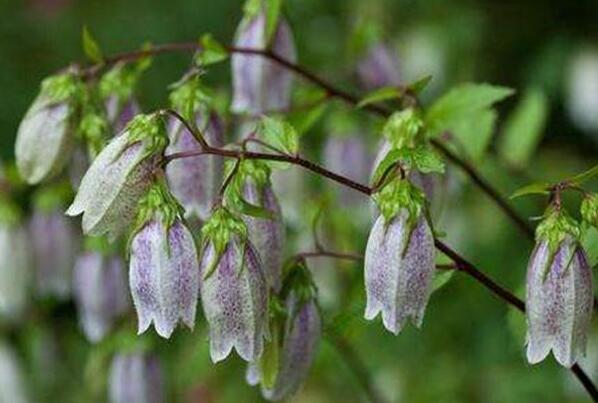
Campanula, also known as bellflower, is native to southern Europe. The plant is sturdy, and the flowers are bell-shaped like wind chimes. The flower colors are bright and elegantly simple. It is very popular in Europe, and is a common herbaceous flower in small courtyards in late spring and early summer, often used to express health and gentle loveliness. Campanula is a biennial herb. The plant is about 1 m tall and very hairy. The rosette leaves are ovate to obovate, with rounded-toothed wavy leaf margins, and rough. The leaf stalks are winged. The stem leaves are small and stalkless. The inflorescence is a raceme, with 1 or 2 small flowers borne on the stem. The corolla is bell-shaped, with 5 shallow lobes, slightly swollen at the base, and the flower colors include white, blue, purple and pale peach pink. The flowering period is April to June.Campanula growing methods
1. Soil: Campanula likes loose, fertile loam with good drainage.
2. Watering: Before the radicle appears, campanula needs to be kept at relatively high relative humidity, and the medium should also be relatively moist. If necessary, you can cover the new seedlings with a layer of coarse vermiculite to retain moisture.
3. Sunlight: Campanula likes long daylight, and 14 hours of sunlight a day is enough for it to flower naturally. If you want to advance the flowering period, you only need a 30-day treatment with 4 hours of interrupted darkness.
4. Fertilizing: If you want campanula seedlings to grow quickly, you can apply 30 to 50 PPM calcium nitrogen fertilizer, and then on that basis apply calcium fertilizer to make them grow fast.
5. Pests: Common diseases of campanula are powdery mildew, leaf spot and rust, which can be sprayed with 50% carbendazim wettable powder diluted 1 500 times. The main pests are aphids and thrips, which can be killed by spraying with 40% omethoate emulsifiable concentrate diluted 1 500 times.
How to plant campanula
How should campanula be planted so it grows vigorously? Propagation: Use seed propagation. When the campanula seeds mature, sow them immediately, and the plants can flower the following year. If sown again when autumn turns cool, most seedlings will not flower until late spring of the third year.
Medium: Choose a porous medium with good drainage. In autumn and winter, temperature and light are lower. This is especially important under conditions where the medium slowly dries out.
Medium pH: 5.5-6.0
Water: Between two waterings, the medium can be allowed to dry out a little, but do not let the campanula wilt from lack of water.
Temperature: 58-60°F (14-60°C) at night, 65-70°F (18-21°C) during the day. When active root growth appears, the night temperature can drop to 50-55°F (10-13°C), and the low temperature can continue until the marketing season.
How to grow Campanula punctata
1. Soil: Campanula punctata grows well in loam with good drainage and rich in humus.
2. Watering: Campanula punctata dislikes waterlogging, so it must not be overwatered, but in high temperatures it has relatively high demands for air humidity, so pay attention to spraying water.
3. Temperature: Campanula punctata is cold-hardy and dislikes extreme heat, so in summer be sure to move it to a place with stronger ventilation, and also pay attention to spraying water to lower the temperature.
4. Pruning: Campanula punctata sprouts and grows fairly quickly in the early stage, and is also rather messy, but it does not need much pruning; it will gradually adjust itself later.
Campanula flower language
1. Gratitude
If you like this flower, you are a person who repays kindness. You will remember in your heart the favors others do for you. But you are extremely self-centered, trust your own feelings, are somewhat cold toward people, and care a lot about others' shortcomings, which makes the friends around you afraid to approach you easily, and you gradually become isolated.
2. Jealousy
The campanula that appears in Greek mythology was loved by the sun god Apollo. The jealous west wind threw a disc at the campanula's head, and the blood that flowed out splashed onto the ground, and from it grew the campanula flower. Therefore, its flower language is jealousy. Anyone born blessed by this flower has a fairly strong desire to possess, and hopes their lover belongs to them twenty-four hours a day. However, this mostly produces the opposite effect!
The uses of campanula
The uses of campanula: 1. Ornamental. Campanula is an annual flower, often used for planting in flower beds, rock gardens, or borders or edges in gardens. Its distinctive flower shape and elegantly simple, bright colors look even better when planted in masses and combined together, and it has great ornamental value.
The uses of campanula: 2. Decorating the environment. Campanula has a distinctive flower shape, like little bells, and its flower colors are fresh and elegantly simple. If grown in pots to decorate the environment, it can also be paired with sunflowers as the main material, together with ivy, climbing fern and baby's breath in a basket arrangement, expressing a lively, flourishing and joyful atmosphere; with purple campanula as the main flower, paired with white lilies, delphiniums and asparagus fern in a flower arrangement, it will appear demure and soft and beautiful. Whichever way it is used in the home, it has a very good beautifying effect.
The uses of campanula: 3. Medicinal. Campanula's uses for ornament and decorating the environment are considerable, and it is no worse medicinally either. The whole plant of campanula can be used as medicine, collected in summer and autumn, cleaned of soil, chopped and dried in the sun. Its nature and flavor are bitter, cool. It has the effects of clearing heat and detoxifying, and relieving pain, and is often used for pharyngitis and headache.
Related encyclopedia
Pocket scale non-woven bag rush pith bamboo shoot crab claw Redmi Note 3 YKK zipper YBS zipper Prunus sargentii climbing rose Cassia nomame wintersweet green pine wristwatch Omega Longines famous watch children's building blocks flint Cremastra appendiculata curling iron soursop