Pest and Disease Control for Anthurium: Strengthen Care and Apply Pesticides
Anthurium is unlikely to suffer from pests and diseases, but poor cultivation habits can often cause pathogens and pests to appear on the plant or in the soil, harming its health. So what should you do if Anthurium gets bugs? What pests and diseases affect Anthurium? Below, the editor answers these questions one by one for flower lovers.
What Pests and Diseases Affect Anthurium
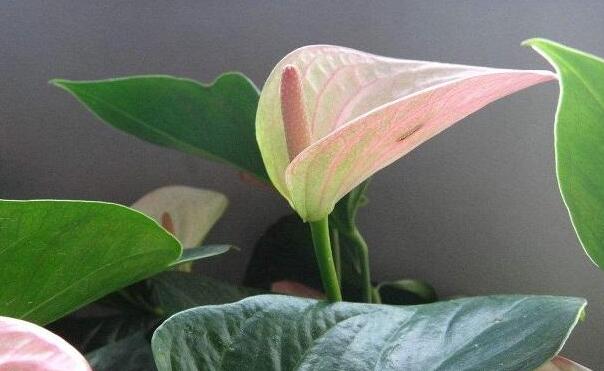
Among the pests and diseases of Anthurium, the more common pests include aphids, nematodes, and so on, while the common diseases include leaf blight and root rot. When they first occur, they will not cause fatal harm to Anthurium, but if not dealt with in time, they can lead to the death of the plant, so flower lovers must never take them lightly.
What to Do If Anthurium Gets Bugs
1. Aphids
Among the most common pests in the world, aphids are the most notorious, because they harm most plants, feeding on the sap in leaves and tender stems. Aphids not only harm Anthurium themselves, but also secrete honeydew, which attracts termites and other pests, so once aphids are found, they must be removed as early as possible.
Removal method: When aphids appear, you can first brush them off with a brush or a wet cloth, but this cannot completely eradicate them at the root, so it is also necessary to apply pesticides to kill the aphids, such as a 900-fold dilution of 12% omethoate emulsifiable concentrate, and so on.
2. Nematodes
The main part that nematodes harm is the roots. They cause the roots of Anthurium to rot, make the roots develop gallbladder-shaped swellings, and are accompanied by brown spots. Nematodes are also one of the main causes of root rot, and their occurrence is mainly caused by eggs contained in the soil.
Removal method: Disinfect the soil before potting. The method is to dry it in the sun or soak it in a carbendazim solution. As long as the soil is kept healthy, nematodes will not appear. When nematodes are found, it is necessary to drench the roots with pesticides such as carbendazim, thereby completely killing the nematodes.
Common Anthurium Diseases
1. Leaf Blight
The edges and tips of Anthurium leaves have irregular lesions, colored reddish-brown or grayish-brown, which later become large blighted spots, and the dried area accounts for half or even more of the leaf. The cause is mainly high temperature and excessively high humidity.
Control method: Lower the environmental temperature and humidity, ensure humidity at 80% and temperature below 35 degrees, and pay attention to good environmental ventilation. When the disease occurs, apply pesticides by spraying, such as a 1000-fold solution of 50% carbendazim wettable powder, and so on.
2. Root Rot
Its characteristic is that new leaves first turn yellow, and the leaves wilt at noon, but can return to normal in the evening and at night, so some flower lovers often mistakenly think the wilting is caused by too strong light. But in fact, this is caused by root rot. If not dealt with in time, later even at night the leaves will not recover from the wilted state to normal.
Control method: We mentioned earlier that nematodes are one of the main causes of root rot. In addition, fungi are another major cause, so the soil must be kept healthy and clean. When root rot occurs, you can spray with mancozeb, carbendazim, and other easy-to-use products.
Pest and Disease Control for Potted Anthurium
Anthurium, formally named Pink Champion, is a perennial evergreen herbaceous flower of the genus Anthurium, tribe Anthurieae, family Araceae.
The flowers of Anthurium are unique, with bright and gorgeous spathes, rich in color and highly variable, and a long flowering period. A single flower in water culture can last 2—4 months. It is a famous and superior flower with great development prospects.
Pest and Disease Control for Potted Anthurium
1. Potted Anthurium sometimes shows premature flower senescence, deformity, adhesion, splitting, vitrification, and blue spots. These are mostly physiological diseases caused by improper management of fertilization, potting soil, and air humidity, or by varietal reasons. The prevention method is to improve cultivation management, fertilize reasonably, and ventilate appropriately.2. The main pests and diseases of potted Anthurium include bacterial wilt, leaf spot, root rot, Cylindrocladium, Cylindrocladiella, nematodes, red spider mites, aphids, lepidopteran pests, whiteflies, scale insects, snails, and so on.
What to Do If Anthurium Leaves Turn Yellow
1. Frequent Watering
If flower lovers water too much during the cultivation of Anthurium, the soil will remain moist for a long time. This will cause insufficient oxygen in the soil, so the roots cannot breathe fresh oxygen, and the plant's water and nutrient absorption will not be very good. At this point, the plant's leaves begin to turn yellow.
Solution
When tender leaves turn pale yellow and old leaves turn yellow and withered, it is necessary to control and reduce watering, stop fertilizing, and loosen the soil of the Anthurium to improve drainage. When watering, try to water only when the soil is dry.
2. Too Much Fertilizer
When too much fertilizer is applied to the plant, it is very easy to burn the plant. Although the plant's leaves are large and thick, yellow leaves will still appear, greatly reducing the plant's beauty.
Solution
Immediately stop fertilizing, then increase watering so that excess fertilizer is washed out of the pot with the water. If the over-fertilization is relatively serious, the soil needs to be replaced, and afterward fertilization should be done reasonably.
3. Lack of Nutrients
If nitrogen fertilizer is lacking during fertilization, or if no fertilizer is applied at all, Anthurium will lack nutrients and turn yellow. The specific manifestations are withered and weak leaves, and new leaves becoming thin and yellow.
Solution
Apply a topdressing of diluted, fully decomposed soybean cake water, and then fertilize scientifically during care, generally once every 2-3 weeks. Before and during the flowering period, topdress with nitrogen, phosphorus, and potassium fertilizers. Ensuring the nutrient elements necessary for its growth is very important.
4. Long-Term Lack of Light
Among indoor ornamental plants, Anthurium is actually a very shade-tolerant plant. It can grow in low-light environments, but if it is placed in a dim environment for a period of time, its leaves will turn yellow due to lack of light.
Solution
If you find that Anthurium leaves become thin, turn yellow, do not bloom, or the flower color becomes dull, check whether the care environment lacks light. If the ambient light is relatively dim, the Anthurium should be moved to a place with light.
The above is an introduction to the reasons why Anthurium leaves turn yellow and how to solve them. Flower lovers who keep Anthurium at home should study this article carefully!