What to Do When Golden Shrimp Plant Gets Bugs? 3 Pest and 2 Disease Control Methods
In the process of growing the golden shrimp plant, the last thing we want to encounter is problems like pests and diseases. Such problems are extremely harmful to the plant, and if not dealt with in time, they can cause the plant to wither and die. So what should you do when the golden shrimp plant gets bugs? How should pest and disease control for the golden shrimp plant be done? Below, the editor will walk you through it.
1. What to Do When the Golden Shrimp Plant Gets Bugs: Find the Cause
To know what to do when the golden shrimp plant gets bugs, we first need to know what kind of bug it is, so that we can deal with it in a targeted way, because the control methods for each pest and disease are different. The details are introduced below, and those interested can take a look.
2. Pest and Disease Control for the Golden Shrimp Plant (Pests)
1. Aphids
Aphids mainly harm the leaves and tender spikes of the golden shrimp plant. Usually, some blighted spots appear on the damaged parts, so you can use this to confirm the problem. These pests gradually suck the sap of the golden shrimp plant, causing it to wilt due to insufficient nutrients.
Control method: For this pest and disease problem of the golden shrimp plant, we can use a 3000-fold dilution of 2.5% deltamethrin emulsifiable concentrate to spray and kill them.
2. Scale insects
Scale insects mainly harm the leaves and branches of the golden shrimp plant. In the early stage of the disease, some brown spots appear on the leaves, and over time they gradually spread over the whole plant, eventually leading to leaf drop and the plant withering and dying.
Control method: When dealing with this pest and disease problem of the golden shrimp plant, we can use an insecticide made by mixing 40.7% chlorpyrifos emulsifiable concentrate and 80% dichlorvos emulsifiable concentrate at a 1:1 ratio, diluted 1000-1500 times, to spray and kill them.
3. Red spider mites
Red spider mites are a pest found on many plants, and the golden shrimp plant is no exception. Their peak period is every summer, so you must pay extra attention at this time. When this pest appears, the plant's leaves gradually turn yellow and whitish, and if left untreated for a long time, it can also cause the plant to wilt.
Control method: When dealing with this pest and disease problem of the golden shrimp plant, if only individual leaves are damaged, we can directly remove the affected leaves. If many leaves are damaged, then we need to spray pesticide. Generally, dicofol can be used to spray and kill the pests.
3. Pest and Disease Control for the Golden Shrimp Plant (Diseases)
1. Powdery mildew
Powdery mildew mainly threatens the leaves, tender buds, tender stems and other parts of the golden shrimp plant. In the early stage of the disease, many white powdery disease spots appear on the leaves, and over time they gradually spread, eventually causing old leaves to wrinkle and tender shoots to shrivel.
Control method: For this pest and disease problem of the golden shrimp plant, we can use a 800-1000 fold dilution of 70% thiophanate-methyl wettable granules to spray the diseased plant. Generally, spraying once every 7-10 days, 2-3 times is enough for it to recover.
2. Sooty mold
Sooty mold mainly threatens the leaves and branch tips of the golden shrimp plant. When the disease occurs, many small black mold spots appear on the leaves and branch tips, and the area gradually spreads, eventually covering the entire leaves and branches, causing the plant to gradually wither and die.
Control method: When dealing with this pest and disease problem of the golden shrimp plant, we can use a 500-800 fold dilution of amobam or a 400 fold dilution of folpet to spray the diseased plant. Generally, spraying once every 12-15 days, 1-2 times is enough for it to recover.
Pests and Diseases of the Golden Shrimp Plant and Their Control
Diseases of the Golden Shrimp Plant and Their Control
When growing the golden shrimp plant, some physiological diseases sometimes appear, such as root rot and leaf yellowing.
Root rot may be caused by improper care. During care, too much watering leads to waterlogged soil, which then causes root rot, with the roots rotting severely and affecting growth.
Leaf yellowing mainly refers to the physiological yellowing of leaves caused by improper fertilization when growing the golden shrimp plant, as well as other diseases. This means that when fertilizing, fertilizer is accidentally splashed on the leaf surface, causing lesions, yellowing or spots.
When growing the golden shrimp plant, hazards such as powdery mildew can also appear. Powdery mildew generally occurs in winter, mostly due to indoor growing with poor ventilation and improper humidity. When controlling powdery mildew, you can wipe the affected areas with alcohol, and it can take effect after several consecutive applications.
Pests of the Golden Shrimp Plant and Their Control
When growing the golden shrimp plant, the pests and diseases it is prone to suffering from are pests such as whiteflies, red spider mites and aphids.
These pests mostly occur during the flowering period and in winter, gathering on the leaves and bracts. They are very harmful and need to be controlled in time.
During the care of the golden shrimp plant, good care needs to be done to prevent pests and diseases caused by improper care. Often observe the growth condition of the golden shrimp plant. If pests or diseases are found, they need to be controlled in time, spraying some omethoate pesticide to kill the pests.
Control Methods for Pests and Diseases of the Golden Shrimp Plant
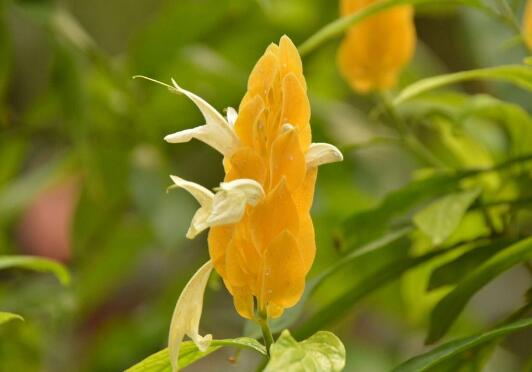
The golden shrimp plant, also called yellow shrimp flower, is a perennial evergreen herbaceous plant of the Acanthaceae family. The plant height is 30 to 50 cm. The plant is much branched, and the leaves are elliptical, bright green, with obvious veins. Usually, a huge inflorescence is produced at the top of each branch. The whole inflorescence looks very much like a golden-yellow pagoda or shrimp. On the inflorescence there are many dense and well-developed golden-yellow bracts and pure white flowers, and its white flowers are surrounded by golden-yellow bracts. In an environment above 15°C, whenever a new shoot appears, a new inflorescence will appear at the top, and it can be enjoyed all year round.
Pest and disease control: the golden shrimp plant is prone to growingwhitefliesin winter, and in other seasons there arered spider mitesoraphids, so attention should be paid to control.