How to treat ginger lily fusarium wilt? Pest and disease control focuses on strengthening management
If humans get infected with a virus, they get sick. So if plants are attacked by pathogens or pests, will they get "sick"? The answer is yes. For example, when growing ginger lilies, improper care can easily lead to infection with mosaic virus, anthracnose, fusarium wilt and so on. So how do you treat ginger lily fusarium wilt? Let's take a look at the methods for controlling ginger lily pests and diseases.
How to treat ginger lily fusarium wilt
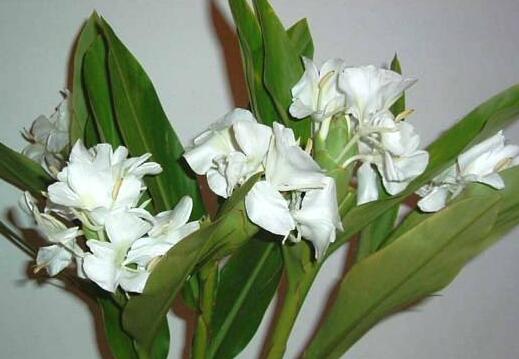
Fusarium wilt is also called blight. Its symptoms are spots appearing on the ginger lily plant, the plant wilting, and the leaves, flowers, stems and so on slowly dying. It may also affect the shoot tips, seedlings, small branches and so on. Its cause is mainly fungi and bacteria.
Control method: Do a good job of pruning the ginger lily to ensure good light penetration between its branches and leaves. When planting, choose disease-free seeds, and avoid overwatering to the point of excessive moisture. When disease occurs, spray with 300-500 times diluted fungicide, and you can also pour 600-700 times diluted 80% hymexazol onto the roots.
Methods for controlling ginger lily pests and diseases
1. Mosaic virus
Besides fusarium wilt, ginger lilies are also prone to mosaic virus. Its main symptom is pale yellow linear stripes on the leaves, making the leaves look mottled like a mosaic. Its main pathogen is mosaic virus, and it is spread by pests such as aphids.
Control method: At the early stage of the disease, spray 500 times diluted 5% ningnanmycin wettable powder, or 500 times diluted 20% Bingdu Ning water-soluble powder, spraying about once every 10 days. Generally 2-3 sprays can bring mosaic virus under control, and afterwards management should be strengthened according to ginger lily cultivation methods.
2. Anthracnose
Among the methods for controlling ginger lily pests and diseases, many diseases mainly harm seedlings, but they can also appear on mature plants. Anthracnose is one of them, and it mostly occurs on mature plants, causing dark green small spots at the leaf tips and leaf margins, which then turn grayish-white, grayish-brown and so on.
There are many reasons for infection with anthracnose, including dry and hardened soil, too few nutrients, shaded environment, too high humidity, too much standing water and so on. The pathogen may also parasitize crops and spread to other plants, so it must be controlled in a timely manner.
Control method: Usually pay attention to reasonable fertilization. Apply sufficient base fertilizer when potting, and do not apply too much quick-acting nitrogen fertilizer at ordinary times. Mainly keep the environment ventilated and with sufficient light. When disease occurs, spray 500 times diluted 50% carbendazim wettable powder, 600-800 times diluted 65% zineb and so on.
Cultivation methods and tips for red ginger lily
Red ginger lily is also called crimson ginger lily. It is native to India. With beautiful flower shapes and brilliant colors, it is a common ornamental plant, and many people like to grow it as a potted plant at home. However, people do not know much about its cultivation methods and always fail to grow it well. Today I will give a special introduction to the cultivation methods of red ginger lily. Friends who need it can focus on learning about it.
Cultivation methods for red ginger lily1. Planting red ginger lily
Red ginger lily is mostly grown by root division, and this can only be done in spring. When planting, you should cut its rhizomes apart and plant them separately into flower pots. After planting, do not water immediately; just keep the potting soil moist. Water again after its rhizomes sprout new shoots.
2. Management of red ginger lily
After planting red ginger lily, whether in pots or in the ground, sufficient base fertilizer should be applied, and the soil should be kept moist during its growth period. During the growth period, it needs topdressing twice. Red ginger lily blooms in August every year. When it blooms, move it to a semi-shaded place to prolong the flowering period. After the flowers fade, cut off the inflorescences in time. In winter, all the withered aboveground parts should be cut off, leaving only the underground roots, which helps red ginger lily overwinter safely.
3. Pest and disease management of red ginger lily
During the growth period of red ginger lily, leaf spot and leaf blight are its common diseases. After these diseases occur, you can dilute 65% zineb wettable powder with 600 times clean water, then spray it directly on the leaf surface. Generally, spraying 2-3 times is enough.
What is ginger lily? How to artificially cultivate wild ginger lily?
Image: ginger lily
[Common question] What is ginger lily? How to artificially cultivate wild ginger lily?
[Expert answer]
Aliases: butterfly ginger, spike-flowered kaempferia, butterfly flower, fragrant snow flower, night cold restorative, ginger orchid, turmeric
Also known as wild ginger lily, it is a perennial herbaceous plant and a freshwater herbaceous plant of the genus Hedychium in the ginger family. The flowering period is from May to November. The plant height is 1 to 2 meters. The underground stem is block-shaped, grows horizontally and is aromatic, shaped like ginger. It is 1-2 m tall, the inflorescence is spicate, the calyx is tubular, the phyllotaxy is alternate, the leaf blade is long and narrow with pointed ends, the leaf surface is smooth, and the leaf back has a slight thin fuzz. It is not cold-tolerant and prefers a warm winter and moist summer environment. Its drought resistance is poor. In the early growth stage it should be semi-shaded, and in the vigorous growth stage it needs sufficient sunlight. The soil should be fertile and have strong moisture retention. Ginger lily has a fresh fragrance and can serve as a natural air freshener when placed indoors. Its color is harmonious and round, generally with white flowers. Potted plants can be used for viewing. The white flowers are like butterflies, so it is also called butterfly ginger, white butterfly flower and so on. It is native to tropical Asia, the tropical regions of India and Malaysia, and was probably introduced to China during the Qing Dynasty. In addition, ginger lily is the national flower of Cuba and Nicaragua.
Ginger lily cultivation techniques:
1. Seedling propagation techniques
There are sexual reproduction and asexual reproduction. Using the division propagation method, the propagation speed is also fast. In areas where it can overwinter outdoors, it can be planted in all four seasons. Cut divisions from clumps of mature plants. If planted in February or March of the same year, it can bloom in July or August. Each root can divide and produce about 20-40 new plants throughout the year, with good flower quality and high yield. However, in the Chibi area of Hubei, it is actually planted from November each year to March of the following year, and can bloom from June to July. It then blooms continuously until the aboveground parts wither only after a heavy frost. By the second year, each mu can produce as many as 32,000 to 38,000 flower stems. It produces about 35,000 to 40,000 flowering roots. Each 5 to 10 cm counts as one root (plant).
2. Planting season and planting method
Golden ginger lily has strong adaptability to soil. The most suitable cultivation soil is fertile, loose loam or sandy loam with good drainage, but the soil should often remain moist or be close to a water source, so that growth is more vigorous. It can be planted in spring, summer and autumn, but planting in February or March of spring is best. Planting by division can obtain high yield in the same year. In the same year, the average yield per mu is nearly 2000 stems/month, and in the second year the yield per mu can reach more than 2200 stems/month. Before planting, deeply plow the land, apply sufficient base fertilizer, and make deep furrows and high beds. Use single-row or double-row planting, with a planting spacing of 50×50cm, and plant 2500-3000 plants per mu. If fertilizer and water management conditions are good, it can bloom in late May of the same year. When one seedling or rhizome is planted, it can divide and produce about 20-40 new plants throughout the year, and can bloom after growing to about more than 15 leaves.
3. Fertilization method
Using microbial bacterial fertilizer together with fermented organic fertilizer can achieve very good results. When using microbial bacterial fertilizer together with fermented organic fertilizer on ginger lily, its effect and economic benefit are better than traditional fertilization schemes. According to the growth and development pattern of ginger lily, different fertilization methods and amounts should be adopted according to the amount of water and fertilizer intake at different stages. Fertilizer for ginger lily can be divided into two types: base fertilizer and topdressing.
4. Pest and disease control
The main problem is anthracnose harming stems and leaves. At the early stage of the disease, spray 500 times diluted 50% carbendazim wettable powder, once every ten days.
[Editor's comments] The flower language of ginger lily is "keep memories forever in summer." Wild ones are generally used as medicine, while potted ones can be enjoyed. They generally bloom in summer and autumn. The editor of First Agricultural Economics above has given a brief introduction to ginger lily and summarized several key points of ginger lily cultivation techniques. I hope this article is helpful to you.