What to do when palm grass (Rhapis excelsa) gets pests? Learn to control 2 pests and 2 diseases
When growing palm grass (Rhapis excelsa), the last thing we want to run into is problems like pests and diseases. Such problems are extremely harmful to it, not only affecting its ornamental value, but in severe cases even causing it to wither and die. So what should you do when palm grass gets pests? And how should pest and disease control for palm grass be done? Below, the editor will walk you through it.
I. What to do when palm grass gets pests: find the cause
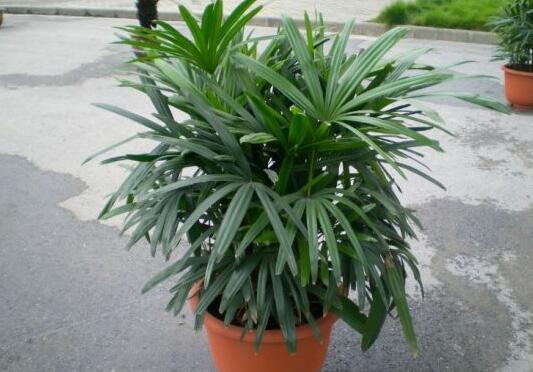
To know what to do when palm grass gets pests, we first need to understand what kind of pest it is, so that we can deal with it in a targeted way, because the control methods for each pest and disease are different. The details are described below, so let's take a look.
II. Pest and disease control for palm grass (pests)
1. Aphids
Aphids are one of the more frequently occurring pests and diseases of palm grass, and also a pest and disease found on many plants. They are a phytophagous insect that mainly harms the leaves and stems of palm grass, gradually sucking out the sap within, causing the plant to lose a large amount of nutrients, and over time causing the plant to gradually wither and die.
Control method: if the number of these pests is small, we can prune off the affected branch tips and then disinfect the plant. If the number is large, we can directly use a 3000-fold dilution of 50% pirimicarb wettable powder to spray and kill them.
2. Scale insects
Scale insects are a pest that appears during the growth of many plants, and palm grass is no exception. These pests mainly feed on the sap in the leaves and stems of palm grass, gradually sucking out the sap, causing palm grass to gradually lose nutrients and finally show signs of shriveling.
Control method: for this pest and disease of palm grass, we can use a 1500-fold dilution of 50% malathion to spray and kill them.
III. Pest and disease control for palm grass (diseases)
1. Bud rot
This disease mainly threatens the young buds and tender leaves of palm grass. When it first develops, the unopened leaves wilt first, turning brown, then droop. The pathogen spreads from the base of the tender leaves to the young tender tissues of the bud, causing the young buds to wither and rot, the plant to stop growing, and in severe cases the whole plant to die.
Control method: when dealing with this pest and disease of palm grass, we can use a 500-fold dilution of 80% mancozeb wettable powder to spray the diseased plant, generally once every 10 days, and it can recover after 3-4 treatments.
2. Anthracnose
This disease mainly threatens the leaves of palm grass. When it develops, many semicircular lesions appear at the leaf tips or leaf margins, appearing yellowish-brown or grayish-brown. When the air is too humid, vermilion needle-head-sized droplets appear on the leaves, and over time the plant gradually withers and dies.
Control method: for this pest and disease of palm grass, we can use a 600-800 fold dilution of Guoguang Yintai wettable powder to spray it, generally once every 7-10 days, and it can recover after 2-3 treatments.
What pests and diseases does palm grass have, and how to control them
Palm grass has upright clumps, green leaves and straight stems, growing together in clusters, well-spaced and graceful, evergreen all year round and full of tropical charm. It is very suitable for potted ornamental display on family balconies, but there are always some palm grass pests and diseases that affect its ornamental value. So what pests and diseases does palm grass have? Below, let's introduce the control methods for palm grass pests and diseases.
What pests and diseases does palm grass have
What pests and diseases does palm grass have? Perhaps everyone will ask this. In fact, the common pests and diseases of palm grass include bud rot, leaf spot disease, anthracnose and scale insects. Actually, palm grass has relatively few pests and diseases, but we should still pay attention, because in all things, do not fail to do a good deed because it is small, and the same principle applies to palm grass pests and diseases.
Control methods for palm grass pests and diseases
Bud rot among the control methods for palm grass pests and diseases
Palm grass bud rot: it mainly harms young buds and tender leaves. When it first develops, the unopened leaves wilt first, turning brown, then droop. The pathogen spreads from the base of the tender leaves to the young tender tissues of the bud, causing the young buds to wither and rot, the plant to stop growing, and in severe cases the whole plant to die. The base of the unopened central tender leaves turns brown and rots, giving off a foul odor. This disease also harms palm family plants such as areca palm, fishtail palm, royal palm, fake betel nut and coconut, and is the most serious disease harming palm family plants. The pathogen overwinters as oospores in infected buds and leaves and roots, or with diseased residues in the soil, and spreads through rainwater or irrigation water and water splash. It is prone to occur in rainy seasons and on days with lots of rain, when the temperature is 20°C to 25°C, the relative humidity is above 90%, and moisture lingers for a long time.
Control method: usually strengthen ventilation and light transmission, and strictly prevent moisture from lingering on leaf surfaces for a long time. When a small number of diseased leaves are found, promptly cut them off from the base of the stem and burn them. If in the early stage of disease, use 50% carbendazim wettable powder plus 75% chlorothalonil wettable powder at 800-fold dilution, or 80% mancozeb wettable powder at 500-fold dilution, or 1:1:100 Bordeaux mixture, spraying the heart leaves and the whole plant alternately, once every 10 days, for 3 to 4 consecutive times, which has a very good control effect.
Leaf spot disease among the control methods for palm grass pests and diseases
Palm grass leaf spot disease. In the early stage of leaf disease, small yellowish-brown spots appear, gradually expanding into streaks, and can merge into irregular necrotic patches. Leaf tips and leaf margins are most susceptible, and in severe cases the leaves dry up and curl.
Control method: (1) Strengthen management, do not over-apply nitrogen fertilizer, and it is advisable to increase potassium fertilizer to improve the plant's disease resistance; (2) In the early stage of disease, spray 50% captan wettable powder at 300-500 fold dilution, or use 70% mancozeb wettable powder at 400-650 fold dilution, once a week, for several consecutive sprays. The main pest of palm grass is the red kidney-shaped scale. It mainly harms the upper surface of leaves, sucking leaf sap.
Anthracnose among the control methods for palm grass pests and diseases
Palm grass anthracnose is one of the important diseases of palm grass, mainly harming palm grass leaves. Palm grass anthracnose lesions mostly start from leaf tips or leaf margins, semicircular to irregular, yellowish-brown to grayish-brown, with dark brown edges, and moire patterns on the surface of the lesions. When humid, vermilion needle-head-sized droplets appear on them.
Control method: (1) Combine with winter and spring garden cleaning to collect diseased residues and burn them, then immediately spray once for prevention; (2) In the early stage of disease, regularly spray Guoguang Yintai wettable powder at 600-800 fold dilution, Guoguang carbendazim, and chlorothalonil for prevention. In the early stage of disease, use Guoguang Yingna wettable powder at 400-600 fold dilution, or Guoguang Bixian emulsifiable concentrate at 500-600 fold dilution for foliar spraying for control, using continuously 2-3 times, with an interval of 7-10 days.
Commonly used chemicals: metalaxyl-mancozeb, prochloraz, propiconazole
Scale insects among the control methods for palm grass pests and diseases
Palm grass has relatively few pests and diseases, mainly scale insects, which can be killed by manual washing and brushing. Regularly applying a small amount of ferrous sulfate solution can prevent leaf yellowing.
Control of pests and diseases in potted palm grass
Palm grass has relatively few pests and diseases, mainlyscale insects, which can be killed by manual washing and brushing. Regularly applying a small amount of ferrous sulfate solution can prevent leaf yellowing.