How to transplant a Peperomia? It is best done in spring, and the growing medium must have good drainage.
As we grow Peperomia, as it gradually grows, it also needs a spacious growing environment, and at this point we need to transplant and repot it; transplanting it into a slightly larger pot also lets it grow better. So how do you transplant a Peperomia plant? Below, the editor takes everyone through it.
I. How to transplant a Peperomia plant
1. Transplanting time: spring is the best time to transplant
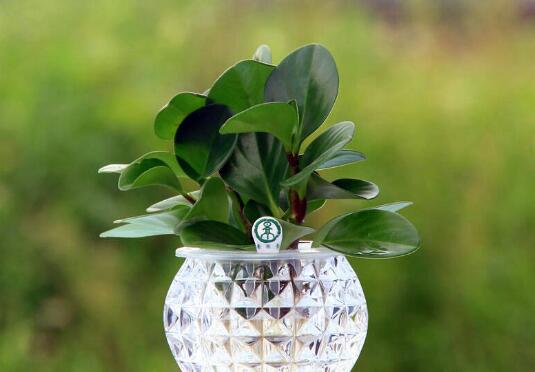
Before transplanting a Peperomia, we first need to choose a suitable time point; transplanting at a suitable time means its survival ability will be higher. This time period is best chosen in spring, because the climate in this season is more suitable for its growth, so the survival rate after transplanting will also be higher.
2. Medium selection: humus soil
Choosing the medium is a very important step; only by choosing a suitable medium can they grow vigorously, otherwise they may grow poorly. Peperomia prefers loose, fertile humus soil, because this kind of soil has good drainage and can help its growth.
3. Transplanting method: do not damage the root system
First, we can dig the plant out of the pot. This process must be done carefully, because Peperomia's root system is rather fragile and can easily be damaged by a single careless move. After digging it out, we can replant it into new potting soil and then carry out long-term care. Here the editor has only briefly introduced it to everyone; if you want to learn the detailed transplanting method, you can refer to the article on Peperomia propagation methods.
II. Care and management after transplanting Peperomia
1. Fertilizing: once a month
During Peperomia's growth process, its demand for fertilizer is very high; basically it needs fertilizing once every month, so that it can have enough nutrients to grow better. However, when fertilizing we must pay attention to one point: the fertilizer must be diluted before application, to avoid burning the plant.
2. Temperature: around 25°C
During Peperomia's growth process, the ambient temperature is very important; only by letting it grow at a suitable temperature can it grow better. Peperomia's suitable growing temperature is around 25°C, and the lowest temperature must not be lower than 10°C, otherwise its growth will be affected.
3. Water: avoid waterlogging
Peperomia prefers a warm and humid environment, so during cultivation we need to water frequently, especially after entering summer, because the temperature is higher and water evaporates faster, so it is best to water once each in the morning and evening every day. However, when watering we still need to control the amount of water; remember not to cause waterlogging, otherwise it can easily lead to root rot.
4. Light: avoid strong light
Peperomia's demand for light is not too high, because it is rather afraid of direct sunlight, so under mild light conditions we can generally grow it in a spot with scattered sunlight. When summer comes and the light is stronger, we need to move it indoors to a semi-shaded spot for cultivation, to avoid scorching the plant.
Yu Hudie (Yu Butterfly) | Yu Hudie profile: how to grow Yu Hudie / how to propagate Yu Hudie
Yu Hudie profileYu Hudie
Aliases:
Classification: Orchidaceae flowers
Family and genus: Plantae, Angiosperms, Dicotyledoneae, Orchidaceae
Full bloom period: spring
Yu Hudie was selected before the War of Resistance; it is said to have originated in Lanxi, Zhejiang, China. In the early 1950s, it was collected from the mountains by a mountain farmer of the Yu family, and after being bought by Japanese people, it bloomed in Japan and was named "Yu Hudie." After the 1980s it was sold back to mainland China. Yu Hudie usually opens two to three flowers per scape, either in spherical chrysanthemum-petal form or in layered jade-tree form. The petals can number more than one hundred. The inner whorl and outer whorl petals overlap layer upon layer, and occasionally there is butterfly transformation. The flower shape is also large, and the fragrance is strong. The flowering period lasts more than twenty days, and some orchid books call it a "variably multi-petaled wonder type without a column." Each flower of Yu Hudie is not exactly the same, each showing its own splendor. Yu Hudie is the first among the chrysanthemum-petaled wonder flowers of Cymbidium goeringii...
Cultivation methods and precautions for Yu Hudie; introduction to Yu Hudie
Yu Hudie was selected before the War of Resistance; it is said to have originated in Lanxi, Zhejiang, China. In the early 1950s, it was collected from the mountains by a mountain farmer of the Yu family, and after being bought by Japanese people, it bloomed in Japan and was named "Yu Hudie." After the 1980s it was sold back to mainland China.
Yu Hudie usually opens two to three flowers per scape, either in spherical chrysanthemum-petal form or in layered jade-tree form. The petals can number more than one hundred. The inner whorl and outer whorl petals overlap layer upon layer, and occasionally there is butterfly transformation. The flower shape is also large, and the fragrance is strong. The flowering period lasts more than twenty days, and some orchid books call it a "variably multi-petaled wonder type without a column." Each flower of Yu Hudie is not exactly the same, each showing its own splendor.
Yu Hudie is the foremost chrysanthemum-petaled wonder flower of Cymbidium goeringii, with a flowering period in spring.
Morphological characteristics of Yu Hudie
Yu Hudie leaves are 25-35 cm long, the marginal leaves are 1 cm wide, and the central leaves are slender at 0.6 cm; the leaf posture is obliquely pendulous, and half-grown seedlings are fairly upright, with leaf tips occasionally showing an inward-hooked shape in the middle of the leaf, while the tips of old leaves bend and droop in width; the leaf veins are relatively flat, and the leaf grooves are relatively shallow; the leaf margins of new leaves curl inward, while the leaf margins of old leaves are recurved. The leaf color is yellow-green, the leaf margin serrations are fine and dense, the veins deviate from the middle of the leaf, and the leaf texture is soft, glutinous and moist. On the underside of the leaf, on both sides of the midrib, there are many fine veins reaching the tip. New leaves have a glossy sheen, and the leaf tips are needle-sharp. The leaf bases are tightly constricted, the pseudobulbs are round and large, and the leaves can reach seven or eight or more. New shoots when first emerging are white-green, gradually becoming pale green, with light purple markings; the bud sheaths have small fine white rice-grain dots at the tips, and new leaves also have small fine white rice-grain dots, and until the five-tenths wood stage, the leaf tips still have small fine white rice-grain dots. The leaf sheaths are slender and long, and the sheath tips are relatively soft.
When the flower bud of Yu Hudie first emerges, it goes from white to pale green from the bottom upward, and after exposure to sunlight it turns green with a purple halo, with the veins being purplish-red; the bud tip also has small fine white rice-grain dots, and the lower part of the flower bud gradually becomes round and swollen. Before blooming, the flower bud swells large; the close-fitting bud sheath is pale green, with purple veins reaching the tip. The flower scape is green, thick and short, about 10-15 cm. The outer whorl petals increase in number, spreading outward in wide bamboo-leaf petal form; the inner whorl petals overlap layer upon layer, with no obvious lip petals or column, and the inner whorl of the flower bears countless tiny petals, whose tips are masculinized and pale yellow; the petals occasionally show lip transformation, sometimes with red spots, and sometimes with incomplete lip petals visible. The flower shape is extremely large, reaching about 8 cm; one scape bears two flowers, occasionally three; the flower color is emerald green with star-like red spots and pale yellow hood-shaped small petals, and it is hard to count them clearly. It can be called a butterfly-transformed chrysanthemum-petaled flower, and sometimes it can also open in a "jade-tree" form. "Three Hundred Questions on Chinese Orchid Art" calls it a "variably multi-petaled wonder type without a column," and each flower is different. "Yu Hudie" has a delicate fragrance that assails the senses; its fragrance is one of the strongest and purest among Cymbidium goeringii, and its flowering period is relatively long, reaching more than 20 days.
Yu Hudie blooms in chrysanthemum form, with petals numbering as many as ten to twenty; the petals show lip transformation, the variation is great, the flowers are emerald, the leaf width is narrow, and the leaf color is yellow-green, semi-pendulous.
The leaf shape is medium-long, semi-arched and pendulous, and the leaf color is slightly yellow-green. One scape usually opens two to three flowers. They may be in spherical chrysanthemum-petal form or in layered jade-tree form. The petals can number more than one hundred. The inner whorl and outer whorl petals overlap layer upon layer, and occasionally there is butterfly transformation. The flower shape is also large, and the fragrance is strong. The flowering period lasts more than twenty days, and some orchid books call it a "variably multi-petaled wonder type without a column." Each flower of Yu Hudie is not exactly the same. Each shows its own splendor, and it is the foremost chrysanthemum-petaled wonder flower of Cymbidium goeringii, with a flowering period from January to March.
Ecological habits of Yu Hudie
Yu Hudie likes shade and fears direct sunlight; likes humidity and avoids dryness; likes fertility and being rich in large amounts of humus; and is suited to an environment with air circulation.
Cultivation techniques of Yu Hudie: the orchid room
The orchid room is the place for cultivating Yu Hudie. Because Yu Hudie has relatively high requirements for temperature and humidity, the orchid room must have functions for regulating temperature, humidity and ventilation. Where conditions allow, set up a water storage trough on the ground or lay sand and gravel to ensure the humidity of the indoor ground. Place the orchid pots on orchid racks, about 60 cm above the ground, so that good ventilation is achieved while also preventing pests from climbing up from the bottom of the pots. Leave an aisle of about 60 cm between orchid racks for convenient daily management.
Install lighting lamps above the orchid racks to increase illumination when light is insufficient on cloudy, rainy and foggy days. Set up a double-layer shade net at the top of the orchid room to block sunlight and also prevent temperature rise. Install a water curtain on one wall; in the high-temperature summer season, turning on the water curtain can lower the room temperature. Install fans to strengthen ventilation and air exchange, especially in the plum rain season, controlling air humidity, which is beneficial for disease prevention and control. In addition there is heating equipment, which in winter low temperatures can ensure safe overwintering and meet the growth requirements of Cymbidium goeringii.
Orchid pots
The root system of Yu Hudie is fleshy root, and the roots store a large amount of water. The characteristics of this kind of root are that it fears waterlogging, likes aeration, and tolerates drought. When choosing orchid pots, it is necessary both to favor ventilation, air permeability and drainage of the growing medium, and to consider factors such as aesthetics. Commonly used orchid pots include plastic pots, porcelain pots, unglazed clay pots, purple clay pots, etc. Plastic pots are light and portable and have good water retention, but they do not absorb water. Their air permeability and heat dissipation are relatively poor. Unglazed pots have good air permeability and a moderate price, but their appearance is rather rough. Purple clay pots have relatively good air permeability and beautiful shapes, and can be chosen according to need. In recent years, thin and tall planting pots have mostly been used; this kind of pot can maintain relatively good air permeability for orchid roots and is beneficial to orchid root growth. It is best to choose orchid pots of the same specification for the same orchid room, so that air permeability is basically consistent and humidity is easier to control.
Traditional orchid growing generally uses non-granular growing media, which easily causes compaction, leading to waterlogging and making orchid roots rot, increasing the difficulty of management. In order to increase aeration and avoid root rot, an advanced mixed substrate cultivation method is currently used; it is loose and airy, has good moisture retention, and very well solves the problem of root rot. The planting substrates include: pond foundation stone, vermiculite, Zhijinshi, perlite, Emei Xiantu, etc., mixed according to need. First sieve out dust, then use different sieves to separate large, medium and small particles, soak them wet and dry them for later use.
Choose a deep cylindrical unglazed pot or purple clay pot with a large bottom hole for planting. Put the pot pad into the bottom of the pot, first fill in large coarse particles, place the plant into the pot, turn the old pseudobulb to one side, and leave space for new shoots. Spread the root system well, add medium particles, fill up to the place of the pseudobulb, pat the planting pot to settle the soil, then cover with small particles, and shape the pot surface into a mound shape slightly higher in the center. Place it in a ventilated and shady place, then water the leaves until water flows out from the bottom of the pot.
Cultivation methods of Yu Hudie: watering
Yu Hudie is suited to growing in an environment with relatively high air humidity; generally the air humidity is required to be 70%-90%. If the air is too dry, then the orchid grows poorly, with leaves small and thin and lacking luster. Usually humidity is maintained by watering; it is best to use rainwater for watering, and if tap water is used, it should be stored for one or two days until the chlorine volatilizes before use. The pH value of the water is best at about 6, and this can be tested with test paper. But there must be no waterlogging at the roots, and water should be given according to seasonal changes and the degree of dryness and wetness of the cultivation pot's growing medium. In summer, when the temperature is relatively high and evaporation is large, water 1-2 times every evening or morning to keep the orchid leaves and pot surface moist, and water thoroughly once a week to make the growing medium completely wet. In winter the orchid is in a dormant state; water once at noon every 4-5 days. In spring water once every 2 days, and in autumn once a day. In short, grasp the principle of not watering when not dry, and watering thoroughly when dry.
Fertilizing
Fertilizing requires light fertilizer applied frequently; the concentration must not be too high, otherwise fertilizer damage will occur, and it may even lead to the death of the orchid. The main fertilizing methods are base fertilizer, root topdressing and foliar fertilizer. This is determined according to the different times of vegetative growth and reproductive growth of the orchid. From April to June is the new shoot growth period; at this time the temperature begins to rise, and you can apply Lanjunwang or Huabao No. 1 at 1000x solution, once every 7-10 days, to promote early and rapid root growth and new shoot growth. After July is the new leaf growth period; apply Huakang tri-in-one nutrient solution or Huabao No. 5 at 1000x solution, once every 7-10 days. From September to October, apply Huabao No. 2 and Huabao No. 3 at 1500x solution, once every 10 days, to promote reproductive growth. By November, you can spray Huabao No. 4 at 1000x solution on the leaves, once every 10 days. You can also apply special compound fertilizers for orchid plants such as Mofei, Haokangduo and Xishuo. After each fertilization, 2-3 hours later, water once with clear water. In daily care, long-acting granular fertilizer can be used in combination, directly scattered on the pot surface. In winter the orchid enters the dormant period, and no fertilizer is applied. Generally no fertilizer is applied during the flowering period either.
Light and temperature
Yu Hudie is suited to growing in an environment with semi-shade and semi-sun scattered light; the suitable temperature is 20-30°C, and the day-night temperature difference should not exceed 15°C. Light has a relatively large effect on orchid growth and development; sufficient sunlight can promote orchid photosynthesis, making the leaves green, delicate and glossy. But if light is too weak, then the leaves are dark green and lack luster; while if light is too strong, then the leaves are pale green and rough. When summer sunlight is strong. When the temperature exceeds 30°C, turn on the fan, open the water curtain, and cover the top with a double-layer shade net. Strengthen indoor ventilation, humidification, and cooling. When the winter temperature drops below 5°C, use a heating machine to raise the temperature, or move it indoors for cultivation. In the rainy season, when cultivating outdoors, lower the rain shield to protect the orchids. In addition, promptly prune away any scorched tips and yellow leaves found. Regularly disinfect and clean the site, and maintain cleanliness and hygiene. When the number of plants grown and propagated is too many, cramming the orchid pot, or when the cultivation growing medium is old and unfavorable to root growth, then repotting must be carried out; generally repot once every 2-3 years, and this can be done together with division propagation at the same time. For some precious varieties, the flowering period should be controlled to 7-10 days, that is, remove the flowers, to ensure that nutrients are concentratedly supplied to plant growth.
Propagation methods of Yu Hudie: division
After one or two years of cultivation, Yu Hudie can sprout many new shoots; when the number of seedlings reaches 6 or 7, division can be carried out, generally once every 2 or 3 years. In spring and autumn, select plants with 6 or 7 or more plants, lift them from the pot, gently pat the bottom of the pot, pour out the orchid roots, being careful not to damage the new roots, use a brush to brush off the old soil on the roots, find the places where the gaps between the pseudobulbs are relatively large, commonly known as "horse roads," carefully break them apart, use scissors to trim dead roots and rotten roots, then soak in 40% thiophanate-methyl or chlorothalonil at 800x solution for 1 hour, then rinse with clear water, dry, and when the roots turn white and soft, they can be planted.
Sowing
Yu Hudie seeds are extremely fine; inside the seed there is only one incompletely developed embryo, and the germination ability is very low. In addition, the seed coat does not easily absorb water, so sowing by conventional methods cannot germinate it; therefore orchid fungi or artificial culture medium are needed to supply nutrients before it can germinate. For sowing, it is best to choose fruit that has not yet split; after sterilizing the surface with 75% alcohol, take out the seeds, soak them in 10% sodium hypochlorite for 5-10 minutes, take them out and rinse them 3 times with sterile water, then sow them into culture bottles containing culture medium, then place them in a dark culture room, keeping the temperature at about 25°C; after germination begins, move them into the light and they can form protocorms. From sowing to transplanting takes half a year to one year.
Tissue culture propagation
To produce large numbers of new plants, first cut 2-3 cm growing buds from the roots of orchid plants cultivated for 2 or 3 years, rinse them with running water for 20 minutes, and in a sterile tissue culture room at a temperature of 22-25°C, remove the outermost 1-2 bud sheaths, soak them in sodium hypochlorite solution for 15 minutes, and sterilize. Then peel and cut them into 2-5 mm stem tips, inoculate them onto prepared culture medium, and move them to the culture site; after 3-4 months rhizomes are produced and continuously proliferate, then shoot induction and rooting are carried out. When the test-tube plantlets grow to 5-8 cm and have 2 or 3 roots, they can be transplanted. Take the small plantlets out of the bottles, clean off the culture medium adhering to the roots, then plant them into a substrate mixed of perlite and vermiculite, and water thoroughly. Place them in a shady place. Three months after surviving, plant them into small pots; the management method is similar to division propagation.
Disease control of Yu Hudie: mold disease
Mold disease (Pythium ultimum), also called white silk disease. It mostly occurs in the plum rain season. At first white hyphae appear on the soil surface and at the leaf bases, causing rhizome rot. The control method is to remove the infected soil and spray with quintozene powder at 500x solution.
Black spot disease
Black spot disease (anthracnose) is the most common disease of orchids, especially in spring and summer when there is much rain, high humidity and high temperature, and the disease is severe. It mainly harms orchid leaves; diseased spots appear on the leaf surface, going from small to large and from yellow to black, and in severe cases they rot in connected patches. It occurs in high-temperature and rainy seasons. At the beginning, brown spots appear on the leaves and gradually expand and increase, turning into black spots. It mostly harms new shoots, and in severe cases the whole plant dies.
Ventilation should be strengthened, water controlled, and diseased plants pulled out; spray with 65% zineb powder at 600x solution, or 50% carbendazim at 800-****x solution or thiophanate-methyl at 800x solution, once every 10-15 days, for 2-3 times in succession.
Scale insects
The scale insects harming Yu Hudie include: Diaspis boisduvalii, Ferrisiana virgata and Lepidoaphes machili. They can be controlled with 20% omethoate at 500-800x solution, 60% dimethoate powder at 1500-2000x solution, and 5% malathion at 800-****x solution.
Distribution area of Yu Hudie
In China, Yu Hudie is mainly distributed in Lanxi, Zhejiang, China.
Cultural background of Yu Hudie: origin of the name
Yu Hudie was collected from the mountains by a mountain farmer of the Yu family, and after being bought by Japanese people, it bloomed in Japan and was named "Yu Hudie."
A brief discussion of Yu Hudie
Although "Yu Hudie" has no old stock preserved domestically, it is indeed a Jiangsu-Zhejiang grass. In previous years various rumors were heard that it originated in such-and-such a place, not in Jiangsu-Zhejiang. In fact, through some of this variety's germplasm characteristics, we can see that it should belong to a very orthodox Jiangsu-Zhejiang grass; its leaf texture, leaf form, changes in bud sheaths, flower color, fragrance, etc. can all illustrate this point. So where exactly does "Yu Hudie" originate?
"Three Hundred Questions on Chinese Orchid Art" says: "This variety was selected by Japanese orchid friends from introduced ordinary Chinese Cymbidium goeringii; the time of selection is unknown." "Chinese Orchids and Foreign Orchids" and "Chinese Orchids" (variety appreciation and cultivation) also have no detailed record of its selection. "Jiangsu-Zhejiang Orchids and Huilan" says: "This variety originated in Lanxi, Zhejiang, and once excavated, it flowed into Japan. The Japanese orchid world, seeing that it opened a multi-petaled, multi-lipped, multi-column butterfly-petaled wonder flower, named it Yu Hudie." "Archive of Famous Chinese Orchid Varieties: Cymbidium goeringii" says: "A wonder flower discovered after the late period of the War of Resistance Against Japan (1945) among wild-collected Cymbidium goeringii exported from China to Japan."
In the book "The Hometown of Chinese Orchids--Lanxi, Zhejiang" there is one color photo of "Yu Hudie," with the caption: "Traditional famous variety of Lanxi." Unfortunately the book does not introduce it the way it does "Yuanji Mei," whose origin is verified as "Zhaofeng Mountain, Xiachen Township." Although the origin of "Yuanji Mei" is somewhat disputed, it is not like "Yu Hudie," which does not even have an introduction. Moreover, all the above introductions come from domestic orchid works published after 1994. Did "Yu Hudie" come from Lanxi? Although we are not clear about the basis recorded in "Jiangsu-Zhejiang Orchids and Huilan," it is certainly not groundless. Before the 1990s, none of the orchid catalogs left by domestic orchid growers mentioned this variety. In 1973, Mr. Dong Xintang of Taiwan, China introduced this variety in "Special Collection of Huilan": "This variety is the foremost wonder flower; the year of discovery and origin are both unknown. Around the 40th year of the Republic (1951), it was secretly kept by the Yu family of Suzhou, and afterward was exported to Japan, once becoming the darling of the Japanese orchid world." This variety should have been exported to Japan around 1951, and this flower came from the Yu family of Suzhou. So where did the Yu family of Suzhou get it? Although it cannot be ruled out that it originated in Lanxi, the book does not explain, so it also cannot be ruled out that it originated elsewhere or even near Suzhou. But one point seems certain: the "Yu" in "Yu Hudie" is named after the Yu family.
Many traditional Cymbidium goeringii and Huilan names often use the method of surname plus petal type. The "Yu" in "Yu Hudie" represents a surname, so does "Hudie" represent the petal type of "Yu Hudie"? "Yu Hudie"'s petal type is actually chrysanthemum petal, so why use the two characters "Hudie"? This must start from the emergence of the chrysanthemum petal type. The "butterfly" petal type existed in ancient times; although it was classified into separate categories or other types, records also appeared in the same period as orthodox-type flowers. In "Huihua Tupu" there is butterfly orchid, saying, "This flower is seen in the ancient Wu Chen Qietao Youxiang Liuying Ji." And it leaves a line-drawing illustration, which is an outer butterfly; "Di Yi Xiang Bi Ji" says: "As for butterfly orchid, three-petal orchid, ingot orchid, and among Huilan those with insect shapes and golden, vermilion types, they can all be called exceptional and unusual." And in orchid grades it ranks butterfly orchid (also called piled orchid) among flower grades; "Lanyan Shulue" holds that: "Orchid and Huilan categories are uneven, and names are also not uniform; some are transmitted by people, some by clan, some by place and flower, not restricted to the original form and color, and occasionally unusual ones may also be named freely." It can be seen that ancient orchid people at that time had not yet strictly standardized butterfly petals.
In the 1920s, "A Brief History of Orchids and Huilan" formally classified butterfly types into flower grades, dividing them altogether into three grades: upper grade, second grade and lower grade. Butterfly plain was classified into second grade, and butterfly into lower grade; this grade classification was still influenced by ancient orchid people. In the text there were already Cymbidium goeringii "Sixi Hudie," "Ruidie," "Sudie," and Huilan "Wudie," etc. Since then, orchid people mostly continued this kind of petal-type record, from the 1930s "Continued Lanhui Tongxin Lu" to Yao and Zhu's "Orchids," "Fifty Years of Orchid Growing Experience," etc. Shen and his son's "Orchids" divided wonder petals into three types: butterfly type, multi-petal type and multi-lip type, which should be said to have laid the foundation for the later classification of chrysanthemum petals and peony petals. According to "Three Hundred Questions on Chinese Orchid Art": "The first to propose the petal type 'chrysanthemum petal' was in the early 1980s, proposed by Mr. Zhou Huangen, a famous orchid artist from Shengzhou, Zhejiang."
In earlier years, Japan selected and bred a multi-petaled wonder flower from among wild-collected assorted Chinese orchids, and the Japanese orchid world named it 'Yu Hudie.' This variety was given by Japanese orchid friends to Mr. Shen Xuebao of Shanghai in the early 1980s, and Mr. Shen in turn gave a share to his friend Zhou Huangen. After Mr. Zhou cared for and nurtured it until it budded and bloomed, the flower opened with so many petals that the inner and outer whorls could not be distinguished; the outer whorl petals were willow-leaf shaped, numbering as many as several dozen, and the inner whorl gathered many small petals, with the overall flower shape closely resembling a chrysanthemum. Moreover, it would open tiered flowers, with as many as 3 flowers on 1 scape. Mr. Zhou named it "Juban Hudie" (chrysanthemum-petaled butterfly). Afterward, people selected and bred some similar new varieties from wild-collected orchids, gradually forming a population series of the chrysanthemum-petal type. From then on, chrysanthemum petal was recognized by the orchid world as a new petal type." From this it can be seen that the naming of "Yu Hudie" occurred before chrysanthemum petal was established as a new petal-type standard.
Stories
At the 12th Pengzhou Orchid Expo in 2002, a pot of "Yu Hudie" that won the "Jinmao Special Award" was reportedly cultivated and submitted for exhibition by Mr. Chen Guiyuan of Miaoli City, Taiwan, China, with six plants of grass in total, bearing two scapes, each scape opening flowers in three tiers, with large flowers and a delicate fragrance. There was also controversy regarding this pot of "Yu Hudie." At the time a certain website reported:
"It is said that this rare orchid from Taiwan, China, which won the award, is named 'Yu Hudie,' and it stood out from more than 6,000 pots of fine orchids sent to the exhibition from all over the world and mainland China. Chen Guiyuan, head of the Taiwan delegation, introduced that this 'Yu Hudie,' after variation through scientific and technological cultivation, currently has an extremely small number in China; with its unique fragrance, color and shape, it is in a class of its own in the development of new Chinese orchid varieties. It has changed from 1 flower per stem in the traditional variety to 3 flowers per stem. It is said that the largest single flower can grow more than 100 petals, which can be called a marvel in orchid history.
And no one would have thought that this pot of 'Yu Hudie' was an orchid that Taiwanese people bought back from Japanese people in earlier years. At that time, not long after the end of China's Cultural Revolution, China and Japan restored China-Japan friendly diplomatic relations for the first time, and to commemorate this moment, the Chinese government gave this pot of 'Yu Hudie' to the Japanese government.
Chen Guiyuan said: 'My family has been orchid growers for three generations. After this pot of "Yu Hudie" was bought back from Japan, under the scientific cultivation of several generations of Taiwanese people, it became ever more lively.'"
The cultivation techniques of Taiwan, China orchid growers are indeed impressive, but the report says that "this 'Yu Hudie,' after variation through scientific and technological cultivation, currently has an extremely small number in China; with its unique fragrance, color and shape, it is in a class of its own in the development of new Chinese orchid varieties. It has changed from 1 flower per stem in the traditional variety to 3 flowers per stem. It is said that the largest single flower can grow more than 100 petals, which can be called a marvel in orchid history." These statements are exaggerated. On the one hand, there is no talk of any "variation through scientific and technological cultivation"; on the other hand, 2 flowers per scape in "Yu Hudie" is actually normal, and 3 flowers per scape is not anything especially new. As for the later statement about "given to the Japanese government," it is even less known where the basis comes from.
Regarding this pot of "Yu Hudie," there were later some rumors saying that this variety originated in Fujian, and after being passed around and bought by a Taiwan businessman, it was sent for exhibition. This is of course hearsay, and there is no basis for it now. It is said that Fujian selected a chrysanthemum-petaled Cymbidium goeringii similar to "Yu Hudie," and now extremely few orchid friends in Fujian and Jiangsu-Zhejiang have it in cultivation; some call it "Green Hydrangea." I once had a few plants of this variety too; one bout of soft rot and it was completely gone, which is very regrettable. Some orchid people believe that "Green Hydrangea" is "Yu Hudie." According to observation, the two leaf forms are somewhat different. "Green Hydrangea" leaves appear narrower, with hard leaf texture and very rich elasticity; new seedlings have obvious snake-skin variegation, stronger at the leaf tips, and after maturing they leave traces of snake-skin variegation. I have not seen the actual flower; from the color photo, it has two flowers per scape and looks very much like "Yu Hudie." In recent years there have indeed been quite a few chrysanthemum-petaled flowers similar to "Yu Hudie" selected from Cymbidium goeringii, such as the one in Yao Yuping and Xu Biyu's 2000 book "Orchids," "New Chrysanthemum-Petaled Butterfly," etc., all belonging to this kind of flower shape.
Speaking of snake-skin variegation, in recent years "Yu Hudie" has indeed produced leaf-variegated varieties; for example, Mr. Liu Qingyong introduced a "Yu Hudie" with rim variegation on the leaves in the book "Appreciation of Multi-Variegated Orchid Flowers and Leaves"; the "Yu Hudie" with claw variegation in "Qianxi Lanxiang," etc.
Ms. Rongrong once had a poem "Yu Hudie": "Do not ask about the lonely wind and rain, gazing afar at the old garden, sorrowful at the sound of the tide. Orchid fragrance dots the emerald, opening through cloud and mist; the jade-green stamens return home, the butterfly dream fulfilled."
Yu Hudie pictures
A comprehensive reference guide to the cultivation techniques of Paris polyphylla
Today the editor brings everyone a method for growing a special plant; the plant's name is Paris polyphylla. Just as the name suggests, it has about 7 leaves, and in the middle of the leaves blooms a flower. Isn't it very interesting? Paris polyphylla has considerable medicinal value, such as clearing heat and detoxifying, reducing swelling and relieving pain. So many regions choose to grow Paris polyphylla. Below, let us together look at the cultivation method compiled by the editor. Such an interesting plant, how should it be grown?
Cultivation techniques
Paris polyphylla is mainly grown from seed, and can also be grown from rhizomes.
Paris polyphylla does not have strict requirements for macroclimate and soil type, but it strives for a special microclimate for growth and development, and site selection is most important. It is most ideal to choose a shady gentle slope with relatively short sunshine or flat land, and to plant in night-damp soil, gray bubble soil, or humus soil that is loose in texture and relatively strong in both water retention and permeability. Chonglou's root system is not deep; after land preparation, form beds 120-150 cm wide, apply 3,000-5,000 kg of farmyard manure or forest humus per mu, then scoop trenches and cover with fertilizer, and turn and hoe once, so that the fertile soil of the plow layer is uniform, and level and finely rake it ready for planting. It likes a cool, shady and humid environment. It is suitable for planting in fertile sandy loam or humus loam. It is propagated by seed and rhizome. For seed propagation, in September and October when the seeds mature, sow immediately after collecting, in drills or broadcast, covering with soil 4-5 fen. Cultivate for 2-3 springs or transplant in late autumn. For rhizome propagation, at harvest time, cut off the 3-5 nodes of the bud tip section, open trenches and plant, with row and plant spacing of 8×4 cun. During the growth period, promptly weed, loosen the soil and water. Topdressing can be carried out after seedlings emerge in the second spring, mainly with nitrogen fertilizer and phosphate fertilizer.
I. Seed planting
It is best to use direct sowing, but in order to save seeds and achieve dense planting and high yield, seed raising and transplanting can be used.
(1) Direct sowing: in mid-to-late May, after thorough rain, on the prepared bed surface, make small shallow ponds 3-5 cm deep at a row spacing of 30-35 cm and a plant spacing of 20-25 cm; make 4 rows on a narrow 130 cm bed and 5 rows on a wide 150 cm bed. Before sowing, cold-soak the seeds for 24 hours, mix with plant ash and sow, placing 2-3 seeds per pond, and after sowing cover with 2-3 cm of fertile soil made of half fine manure and half fine soil. If the soil is dry, water promptly; seedlings sprout and emerge in 7-10 days.
(2) Seedling raising and transplanting: this is an important measure for saving seeds and seizing the season. In early April, choose a seedbed in dry land with a water source or in vegetable garden land. Before digging the soil, it is best to use 40% quintozene, 5-10 g per square meter mixed with fine soil and broadcast, to disinfect the soil, then repeatedly dig and turn the topsoil, and after leveling and finely raking the bed surface, open sowing furrows about 5 cm deep on the bed surface at a row spacing of 15 cm, sow in the furrows at a plant spacing of 5 cm, then cover with 3 cm of soil, cover with 2 cm of fine manure, water thoroughly and cover with plastic film; seedlings can emerge in 5-7 days. One month after raising seedlings, transplant the small seedlings into the field according to the direct sowing specifications.
Seed germination characteristics: Paris polyphylla is a precious Chinese medicinal material, wild resources are extremely scarce, the seed dormancy period is long, and the natural germination rate is low. Artificial methods are used to break dormancy, increase the germination rate, and shorten the growth cycle; method: use variable-temperature stratification combined with plant hormone treatment to break dormancy, and explore the effects of temperature, substrate and light on its germination; result: it was found that Paris polyphylla seed embryos have a secondary dormancy phenomenon. After variable-temperature treatment by fine sand stratification and cold storage, then treatment with 50-100 mg·L GA for 24 hours, using fine sand as substrate, and germinating at 20°C for 60 days, the germination rate can reach more than 90%.
II. Rhizome planting
In autumn and winter, dig up robust rhizomes free of diseases and insect pests and store them in sand in a cool and dry place. In mid-to-early April of the following year, take them out, and according to the characteristics of residual sprouting stems and bud scars with germination ability, cut them into small sections, ensuring each section carries 1 bud scar. After cutting, dry them properly and mix with plant ash, then plant them in rows in the seedbed like sowing, and cover with film. After 15-20 days, when roots and buds have grown, in mid-to-late May, transplant them into the field according to the direct sowing specifications.
III. Field management
(1) Thinning and filling gaps: in mid-to-late May, thin the direct-sown field, and at the same time check the ponds and fill gaps. Before thinning, water first, use a wooden stick to pry out the seedlings, and when filling gaps water with root-setting water, making full use of small seedlings, ensuring full stands and sufficient density.
(2) Intertillage and weeding: Chonglou requires loose soil. The aboveground part has relatively weak growth, so special attention must be paid to loosening the soil and weeding. From late May to early June, there is much heavy rain, and the soil easily compacts, so drainage and waterlogging prevention must be timely, frequent intertillage and shallow soil loosening must be carried out, and weeds must be removed at all times.
Weeding: after the seedlings are uniform or after transplanting, promptly weed and loosen the soil, doing so frequently and shallowly, to avoid damaging the roots and affecting growth. At ordinary times cover the bed surface with grass to retain moisture.
(3) Fertilizing: for artificially cultivated Paris polyphylla, the base fertilizer used accounts for 70-80% of the total fertilizer amount and must be applied into the soil before transplanting; the later topdressing amount can only account for about 20% of the total fertilizer amount. After the seedlings emerge each year, apply human manure water once as topdressing; do not use or use little chemical fertilizer, and prohibit chemical nitrogen fertilizer.
(4) Water management: Paris polyphylla likes a shady and humid environment; the bed surface and soil layer must be kept moist. In dry seasons, water promptly; at ordinary times spray water at intervals; in the rainy season, promptly dredge ditches and drain water to prevent waterlogging in the field and induce diseases.
(5) Removing flower scapes: in order to reduce nutrient consumption and concentrate nutrients to supply the growth of underground tubers, in May-June when flower scapes appear, except for those kept for seed, all flower scapes should be promptly cut off to increase yield.
(6) Shading: Chonglou likes shade and fears strong light; throughout the entire growth period, a light transmittance of 40%-50% is best. Therefore after emergence and transplanting, shading measures must be taken. Where conditions allow, it is best to use a shade net; where conditions do not allow, the method of inserting branches for shade can be used, and depending on the rows, high-stalk crops such as corn can also be interplanted for shade, but attention must be paid to density and the interplanting and relay-cropping methods.
(7) Earthing up: Chonglou usually has the growth pattern that when the upper part flowers, the lower tuber swells; generally it swells fastest from mid-to-late June to August. In early June, heavy topdressing must be applied, using 2,000-3,000 kg of decomposed farmyard manure per mu, plus 20-30 kg of calcium superphosphate, applied to the roots and then combined with clearing ditches and heavy earthing up; the soil earthed up must be loose, keeping the bed surface and ditch bottom free of waterlogging.
IV. Harvesting and processing
For Paris polyphylla cultivated from seed, harvest the tubers after 5 years for medicinal use; for those planted from tubers, harvest the tubers for medicinal use after 3 years. In autumn before and after the stems fall, that is, from November-December to before March of the following year, all can be harvested. Most Chonglou tubers grow in the surface soil layer and are easy to dig, but care must be taken to keep the tubers intact. First cut off the stems and leaves, then use a hoe to dig from the side, dig out the tubers, shake off the soil, scrub clean with clear water, and while fresh slice them, with a slice thickness of 2-3 mm, and sun-dry. On cloudy days, they can be dried with a low fire at about 30°C.
Legend says that the seven leaves of Paris polyphylla are the seven fairies' silk scarves, and the flower in the middle is the Queen Mother of the West's jade hairpin. They used the silk scarves and jade hairpin to save Shen Jianshan, who had been bitten by a venomous snake. When the villagers asked what medicine it was, Shen Jianshan told them: "Paris polyphylla." The above is the legend of Paris polyphylla. It seems that since ancient times, Paris polyphylla has had relatively high medicinal value. The editor's introduction to its cultivation method ends here, hoping it can provide help for everyone's planting.