The main propagation method for ginger lily is division, and the growing medium should not be too wet.
Ginger lily is a flower recognized by many gardening enthusiasts. It is not only the national flower of Cuba, but is also cultivated all over the world. If enthusiasts want to grow a few more pots at home, besides buying them, they can also use propagation. So how do you propagate ginger lily? Let's take a look at the propagation methods for ginger lily.
How to propagate ginger lily
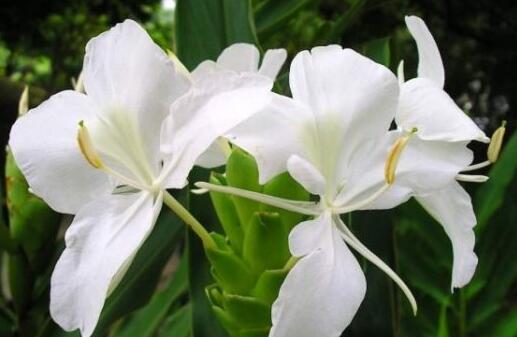
According to the characteristics of ginger lily, its propagation can be asexual or sexual, and the most commonly used method is division propagation. It is not only simple to carry out but also fast to multiply. If planted in February to March, it generally blooms in July to August.
Propagation methods for ginger lily
1. How to divide ginger lily
1. Timing
Usually, division is carried out in spring because the climate is suitable, and repotting or pruning is also done in spring, so the three can be combined to reduce the difficulty of care for enthusiasts.
2. Method
(1) When using division, how do you propagate ginger lily? Dig the underground rhizomes of the ginger lily out of the potting soil. During this process, be careful to dig the plant out together with the soil ball, then clean off the soil from the roots. This can avoid damaging the roots, otherwise it will affect growth after propagation.
(2) Use a tool to divide the rhizomes into several clumps, keeping at least 2-3 buds in each clump, then place them in a cool place for later use. Prepare the flowerpot and growing medium. Generally, a relatively fertile and loose sandy soil is chosen.
(3) Plant the divided daughter plants separately in the growing medium, firm the soil and water thoroughly. If there is no need for transplanting, then before potting you can apply some base fertilizer at the bottom of the pot, then keep the temperature at 22-28 degrees, and after 20-30 days they will sprout and grow.
Care and management after propagation
1. Do not water too much. After division planting, there is no need to water too much. Water thoroughly the first time, and afterward choose spraying or bottom-watering from the saucer according to the moisture condition of the soil. The cut surfaces of the rhizomes must not rot because the growing medium is too wet, otherwise propagation can easily fail.
2. Provide good shade. The plant is best placed in a bright spot with light but not direct sunlight. Even if propagation succeeds, shade should still be provided when summer arrives. If the light is too strong, it will affect growth and flowering. Suitable light can prolong the flowering period of ginger lily.
3. Propagate at the right time. Ginger lily grown from seedlings will generally grow lush and full in about March to April. At this time the flowerpot may become crowded, so 3-4 year old ginger lily is most suitable for propagation. When propagating, you can prepare several more flowerpots and choose the propagation quantity according to need.
Cultivation methods and precautions for Hedychium gardnerianum
Chinese scientific name: Hedychium gardnerianumAlso known as: Kahili gingerKingdom: PlantaeFamily: ZingiberaceaeGenus: HedychiumDistribution area: suitable for growing in the Guangzhou regionHedychium gardnerianum (scientific name: Hedychium gardnerianum) is a perennial herbaceous plant in the family Zingiberaceae and genus Hedychium. Hedychium gardnerianum was originally a hybrid variety, and planting results separated out two different flower color type materials: golden flowers and pink flowers.1. Morphological characteristics
The leaf shape of Hedychium gardnerianum closely resembles edible ginger, and the plant height is about 1.5 m. The underground rhizome is well developed, growing horizontally and creeping, thick and pale yellow like edible ginger. The leaves are green, entire, smooth, long elliptic-lanceolate, 40 cm long and 5-6 cm wide, with a caudate-acuminate apex and a narrowed base; the petiole is short and the leaf sheath is green. The initial flowering period is late May, the full flowering period is June to October, and the flower quantity drops sharply in November. The spike is terminal, the bracts are green, ovate or obovate, with a rounded or acuminate apex, and each bract generally contains 3-5 small flowers. The small flowers are densely borne, with 3 petals, the edges pale yellow and the center golden yellow, and the style is elongated and exposed; they gradually open from the lower part upward, each plant can continuously open up to 80 small flowers, and the flowering period on the plant can last more than 1 month.2. Growth habits
Tests show that Hedychium gardnerianum is suitable for growing in the Guangzhou region. Apart from slightly inhibited growth due to low winter temperatures, the plant grows vigorously the rest of the time and has strong stress resistance. It prefers a semi-sunny environment, and slight shading is beneficial to growth and gives better cut flower quality. The optimum growth temperature is 25-30 degrees C, and it can tolerate both the high temperatures of summer and the relatively low temperatures of winter. Below 0 degrees C, the leaves suffer slight cold damage, but the aboveground parts still do not wither.3. Cultivation techniques
Seedling propagation techniques
There are sexual propagation and asexual propagation. Hedychium gardnerianum can set a small amount of scattered seed locally, so sexual propagation is of little significance. Tissue culture has been successfully achieved, enabling rapid factory-scale seedling propagation. Its tissue culture technique is: cut sprouted young buds from the underground rhizome of Hedychium gardnerianum, disinfect them, and first induce buds on MS 6-BA 5.0 mg/L NAA 0.2 mg/L medium. After the buds grow out, transfer them to MS 6-BA 3.0 mg/L NAA 0.1 mg/L medium for adventitious bud induction. When the plantlets grow to 2 cm, cut them off and transfer them to MS NAA 0.1 mg/L medium for rooting induction. Division propagation is also fast and effective. Cut divisions from a clump of mature plants and plant them in February or March of the same year, and they can bloom in May or June. Over the whole year they can produce about 20-40 new plants, with good flower quality and high yield. Tissue-cultured plantlets can generally also bloom in the same year, but the quality is poorer and the yield is also lower.Planting methods
Hedychium gardnerianum has strong adaptability to soil. The most suitable cultivation soil is fertile, loose, well-drained loam or sandy loam, but the soil should often remain moist or be close to a water source, which makes growth more vigorous. It can be planted in spring, summer, and autumn, but planting in February or March of spring is best, and division planting can obtain high yield in the same year. In the same year, the average yield per mu is nearly 2000 stems/month, and in the second year the yield per mu can reach more than 2200 stems/month. Before planting, plow the soil deeply, apply sufficient base fertilizer, and make deep furrows and high beds. Use single-row or double-row planting, with a planting spacing of 50 x 50 cm, and plant 2500-3000 plants per mu. If fertilizer and water management conditions are good, it can bloom in late May of the same year. When one seedling or rhizome is planted, over the whole year it can produce about 20-40 new plants, and it can bloom after growing to more than about 15 leaves.Field management
Hedychium gardnerianum has strong tillering ability and a large annual growth volume, and it needs a relatively sufficient supply of fertilizer and water throughout the growth period. Generally, a three-element compound fertilizer should be applied as a top dressing 1-2 times per month. During flowering, a more sufficient supply of fertilizer and water should be maintained. During the full flowering period, straw or growing medium can be used as mulch, which helps retain fertilizer, warmth, and moisture. In winter, earthing up and covering with compost help the underground rhizome thicken and promote the regeneration of new plants the following spring. If a cold wave strikes, plastic film can be used for insulation during freezing to avoid cold damage. Generally after 3 years of planting, the underground rhizome tends to age, and the plant's regeneration ability and resistance weaken, leading to worsened pests and diseases and an increase in weak diseased plants, affecting product quality. Therefore, division should be carried out again and new land arranged for crop rotation, which is beneficial for preventing and controlling the occurrence of pests and diseases, maintaining strong plant growth, promoting the plant's regeneration ability, obtaining higher yield, and improving product quality.Harvesting
Hedychium gardnerianum has a long continuous harvest period and high yield. Fresh cut flowers must be harvested at the right time. The best is to harvest when the inflorescence is full, with 8-10 flower buds exposed and still unopened, for market. The harvest time should preferably be before 9:00 in the morning or in the evening, and where conditions allow, water can be sprayed once before harvest. The cut flowers should be promptly immersed in a flower bucket for preservation, placed in a cool and moist place, and sprayed several times to maintain moisture, which helps prolong the vase life. After harvest, the cut flowers should be concentrated in a cool and moist environment, graded and packaged according to quality grade classification standards, and during transport the temperature should be regulated at about 27 degrees C. Too high a temperature easily promotes the opening of flower buds. In an environment with an indoor temperature of 27 degrees C and relative humidity of 80-90%, the vase life can be greatly prolonged, reaching more than 7 days.Key cultivation points for Hedychium gardnerianum
1. Seedling propagation techniques
There are sexual propagation and asexual propagation. Division propagation is fast and effective. Cut divisions from a clump of mature plants and plant them in February or March of the same year, and they can bloom in May or June. Over the whole year they can produce about 20-40 new plants, with good flower quality and high yield. Tissue-cultured plantlets can generally also bloom in the same year, but the quality is poorer and the yield is also lower.
2. Planting season and planting methods
Hedychium gardnerianum has strong adaptability to soil. The most suitable cultivation soil is fertile, loose, well-drained loam or sandy loam, but the soil should often remain moist or be close to a water source, which makes growth more vigorous. It can be planted in spring, summer, and autumn, but planting in February or March of spring is best, and division planting can obtain high yield in the same year. In the same year, the average yield per mu is nearly 2000 stems/month, and in the second year the yield per mu can reach more than 2200 stems/month. Before planting, plow the soil deeply, apply sufficient base fertilizer, and make deep furrows and high beds. Use single-row or double-row planting, with a planting spacing of 50 x 50 cm, and plant 2500-3000 plants per mu. If fertilizer and water management conditions are good, it can bloom in late May of the same year. When one seedling or rhizome is planted, over the whole year it can produce about 20-40 new plants, and it can bloom after growing to more than about 15 leaves.
3. Field management
Hedychium gardnerianum has strong tillering ability and a large annual growth volume, and it needs a relatively sufficient supply of fertilizer and water throughout the growth period. Generally, a three-element compound fertilizer should be applied as a top dressing 1-2 times per month. During flowering, a more sufficient supply of fertilizer and water should be maintained. During the full flowering period, straw or growing medium can be used as mulch, which helps retain fertilizer, warmth, and moisture. In winter, earthing up and covering with compost help the underground rhizome thicken and promote the regeneration of new plants the following spring. If a cold wave strikes, plastic film can be used for insulation during freezing to avoid cold damage. Generally after 3 years of planting, the underground rhizome tends to age, and the plant's regeneration ability and resistance weaken, leading to worsened pests and diseases and an increase in weak diseased plants, affecting product quality. Therefore, division should be carried out again and new land arranged for crop rotation, which is beneficial for preventing and controlling the occurrence of pests and diseases, maintaining strong plant growth, promoting the plant's regeneration ability, obtaining higher yield, and improving product quality.
4. Pest and disease control
Hedychium gardnerianum grows coarsely and quickly, has strong adaptability, good stress resistance, and strong resistance to pests and diseases. In production, the main problems include stem borers (boring worms) boring into the heart and causing damage, tobacco cutworms biting and eating young tender leaves, and mole crickets damaging underground tubers. Generally in the early flowering period in May and June, it is susceptible to damage by boring stem borers. Adults lay eggs in leaf axils or at the top of the plant, and after hatching they bore in and damage the heart, causing the top of the plant to die, preventing flowering or breaking the flower stems, and seriously affecting yield and quality. For control, prevention should be primary, with careful observation and early spraying, seizing the adult egg-laying period and early larval stage for spraying. You can use trichlorfon 800-fold solution, or cartap 1000-fold solution, or chlorpyrifos 1500-fold solution for spray control. Spraying continuously three times or more can achieve a good control effect.
5. Harvesting and preservation of fresh cut flowers
Hedychium gardnerianum has a long continuous harvest period and high yield. Fresh cut flowers must be harvested at the right time. The best is to harvest when the inflorescence is full, with 8-10 flower buds exposed and still unopened, for market. The harvest time should preferably be before 9:00 in the morning or in the evening, and where conditions allow, water can be sprayed once before harvest. The cut flowers should be promptly immersed in a flower bucket for preservation, placed in a cool and moist place, and sprayed several times to maintain moisture, which helps prolong the vase life. After harvest, the cut flowers should be concentrated in a cool and moist environment, graded and packaged according to quality grade classification standards, and during transport the temperature should be regulated at about 27 degrees C. Too high a temperature easily promotes the opening of flower buds. In an environment with an indoor temperature of 27 degrees C and relative humidity of 80%-90%, the vase life can be greatly prolonged, reaching more than 7 days.