How to propagate the variegated spider plant (Chlorophytum comosum 'Vittatum')? Two methods: cuttings and division
As a common indoor potted plant, the variegated spider plant is highly useful: it not only looks good, but also absorbs formaldehyde, and has good medicinal applications. Such a plant is naturally very popular and sought after by many plant lovers, and it is therefore propagated in large quantities. So how do you propagate the variegated spider plant? Below are the two propagation methods for the variegated spider plant; follow along with the editor to learn more.
I. How to propagate the variegated spider plant: cuttings / division
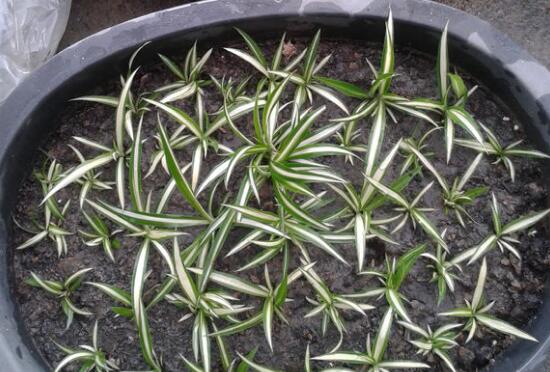
As the finest of the spider plants, the variegated spider plant is not the easiest to grow, but with a little care it can be mastered perfectly. If you are an experienced grower, besides knowing how to grow it, you should also know how to propagate the variegated spider plant, which adds to the fun of growing it. As for how to propagate the variegated spider plant, there are mainly two methods: cuttings and division. Let's look at the specific steps below.
II. The two propagation methods for the variegated spider plant
(1) Propagating the variegated spider plant by cuttings
The variegated spider plant is a common indoor potted plant, so the most commonly used method to propagate it is cuttings. During the growing season, take a section of a variegated spider plant stem and insert it into propagation soil; with careful care, one pot of variegated spider plant can become many pots. Next, let's look at the specific steps:
1. Cutting time
To propagate the variegated spider plant by cuttings, you must choose a good time. The variegated spider plant likes a warm environment, so spring and autumn are its peak growing seasons, and this is the best time for cuttings.
2. Cutting medium
Cuttings naturally need soil. According to the growing habits of the variegated spider plant, you should choose soil that is loose, breathable and well-draining. For this, the editor recommends using vermiculite, or a mix of coir brick soil + perlite.
3. Choosing the cuttings
In the whole cutting propagation process, choosing the cuttings is especially key. From a healthy, well-growing variegated spider plant, cut off a stolon, then cut off the small plantlet to use as the cutting, as shown in the picture above.
4. Starting the cuttings
Once the above work is done, the cutting of the variegated spider plant can officially begin: insert the cuttings into the prepared soil, then water the soil thoroughly so the cuttings and soil are tightly combined; if conditions allow, cover with a plastic bag.
(2) Propagating the variegated spider plant by division
Besides cuttings, division is also the most commonly used propagation method for the variegated spider plant. Method: in March, on a healthy, well-growing variegated spider plant, choose and separate the clustered old plants for division and planting, or cut off the small plantlets on the stolons for planting. After that, fertilize moderately, then place the pot in a sunny spot indoors and care for it carefully.
Overall, propagating the variegated spider plant is not difficult; both cuttings and division can survive, but when it comes to survival rate, cuttings are the best. Of course, methods are fixed while people are flexible; you can choose a method to propagate according to the actual situation. That's all from the editor on the propagation methods of the variegated spider plant; I hope it helps everyone.
How to propagate the green spider plant (Chlorophytum comosum): illustrated propagation methods / division has a high survival rate
The green spider plant, one member of the many spider plants, is not as beautiful as the golden-edged spider plant or the variegated spider plant, but it wins for being fresh and elegant. Moreover, the green spider plant is highly useful, especially its ability to absorb formaldehyde, which is astonishingly strong. Such a plant is naturally propagated in large quantities, so how do you propagate the green spider plant? Below are the three propagation methods for the green spider plant; follow along with the editor to learn more.
I. How to propagate the green spider plant: division / cuttings / sowing
As the most common variety among spider plants, the green spider plant is not difficult to grow; you just need to be a little careful to grow it well. If you are an experienced grower, besides knowing how to grow it, you should also master the propagation methods of the green spider plant, so that growing it is more interesting. As for how to propagate the green spider plant, there are mainly three methods: division, cuttings and sowing. Let's look at the specific steps below.
II. Illustrated propagation methods for the green spider plant
(1) Propagating the green spider plant by division
Among the propagation methods for the green spider plant, the most convenient is division. Method: take a mature, healthy green spider plant out of its pot, clean off the soil, cut apart a portion of the root system (leaving at least three stems), then transplant them into new pots to grow and care for.
(2) Propagating the green spider plant by cuttings
1. Cutting time
Besides division, the most commonly used propagation method for the green spider plant is cuttings. The best time for cuttings is spring and autumn, when the green spider plant is in its peak growing season and the survival rate of cuttings is highest.
2. Cutting medium
According to the growing habits of the green spider plant, you should choose soil that is loose, breathable and well-draining. For this, the editor recommends using vermiculite, or a mix of coir brick soil + perlite.
3. Choosing the cuttings
The cutting is the most critical part of propagating the green spider plant by cuttings; it can be said that if it is chosen well, more than half of the whole cutting process is already successful. Plant lovers can cut off a stolon from a healthy, well-growing green spider plant, and cut 5-10 cm from it to use as the cutting.
4. Starting the cuttings
How do you propagate the green spider plant? Once the above work is done, the cutting propagation of the green spider plant can officially begin: insert the cuttings into the prepared soil, water thoroughly once, then place in a cool, ventilated spot and wait for roots to form; generally roots will form in 3 to 4 weeks.
(3) Propagating the green spider plant by sowing
After the green spider plant flowers, seeds can be obtained through certain steps, so sowing can also be used for propagation. Method: in March each year, scatter the green spider plant seeds, cover with 0.5 cm of soil, and water with an appropriate amount of water. At a temperature of 15°C, they will root and sprout in about 2 weeks; once the seedlings have formed, transplant them.
Overall, propagating the green spider plant is not difficult; whether by cuttings, division or sowing, they can all root and survive, but when it comes to convenience, division is the best. Of course, methods are fixed while people are flexible; you can choose a method to propagate according to the actual situation. That's all from the editor on the propagation methods of the green spider plant; I hope it helps everyone.
How to grow and cultivate the variegated spider plant
Plants are becoming more and more common in households, and growing plants is a very widespread phenomenon. I wonder if everyone has heard of the variegated spider plant. What is the method for growing the variegated spider plant? What is the method for cultivating the variegated spider plant? Below, the editor will take everyone through some knowledge on this subject. Let's take a look, and I hope it helps everyone.
How to grow the variegated spider plant
The variegated spider plant likes warmth and humidity, and likes partial shade; in summer it should avoid scorching sun. It has relatively high requirements for soil and likes loose, fertile, sandy soil. The variegated spider plant has poor cold tolerance and does not like a hot growing environment; in summer, pay attention to shading, and in winter, pay attention to keeping it warm. At a room temperature of 20°C, the stems and leaves grow quickly; in winter the temperature must not be lower than 5°C. The flowering period is between spring and summer. The variegated spider plant likes a warm, damp and shady climate and is suited to growing long-term in a humid, partially shaded environment.The variegated spider plant has slender leaves, linear-lanceolate, with yellow-white longitudinal stripes in the center, clasping the stem at the base, bright green. Its place of origin is South Africa; it is a common flower and is widely planted separately. The flowers are white, with 6 perianth segments, and the flowering period is spring and summer. Flower language: "Helpless yet giving people hope." It is a common green plant for office and home bonsai. Stolons emerge from the leaf axils, extend out of the plant clump, curve outward, and bear small plantlets with aerial roots at the tips.
Placing the variegated spider plant at home gives it ornamental value. The variegated spider plant is an excellent indoor hanging foliage plant; it can be planted inlaid in roadside stone crevices, or used to accent water-and-stone or tree-stump bonsai, all with distinctive character. The variegated spider plant has medicinal value; its medicinal value is very high, and the whole plant can be used as medicine. It has the effects of nourishing yin and moistening the lungs, clearing heat and resolving phlegm, relieving cough and expelling phlegm, as well as invigorating blood. It can be used to treat fever, lung heat or lung yin deficiency, cough, vomiting blood and coughing blood, and other conditions.
In addition, it can also be decocted and taken to treat pharyngitis and other oral diseases. The variegated spider plant also has environmental value; it has a very good air-purifying effect and can absorb harmful gases in the air such as carbon monoxide, carbon dioxide, formaldehyde and benzene; in addition, the odor given off by the spider plant can also kill germs in the air.
Cultivating the variegated spider plant
Cultivating the variegated spider plantThe variegated spider plant is an evergreen herbaceous plant of the genus Chlorophytum in the Liliaceae family. The plant grows in clumps, with fleshy short rhizomes and slender, strip-shaped lanceolate leaves, bright green, with relatively wide yellow-white longitudinal stripes in the middle; the raceme is terminal, with small white flowers.
The variegated spider plant likes a warm, humid, partially shaded environment; it is not cold-tolerant and fears exposure to scorching sun. During high summer temperatures, it should be kept under a shade awning or in the shade of trees. In daily care, keep the potting soil moist but not waterlogged, while also creating a small humid-air environment. During the growing season, apply a decomposed dilute liquid fertilizer or compound fertilizer about once every 20 days; when fertilizing, do not splash the fertilizer liquid onto the leaves. In winter, keep it indoors in a spot with sufficient light; if the temperature is not lower than 10°C and there is a certain day-night temperature difference, water normally and apply a light fertilizer once a month; if the room temperature is lower than 10°C, control watering and stop fertilizing to let the plant go dormant. Repot once every spring; the potting soil should preferably be loose, fertile, rich in humus, and well-draining, breathable sandy loam. When repotting, remove rotten roots and old roots with no absorbing ability.
The propagation of the variegated spider plant is mainly by division and cuttings. Division is generally done together with spring repotting; the method is to split the clustered plant into several plants and plant them separately. Cuttings are done during the growing season; cut off the small plantlets at the front end of the stolons and plant them in pots. Whether propagated by cuttings or division, after the new plants are planted they must be placed in a spot without sunlight, and once the root system has recovered, carry out normal care.