How to Propagate Cypress Vine and When to Sow: April Is the Best Time
Cypress vine is an extremely fast-growing plant, often grown as an annual, so after growing it for a while, flower lovers need to think about propagation. Cypress vine is quite distinctive when it comes to propagation: it can reproduce by self-seeding, but home cultivation generally requires manual raising. So how do you propagate cypress vine? Let's take a look at the propagation methods for cypress vine.
How to Propagate Cypress Vine
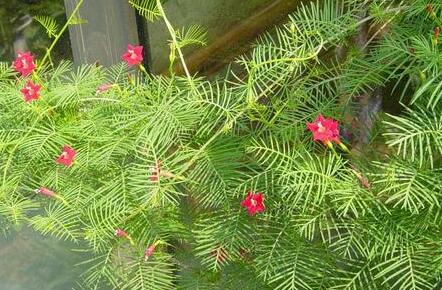
Wild cypress vine self-seeds, but cultivated cypress vine generally uses two propagation methods: sowing and cuttings, of which sowing is used more often. When sowing, however, you must pay attention to technique, such as collecting the seeds and choosing the time. Let's look at the specific methods below.
Propagating Cypress Vine by Sowing
1. When Is the Best Time to Sow Cypress Vine
The editor suggests sowing in April each year, because seeds take root easily at this time. Collecting the seeds, however, does not happen in April; rather, they should be collected as they ripen, because the fruits mature at different times and drop off easily once ripe. So watch the ripening times carefully and collect the seeds as soon as they are ripe.
2. How to Sow Cypress Vine
(1) How do you propagate cypress vine when sowing? Usually a seedling tray is used. Scatter the collected cypress vine seeds on the seedbed, then cover with 1-2 cm of fine soil, water from the bottom of the tray, and keep the temperature between 20-25°C; seedlings will emerge after 4-7 days.
(2) After emergence, the seedlings need to be grown on for a while longer; generally about 45 days, until new branches appear, before transplanting. After transplanting, carry out care and management according to cypress vine growing methods. During the seedling stage, be careful to prevent the vines from tangling together, and make sure the soil stays moist and does not dry out, otherwise the young seedlings may wither and die.
3. Points to Note
When selecting seedlings, be sure to plant the red and white ones separately, because cypress vine flowers come in both white and red. The seeds must be collected separately and sown separately, and must never be mixed together, otherwise sowing is likely to fail.
Propagating Cypress Vine by Cuttings
1. Can Cypress Vine Be Propagated by Cuttings
Cuttings are a common propagation method for growing many plants. Since cypress vine is an annual plant, can it be propagated by cuttings? Some flower lovers currently believe it can be, but some botanists believe it can only be propagated by sowing, so there is some controversy. Below, we share the methods of flower lovers who have tried cuttings.
2. How to Take Cypress Vine Cuttings
Cuttings are usually taken in early spring, using relatively robust branches growing on the plant as cuttings. When preparing the cuttings, cut the branches into 5-15 cm lengths, keeping more than 3 leaf nodes, with a flat cut at the bottom, then leave them in a shady spot to dry.
Insert the cuttings into the prepared substrate, made from a mix of potting soil and fine sand. Firm it down and water thoroughly, keep the temperature at 20-30°C, and place in a shady spot. When the temperature is higher, mist appropriately to keep humidity at around 75%; after a period of time they will take root.
When to Sow Cypress Vine: Propagation Methods and Growing of Cypress Vine
Cypress vine is native to Mexico and is also known as mi luo song, commonly called five-pointed star flower and lion grass. It was introduced to England for cultivation in 1629, and later introduced to China. Cypress vine's propagation methods include sowing, cuttings and layering. If sowing is used, when should cypress vine be sown? Let's learn the relevant information together below.
Introduction to Cypress Vine
Cypress vine, native to Mexico, is also known as mi luo song, commonly called five-pointed star flower and lion grass. The Book of Songs says: "The tu is the female luo, spread upon the pines and cypresses," meaning brothers and relatives clinging to one another. The tu is mistletoe, and the female luo is dodder; both are plants that parasitise pines and cypresses. Cypress vine's form closely resembles the tu and the female luo, so the two names were combined to name it (also known as cypress vine pine (Flower Calendar Hundred Odes, Great Dictionary of Botany), feather-leaf cypress vine, brocade screen seal (Illustrated Guide to Higher Plants of China), golden silk thread (Guangxi), swimming dragon grass, and twining dragon flower). The flowering period is long; in China, in the Anhui, Hubei and Hunan areas, the flowering period can run from April to November each year. It has low requirements for soil and fertiliser; scattering seeds on moist soil is enough for them to germinate, with a germination rate above 95%.
I. Morphological Characteristics
Overview: Cypress vine is an annual, slender, twining herb, hairless.
Leaves: The leaves of cypress vine are ovate or oblong, 2-10 cm long and 1-6 cm wide, simple leaves arranged alternately. The leaf lobes are slender like threads, pinnately parted almost to the midrib, with 10-18 pairs of linear to thread-like, flat, fine lobes, the lobe tips sharply pointed; the petiole is 8-40 mm long and the base often has false stipules.
Flowers: The inflorescence of cypress vine is axillary, consisting of a few flowers in a cyme; the peduncle mostly exceeds the leaves, 1.5-10 cm long. The flowers are upright, the pedicel longer than the calyx, 9-20 mm long, thickening into a club shape when in fruit; the sepals are green, slightly unequal in length, elliptical to oblong-spatulate, the outer one slightly shorter, about 5 mm long, with a blunt tip bearing a small point; the corolla is salver-shaped, about 2.5 cm or more long, deep red, hairless, the tube slender and slightly swollen above, the limb spreading, about 1.7-2 cm in diameter, with 5 shallow lobes; the stamens and style protrude; the filaments are hairy at the base; the ovary is hairless. It bears several small five-pointed-star-shaped flowers in a vivid deep red; besides red, there are also white ones.
Cypress vine's flowering period runs from early July to late September, with a batch opening each day, opening in the morning and wilting by the afternoon.
Fruit: Cypress vine's capsule is ovate, 7-8 mm long, 4-chambered, splitting into 4 valves, with the septum persistent and transparent. There are 4 seeds, ovate-oblong, 5-6 mm long, dark brown. Cypress vine's slender, smooth trailing stems can reach 4-5 m long; they are soft and highly capable of climbing, making it an ideal hedge plant. Cypress vine's fruit ripening period is September-November.
II. Ecological Habits
Cypress vine likes light and a warm, humid environment, growing in areas from 0 to 2,500 m above sea level. It is not cold-tolerant and can self-seed (generally introduced and cultivated by humans), and requires fertile soil.
Cypress vine has strong resistance to adverse conditions and is simple to manage. The capsule contains 4 seeds; after ripening they fall to the ground on their own and grow by themselves the following year. If sowing by hand, sow in March. Transplant when the seedlings are 10 cm long. To encourage more flowers, it should be planted in a sunny spot in fertile soil. Potted plants need a support for them to twine around, and when in bloom they are extremely delicate and lovely.
When to Sow Cypress Vine?
It was introduced to England for cultivation in 1629, and later introduced to China. Cypress vine is best propagated by seed. Sow in early April; after sowing, pay attention to shading and keep the seedbed moist, and seedlings will emerge in about a week.
I. Cultivating cypress vine is relatively simple:
1. Open-Ground Planting
Choose a sheltered, sunny spot with good drainage. Besides applying base fertiliser, liquid fertiliser should be applied 1-2 times before flowering. When transplanting, be sure to water thoroughly; afterwards, watering once a week is enough. (Note: once cypress vine has grown into a large seedling, it should not be transplanted.)
2. Potted Cypress Vine
When potting, put a little base fertiliser in the bottom of the pot, and afterwards apply liquid fertiliser once a month. Water in a timely way, but do not let water accumulate.
3. Thin Out Vines and Leaves Appropriately
This not only helps ventilation and light penetration but also makes the plant shape more graceful. After the flowers fade, remove the spent flowers promptly so the plant does not set seed, concentrating nutrients on new branches for flowering and extending the flowering period.
Conditions: Because cypress vine is native to tropical regions, it likes warmth, dislikes cold and fears frost; growth is very slow when temperatures are low. The suitable temperature for seed germination is 20-25°C. It requires a sunny environment; most types are not strict about day length, but the firecracker vine (Quamoclit lobata) only flowers when daylight is shorter than 12 hours. It is not strict about soil, but grows well in fertile, loose soil.
The thousand-seed weight of feather-leaf cypress vine is around 139, and the seeds can be used for 3-4 years. The fruits ripen unevenly and drop easily once ripe, so collect them as they ripen. Each fruit contains 3-4 seeds; if you have both red-flowered and white-flowered plants, collect the seeds separately.
Propagation Methods for Cypress Vine
1. Propagation by Sowing
In spring, raise seedlings in a protected area; the seedling-raising period before transplanting to open ground after the last frost is about 45 days, and it should not be too long, otherwise the vines growing from the seedlings will tangle together.
Sowing and growing seedlings with ordinary seedling nutrient soil is enough for good growth. Sow in a seedling tray. Sow about 100 g per square metre of seedbed, and after sowing cover with about 1.5 cm of fine soil; it must not be too thin, otherwise seedlings may emerge with the seed coat still attached. Keep the soil temperature at 20-25°C; dry seeds emerge in 4 days. Seedlings of feather-leaf cypress vine and maple-leaf cypress vine are shown in Figure 7. Cypress vine emerges easily but often unevenly, so select seeds carefully to get uniform seedlings. The author has observed that cypress vine seedlings are very afraid of drought; when drought is even slightly severe they wither and die, and even watering cannot easily revive them, so special attention must be paid to this when raising seedlings. Because it is a taproot plant, it is best to grow seedlings in plastic seedling pots 8 cm in diameter, and to transplant only once, with 1 seedling per container. A 72-cell tray can also be used to grow seedlings, and water supply must also be watched during seedling growth. In the middle and later stages of seedling raising, soil moisture should be controlled at a moderate level. During the seedling stage, always give plenty of light. If the seedlings are fairly large and the vines have tangled together, separate them as early as possible, moving the seedling pots a certain distance apart if necessary.
The red flowers of feather-leaf cypress vine are more gorgeous than the white ones, and most people prefer the red flowers. But even if only red-flowered seeds are collected, many offspring may still segregate out white flowers. The seeds are hard to distinguish, but the seedlings are easy to tell apart. The stems of red-flowered plants are deep red, while the stems of white-flowered plants are green; with careful observation they can be told apart well. If you select seeds carefully every year and pay attention to isolation, the proportion of mixed colours in the offspring will become smaller and smaller.
Cultivation and Management: Transplant after the last frost; in areas where night temperatures are still relatively low, early transplanting is generally not recommended. Cypress vine has strong self-seeding ability; if you do not mind when flowering begins, you can also use self-sown seedlings in the second year of cultivation, but because the seeds are not selected and the seedlings emerge late, the landscaping effect is somewhat poorer. Cypress vine has a large growth volume, so apply plenty of base fertiliser, spread it evenly, and dig it in deeply. Dig holes for transplanting, remove the plastic seedling pot, plant the seedling in the hole, 1 plant per hole, cover the root ball with fine soil, then water and cover with soil to close the hole. For single-row planting, the plant spacing is about 35 cm; for seedling cultivation or fertile soil, the spacing should be appropriately larger; self-sown seedlings emerge late and grow later, so the spacing should be appropriately smaller. Timely watering can promote stem and leaf growth, but be careful not to let it grow excessively, which may delay flowering. In the early stage, guide the vines by hand onto trellises, fences, trees or other supports. In the middle and later stages the plant has a very strong climbing ability of its own; apart from shaping, there is no need to manage it, just let it climb and twine. Potted plants should be watered and fertilised regularly. (It can also be grown indoors in winter, but attention should be paid to room temperature, light and other conditions.)
In northern households, cypress vine can also be grown in winter. After heating is supplied at home, use the "paper towel cultivation method" (also called sprouting) to make cypress vine seeds germinate in a short time. Once the seeds show tender sprouts, scatter them into a flowerpot and cover with 1-1.5 cm of soil to ensure the growth of the cypress vine. After about a week, the cypress vine will take root and sprout; at this point the seedlings must be handled with care. Because there is less light in winter, you need to choose a spot with relatively ample light to grow cypress vine; it is recommended to place it in a south-facing room, and to place the flowerpot relatively close to the heating to ensure a suitable temperature.
2. Propagation by Cuttings
Softwood cuttings are often taken from current-year branches in late spring and early autumn, or hardwood cuttings are taken from last year's branches in early spring.
For softwood cuttings, when the plant is growing vigorously from late spring to early autumn, choose robust current-year branches as cuttings. After cutting the branches off, select the sturdy parts and cut them into 5-15 cm lengths, each with more than 3 leaf nodes. When taking the cuttings, note that the upper cut should be made about 1 cm above the topmost leaf node with a flat cut, and the lower cut about 0.5 cm below the lowest leaf node with a slanted cut; both cuts should be smooth (the blade must be sharp). For hardwood cuttings, after temperatures rise in early spring, choose robust branches from last year as cuttings. Each cutting usually keeps 3-4 nodes, and the cutting method is the same as for softwood cuttings. After cutting, manage them properly.
Temperature: The optimum temperature for cuttings to take root is 20-30°C. Below 20°C, rooting is difficult and slow; above 30°C, the upper and lower cuts of the cuttings are easily infected by pathogens and rot, and the higher the temperature, the greater the proportion that rot. If low temperatures occur after cutting, the main measure to keep warm is to wrap the flowerpot or container used for cuttings with plastic film; if the temperature is too high after cutting, the main cooling measure is to shade the cuttings, blocking out 50-80% of sunlight, and at the same time mist the cuttings 3-5 times a day; on sunny days with higher temperatures, mist more often, while on cloudy and rainy days with lower temperatures and higher humidity, mist less often or not at all.
Humidity: After cutting, the relative humidity of the air must be kept at 75-85%. The basic requirement for cuttings to root is that before they root, the cuttings must be kept fresh so they can photosynthesise to produce rooting substances. But cuttings that have not rooted cannot absorb enough water to maintain their internal water balance, so misting must be used to reduce water loss from the cuttings: under shaded conditions, mist the cuttings 3-5 times a day; on sunny days the higher the temperature, the more often you mist, while on cloudy and rainy days the lower the temperature, the less often you mist or not at all. But excessive misting makes cuttings prone to infection by pathogens and rot, because many kinds of pathogens exist in water.
3. Propagation by Layering
Select a robust branch, and about 15-30 cm below the growing tip, remove a ring of bark. The wound after peeling should be about 1 cm wide, and only as deep as just removing the outer bark. Cut a piece of plastic film 10-20 cm long and 5-8 cm wide, put some moistened garden soil on it, and wrap it around the girdled part as if bandaging a wound, tying the top and bottom ends of the film tightly so it bulges in the middle. Roots form in about four to six weeks. After rooting, cut off the branch together with the roots, and it becomes a new plant.
Cypress Vine Sowing Method and Time: Cypress Vine Propagation Methods
Cypress vine is a herbaceous plant. Its flowers are deep red, and can also be white; from a distance they look like little red trumpets, and up close the flowers are red five-pointed stars, bright and eye-catching, so in many places it is also called five-pointed star flower. So do you know how to grow cypress vine? Let's learn about cypress vine growing methods together with the editor below!
Cypress Vine Sowing Method and Time
Sowing time for cypress vine: Cypress vine is suitable for sowing in early spring in March-April; southern regions can sow earlier, while northern regions should sow a little later.
Sowing method for cypress vine: Cypress vine can be sown directly in the open ground, and can also be sown in a shallow pot. Once seedlings grow, use fine string to guide them, making all kinds of flower-stand bonsai. Sow 5-7 seeds in the pot by dibbling, cover with about 0.5 cm of soil, and keep the soil in the pot moist; seedlings emerge in about 10 days. Half a month later, thin the seedlings, removing the weak and keeping the strong, keeping 3-4 cypress vine seedlings. When the seedlings are 8-10 cm tall, pinch out the growing tips to encourage more branching and more flowers.
Cypress Vine Propagation Methods
1. Propagation by Sowing
Cypress vine emerges easily, and sowing by hand is also very simple. In spring, sow and raise seedlings, and once they reach a suitable size, transplant the cypress vine seedlings for cultivation.
First, sow in a seedling tray. Scatter the cypress vine seeds on the seedbed and cover with a layer of fine soil. The temperature for seed germination is between 20-25°C; keep this temperature, and seedlings will emerge 4 days after sowing. After emergence, let them continue growing for a while; after about 45 days of seedling raising they can be transplanted. Note that the vines of the grown seedlings should not tangle together.
Cypress vine seedlings must be given plenty of water during cultivation and must not dry out; once they wither and die, there is no remedy. During the seedling stage, ensure plenty of light, and keep a certain distance between seedlings so they grow vigorously.
One point to note is the selection of cypress vine seedlings. Since cypress vine comes in red and white, and most people prefer red because of its bright colour, when planting, be careful to avoid mixed colours in the offspring. Generally, among cypress vine seedlings, those that will bear red flowers have deep red stems, while those that will bear white flowers have green stems, so they are fairly easy to tell apart.
2. Propagation by Layering
Layering is a common method for propagating flowers. When layering cypress vine, choose a robust branch, take a 15-30 cm section, and remove the outer bark from the branch at a suitable spot. Take a piece of plastic film 10-20 cm long and 5-8 cm wide, wrap it with some soil, and bandage it around the peeled part of the cypress vine like wrapping a wound, letting it root; it usually roots in four to six weeks. After rooting, cut off the branch together with the roots that have grown, and it becomes a new plant. It can then be planted.
Points to Note When Growing Cypress Vine
Although this plant likes moisture and is not drought-tolerant, it is also afraid of waterlogging, so water must not accumulate. Even in summer, when evaporation is at its strongest, do not water so much that the roots sit in water.
In the hot summer season, to replenish enough water, besides appropriately increasing the amount of watering, you can also supply water by humidifying the air or misting the leaves. Even in winter, you can sprinkle some water on the leaves to make them look cleaner.
During the rainy season, if the plant is kept outdoors, drainage should also be done promptly.
Cypress Vine Growth Habits
Cypress vine likes sunlight and is suitable for growing in a warm, humid environment. It is not cold-tolerant and can self-seed. It is not strict about soil, but when grown in fertile soil the flowers are more vivid and the stems and leaves more verdant and lush. It grows vigorously and can be managed roughly in ordinary care. It can be propagated by sowing.
Cypress vine looks delicate and frail, and generally grows by twining. The branches are slender, the leaves ovate, and the leaf lobes slender like threads, feather-like. The flowers are fairly small, five-pointed-star-shaped, deep red, like scattered stars, with a distinctive charm. After flowering, it sets seed.
As described above, cypress vine is a very beautiful flowering plant. Not only is its flower shape lovely and its colour vivid, but its flowering period is also very long, making it deeply loved and sought after by everyone. Do you like the gorgeous cypress vine?