How to water a Norfolk Island pine bonsai, how often to water a Norfolk Island pine / twice a week in summer
As a common ornamental plant, the Norfolk Island pine (Araucaria heterophylla) is not difficult to grow; with a little attention to light, water and fertilizer, you can keep it alive. But keeping it alive is one thing; if you want to grow a beautiful Norfolk Island pine, there are some details you need to pay attention to, especially watering, which must be done in the right amount. So how do you water a Norfolk Island pine bonsai? Next, let's take a look together at the watering methods for a Norfolk Island pine bonsai.
I. How to water a Norfolk Island pine bonsai
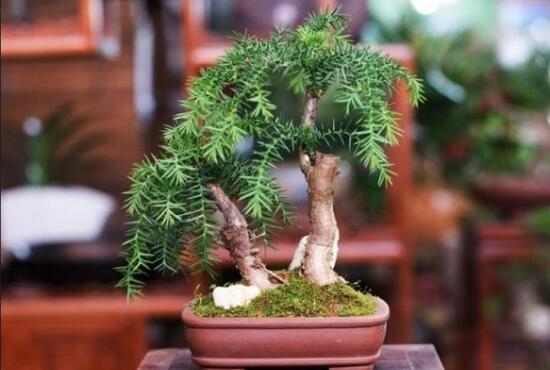
The Norfolk Island pine likes a warm environment. Spring and autumn are its fast growing seasons, and at this time watering should be frequent to keep the potting soil moist, but waterlogging in the pot should be avoided; when temperatures are high in summer, watering should be timely, and you should not wait until the potting soil is dry before watering; from late autumn onward, the growth of the Norfolk Island pine slows down, so watering should be reduced to strengthen its cold resistance.
II. Watering methods for a Norfolk Island pine bonsai
(1) How often to water a Norfolk Island pine
There is no fixed answer to this question; growers need to decide based on how moist the potting soil is. Generally speaking, watering should be more frequent in spring and autumn, but do not let the potting soil become waterlogged; in summer, watering twice a week is enough; in winter, watering should be reduced and kept to once a week.
(2) Four-season watering method for the Norfolk Island pine
1. Watering in spring and autumn, once every 2-3 days
The Norfolk Island pine likes a warm environment, and its most suitable growing temperature is 10-25°C, so spring and autumn are its fast growing seasons. At this time it needs a lot of water, so watering should be more frequent, but do not let water accumulate in the pot. As for the specific watering interval, it can be kept at once every 2-3 days.
2. Watering in summer, twice a week
In summer, the temperature will be very high and water will evaporate faster, so watering must be timely; do not wait until the water in the soil has dried up before watering. Generally, watering twice a week is enough.
Watering method: In summer, when the potting soil of the Norfolk Island pine is in a half-dry, half-moist state, it needs watering. When watering, you can water in a circle along the edge of the pot. If the air is very dry, in addition to watering, you should also spray water around the plant to lower the temperature and increase humidity.
3. Watering in winter, once a week
After winter arrives, the temperature will be very low and the growth of the Norfolk Island pine will slow down. At this time, watering should be reduced and kept to once a week. This not only meets the growth needs of the Norfolk Island pine but also strengthens the plant's cold resistance.
4. Points to note
Besides watering, do not forget fertilizing, especially during the growing season; you should fertilize once every two weeks, preferably combining water and fertilizer. Only in this way can you avoid the appearance of yellowing leaves on the Norfolk Island pine.
How to grow a Norfolk Island pine, how to prune a Norfolk Island pine bonsai
The Norfolk Island pine is an evergreen tree, also called the slender-leaved Norfolk Island pine, etc. The Norfolk Island pine can be placed in the living room, study, office, storefront, etc., and is one of the precious indoor decorative plants. Large Norfolk Island pine bonsai have a majestic presence, while small ones have their own delicate charm. You can choose and prune them according to each person's different preferences. Below, I will share with you in the following text some knowledge about how to grow a Norfolk Island pine and how to prune a Norfolk Island pine bonsai.
How to grow a Norfolk Island pine - cultivation methods for the Norfolk Island pine
1. Soil: The Norfolk Island pine is suitable for well-drained, humus-rich, slightly acidic sandy loam. When potting, a substrate made by mixing garden soil, leaf mold and peat moss is best.
2. Watering: From spring to autumn, the Norfolk Island pine should be watered more, but waterlogging in the pot should be avoided. When it is hot and dry, spray water on the potted plant and the nearby ground to lower the temperature and increase humidity. Watering should be timely; do not wait until the soil is dry before watering. From late autumn onward, gradually reduce watering to strengthen its cold resistance.
3. Light: The Norfolk Island pine likes diffused light and should be placed in a bright spot indoors. If it is kept in a dark place for a long time, it should be moved into the sunlight every few weeks for appropriate exposure, which can keep the deep green leaves a beautiful color.
4. Temperature: The growing season is long; except when the summer temperature exceeds 32°C, the Norfolk Island pine can grow all year round.
5. Fertilizing: During the growing season, apply fertilizer once every 2 weeks, preferably a compound fertilizer containing nitrogen and potassium. Insufficient fertilizer can easily cause the branches and leaves to turn yellow.
6. Pests and diseases: The Norfolk Island pine has very few pests and diseases. When cared for indoors, scale insects are commonly seen. You can spray methidathion, chlorpyrifos emulsifiable concentrate, Guoguang Jie Bisi, etc. for control, with good results.
How to grow a Norfolk Island pine - points to note when cultivating the Norfolk Island pine
1. Summer and autumn are the growing seasons. Potted plants can be placed in a semi-shaded spot outdoors, or kept in a ventilated spot with light near a window. Avoid exposure to blazing sun above 35°C, and do not keep it for a long time in a lightless, shaded place. Either of these will cause the branches and leaves to wither and yellow or to grow leggy, affecting their ornamental value.
2. During growth, to prevent the trunk from leaning to one side, it is best to turn the pot once every half month so the plant receives light evenly. In addition, the trunk of young trees is fragile and easily bends and deforms, so from the young plant stage a support should be set up to fix the trunk. To prevent the plant from growing too tall, it should be repotted once every 2-3 years after the weather warms in spring. Usually, take care to protect the side branches so they are not damaged and affect the plant's shape.
3. Under normal conditions, the Norfolk Island pine does not need branch pruning; let it grow naturally. The suitable growing temperature is 10-25°C, and the overwintering temperature is above 5°C. During the overwintering season, a certain amount of light can be given, the potting soil should not be too dry, and on clear days water should also be sprayed to increase humidity.
How to prune a Norfolk Island pine bonsai
1. Heading back. This pruning method is to cut off part of the overly long branches growing on the Norfolk Island pine. The purpose of doing this is to stimulate its lateral buds to sprout quickly and grow new branches, improving the visual ornamental effect of the Norfolk Island pine.
2. Thinning. This pruning method is to cut the branches of the Norfolk Island pine off from the fork. Doing this can make its branches distribute more evenly, increase ventilation and light penetration, and help the inner branches of the Norfolk Island pine grow quickly. This method is mainly for cutting off withered branches and overly dense branches.
3. Removing suckers. This pruning method is to remove the tender shoots or root suckers growing from the base of the trunk or near the ground, so as to prevent these root suckers from affecting the overall appearance.
Finally, I want to remind everyone that when pruning, the scissors used must be sharp and smooth. When pruning, the scissor opening and the branch should form a 45-degree oblique angle; this way the cut will be smaller, which helps the cut heal and allows new tender buds to grow out quickly. If you want to suppress branches that are growing too vigorously, you can choose the small tender buds of the Norfolk Island pine as the cutting point, which can promote the growth of strong buds.
Care of a Norfolk Island pine bonsai
Care of a Norfolk Island pine bonsai
The Norfolk Island pine is also called the Norfolk Island pine, beautiful Norfolk Island pine, of the family Araucariaceae and genus Araucaria. It is evergreen, with a tree height of up to 50 m, and the bark is dark gray and splits into thin flakes. The leaves are awl-shaped and curve upward. It is native to Norfolk Island in Oceania, and has been introduced and planted in Fujian and Guangdong in China. The main domestic place of origin is Fuzhou.
1. The Norfolk Island pine is one of the three major ornamental trees in the world. It only needs appropriate watering and is easy to care for. Therefore, it is also especially suitable for beginners to cultivate.
2. Main characteristics of the Norfolk Island pine: it grows very robustly, has no pests, and is not afraid of either dry or wet conditions. It is not afraid of strong light and can also tolerate low light. It has very strong vitality, likes moisture, and is also drought-tolerant. It is evergreen in all four seasons. As long as it is kept above zero degrees, it can overwinter, and it is one of the masters at purifying air. It is very suitable for long-term care in indoor spaces with insufficient light.
3. Potting management: When potting, a substrate made by mixing garden soil, leaf mold and peat moss is best. The Norfolk Island pine likes diffused light and can be placed in a bright spot indoors. If it is kept in a dark place for a long time, it should be moved into the sunlight every few weeks for appropriate exposure, which can keep the deep green leaves a beautiful color. The growing season is long; except when the summer temperature exceeds 32°C, it can grow all year round. From spring to autumn, water about once every 2 weeks, but waterlogging in the pot should be avoided. From late autumn onward, gradually reduce watering to strengthen its cold resistance. To prevent the plant from growing too tall, it should be repotted once every 2-3 years after the weather warms in spring to increase nutrients, which can keep the deep green leaves a beautiful color for a long time. Usually, take care to protect the side branches so they are not damaged and affect the plant's shape. Under normal conditions, there is no need to prune the branches; let it grow naturally. The suitable growing temperature is 10-25°C, and the overwintering temperature is above 5°C. During the overwintering season, a certain amount of light can be given, the potting soil should not be too dry, and on clear days water can be sprayed appropriately to increase humidity.