How to water Dendrobium orchids? Water more in spring and summer
Dendrobium is a fairly common flowering plant in people's daily lives, and many people grow it in various places. However, to grow it well, there are many things we need to pay attention to, and watering is an essential part of that. So how do you water Dendrobium? What are the watering methods for Dendrobium? Below, the editor will walk you through it.
1. How to water Dendrobium: it depends on the climate
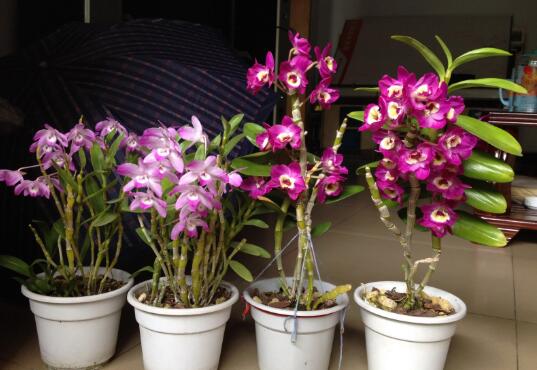
This plant prefers a warm and humid environment, so when growing it we should water frequently to keep the soil somewhat moist, but the watering frequency does not need to be too frequent. Spring and summer are its peak growing seasons, so we can choose to water more, but after entering October, because the temperature gradually drops, we also need to control the watering frequency.
2. Watering methods for Dendrobium
1. Soaking pot method
When using the soaking pot method to water Dendrobium, we first need to prepare a large basin of water, then place the flower pot into it so that water enters through the bottom of the pot to moisten the soil. After we see the surface soil become moist, we can take the flower pot out. This method has great benefits for preventing soil compaction and promoting root development.
2. Sand column method
When potting or repotting Dendrobium, first stand a few hollow tubes upright in the empty pot, then add soil and press it firm, then fill the tubes with coarse sand, and afterward pull the hollow tubes out. In this way, sand columns can be formed in the potting soil. When we water in the future, the water will only spread outward through the sand columns. This method can avoid soil compaction and is more suitable for potted Dendrobium.
3. Cotton thread water absorption method
When planting Dendrobium, we can place a cotton cloth strip in the pot and then fill it with soil. After that, place the other end of the cloth strip in the water of the saucer. Using the cloth strip's water-absorbing ability, water can be absorbed from the saucer into the pot, keeping the potting soil moist. If we need to go out for a few days and no one is home, we can use this method to water it.
4. Spraying method
During the growth process, Dendrobium has very high requirements for air humidity. If the environment is too dry, the plant's appearance will look less bright, and the branches and leaves will also appear less full of vitality. Therefore, in the process of growing Dendrobium, we should frequently spray water around it and on its branches and leaves to maintain air humidity, which is very beneficial for its growth.
3. Precautions for watering Dendrobium
Although this plant prefers water, we still need to control the amount of water when watering. Remember not to cause water accumulation, otherwise it is very easy for its roots to rot. When watering, once you feel the soil has a certain moisture level, you can stop. After that, wait until the soil is almost completely dry before watering again.
How to water Dendrobium
Watering principles
Pay attention to checking whether the growing medium is almost dry but not completely dry; that is, watering is suitable when it is dry. When watering, the medium needs to be thoroughly watered; otherwise, do not water. When growing with sphagnum moss, for qualified potted seedlings, when watering, a certain water layer will form above the water ring, allowing water to fully soak through the growing material. The interval between waterings must not be too frequent; you need to wait until the sphagnum moss is almost dry but not completely dry before watering.
Watering methods
In spring, summer, and autumn, watering is mostly best done between 9 and 11 in the morning. When the summer temperature is above 30°C, pay attention to ventilation and moisture retention, and do not water during high temperatures. Also, after watering, turn on a circulating fan to dry the moisture on the leaves as soon as possible to avoid disease.
When the winter temperature drops below 10°C, the plant will enter a certain dormant period, and watering should no longer be carried out. If the winter temperature exceeds 10°C, watering can be done appropriately. The time for watering should be set during sunny daylight hours.
When there is too much water, the plant's growth will become slow, and the roots are prone to necrosis. You can stop watering to increase air in the medium, and start watering again after the plant resumes growth.
When water is insufficient, it is mostly because watering is not even enough. At this time, the watering method needs to be improved. If the medium has completely dried out, it will become difficult to absorb water, and repeated watering is needed to help it recover. The editor has finished explaining it here for you, everyone hurry up and start planting~
How to grow Dendrobium, Dendrobium growing methods and precautions / water frequently
Dendrobium is a fairly common flowering plant worldwide and has high ornamental value. It can be seen in many regions of China, but to grow it well, there are many things we need to pay attention to. Regarding how to grow Dendrobium, what are the growing methods and precautions for Dendrobium? Below, the editor will walk you through it.
1. How to grow Dendrobium: understand its habits
To know how to grow Dendrobium, we first need to understand its growth habits. This plant prefers a warm and humid environment and is not cold-tolerant, so when growing it we need to control the temperature well and not let the temperature get too low, otherwise the plant is very easily frostbitten. In addition, daily water and fertilizer management are also points that need attention. The specific details are below, so let's take a look.
2. Dendrobium growing methods and precautions
1. Soil: good drainage
Before growing Dendrobium, we first need to choose the soil. This is like laying the foundation when building a house, and it is very important. Generally, it is best to choose well-drained, highly breathable crushed fern roots, sphagnum moss, charcoal crumbs, broken tile pieces, perlite, etc., and it is best to use crushed fern roots and sphagnum moss as the main components.
2. Temperature: 18-30°C
During the growth process, Dendrobium has very high requirements for environmental temperature. Its suitable growing temperature is between 18 and 30°C. During the growing period, 16-21°C is most suitable, during the dormant period 16-18°C, and the nighttime temperature is 10-13°C. The best temperature difference is maintained at 10-15°C. A daytime temperature above 30°C has little effect on Dendrobium growth, and the winter temperature should not be lower than 10°C. Seedlings are easily frostbitten below 10°C.
3. Fertilizing: 1-2 times per month
Fertilizer is one of the main nutrients during the growth of Dendrobium. Especially after entering the growing period, its demand for fertilizer is very high, and it basically needs fertilizing 1-2 times every month so that it can grow better. However, before fertilizing, there is one thing we need to pay attention to: the fertilizer must first be diluted with water before application, because if the concentration is too high, it will burn the plant.
4. Moisture: keep the soil moist
This plant prefers a warm and humid environment, so when growing it we should water frequently to keep the soil somewhat moist, but the watering frequency does not need to be too frequent. Spring and summer are its peak growing seasons, so we can choose to water more, but after entering October, because the temperature gradually drops, we also need to control the watering frequency.
5. Light: avoid strong light
This plant prefers a semi-shaded environment, so when growing it we should not place it in direct sunlight, as this is not conducive to its growth. Especially after entering summer, because the light is relatively strong, we also need to shade it to prevent strong light from scorching the plant.
6. Pests and diseases: handle promptly
In the process of growing Dendrobium, if we are not careful enough, pests and diseases are very likely to appear. Such problems are very harmful to the plant. They not only affect its ornamental value, but in severe cases can also cause the plant to wither and die. Therefore, when we discover a problem, we must handle it promptly. For specific treatment methods, everyone can refer to the article on pest and disease control for Dendrobium, which has detailed introductions.