How to prune dwarf asparagus fern? Pinch the seedlings, cut dead branches from older plants
Dwarf asparagus fern (Asparagus plumosus) is a common foliage plant in homes. It was developed from the ordinary asparagus fern, and its branches and leaves look denser with a richer leaf color, making it very popular among flower lovers. However, if you want the dwarf asparagus fern to grow short and sturdy and look more beautiful overall, timely pruning is very important. So how do you prune a dwarf asparagus fern? Next, let's take a look at the pruning methods for dwarf asparagus fern.
I. How to prune dwarf asparagus fern
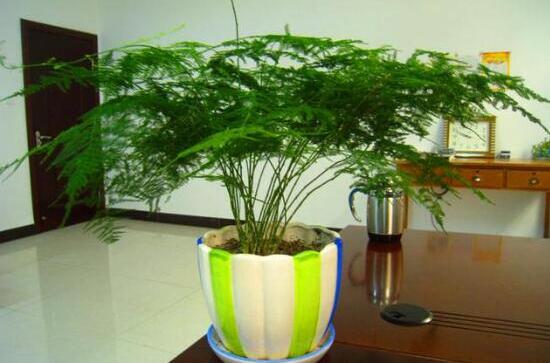
Asparagus fern has very strong growth ability. If it is not pruned in time, it cannot become a dwarf asparagus fern. As for how to prune dwarf asparagus fern, first pinch the top during its seedling stage to control height; second, cut off the vine-like branches to control the plant shape; finally, after the plant has grown into shape, cut off the overly dense and yellowed branches and leaves to maintain a perfect form.
II. Pruning methods for dwarf asparagus fern ⟧7⟧1. Pinching
1. Pinching
The value of dwarf asparagus fern lies in its beauty, and only a short, sturdy form can bring that out. So for how to prune dwarf asparagus fern, you should first pinch the top after the seedlings have grown to a certain height, in order to achieve dwarfing.
2. Short cutting
During the growth of dwarf asparagus fern, the leaves at the top often grow poorly or are missing. At this time, for overall beauty and also so that nutrients can reach the top of the plant, we should shorten the main branches that are missing leaves.
3. Branch pruning
After the dwarf asparagus fern has taken shape, some thin branches sometimes grow. At this time we should cut them off to prevent them from ruining the overall beauty; in addition, for those branches that gradually grow into vines, they should be cut off from the root all at once.
4. Shaping and pruning
When dwarf asparagus fern has grown for more than 3 years, we should prune it every year. Cut off the overly dense and yellowed branches and leaves so that the plant grows well and looks beautiful.
5. Managing the shape
In addition to pruning, if you want the dwarf asparagus fern to have a perfect shape, you should also learn to use light: because dwarf asparagus fern is phototropic, we can often turn the flower pot so that the plant receives light evenly. Through pruning and care, you will get a beautiful pot of dwarf asparagus fern.
That is all for the pruning methods of dwarf asparagus fern. After reading the whole article, I believe everyone should feel confident about pruning dwarf asparagus fern! Overall, the cultivation method of dwarf asparagus fern is not difficult. As long as we care for it carefully and prune it in a timely manner, a short, sturdy, and overall beautiful dwarf asparagus fern will appear before us!
Pruning and propagation methods for flowers and plants
Pruning and propagation methods for flowers and plants
Pruning and shaping flowers and trees can regulate growth, flowering, and fruiting. Pruning can also improve ventilation and light conditions and promote robust growth of branches and leaves. Common methods used in home flower growing include pinching, branch pruning, bud removal, and leaf removal.
(1) Pinching
It is often used on herbaceous flower seedlings. After the main stem of the herbaceous flower is removed, it helps promote the sprouting of lateral buds, increases branching, and achieves the goals of dwarfing the plant and having more branches and flowers. It can also adjust the flowering period. It is often applied to chrysanthemums, scarlet sage, petunias, marigolds, and so on.
(2) Branch pruning
There are two ways to prune branches. One is to remove them from the base of the branch, called thinning. Thinning is the removal of overly dense branches as well as crossing branches, leggy branches, weak branches, diseased and pest-damaged branches, and dead branches, which helps the tree body ventilate and receive light and enhances plant vigor. The other way is to shorten the branch, called short cutting. Short cutting can prompt the lateral buds of the branch to sprout, adjust growth vigor, and benefit flowering and fruiting. For roses, in winter the branches are left about 20-30 cm and short cut, which can control plant height and make spring flowering abundant and uniform. Short cutting the leggy branches of wintersweet can promote lateral bud sprouting and form flowering branches for the next year. Different flowers and trees have different growth habits. Some branches form flower buds from terminal buds, and some form flower buds from lateral buds, so short cutting should also adopt correspondingly different methods.
(3) Bud removal
During the growth period of flowers and trees, adventitious buds often appear. If allowed to grow, they will consume nutrients, disrupt the tree shape, and affect ventilation and light, so they need to be removed in the early stage of bud sprouting. For grafted rose seedlings, the sprouts on the root sucker part are all wild roses and must all be removed.
(4) Leaf removal
For some foliage plants, such as spider plant, evergreen, cast-iron plant, and calla lily, some old leaves should be removed in time to promote new leaves. After jasmine is moved outdoors in spring, removing old leaves can promote more new branches and new leaves, vigorous growth, and more flower buds.
Pruning and propagation methods for flowers and plants
Propagation
In home flower growing, propagating new plants and new seedlings yourself will add more fun to growing flowers. Common methods include sowing, cuttings, division, layering, and grafting.
(1) Sowing
Seeds must be collected after they are fully mature.
Dry and low-temperature storage conditions can extend seed life. For home storage, they can be packed in plastic bags and stored in the refrigerator crisper.
Biennial herbaceous flowers that bloom in spring are sown in mid-to-late August. Annual flowers that bloom in autumn are sown from late March to early April in spring.
After sowing, the soil covering thickness should be 2-3 times the height of the seed.
Seed germination requires temperature, moisture, and air. Generally 20-25C is most suitable for germination. The sowing bed soil must not become compacted or waterlogged, so as to provide the oxygen needed for germination.
After seedlings emerge and have 2-4 leaves, they should be transplanted.
(2) Cuttings
This uses the regeneration ability of plant organs such as roots, stems, leaves, and buds after being separated from the mother plant to cultivate new plants.
The soil (medium) used for cuttings should be loose, breathable, and harmless. For home propagation, materials such as rice hull ash, yellow sand, perlite, and vermiculite can be used.
For stem cuttings of woody plants, choose fully grown branches of the current year, with cutting material 10-15 cm long and with 3-4 buds, inserted 5-6 cm into the soil. The lower cut of the cutting should be at a node. Dormant branch cuttings are done 10-15 days before budding. Green branch cuttings with leaves can be done during the growth period after the new branches have matured. However, the aboveground leaves should be appropriately trimmed off to reduce transpiration and help rooting.
For herbaceous plant cuttings, choose plump young stems. Wax begonia, petunia, Impatiens hawkeri, New Guinea impatiens, scarlet sage, and marigold all root easily from cuttings.
Most succulents can be propagated by leaf cuttings.
For home cuttings, use flower pots as cutting beds, place tile pieces at the bottom of the pot to aid drainage, and always maintain soil moisture. The cutting pot should avoid direct sunlight. If you can frequently spray mist to maintain a certain air humidity, it can be placed in sunlight. Rose cuttings in summer can root in about 10 days.
Pruning and propagation methods for flowers and plants
(3) Division and bulb separation
Some perennial flowers and shrubs, such as daylily, iris, asparagus fern, bamboo palm, umbrella plant, wintersweet, and peony, after growing for several years, have enlarged clumps. In early spring or autumn, the clump can be dug up and divided into several individual plants. When dividing, each plant should carry as many roots as possible, and the area of the cut wounds should be reduced.
Bulb flowers such as tulips, lilies, narcissus, gladiolus, and red wood sorrel can be propagated by separating small bulbs.
(4) Layering
For flowers and trees such as osmanthus, camellia, and wintersweet, branches close to the ground can be bent and pressed into the soil without being detached from the mother plant, prompting the middle stem nodes of the buried branch part to root. Usually layering is carried out in March-April. The buried part needs to be notched or ring-barked to help the callus tissue at the wound site produce new roots. In autumn, cut below the rooted part to grow a new plant.
On the upper part of the flower or tree plant, choose a branch about 0.5-1.0 cm in diameter and perform ring barking, with a ring width of 0.3-1.5 cm. On the outside, use a bamboo tube or plastic film bag, filled with breathable and moisture-retaining material, to promote rooting at the ring-barked part. This is called air layering. The suitable season for air layering is before the plum rain.
(5) Grafting
One of the artificial vegetative propagation methods for plants. That is, grafting the branch or bud of one plant onto the stem or root of another plant, so that the two joined parts grow into a complete plant. Grafting methods are divided into branch grafting and bud grafting. During grafting, the cambium of the scion and the rootstock should be closely joined to ensure the survival of the scion. The branch or bud that is grafted on is called the scion, and the plant being grafted onto is called the rootstock or stock. For the scion, seedlings with 2 to 4 buds are generally selected. After grafting, it becomes the upper part or top of the plant, and the rootstock after grafting becomes the root system part of the plant.)
The key to successful grafting lies in: the nutritional status of the grafting materials, compatibility, the temperature and humidity environment after grafting, and grafting technique. The commonly used methods are branch grafting and bud grafting.