Can the fruit of the coral ardisia be eaten? It cannot be eaten but can be used medicinally to treat illnesses
Coral ardisia (Ardisia crenata), a beautiful ornamental fruit plant, bears a large mass of bright red fruit that looks very tempting. Although coral ardisia looks poisonous, in fact, its fruit is not only non-toxic but can also be used as medicine to treat various diseases. Thus, some people ask: can the fruit of coral ardisia be eaten? How do you eat coral ardisia? On this, let the editor clear up the confusion for everyone.
I. Can the fruit of coral ardisia be eaten
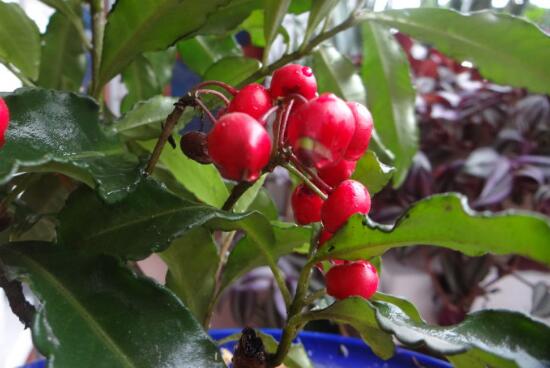
As shown in the picture above, the fruit of coral ardisia is about the size of a pea. It starts out pale green and turns bright red when ripe, looking extremely tempting. Many people want to eat it just by looking at it, so can the fruit of coral ardisia be eaten? Generally speaking, coral ardisia cannot be eaten; it is often taken as a medicinal herb. Of course, nothing will happen if you eat it.
II. How to eat coral ardisia
Although the fruit of coral ardisia cannot be eaten directly, it can be taken as a medicinal herb. Specifically, it has the effects of clearing heat and reducing internal heat, reducing swelling and detoxifying, and promoting blood circulation and removing blood stasis. It has good therapeutic effects on treating tonsillitis, toothache, bruises and injuries, joint rheumatism pain, women's leukorrhea, menstrual pain and various other diseases. As for how to eat coral ardisia, everyone can take it together with other medicinal herbs.
III. The fruit's efficacy of coral ardisia
1. Treating sore and swollen throat
In daily life, when you catch a cold and feel a sore throat, you can pick a few coral ardisia fruits from the tree, wash them clean, and decoct them in water to take. After taking it this way a few times, it has a very good effect on treating sore and swollen throat.
2. Treating joint rheumatism pain
For the elderly, joint rheumatism pain is an extremely troublesome stubborn disease, and taking lots of medicine has little effect. For this, everyone can take a few coral ardisia fruits, plus 2 liang of caulis akebiae (Akebia stem), 3 qian of tiger bone, 3 qian of chicken-bone fragrant herb (Aquilaria sinensis?), 4 qian of Sargentodoxa cuneata, and 3 qian of mulberry mistletoe, and soak them in 2 jin of liquor. Take 1 liang orally each time, twice a day; long-term use gives excellent results.
3. Treating lung disease and blood-streaked coughing from overexertion
If you suffer from lung disease and blood-streaked coughing from overexertion, you can also use coral ardisia fruit and stew it together with pig lungs. After stewing, first drink the soup, then eat the pig lungs. Eating it three times in a row counts as one course of treatment. Because this food therapy is non-toxic, patients can keep taking it until results are seen.
4. Treating bruises and injuries
In daily life, no matter who you are, bruises and injuries are unavoidable. If you temporarily do not have that kind of medicine on hand, you can take the fruit of coral ardisia, decoct it in water, or take it with yellow rice wine, to promote recovery.
Overall, coral ardisia has strong efficacy. It is not only good-looking but can also purify the air and beautify the home, and it also has good applications in medicine. Of course, nothing will happen if you eat the fruit of coral ardisia, but it does not taste good, so it is better used as medicine. As for whether the fruit of coral ardisia can be eaten, the editor has introduced it here, hoping to bring help to everyone.
Bringing wealth and treating illness: what are the uses of seven-leaf lotus (Schefflera arboricola)?
The seven-leaf lotus has a vine-like appearance, with smooth, small vertical stripes on the stem. The leaves are alternate, and the leaf shape varies at different positions. The petals of the seven-leaf lotus bloom in spring and summer, and grow out from the middle of a ring of whorled leaves. The flowers are generally pale greenish-white, and the flower shape is like an umbrella, while the berries are spherical. Generally, the fruit turns yellow-red after ripening.
Because of the seven-leaf lotus's unique growing environment, it cannot easily be found in our daily life. But I believe that people who have some understanding of feng shui all know that the seven-leaf lotus has a certain auspicious meaning in feng shui. Below we will talk about the topic everyone cares about most, which is the feng shui role of the seven-leaf lotus in feng shui.
The feng shui role of the seven-leaf lotus
The seven-leaf lotus is an auspicious feng shui plant that brings wealth and prosperity. Because the seven-leaf lotus is rarely found in ordinary times, many people are completely baffled about its feng shui role. In fact, it is a feng shui plant that brings wealth and prosperity, because it has a highly ornamental appearance, and people like to grow it as a potted plant and place it at home or in the office.
The seven-leaf lotus is a feng shui plant that brings wealth and prosperity. If placed in the correct position, it can bring very good effects to our lives. Generally, placing the seven-leaf lotus in the wealth position in a room can have a very good promoting effect on our financial luck, can make the family wealthy and auspicious, and attract wealth and treasure. In the office, it also has the effect of dissolving petty people and warding off evil and neutralizing negative energy. At the same time, if placed in the company's wealth position, it implies that it can attract wealth from all directions, with endless business and rolling wealth.
The above are some small feng shui tips about the seven-leaf lotus. Below, let me also share some other efficacy and functions of the seven-leaf lotus, which is its medicinal effect that should not be underestimated.
The medicinal value of the seven-leaf lotus
The seven-leaf lotus itself has a unique fragrance, plus a beautiful appearance, pale greenish-white flowers, palmately compound leaves, and spherical berries. After careful artificial cultivation and care, it has high ornamental value. In addition, the seven-leaf lotus also has good medicinal value. When used to soak in liquor or decoct in water, it has the effects of clearing heat and detoxifying, and promoting blood circulation and removing dampness. Its leaves can be used to stop bleeding from external injuries, and its stems can be used to treat pain in certain areas.
The seven-leaf lotus contains seven-leaf lotus polypeptide, which has an extremely strong eliminating effect on the rheumatic complex of bone marrow and blood, and can quickly relieve some uncomfortable feelings such as swelling, pain, soreness, and numbness. Below, let me describe a prescription for the seven-leaf lotus as medicine from "Guangxi Chinese Herbal Medicine".
1. Rheumatic joint pain: take an appropriate amount of seven-leaf lotus, greater burdock, and red dragon-boat flower leaves, mix and mash them, then stir-fry them with liquor until hot, apply directly to the painful area, and then wrap the painful area with gauze.
2. Treating bruises and injuries: use an appropriate amount of distillers' grains plus seven-leaf lotus, mash them together, wrap them in banana leaves, warm them, and apply directly to the injured area.
3. External bleeding: for external bleeding, simply mash an appropriate amount of seven-leaf lotus directly, and then apply it to the bleeding wound.
The efficacy of various indoor plants, they can treat illnesses!
1. Golden pothos (Epipremnum aureum):Can absorb 95% of carbon monoxide and 85% of formaldehyde in the air
Golden pothos can carry out photosynthesis under weak light and absorb toxic and harmful gases in the air. One pot of golden pothos in a room of 8~10 sq m is equivalent to an air purifier. Generally, keeping 1~2 pots of golden pothos in a room can release oxygen within 24 hours while absorbing formaldehyde, styrene, carbon monoxide, carbon dioxide and other carcinogenic substances in the air.
Golden pothos has a particularly strong absorption capacity for certain harmful substances. For example, the carbon monoxide and formaldehyde mixed in the air can reach 95% and 85% respectively. Golden pothos can also decompose benzene and absorb relatively stable harmful substances such as nicotine in cigarette smoke, so golden pothos is also called the green purifier of indoor air.
2. Alocasia (Alocasia macrorrhizos):
Has the effect of removing dust from the air
However, the white sap in the stem of Alocasia is toxic, and the water it drips is also toxic. Accidental contact with or accidental ingestion of its sap will cause discomfort in the throat and mouth, and a burning pain in the stomach. Special attention should be paid to preventing young children from accidentally eating it. But Alocasia does not belong to the carcinogenic plants.
3. Clivia (Clivia miniata):
Releases oxygen. A freshener that absorbs smoke
One adult Clivia can absorb 1 liter of air and release 80% oxygen in a day and night, and can also carry out photosynthesis under extremely weak light.
It will not release carbon dioxide at night. In a room of more than ten sq m, two or three pots of Clivia can absorb the smoke in the room. Especially in the cold winter in the north, because doors and windows are tightly closed and indoor air is not circulating, Clivia will play a very good role in regulating the air and keeping the indoor air fresh.
4. Rubber plant (Ficus elastica):
An all-rounder in eliminating harmful substances
The rubber plant is an all-rounder in eliminating harmful substances. It has a certain resistance to harmful gases such as carbon monoxide, carbon dioxide, and hydrogen fluoride in the air. The rubber plant can also eliminate inhalable particulate pollution and has an effective dust-retaining effect on indoor dust
5. Asparagus fern (Asparagus setaceus):
A protective umbrella that eliminates bacteria and viruses
The plant fragrance contained in asparagus fern has antibacterial components, can remove bacteria and viruses in the air, and has a health-care function. Therefore, the smell released by asparagus fern has the power to sterilize and benefit bacteria.
In addition, asparagus fern also has high medicinal value. Dig up its fleshy roots and wash off the dust and dirt on them. Dry them in the sun for later use or use them fresh. The leaf-like branches can be picked as needed. All have the effects of relieving cough, moistening the lungs, cooling blood and detoxifying
6. Aglaonema (Aglaonema commutatum):
Famous for its unique air purification ability
The higher the concentration of pollutants in the air, the more it can exert its purification ability! Therefore, it is very suitable for dark rooms with poor ventilation.
7. Maidenhair fern (Adiantum):
Can absorb about 20 micrograms of formaldehyde per hour
Therefore, it is considered the most effective biological "purifier". People who deal with paint and coatings all day, or who have people around them who like to smoke, should place at least one pot of fern in the workplace. In addition, it can also inhibit xylene and toluene released from computer monitors and printers
8. Aloe (Aloe vera):
One pot of aloe is equivalent to nine biological air cleaners
Potted aloe has the reputation of an air purification expert. One pot of aloe is equal to nine biological air cleaners, and can absorb harmful substances such as formaldehyde, carbon dioxide, sulfur dioxide, and carbon monoxide.
It is especially strong in absorbing formaldehyde. Under 4 hours of light conditions, one pot of aloe can eliminate 90% of the formaldehyde in one sq m of air. It can also kill harmful microorganisms in the air and adsorb dust, playing a great role in purifying the home environment.
When the harmful air indoors is too high, spots will appear on the leaves of aloe. This is a signal for help. As long as a few more pots of aloe are added indoors, the indoor air quality will return to normal.
9. Broadleaf lady palm (Rhapis excelsa):
Eliminates heavy metal pollution and carbon dioxide
The function of broadleaf lady palm is similar to that of Swiss cheese plant. Both belong to large-leaf ornamental plants. Broadleaf lady palm can absorb more than 80% of various harmful gases and purify the air. At the same time, broadleaf lady palm can also eliminate heavy metal pollution and has a certain resistance to sulfur dioxide pollution. Of course, as foliage plants with huge leaves, their greatest feature is the ability to digest carbon dioxide and produce oxygen that ordinary plants cannot match
10. Swiss cheese plant (Monstera deliciosa):
Absorbs carbon dioxide at night and improves air quality
The air purification function of the Swiss cheese plant is slightly weaker. It is not like spider plant. Aloe is an all-rounder in purifying air. But the Swiss cheese plant has a relatively obvious effect on removing formaldehyde from the air.
In addition, the Swiss cheese plant has the effect of absorbing carbon dioxide at night. It is of great help in improving indoor air quality and increasing oxygen content. Plus, the Swiss cheese plant generally has a relatively large plant size and an elegant shape.
Its leaves are also relatively sparse and beautiful. So it is a very ideal indoor plant. The fruit of the Swiss cheese plant can be used for cooking after it ripens. The fragrance is like pineapple or banana.
11. Ivy (Hedera helix):
The champion in absorbing formaldehyde
Ivy is currently the most effective indoor plant for absorbing formaldehyde. Every sq m of ivy leaves can absorb 1.48 milligrams of formaldehyde. And the total leaf area of 2 adult ivy plants is about 0.78 sq m. At the same time, ivy can also absorb toxic and harmful substances such as benzene, and under 24-hour light conditions can absorb 90% of indoor benzene. According to speculation, for a room of 10 sq m, only 2-3 pots of ivy are needed to purify the air. It can also adsorb particulate dust.
12. Lucky bamboo (Dracaena sanderiana):
A healthy plant suitable for the bedroom
Lucky bamboo can help rooms that are not often ventilated by opening windows to improve air quality, and has a disinfection function. Especially in the bedroom, lucky bamboo can effectively absorb exhaust gas and improve the private environment of the bedroom.
13. Money tree (Pachira aquatica):
Counters exhaust gas produced by burning tobacco
The money tree is evergreen all year round and can absorb toxic gases and release oxygen through photosynthesis. It can relatively effectively absorb carbon monoxide and carbon dioxide pollution and has a certain effect on resisting exhaust gas produced by burning tobacco.
14. Cactus:
The best plant for reducing electromagnetic radiation
Cactus has a strong anti-inflammatory and sterilizing effect. In dealing with pollution, cactus is the best plant for reducing electromagnetic radiation. In addition, cactus absorbs carbon dioxide and releases oxygen at night. If a cactus is placed in the bedroom at night, it can supplement oxygen and help sleep.