What to Do When Cleome Gets Pests? Control Methods for 2 Pests and 2 Diseases
During the growth of Cleome, the last thing we want to encounter is problems like pests and diseases. Such problems are extremely harmful to the plant, and if not dealt with in time, they can even cause the plant to wither and die. So what should you do when Cleome gets pests? How should pest and disease control for Cleome be carried out? Let's take a look together below.
I. What to Do When Cleome Gets Pests - Find the Cause
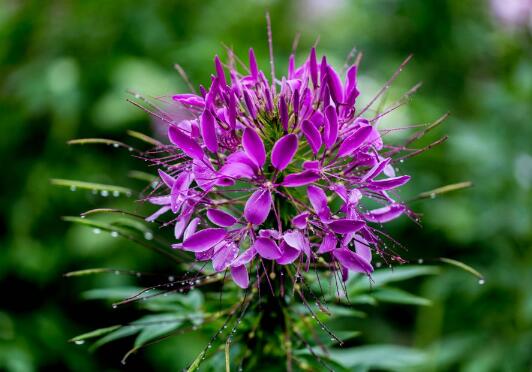
To know what to do when Cleome gets pests, we first need to understand what kind of insect it is, so we can deal with it in a targeted way, because the control methods for each pest and disease are different. The details are introduced below, and those troubled by this can take a look.
II. Pest and Disease Control for Cleome (Pests)
1. Stem borers
Stem borers are a type of pest belonging to the order Lepidoptera. This pest is more common in southern regions. It mainly damages the leaves of Cleome, causing the leaves to gradually curl and wither, and eventually fall off.
Control method: When dealing with this pest and disease of Cleome, we can use 75 grams each of 90% crystalline trichlorfon and 90% acephate soluble technical powder to spray and kill them.
2. Pagoda looper (Sophora inchworm)
The pagoda looper is a leaf-eating pest, and its peak period is every summer, so everyone must pay extra attention at this time. This pest mainly feeds on the leaves of Cleome, and in severe cases it can even cause the plant to die.
Control method: For this pest and disease of Cleome, we can use a 2000-3000 times dilution of 2.5% deltamethrin EC to spray and kill them.
III. Pest and Disease Control for Cleome (Diseases)
1. Leaf spot
Leaf spot is a disease that exists in many plants, and Cleome is no exception. When it occurs, many oval and elongated brown lesions appear on its leaves, and over time they gradually spread, eventually causing the plant to gradually wither and die.
Control method: When dealing with this pest and disease of Cleome, we can use a 500 times dilution of 50% thiophanate wettable powder to spray it. Generally once every 5-7 days, and after 2-3 times it can be cured.
2. Rust
Rust is a disease caused by fungi. It mainly damages the leaves, stems and fruits of Cleome. When it occurs, many small blister spots of different colors appear on the affected parts, and over time they gradually spread. When the blister spots densely merge into patches, the plant will also rapidly wither and die due to massive evaporation of water from within.
Control method: For rust, this pest and disease of Cleome, we can use a 3000 times dilution of 50% carboxin wettable powder to spray for control. Generally spray once every 7-12 days, and after 1-2 times it can be cured.
Control Methods for Common Pests and Diseases of Cleome
Common diseases includeleaf spotandrust。
Control methods:
1. For leaf spot, spray with a 500 times dilution of 50% thiophanate wettable powder;
2. For rust, spray the leaves with a 3000 times dilution of 50% carboxin wettable powder for control.
Cleome is prone toLepidoptera pests。
during the seedling stage. Control method:
You can use the insecticide abamectin at a 4000 times dilution for foliar spraying.
Daily Cultivation Methods and Pest and Disease Management for Cleome
Today the editor of Huinong Network will talk about the cultivation and management techniques for Cleome. This technique mainly focuses on how to extend the ornamental period of the potted bedding plant variety Cleome and dwarf it.
1 Pre-sowing preparation
1.1 Germination promotion
On May 1, soak the seeds in 28°C warm water for 5 hours. After the seeds fully absorb water and swell, place them in a light incubator at 4°C for low-temperature treatment for 5 days. One week later, on May 7, 95% of the seeds "show white" and sowing begins.
1.2 Seedbed preparation
Choose a plot with high and dry terrain, ventilation and coolness, good drainage, and loose and fertile soil to make a 120 sq m seedbed. Build a greenhouse, cover it with a shade net for shading, and cover the entire greenhouse with an insect-proof net; on May 5, fill 288-cell trays with special flower nutrient soil, with the nutrient soil 1 cm below the tray surface.
2 Sowing
Sow on the morning of May 7, 1-2 seeds per cell, evenly sown in the center of the cell holes. After all are sown, evenly scatter about 1 cm of nutrient soil, water thoroughly, and then cover the surface with newspaper to retain moisture.
3 Seedling stage management
On May 10, the seedlings emerge uniformly. Remove the greenhouse covering, let the seedlings get sufficient light on sunny days, and cover the greenhouse with film on rainy days. Keep the soil moist during the seedling stage; 1-2 days after emergence, promptly remove weak seedlings, leaving 1 plant per cell. On May 23, when the seedlings have 3 true leaves, carry out seedling hardening. On May 25, water once thoroughly and prepare for transplanting.
4 Field land preparation and fertilization
In late April, level the plot and prepare the land and apply fertilizer. Apply 1000 kg/667 sq m of decomposed barnyard manure, and apply water-soluble ternary compound fertilizer with N:P:K = 15:15:15 at 50 kg/667 sq m combined with harrowing, mixing evenly with the soil; when making beds, make shallow-furrow flat beds as needed; prepare the land and make beds, and cover with black plastic film.
5 Transplanting
Transplant on May 27. After transplanting, cover with soil up to the cotyledons, and water with rooting water. Row spacing 35 cm, plant spacing 40 cm, about 4000 plants/667 sq m.
6 Field management
On June 15, when the seedlings have 8-10 true leaves, irrigate once with a 1000 times dilution of water-soluble ternary compound fertilizer (N:P:K=10:30:20). On June 30, irrigate once with a 1000 times dilution of water-soluble ternary compound fertilizer (N:P:K=10:30:20) to promote reproductive growth of the plant. Supply sufficient water throughout the growth period to keep the soil moist. During bud formation and flowering, apply ternary compound fertilizer (N:P:K = 15:15:15) 1-2 times as a top dressing, 10 kg/667 sq m each time, once every half month. Water normally to keep the soil moist; during the growth period, control watering and top dressing to prevent excessive vegetative growth and avoid affecting flowering.
7 Regulating plant type
2 pinching and spraying 400 mg/L paclobutrazol once 1 week before flowering gives the best effect, and the ornamental period can reach 114 days.
8 Pest and disease control
For leaf spot, spray with a 600 times dilution of 50% thiophanate-methyl wettable powder for control 2 times. For rust, spray with a 1500 times dilution of 50% carboxin wettable powder for control 2 times; when Lepidoptera pests appear at the seedling stage, use a 800 times dilution of 10% abamectin wettable powder for foliar spraying for control 2 times. During the growth period, use 10% imidacloprid wettable powder at 700 times dilution, 5% flufenoxuron EC at 800 times dilution, and Bacillus thuringiensis at 600 times dilution insecticides alternately to control diamondback moth, cabbage caterpillar and aphids and other pests 3 times.
9 Harvest
Harvest the plants before the first frost comes at the end of November. After the seeds mature successively, harvest in stages. After harvesting, dry the fruits in the sun and gently rub the seeds to completely separate them from the fruits, then dry them in the sun and bag them; if seeds are not to be kept, promptly cut off the spent flowers after flowering to prevent seed formation, reduce nutrient consumption, and help extend the flowering period. After crushing, the straw can be used as green manure and plowed into the ground.
Well, that's all for today's content. If farmer friends are interested in the cultivation techniques of Cleome, you are welcome to leave comments below on Huinong Network.