What to do when the peacock flower gets bugs? Get the control of 2 pests and 3 diseases right
During the growth of the peacock flower, the last thing we want to encounter is pests and diseases. Such problems are extremely harmful to the plant, not only affecting its ornamental value, but in severe cases even causing the plant to wither and die. So what should you do when the peacock flower gets bugs? And how should pest and disease control for the peacock flower be carried out? Below, the editor will walk you through it.
I. What to do when the peacock flower gets bugs: find the cause
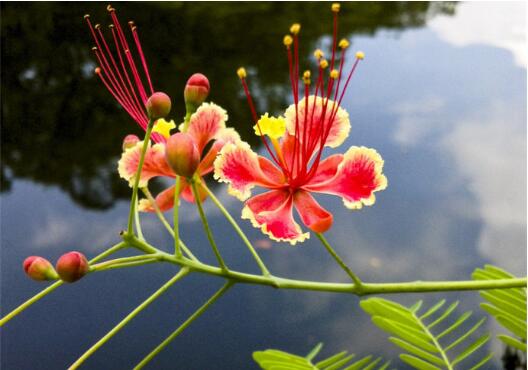
To know what to do when the peacock flower gets bugs, we first need to understand what kind of insect it is, so we can deal with it in a targeted way, because the treatment methods for each pest and disease are different. The details are described below, and those troubled by this can take a look.
II. Pest and disease control for the peacock flower (pests)
1. Scale insects
Scale insects prefer to grow in warm, humid environments. If the growing environment is too dry, scale insects are very likely to appear. They mainly threaten the peacock flower's branches, leaves and fruit, causing the leaves to gradually turn yellow, the tree's vigor to gradually decline, and finally a withering appearance.
Control method: When dealing with this pest and disease of the peacock flower, we can use 255 phosmet 1000x solution or 2.5% deltamethrin 3000x solution to spray and kill them directly.
2. Aphids
Aphids are a kind of phytophagous insect. They mainly suck the sap from the peacock flower's leaves, causing the leaves to gradually lose their green color, and in severe cases causing the leaves to continuously shrivel and drop off, and also affecting its blooming.
Control method: For this pest and disease of the peacock flower, we can directly use 50% malathion emulsion 1000x solution or 50% pirimicarb wettable powder 3000x solution to spray and kill them.
III. Pest and disease control for the peacock flower (diseases)
1. Powdery mildew
Powdery mildew is a disease that can appear on many plants, and the peacock flower is no exception. When it strikes, many white powdery lesions appear on its leaves, and over time they gradually cover the entire leaf, so the plant cannot carry out photosynthesis and gradually withers and dies.
Control method: When dealing with this pest and disease of the peacock flower, we can use 70% thiophanate-methyl wettable powder 1000x solution to spray the diseased plant, generally once every half month, and it can recover after about two applications.
2. Damping-off
This disease mainly attacks the root and stem base of the peacock flower, causing the root and stem base to turn black or constrict, and in humid environments white mold-like substances also appear. Generally, within a few days of being attacked by this disease, the plant's leaves wilt, and over time the whole plant gradually dies.
Control method: For this pest and disease of the peacock flower, we can use 20% tolclofos-methyl emulsifiable concentrate 1200x solution to spray the diseased plant for control, generally once every 7-10 days, and it can recover after 2-3 applications.
3. Brown spot
Brown spot is also called leaf spot. This is a disease caused by fungi. This disease mainly threatens the plant's leaves. When it strikes, many brown lesions appear on the leaves, and over time they gradually spread, finally causing the plant to wither and die.
Control method: When dealing with this pest and disease of the peacock flower, we can use 25% carbendazim wettable powder 300-600x solution for control, generally applying it once about every 10 days, and it can recover after 1-2 applications.
How does the peacock flower propagate? Propagation methods of the peacock flower / mainly seed propagation
The peacock flower is the city flower of Shantou City, Guangdong Province, China, and many people there grow it. However, as more people grow the peacock flower, questions about its propagation have also become a concern. How does the peacock flower propagate? What are the propagation methods of the peacock flower? Below, the editor will walk you through it.
I. How does the peacock flower propagate? Mainly seed propagation
When it comes to how the peacock flower propagates, it is mainly seed propagation. After countless trials by people, this method still has a very high survival rate. However, to survive successfully, there are many things to pay attention to, such as the choice of substrate, the germination of seeds, and the sowing method. The specific operation methods are below, so let's take a look.
II. Propagation methods of the peacock flower (seed propagation)
1. Sowing time, September-October
When preparing to propagate the peacock flower by sowing, choosing the right time period is very important. This time is generally best in September-October, because the temperature and humidity at this time fully meet its growing conditions. After sowing, its nutritional needs are very easy to satisfy, so the survival rate is naturally very high.
2. Substrate choice, good drainage required
The peacock flower prefers acidic soil, so we had best choose loose, fertile, slightly acidic humus soil as the substrate. This kind of soil has relatively good drainage and aeration, allowing it to absorb nutrients better, and it is also less prone to waterlogging.
3. Substrate disinfection, high-temperature disinfection
After choosing the substrate, we had best disinfect it first, to avoid bacteria in it infecting the peacock flower. When disinfecting, we can break it up and then expose it to the sun for disinfection. We can also put it in an iron pot and stir-fry it over high heat, so that even if there are bacteria, they will be killed at high temperature.
4. Seed germination, soaking in warm water
After harvesting the peacock flower seeds, it is best not to sow them immediately. We can soak the seeds in warm water for 1-2 days, and when the seeds begin to absorb water and swell, we take them out for sowing. This can germinate the seeds and let them sprout faster.
5. Sowing method, apply base fertilizer before sowing
Before sowing, we should first apply an appropriate amount of base fertilizer into the substrate, then scatter the germinated seeds on the soil surface, cover them with 1 cm of soil, and then water. When watering, it is best to use the soaking method, because if you water directly, it is very easy to wash the seeds away. After that, the seeds can sprout in about three days.
What is the flower language of the peacock flower? Peacock flower pictures
✾
The peacock flower is a plant of the Balsaminaceae family, of the genus Delonix in the Fabaceae family, and has the alternative name of the plant flamboyant tree. Its form is shrub-like, with a height of about 5 m, and the corolla is orange-red with golden yellow edges, like a flying golden phoenix, and the stamens are especially long, very much like a phoenix's tail. This flower blooms on the branches all year round, and is a very valuable ornamental tree in tropical regions. The peacock flower is suited to growing in warm areas, and is cultivated in Yunnan, Guangxi, Guangdong, Taiwan, China and other places in China.
The stem of the peacock flower is fleshy, and upright, and also very thick. The large tree of the peacock flower is generally 8-25 m tall, grayish-white or light gray in color, and has many small branches. The crown of this plant is umbrella-shaped, and the branches mostly extend horizontally, relatively slender, with smooth branch trunks and no fuzz. The branch trunk color is green or pinkish-green. The flowers of the peacock flower are huge and gorgeous, and numerous. When the flowering season comes, they dye the crown a stretch of scarlet, especially beautiful.
✾ Propagation and care of the peacock flower
I. Generally speaking, the peacock flower is propagated by seeds. From mid-June to mid-December, the pods of the peacock flower mature one after another, and September-October is its maturity period. We place the collected mature-stage pods in the sun to expose them, and after the seeds crack open and come out, they can be used for sowing. The seedlings of the peacock flower need protection from cold to overwinter, and the seeds can also be stored until the next spring before sowing.
II. The seeds of the peacock flower sprout quickly. Generally, the seeds begin to sprout three days after sowing, and sprouting ends within a week. The germination rate is relatively high, about 60%. The seedlings grown from seeds planted by the drill method have a medium growth rate. During the seedling stage, nitrogen fertilizer is generally applied, and 2-3 rounds of supplementary fertilizing for the seedlings are carried out. After October, nitrogen fertilizer can be stopped and potassium fertilizer applied, to promote early lignification of the peacock flower plant. The peacock flower needs mulching and frost protection in winter.
✾ The peacock flower'sflower language: wisdom, escape
The peacock flower is a very beautiful flower. There is a legend about the flower language of this plant. It is said that the peacock flower was chosen to be dedicated to the Frankish prince Saint Clarus, but after his father died, Saint Clarus was hunted down by the uncle who wanted to seize the throne. To save his life, Saint Clarus gave up the right of succession to the throne and became a clergyman, so the flower language of the peacock flower is escape.
Conclusion:The peacock flower is a beautiful ornamental flower. Its flower color is very gorgeous, just like a flying golden phoenix, so it has very high ornamental value. We can grow it as a potted plant indoors, as an indoor decoration to increase beauty, and can also enjoy it elsewhere, but do remember the temperature conditions for the peacock flower. The above is the editor's brief introduction to the flower language and cultivation methods of the peacock flower, and I hope it can help friends.