What to do when Bleeding Heart Vine gets bugs? 2 pest and 2 disease control methods
When growing Bleeding Heart Vine, the last thing we want to run into is pests and diseases. These problems are very harmful to the plant, not only affecting its ornamental value, but in severe cases even causing the plant to wither and die. What to do when Bleeding Heart Vine gets bugs? How should pest and disease control for Bleeding Heart Vine be done? Below, the editor will walk you through it.
I. What to do when Bleeding Heart Vine gets bugs: find the cause
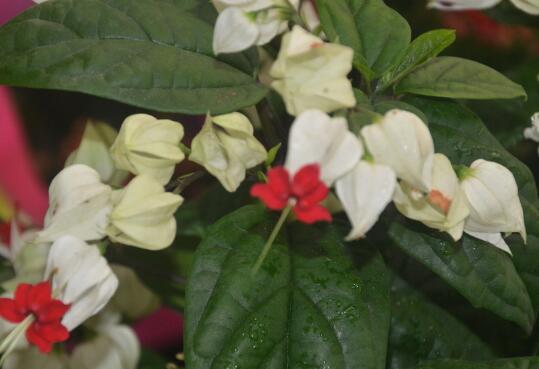
To know what to do when Bleeding Heart Vine gets bugs, we first need to understand what kind of bug is on it, so that we can deal with it in a targeted way, because the treatment for each pest and disease is different. The details are described below, and anyone troubled by this can take a look.
II. Pest and disease control for Bleeding Heart Vine (pests)
Scale insects
Scale insects are a relatively common pest during the growth of Bleeding Heart Vine. They mainly harm the plant's leaves, branches and fruit, living out their entire lives on the branches, leaves and fruit of the Bleeding Heart Vine, causing its leaves to turn yellow and its branch tips to wither, and in severe cases even causing the whole plant to die.
Control method: When controlling this pest and disease of Bleeding Heart Vine, we can use an insecticide made by mixing 40.7% chlorpyrifos EC and 80% dichlorvos EC at a 1:1 ratio, diluted 1000-1500 times, to spray and kill them.
Whiteflies
Whiteflies are a very tiny pest, with the largest ones not exceeding 3mm. This pest mainly feeds on the sap of the Bleeding Heart Vine, gradually sucking it out, causing the plant to lose a large amount of nutrients and finally wither. Among the pests and diseases of Bleeding Heart Vine, it counts as one of the most harmful.
Control method: This pest has an extremely strong reproductive capacity, so it must be dealt with as early as possible. When controlling it, we can use 40% omethoate EC diluted 1200 times to spray and kill it.
III. Pest and disease control for Bleeding Heart Vine (diseases)
Leaf spot disease
Leaf spot disease is one of the more common pests and diseases of Bleeding Heart Vine. Its peak period is from August to September each year, so everyone should pay extra attention at this time. Leaf spot disease mainly threatens the plant's leaves. When it strikes, many round diseased spots appear on the leaves, and over time the spots gradually expand, finally causing the leaves to gradually fall off.
Control method: When controlling leaf spot disease, we can use 38% oxadixyl-famoxadone-kresoxim-methyl diluted 800-1000 times to spray the diseased plant, spraying once every 5-7 days, and it can be basically cured after 2-3 times.
Powdery mildew
Powdery mildew is a disease caused by fungi. When it strikes, many white powdery mold spots appear on the leaves of the Bleeding Heart Vine, and over time they gradually cover the entire leaf, affecting its photosynthesis, disrupting normal metabolism, and thus causing premature aging.
Control method: For this pest and disease of Bleeding Heart Vine, we can choose to use 2% antimycin aqueous solution diluted 200 times or 15% triadimefon diluted 1000 times to treat it, generally once every 3-6 days, and it can be basically cured after 3-6 consecutive times.
Control of the main pests and diseases of Bleeding Heart Vine
Bleeding Heart Vine belongs to the Verbenaceae family, and can developleaf spot disease, which is caused by infection with an imperfect fungus. At first there are just small brown dots, and if not treated in time, large black spots will appear, and the leaves will turn yellow and die.
So once disease is found, immediately use chlorothalonil diluted 800 times for foliar spraying, once every 7-8 days, for 2-3 consecutive times, and it can basically be cured.
The main pests includescale insects, greenhouse whiteflies, etc.
Control method: Spray with 40% omethoate diluted 1000 to 1500 times. For leaves that cannot spread normally and lose their green color and turn yellow due to alkaline soil, water with a 0.2% ferrous sulfate solution. For mosaic disease and fungal diseases, promptly remove fallen diseased leaves, strengthen ventilation, and keep the leaves dry, which can control the condition.
How does Bleeding Heart Vine propagate? Two propagation methods for Bleeding Heart Vine (seed sowing/cuttings)
For flower lovers, Bleeding Heart Vine is certainly familiar. Its white calyx and bright red corolla make it look like a swimming dragon spitting out a pearl, appearing exceptionally beautiful. In daily life, many people keep a pot of Bleeding Heart Vine at home, but is one pot too monotonous? It's time to propagate a pot yourself, so how does Bleeding Heart Vine propagate? Below are two common propagation methods for Bleeding Heart Vine, let's take a look together!
I. How Bleeding Heart Vine propagates: seed sowing/cuttings
As a beginner grower, just knowing the growing methods for Bleeding Heart Vine is enough; but if you are an old hand, besides knowing how to grow it, you should also master the propagation methods for Bleeding Heart Vine, which not only lets you turn one pot into many, but also adds to the fun of growing. As for how Bleeding Heart Vine propagates, there are two common methods: seed sowing and cuttings. Next, let's take a look at the specific operations.
II. Two propagation methods for Bleeding Heart Vine
(1) Seed propagation of Bleeding Heart Vine
How does Bleeding Heart Vine propagate? Generally, the seed sowing method is used, and the sowing time is usually chosen in spring, from March to April. Before sowing, soak the seeds in warm water for 12 hours, then scatter-sow them in a shallow pot. Because Bleeding Heart Vine seeds are relatively large, keep a plant-to-row spacing of 3×5 cm. After that, keep the room temperature at 20-25°C, and seedlings will emerge in about 10 days. When the seedlings reach 10 cm tall, pot them up.
Because seedlings of Bleeding Heart Vine grown from seed grow very slowly and can only bloom in the second year, so if you want Bleeding Heart Vine to bloom in the same year after propagation, you can use the cutting method to propagate. It is worth mentioning that seedlings grown from seed will be healthier and more robust, which looks more reassuring. Next, let's take a look at the cutting propagation method for Bleeding Heart Vine.
(2) Cutting propagation of Bleeding Heart Vine
1. Cutting time
How does Bleeding Heart Vine propagate? Besides seed sowing, the most commonly used is of course cuttings. However, for Bleeding Heart Vine cuttings, the choices are very broad: you can use stem cuttings, leaf-bud cuttings, or root cuttings. As for the cutting time, it is generally done in spring and autumn, which is the growth period of Bleeding Heart Vine, when its vitality is high and the cutting survival rate is highest.
2. Cutting medium
For the cutting medium for Bleeding Heart Vine, everyone should also choose carefully. According to the growth habits of Bleeding Heart Vine, you can use media such as peat, perlite, leaf mold, river sand and vermiculite. Keeping the cutting bed temperature at around 26°C is very beneficial for rooting.
3. Cutting method
① Stem cuttings
On a potted Bleeding Heart Vine, choose a robust one-year-old branch, cut it into sections of 2-3 nodes as cuttings, keep the top leaves and cut off 1/2 of them. Then insert the cuttings into the prepared medium, care for them in a shaded place, maintain humidity, and they will root in 20 days, and can be potted and planted after 35 days.
② Leaf-bud cuttings
On a potted Bleeding Heart Vine, select a lateral bud on a branch as the cutting, cut it with a small section of branch, then insert it into the prepared medium. Note: the leaf bud should be exposed outside the medium, then care for it in shade for 20-25 days and it will root. After the leaf bud sprouts, pot it up.
③ Root cuttings
This cutting method is generally done together with repotting. Cut the root-like stolons on the soil into 8-10 cm sections as cuttings, then insert them into the prepared medium. Keeping the cutting bed temperature at around 26°C is very beneficial for rooting.
Overall, when propagating Bleeding Heart Vine, whether by seed sowing or cuttings, both can survive, but the most suitable for home propagation is still cuttings. Of course, methods are fixed but people are flexible, so everyone can choose a method to propagate according to actual conditions. That's all the editor has to introduce about Bleeding Heart Vine propagation methods, and I hope it can be of help to everyone.