What to Do When Medinilla Gets Bugs? 4 Pests and 1 Disease and How to Control Them
When we grow Medinilla, the last thing we want to run into is pests and diseases. These problems are extremely harmful to the plant, not only affecting its shape and beauty, but in severe cases causing the plant to wither and die. So what should you do when Medinilla gets bugs? How should pest and disease control for Medinilla be done? Below, the editor takes you through it.
I. What to Do When Medinilla Gets Bugs - Find the Cause
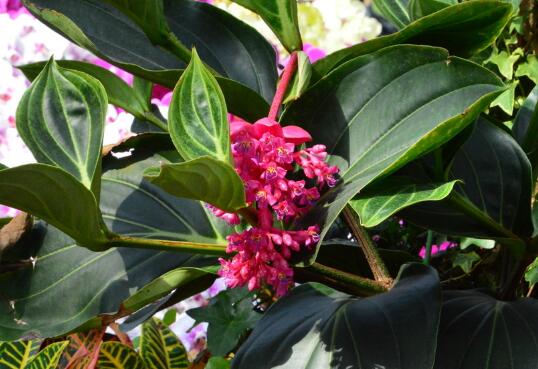
If you want to know what to do when Medinilla gets bugs, you first need to understand what kind of bug it is, and only then can you deal with it in a targeted way, because the control methods for different pests and diseases are also different. Below you will find control methods for various types of pests and diseases on Medinilla. Friends troubled by this can take a look.
II. Pest and Disease Control for Medinilla
1. Noctuid moths
Noctuid moths are a type of phytophagous pest in the order Lepidoptera. They mainly harm the leaves and flowers of Medinilla. Their larvae constantly chew on the leaves and flowers, causing many holes to appear on them, which greatly affects their ornamental value, and in severe cases can even cause the plant to wither and die.
Control method: For this kind of pest and disease on Medinilla, we can use 2.5% trichlorfon powder or 1.5% parathion (1605) powder to spray and kill them directly.
2. Red spider mites
Among the pests and diseases of Medinilla, red spider mites are one of the more common ones. Their peak season is every summer, so everyone must pay extra attention at this time. When this pest appears, the plant's leaves will gradually turn yellow and pale, and if left untreated for a long time, it can also cause the plant to wither.
Control method: When dealing with red spider mites, we can directly use a 1000-1500 times dilution of 40% dicofol emulsifiable concentrate to spray and kill them. Generally, spraying three times in a row can completely kill this pest.
3. Scale insects
Scale insects are a type of insect in the order Homoptera, and they harm many plants, with Medinilla being no exception. They gather for life on the plant's branches, leaves and fruits, causing leaves to turn yellow and the plant to weaken, and in severe cases can cause the plant to wither and die.
Control method: When dealing with this kind of pest and disease on Medinilla, the most direct method is to use a 1000 times dilution of 40% omethoate or a 3000 times dilution of 2.5% deltamethrin to spray and kill the pests.
4. Aphids
Aphids are a relatively common phytophagous insect, with more than 4000 species worldwide. Their body length is often less than 10 mm, making them relatively hard to spot. They leave honeydew on the plant's leaves and suck the leaf sap, causing the leaves of Medinilla to wither, turn yellow and lose their luster, and can also cause diseases such as sooty mold.
Control method: For this kind of pest and disease on Medinilla, we can directly use a 3000 times dilution of 2.5% fenpropathrin emulsion to spray and kill them.
5. Soft rot
Among the pests and diseases of Medinilla, soft rot is a relatively common disease. When it occurs, many water-soaked lesions appear on the plant's roots. As time goes on, the root and stem gradually rot and give off a wave of foul odor, ultimately causing the plant to gradually rot to death.
Control method: When controlling this disease, we can use 38% famoxadone-cymoxanil diluted 1000 times for root drenching. Generally, apply once a week, and after 2-3 times it can be controlled.
How Does Medinilla Propagate? Medinilla Propagation Methods / Mainly by Cutting Propagation
Medinilla, also known as Baolian Deng, is a relatively common ornamental flowering plant in people's daily lives, and many people grow it in various places. As more people grow Medinilla, questions about its propagation have also drawn people's attention. How does Medinilla propagate? What are the propagation methods for Medinilla? Below, the editor takes you through it.
I. How Does Medinilla Propagate - Cutting Propagation
When it comes to how Medinilla propagates, it is generally mainly by cutting propagation. In early spring, we can use branches from last year for hardwood cuttings. In late spring or early autumn, we can use current-year branches for softwood cuttings. As for the specific cutting methods, they are described in detail below. Let's take a look.
II. Medinilla Propagation Methods
1. Substrate selection - good drainage
Before propagating Medinilla by cuttings, we first need to choose a substrate. This is the foundational step and is very important. Generally, it is best to choose loose, fertile leaf mold or peat soil as the substrate. These two soils have relatively good drainage and aeration, and are also rich in nutrients, allowing the plant to grow vigorously.
2. Substrate disinfection - high-temperature disinfection
After choosing the substrate, we cannot disinfect it right away; we still need to disinfect it. When disinfecting, we can break it up and spread it flat in the sunlight to disinfect it by sun exposure, or we can put it into an iron wok and turn on high heat to stir-fry it. This way, even if pests or bacteria are lurking in the substrate, they will be killed by the high temperature.
3. Softwood selection - cuttings in late spring or early autumn
Softwood cuttings are generally carried out in late spring or early autumn each year. We can select robust current-year branches as cuttings. After cutting them off, choose the sturdy part, then cut it into segments 5-15 cm long, with each segment having 2-3 leaves. When cutting the cuttings, be sure to cut 2 cm away from the stem node, and both the upper and lower cuts should be smooth.
4. Hardwood selection - cuttings in early spring
In early spring each year, the current-year branches have not yet grown, so if we want to take cuttings, we need to choose branches from last year. Generally, it is best to choose vigorously grown branches from last year as cuttings, as this will give a higher survival rate. Each cutting usually retains 3-4 nodes. As for the cutting method, it is the same as for softwood, so the editor will not repeat it here.
5. Cutting method - roots in 40-50 days
When taking cuttings of Medinilla, we first need to apply an appropriate amount of base fertilizer into the substrate, then poke a hole in the potting soil, then insert the cutting into it. This method can prevent the cutting from being damaged during insertion and is very practical. After that, roots will form in about 40-50 days.
Pests and Diseases of Baolian Deng and Their Control
Pests and Diseases of Baolian Deng
Baolian Deng has relatively few pests and diseases. Mainly two are more common, leaf spot disease and stem rot. Today we will look at the basic situation of these two diseases and how we can control them.
Leaf spot disease
Leaf spot disease generally occurs in spring and autumn. The symptom is that many brown or black spots appear on the leaves and gradually expand.
Control method
Immediately remove the diseased parts, replace the original potting soil, and spray the plant with medication to prevent the spread of pests and diseases.
Stem rot
Stem rot generally occurs on the newly grown branch tips of the plant. The diseased part is brown and gradually expands and rots.
Control method
Cut off and destroy the diseased parts to prevent re-infection. Spraying medication can treat this condition. Replace the potting soil in time, and try not to use unfermented fertilizer when fertilizing Baolian Deng, to reduce the source of pathogens and reduce the occurrence of stem rot.
Baolian Deng has a relatively strong ability to resist pests and diseases. For Baolian Deng, prevention is the main approach to pests and diseases. You can use carbendazim and Baiduqing agents diluted with water and spray them on the leaf surface, which can sterilize and disinfect the plant, with a cycle of once every half month.