What to Do When Coral Tree Flowers Get Bugs? 2 Pest and 4 Disease Control Methods
When we grow coral tree flowers, the last problem we want to encounter is pests and diseases. Such problems are extremely harmful to the plant, not only affecting its ornamental value, but in severe cases even causing the plant to wither and die. So what should you do when coral tree flowers get bugs? And how should pest and disease control for coral tree flowers be done? Below, the editor will walk you through it.
I. What to Do When Coral Tree Flowers Get Bugs: Find the Cause
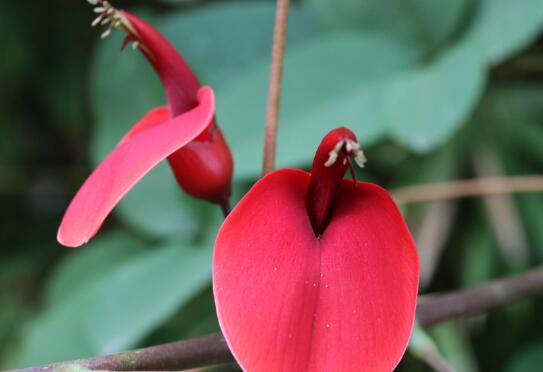
To know what to do when coral tree flowers get bugs, we first need to understand what kind of bug it is, so that we can deal with it in a targeted way, because the treatment methods for each pest and disease are different. The details are introduced in the text below, and those troubled by this can take a look.
II. Pest and Disease Control for Coral Tree Flowers
1. Leafhopper
The leafhopper mainly threatens the leaves of coral tree flowers. It gradually sucks the sap from the leaves, causing the plant to lose large amounts of nutrients and wither. When this pest appears on coral tree flowers, many pale mottled spots also appear on the leaves, which you can use to identify it.
Control method: When controlling this pest and disease of coral tree flowers, we can use a 1000-fold dilution of 50% fenitrothion emulsifiable concentrate to spray the affected plant, generally once every 5-7 days, and after 1-2 applications this pest can be completely eliminated.
2. Carpenter moth
This is an insect of the Cossidae family. In its larval stage it bores into the stems of coral tree flowers, gradually causing its branches to wither and die, so that it cannot bloom normally, and in severe cases even causing the entire plant to wither and die.
Control method: When controlling this pest and disease of coral tree flowers, we can first prune off the bored branches, then use a 100-200 fold dilution of 40% omethoate to spray the plant for control.
3. Leaf spot disease
Leaf spot disease is a disease caused by fungi. Its peak period is in spring and autumn each year, so everyone must pay extra attention during this time. When coral tree flowers develop this disease, many brown circular spots appear on the leaves, and over time they gradually spread to the petioles and stems, finally causing the plant to gradually shrivel and die.
Control method: When dealing with this pest and disease of coral tree flowers, we can use a 1000-fold dilution of 20% simeconazole · prochloraz to spray for control, generally once about every week, and after 1-2 applications it can be cured.
4. Anthracnose
Anthracnose mainly threatens the leaves of coral tree flowers. When it occurs, many semicircular spots appear at the leaf tips or leaf margins, appearing yellowish-brown or grayish-brown. When the air is too humid, vermilion needle-head-sized liquid spots appear on the leaves, and over time the plant gradually withers and dies.
Control method: For this pest and disease of coral tree flowers, we can use a 600-800 fold dilution of Guoguang Yintai wettable powder to spray, generally once every 7-10 days, and after 2-3 applications it can be cured.
5. Bark rot
Bark rot is a relatively common disease of coral tree flowers. The appearance of this disease follows no pattern and it can occur in any season. When it occurs, many small black spots appear on the trunk, and over time they gradually spread to the lower part, finally causing the plant to gradually rot.
Control method: When dealing with this pest and disease of coral tree flowers, we can use 1 bottle of Hushu Dajiangjun stock solution diluted with 30 kg of water, then apply it to the plant, generally once about every 15 days, and after 2-3 applications it can be cured.
6. Mosaic disease
This disease mainly harms the leaves of coral tree flowers. In the early stage of onset, the leaves become distorted and yellow streaks appear. Later, irregular necrotic spots appear on the leaves. In severe cases it may even prevent coral tree flowers from blooming.
Control method: To prevent and control this disease, you must do every step well from the start of cultivation. When selecting bulbs, choose those with strong resistance, and during cultivation be sure to frequently spray the plant with disinfectant to sterilize, and promptly replenish the nutrients of coral tree flowers to make them more resistant.
Coral Tree Pest and Disease Control
Coral tree, (scientific name: Erythrina variegata Linn.) Fabaceae, Erythrina genus, deciduous tree, about 20 m tall, bark gray, with conical prickles, flowering period March. The pod is moniliform, seeds red. Native to the coral reef coasts of tropical Asia and the islands of the Pacific. It is the city flower of Quanzhou, China, the city flower of Miyakojima, Japan, and the prefectural flower of Okinawa Prefecture. Coral Tree Pest and Disease ControlDuring indoor maintenance it is susceptible to scale insect infestation.
Control methods
A 1000-fold dilution of Jiesha can be used to spray the plant for control. If there are few potted plants at home, you can use a soft brush, toothpick, etc. to brush or scrape them off, or use an alcohol cotton ball to wipe off the insects. The second is chemical control. The suitable period is the early nymph hatching stage. During the peak egg hatching period, a 1500-fold dilution of 50% phoxim wettable powder can be sprayed. Currently, drugs for controlling mature scale insects such as Temik granules (use 3-5 g for a flower pot with a diameter of 25 cm) or 3% carbofuran granules (use about 20 g for a flower pot with a diameter of 25 cm) are scattered in the potting soil, or a 1500-fold dilution of 40% Supusha emulsifiable concentrate can be sprayed, all of which can achieve good results. Clivia is allergic to dimethoate and the like, so it must not be used.
What Is the Flower Language of Coral Tree Flowers? The Legend of Coral Tree Flowers / Prosperity and Vitality
Coral tree flower is a flowering plant with very high ornamental value, and it can be seen in many cities in our country. Like many flowering plants, it also has its own flower language. What is the flower language of coral tree flowers? What legends are there about coral tree flowers? Below, the editor will walk you through it.
I. The Flower Language of Coral Tree Flowers: Prosperity and Vitality, Auspiciousness and Wealth
As early as the Five Dynasties period in our country, the jiedushi Liu Congxiao, in order to expand the city walls of Quanzhou, once planted many coral tree flowers along the city. Later, when the coral tree flowers grew up, their flowers were red like fire, and thus they became a local feature famous at home and abroad. Later this plant was even designated the city flower of Quanzhou, so the flower language of coral tree flowers also represents prosperity and vitality, auspiciousness and wealth.
II. The Legend of Coral Tree Flowers
Legend one
In the old customs of some places in our country, people once used the flowering situation of coral trees to predict the harvest: if the flowering period in the first year was relatively late and the flowers were luxuriant, then they believed that the coming year would surely have a bumper harvest of all grains and prosperity of all livestock, otherwise the opposite; there is also a saying that if coral trees sprout first and then bloom each year, then that year will be abundant, otherwise the opposite. So the coral tree is also called "Ruitong" (auspicious tree).
It represents good fortune and happiness. Because of this, a small debate even arose during the Song Dynasty! One side of the debate was Ding Wei, who came to Quanzhou as a lianfangshi. He very much hoped to see the green leaves of the coral tree first, so that Quanzhou would have a ripe and plentiful harvest, so he once wrote this poem: "I heard the villagers speak of the coral tree, leaves first and then flowers foretell a plentiful year. Now that I have come here, I worry deeply for the people, and love only the green, not the red."
The other side of the debate was Wang Shipeng, who came to Quanzhou as the prefect. He held the same wish as Ding Wei, but he did not believe in that set of prophecies about flowers first or buds first. For this reason he also wrote a poem: "At first I see the branches thick with a myriad of green, then suddenly I am startled by fire umbrellas about to burn the sky. Whether flowers first or flowers later, the year is ripe either way; do not say people today do not love the red." Although there was a debate, what passed down among people was a much-told tale. Truly lovable public servants and lovable flowers.
Legend two
It is said that during the Five Dynasties, the jiedushi, in order to expand the city walls of Quanzhou, once planted coral trees all around the city. Later, the coral trees grew with luxuriant flowers and leaves, red like fire, and became a major feature of Quanzhou, and Quanzhou became famous at home and abroad because of this. Therefore, the coral tree flower became a symbol of Quanzhou and was designated the city flower of Quanzhou. Its meaning is: prosperity and vitality, auspiciousness and wealth, full of people's beautiful hopes for the future.
The people of Quanzhou love coral tree flowers and regard them as an "auspicious tree." Literati of past dynasties also left many fine lines chanting coral tree flowers. There is a poem that says: "At first I see the branches thick with a myriad of green, then suddenly I am startled by fire umbrellas about to burn the sky." This shows the magnificent scene when coral trees bloom. At places such as Kaiyuan Temple and the Huaqiao Building in Quanzhou, quite a few coral tree flowers are planted, and the beautiful city of Quanzhou is set off among the green leaves and red flowers of the coral trees.