How to propagate witch hazel? Seed propagation has a 95% survival rate
Witch hazel is a flowering plant with high ornamental value, and it can be seen in many regions of our country. As more people grow it in various places, questions about its propagation have also drawn considerable attention. How to propagate witch hazel? What are the propagation methods for witch hazel? Below, the editor will walk everyone through it.
1. How to propagate witch hazel: mainly by seed propagation
When it comes to how to propagate witch hazel, it is actually mainly by seed propagation. After countless trials by people, this propagation method still has a fairly high survival rate. However, to propagate successfully, the operation method is still very important. In addition, carefulness is needed. As long as everyone pays attention to these two points, the survival rate can reach as high as 95%.
2. Propagation methods for witch hazel (seed propagation)
1. Sowing time: spring and autumn
The sowing time of witch hazel still has a certain effect on its survival rate. Choosing a suitable time to sow it can improve the survival rate. We can choose this suitable time in spring and autumn, because the climate and environment in these two seasons are both relatively suitable for the growth of witch hazel, so relatively speaking the survival rate will also be higher.
2. Seed collection: collect in autumn
Seed collection is also a very important step. The fruit of witch hazel generally matures in autumn. At this time, we need to collect it together with the fruit and branch, then place it in the sun and expose it for 2-3 days. After the fruit shell cracks, we take out the seeds inside and store them, and then plant them the following year.
3. Soil selection: well-drained
Witch hazel is a plant with strong environmental adaptability. It can grow in either acidic or neutral soil. However, if you want it to grow more vigorously, it is generally best to choose loose, fertile sandy soil, because this kind of soil has better drainage and aeration, allowing the plant to breathe better and also absorb nutrients better.
4. Soil disinfection: stir-fry over high heat or expose to strong sunlight
After we have chosen the substrate, we cannot immediately sow witch hazel seeds. The substrate also needs to be disinfected to avoid pests and diseases in it being transmitted to witch hazel. When disinfecting, we can choose to break it up and spread it flat under strong sunlight for disinfection, or put it in a pot and stir-fry it over heat, so that if there are pests in the soil they will also be killed.
5. Seed germination stimulation: soak in warm water
Before sowing witch hazel, it is best to first soak the seeds in warm water at about 40°C for 1-2 days. When the seeds begin to absorb water and swell, take them out. This can stimulate the seeds and allow them to germinate more quickly after planting.
6. Sowing method: germination in 15-20 days
When we propagate witch hazel by sowing, we first need to evenly scatter the soaked seeds on the surface of the soil, then cover them with 1cm of soil and water them. When watering, it is best to use the immersion method: place the flowerpot half into water, let the water slowly seep up, and after about 15-20 days they can germinate.
Propagation methods for witch hazel
Propagation methods for witch hazel
The propagation of witch hazel is mainly by sowing. In order to increase variety diversity, cutting, grafting and other methods are occasionally used
Sowing and seedling raising
After the fruit matures in autumn, collect the fruiting branches, place them in the sun to dry for 2-3 days, and the fruit will crack open automatically. Take out the seeds and sow them. About half a month to around twenty days after sowing, the seeds basically germinate. Choose a time when the light is not very strong and uncover the covering grass. In addition, promptly carry out loosening the soil, weeding, topdressing, and other work afterward. During this period, pay attention to water and fertilizer management so as to cultivate healthy seedlings. After the seedlings lose their leaves until the following spring when they sprout, begin transporting the seedlings, carry out bare-root planting or transplanting, and complete the final planting.
Other propagation
For the propagation of witch hazel, seed sowing and seedling raising are mostly used. Grafting, cutting and other methods can also be used, but their propagation survival rate is not as good as sowing, so they are rarely adopted.
Witch hazel Hamamelis mollis Oliver Witch hazel illustrated guide: how to grow witch hazel / how to propagate witch hazel
Witch hazel profileWitch hazel Hamamelis mollis Oliver
How to grow witch hazel and precautions Introduction to witch hazel
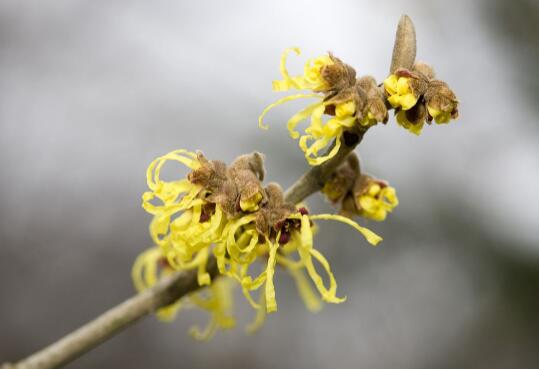
Witch hazel, also known as Muli xiang and Niuta guo, is a deciduous shrub or small tree of the order Rosales, family Hamamelidaceae, genus Hamamelis, up to 8 m tall; young branches have stellate hairs; old branches are smooth and bare; buds are long ovoid, and the broadly obovate leaves are beautiful in shape. It blooms before the leaves around February, with several flowers clustered in the leaf axils, golden yellow in color, and its golden petals are like threads, dancing gracefully and elegantly. It blooms in early spring and blossoms proudly in the snow, resembling wintersweet, hence the name. Because of its cold resistance, it is also called "honeysuckle flower." It is distributed in all provinces of the Yangtze River basin.
The young branches and terminal buds of witch hazel are densely covered with gray-yellow stellate hairs, leaves are alternate, and the broadly obovate leaves are beautiful in shape. It blooms before the leaves around February, with several flowers clustered in the leaf axils, golden yellow in color, and the petals are like threads, similar to wintersweet, hence it is called Jinlü mei. It is an important spring-flowering ornamental tree. It is suitable for solitary planting in a corner of a courtyard, beside a pond, by a stream, and at the edge of tree clusters. The flowering branches can be used as cut flowers and are also good material for making bonsai. The roots can be used as medicine.
Morphological characteristics of witch hazel
Witch hazel is a deciduous shrub or small tree, up to 8 m tall; young branches have stellate hairs; old branches are smooth and bare; buds are long ovoid, with gray-yellow hairs. Leaves are papery or thinly leathery, broadly obovate, 8-15 cm long and 6-10 cm wide, apex short and acutely pointed, base unequally cordate, upper surface slightly rough, with sparse stellate hairs, not shiny, lower surface densely covered with gray stellate hairs; lateral veins 6-8 pairs, the lowest pair of lateral veins has obvious secondary lateral veins, very prominent on the upper surface and raised on the lower surface; margin has wavy obtuse teeth; petiole 6-10 mm long, covered with hairs, stipules early deciduous.
Capitulate or short spicate inflorescences are axillary, with several flowers, without pedicels, bracts ovate, inflorescence stalk short, less than 5 mm long; calyx tube short, adnate to the ovary, calyx teeth ovate, 3 mm long, persistent, all covered with stellate hairs; petals ribbon-like, about 1.5 cm long, yellow-white; stamens 4, filaments 2 mm long, anthers nearly as long as filaments; staminodes 4, apex truncate; ovary hairy, style 1-1.5 mm long.
Capsule ovoid, 1.2 cm long, 1 cm wide, densely covered with yellow-brown stellate hairs, calyx tube about 1/3 the length of the capsule. Seeds elliptical, about 8 mm long, black, shiny. Flowering period May.
Slender branches densely covered with stellate hairs; naked buds stalked. Leaves obovate, 8-15 cm long, apex acute, base oblique-cordate, margin wavy-toothed, surface slightly rough, back densely covered with hairs, lateral veins 7-9 pairs; petiole 6-10 mm long. Spicate inflorescences short, axillary with several small golden-yellow flowers, flowers bisexual, petals 4, narrow and long like ribbons, 1.5-2 cm long, pale yellow, reddish at the base, fragrant; calyx back has rusty hairs, stamens 4, filaments 2 mm long, staminodes 4, alternate with stamens, apex truncate; ovary nearly superior, 2-loculed, each locule with 1 pendulous ovule, styles 2, very short. Capsule ovoid, dehiscing into two valves, about 1.2 cm long. It blooms before the leaves from February to March; the fruit matures in October. The same genus also includes red-flowered witch hazel, with round leaves and red flowers, extremely beautiful.
Ecological habits of witch hazel
Witch hazel mostly grows on mountain slopes, stream valleys, edges of broad-leaved forests, and in thickets; it is a high-mountain tree species, with vertical distribution often at an altitude of 600-1600 m. Witch hazel is a warm-region tree species with relatively strong cold resistance. It can grow in the open field at -15°C. It likes light, but is relatively shade-tolerant in the juvenile stage and can grow under semi-shade conditions. It has no strict requirements for soil and can grow in acidic and neutral soils. It grows best especially in fertile, moist, loose, well-drained sandy soil.
It is produced in Jiangxi, Hubei, Hunan and other provinces; it mostly grows on mountain slopes, stream valleys, edges of broad-leaved forests, and in thickets; it is a high-mountain tree species, with vertical distribution often above an altitude of 1000 m. It likes light, is tolerant of semi-shade, likes a warm and humid climate, is relatively cold-resistant, has no strict requirements for soil, and often grows in mountain forests rich in humus.
Cultivation techniques of witch hazel: cultivation and care
For witch hazel shaping and pruning, it is advisable to keep the tree height below 2 m. After flowering, pruning until before sprouting is best. About 7 days after pruning, flower buds differentiate. After September, disordered branches can be pruned to facilitate the development of normal branches. Clustered branches should be cut off from the base.
How to grow witch hazel
Witch hazel is commonly propagated by sowing and grafting. For shaping and pruning, it is advisable to keep the tree height below 2 m. After flowering, pruning until before sprouting is best. About 7 days after pruning, flower buds differentiate. After September, disordered branches can be pruned to facilitate the development of normal branches. Clustered branches should be cut off from the base.
Propagation
Witch hazel is commonly propagated by sowing and cutting. For sowing, collect seeds in October, store them indoors, and sow the following spring; they germinate in about 20 days. For cutting, it is best to carry out in the plum rain season, using mature current-year branches 10 cm long, inserted into a sand pot, shaded and misted; they root 30-40 days after cutting.
Cultivation
Before planting witch hazel, properly prune the aboveground part, otherwise it is not easy to survive, and it can bloom the following year. It blooms every year from April to May. When new shoots, young leaves, and flowers sprout and open at the same time, keep the soil moist. Apply phosphate fertilizer once during flowering. From after flowering to late autumn, properly prune and shape it to maintain a graceful form.
Propagation methods of witch hazel
For the propagation of witch hazel, seed sowing and seedling raising are mostly used.
Seed propagation
After the fruit of witch hazel matures in autumn, collect it together with the fruiting branches, place it in the sun to dry for 2-3 days, the fruit shell cracks, take out the seeds, and then use them immediately to the extent that soil is not visible. About half a month to 20 days after sowing, when germination and emergence reach 1/3-1/2, gently remove the covering grass on a cloudy day or in the evening of a sunny day. After that, promptly do well in loosening the soil, weeding, topdressing, drought resistance and other work, and good seedlings can be cultivated. During the period after the seedlings lose their leaves until before the following spring when they leaf out, begin transporting the seedlings, carry out bare-root planting or transplanting, and a high survival rate can be obtained. Asexual propagation methods such as layering (air layering), grafting, and cutting can also be used to increase the population.
Pest and disease control of witch hazel: diseases
Witch hazel has leaf spot and anthracnose, which can be sprayed with 65% zineb wettable powder 600 times solution. It is also harmed by nettle grubs and tortrix moths, which can be killed by spraying with 10% permethrin emulsifiable concentrate 2000 times solution.
Diseases include leaf spot and anthracnose, which can be sprayed with 65% zineb wettable powder 600 times solution. It is also harmed by nettle grubs and tortrix moths, which can be killed by spraying with 10% permethrin emulsifiable concentrate 2000 times solution. It is often harmed by bagworms and nettle grubs; adults can be trapped and killed with light, and larvae can be killed by spraying with trichlorfon solution.
Pests
Witch hazel is often harmed by bagworms and nettle grubs; adults can be trapped and killed with light, and larvae can be killed by spraying with trichlorfon solution.
Distribution range of witch hazel
Witch hazel is distributed in Sichuan, Hubei, Anhui, Zhejiang, Jiangxi, Hunan and Guangxi and other provinces and regions.
Variety classification of witch hazel: variety types
1. North American witch hazel
North American witch hazel, also known as Virginia witch hazel, is a deciduous shrub in the family Hamamelidaceae, genus Hamamelis. It is native to eastern North America, from Nova Scotia in Canada westward to Minnesota in the United States, and southward to central Florida and eastern Texas.
North American witch hazel is a large deciduous shrub, with stems emerging from the base of the plant, branches densely grown, and the plant height can grow to six meters tall, with very few individuals sometimes able to grow to about ten meters. The bark is light brown, smooth on the surface, scaly-cracked, flaking in scales when peeling, and the inner bark is red-purple. New small branches initially have short soft hairs, then become smooth and hairless, at which time the branch surface is light orange-brown, and some small white dots are scattered on the branches, and finally the branches become dark brown or red-brown. Leaf buds are acute, apex slightly curved in sickle shape, surface with fine soft hairs, leaf buds light brown.
Leaves broadly elliptical, leaf length 3.7-16.7 cm, leaf width 2.5-13 cm, leaf base oblique, the two sides of the base asymmetrical, leaf tip acute or rounded, leaf margin wavy-toothed or shallowly round-lobed, petiole short and stout, 0.6-1.5 cm long, leaf midrib thick and hairy, lateral veins branching from the midrib, lateral veins six to seven pairs. Young leaves are involute in the leaf bud; mature leaves have a dark green upper surface, and the lower surface is lighter in color than the upper surface. In autumn the leaf color turns yellow, and there are red-brown spots on the leaf surface.
Stipules lanceolate, acute; after the leaves unfold, the stipules soon fall off. Flowers pale yellow to bright yellow, rarely orange or red, with four ribbon-shaped petals, petals 1-2 cm long, stamens short, four, flowering period from mid-autumn continuously to late autumn. Calyx deeply lobed, four, exterior hairy, interior orange-brown, calyx persistent, borne at the base of the ovary.
The fruit is a woody capsule, 1-1.4 cm long. The fruit matures only one year after pollination. When mature, the fruit bursts open from the top and shoots out two shiny black seeds, and the seeds can be ejected to more than ten meters away from the mother tree. North American witch hazel is very similar to its close relative spring witch hazel (Hamamelis vernalis), and the two can be distinguished by flowering period: North American witch hazel flowers from mid-autumn to late autumn, while spring witch hazel flowers from mid-winter to early spring.
Dowsing rods
The forked branches of North American witch hazel are considered excellent material for making dowsing rods (divining rods). The bark extract has an astringent effect and is added to cosmetics as an astringent. The Pond's skin care series produced by Unilever contains this ingredient. Native peoples of the Americas used the bark and leaves to treat skin inflammation. The wood is light red-brown, the sapwood nearly white, the texture fine, the wood heavy and high in hardness, with a density of 0.68.
2. Small-leaved witch hazel
Deciduous small tree; young branches initially have stellate soft hairs, later becoming smooth and bare, dark brown after drying, without lenticels; buds naked, small, covered with hairs. Leaves thinly leathery, obovate, 4-6.5 cm long, 2-4.5 cm wide, widest above the middle, apex obtuse, base rounded, truncate or slightly cordate, the two sides nearly symmetrical; upper surface green, slightly dull after drying, somewhat glossy, except for the midrib and lateral veins with a few stellate hairs, the rest smooth and hairless; lower surface light brown, with stellate soft hairs; lateral veins about 4-5 pairs, slightly sunken on the upper surface and raised on the lower surface, the first pair of lateral veins without second-order branch lateral veins; margin near the apex with several wavy shallow teeth, without tooth tips, the lower half entire; petiole 5-7 mm long, with stellate hairs; stipules early deciduous.
Small-leaved witch hazel is an endemic species of East China and a national first-class protected tree species. An ancient plant from the same era as the dinosaurs, it is a deciduous tree up to 8 m tall, with a trunk diameter of up to 40 cm. The trunk is twisted and uneven, and the bark peels off in irregular thin flakes. It is produced in Zhejiang, Jiangsu, and Anhui.
Ornamental value: The tree form is quaint, the trunk shape vigorous, and the leaves turn yellow in autumn. It can be used as a landscape tree and is also an excellent bonsai tree species.
Economic value: The material is hard, the grain straight, the structure fine and dense, the cut surface smooth, light brown, glossy. It can be used for joinery, handicrafts, furniture, etc.
Scientific research value: An endemic species of East China and a national first-class protected tree species. An ancient plant from the same era as the dinosaurs, it has important value for studying the flora of East Asia and North America and the phylogenetic development of Hamamelidaceae.
Landscape uses of witch hazel
Witch hazel has peculiar flower shapes and is fragrant. It blooms before the leaves in early spring, and the yellow slender petals are like golden threads, covering the branches and making it very endearing. It is often cultivated in gardens at home and abroad, and some good varieties have appeared. It is one of the famous ornamental flowering trees. It is very suitable at the corners of courtyards, beside ponds, by streams, among rocks, and at the outer edges of tree clusters. In addition, the flowering branches can be used as cut flowers for vase arrangement. If you want to force flowering, cut the branches between December and the following January and place them in a vase in a greenhouse at about 20°C, and they can bloom after about 10-20 days.
Medicinal or dietary therapeutic value of witch hazel
The medical information and health dietary therapy information on Hugarden Network is for reference only and cannot be used as a basis for diagnosis or medical treatment. Any health problem should be consulted with professional medical personnel, and the treatment of any disease should follow a doctor's advice.
Ultimate flower-protecting task: Love yourself, start from reality, and strictly follow the doctor's advice. For illness, do not be careless, do not delay, do not give up hope, face it bravely, warm the silent world with love, and care for the flower field in your heart with your heart.
Medicinal value of witch hazel
Nature and flavor: sweet; neutral.
Meridian tropism: spleen meridian.
Functions and indications: supplement qi. Mainly for fatigue and lack of strength from overexertion.
Usage and dosage: oral administration: decocted in soup, 15-30 g; fresh product 60-90 g.
Note: When taking the medicine, avoid sour, spicy, mustard greens, radish, etc.
Chemical constituents: contains kaempferol, quercetin, astragalin, etc.
Effects and uses of witch hazel: ornamental value
Witch hazel is an ornamental flowering tree with an elegant tree form. The crown is spherical, ovate, or broadly spherical. In particular, its flowering period is early, from winter to early spring, exactly the period of the year when few flowers bloom. Its petals are slender and soft, and the flower shape is graceful and charming, with a unique appeal; the flower color is bright and vivid, from pale yellow to orange-red, in different shades; it blooms before the leaves, has a pleasant fragrance, a light tree form, and beautiful floral appearance, making it especially striking in winter courtyards.
It is suitable for solitary planting, to appreciate the peculiar petals and graceful tree posture. If matched with landscape stones and flowers and grasses, one tree makes one scene, naturally stirring emotion. It can also be planted in clusters or groups. During the flowering season, the whole tree is golden yellow, brilliant like rosy clouds, and magnificent.
It can serve as an important early-spring flowering tree in scenic areas and urban and rural landscaping construction. It can be combined with many flowering trees, such as plum, peach, apricot, cherry, wintersweet, paper bush, and redbud, and can achieve good results in greening, flowering, and fragrance enhancement of the ecological environment.
Beauty value
Witch hazel contains various tannins such as Ellagtannin and Hamamlitannin, which can regulate sebum secretion and have moisturizing and brightening effects. It promotes lymphatic blood circulation and can specifically address morning eye puffiness and dark circles. It has calming and soothing effects and improves chapping, sunburn, and acne. It can effectively help the skin's nighttime regeneration ability. It has excellent effects in removing eye bags, relaxing, and soothing oily or sensitive skin. It has soothing, astringent, antibacterial, and anti-aging effects. Because of its remarkable astringent oil-control and bactericidal effects, it is the obvious choice for adolescent youths or skin with relatively severe oiliness.
Specific effects
1. Soothing
Witch hazel contains special soothing factors. It can soothe unstable skin, help the skin return to a calm state, maintain metabolic balance, and eliminate skin discomfort.
2. Astringent
For adolescent youths or skin with relatively severe oiliness, the astringent effect of witch hazel is obvious. It can control oil secretion, help regulate the skin's water-oil balance, effectively increase the skin's moisture content, balance pH, and shrink pores.
3. Antibacterial
Witch hazel has special effects on fungal infections. Patients with psoriasis, eczema, varicose veins, or hemorrhoids can use witch hazel extract in a sitz bath to soak and improve skin conditions.
4. Anti-aging
Witch hazel extract can significantly reduce the content of malondialdehyde produced in tissues by strong ultraviolet radiation, can prevent skin inflammation caused by exposure to ultraviolet rays, and reduces free radical damage caused by ultraviolet irradiation. It has an anti-aging effect.
Flower language of witch hazel
Flower language of witch hazel: inspiration.
Witch hazel began to be used several hundred years ago. At first, people used it as a skin care product, and it can play an anti-aging role.
The flower language of witch hazel is inspiration. When witch hazel blooms, it opens before the leaves in early spring. Its yellow and slender petals are like golden threads, hanging all over the branches, very endearing. Especially when dancing in the wind, it gives people a sense of movement even more, so its flower language is inspiration.
Witch hazel pictures