Forsythia spring sowing method and planting techniques: seedlings emerge in 8-9 days
Among the propagation methods for forsythia, sowing is a fairly commonly used one. This method has been tested countless times, so the survival rate is relatively high. Of course, the prerequisite is that you must master the correct sowing method. So how do you sow forsythia? What are the planting techniques for forsythia? Below, the editor will walk you through it.
I. How to sow forsythia
There are many things to pay attention to when it comes to how to sow forsythia, such as seed collection, storage and germination, and soil selection, all of which need to be done according to requirements so that the survival rate will be high. The specific forsythia planting techniques are given below, and interested friends can take a look.
II. Forsythia planting techniques
1. Seed collection, harvest from September to October
Forsythia fruit generally gradually matures from mid-September to early October each year. At this time we need to harvest it to prevent the seeds from falling off on their own after maturing. Generally, collect fully developed, plump, large and heavy forsythia fruit, then spread it thinly in a ventilated and shaded place and thresh it after drying in the shade. After careful selection and removal of impurities, choose neat, plump seeds free of pests and diseases, store them for seed, and wait until the following spring to plant.
2. Substrate selection, drainage must be good
Before planting forsythia, we first need to choose soil. Although this plant does not have high requirements for soil, choosing suitable soil is still very helpful for its growth. Generally, it is best to choose loose, fertile humus soil as the substrate. This kind of soil has good drainage and air permeability and is less prone to water accumulation.
3. Substrate disinfection, sun exposure or pan-frying
After choosing the substrate for forsythia, we also need to disinfect it to prevent pests and diseases from lurking in it. When disinfecting, we can break it up and put it in the sun to disinfect it, or put it in a pot and heat it while stirring so that any pests and diseases are killed by the heat.
4. Seed germination, soaking in warm water
Before planting forsythia, we can also treat its seeds to promote germination. First, we can choose mature, plump seeds and soak them in warm water at about 30°C for about 4 hours. After removing them, mix them with 3 times their amount of wet sand, put them in a wooden box or small vat, cover the top with plastic film, and place it in a wind-sheltered, sunny spot. Turn them twice a day and keep them moist often. After more than 10 days, the seeds sprout and can be sown.
5. Planting method, seedlings emerge in 8-9 days
The method of planting forsythia is actually relatively simple. First, apply an appropriate amount of base fertilizer to the potting soil, then evenly scatter the seeds on the soil surface, then cover them with 1-2 cm of soil and water. When watering, be careful to water thoroughly at one time. After that, seedlings will emerge in about 8-9 days.
How to sow forsythia
How to collect forsythia seeds
When collecting seeds, choose superior mother plants that are robust in growth, densely branched, with plump flowers and fruit, and free of pests and diseases.
Pay attention to observing the time of flowering and fruiting, grasp the suitable seed collection time, and avoid the seeds falling off on their own after maturing.
Generally, seed collection is done from mid-to-late September to early October by collecting mature fruit. Collect fully developed, plump, large and heavy forsythia fruit, then spread it thinly in a ventilated and shaded place and thresh it after drying in the shade.
After careful selection and removal of impurities, choose neat, plump seeds free of pests and diseases and store them for seed.
How to store forsythia seeds
Seeds stored under different conditions have different survival rates. Seeds stored in a desiccator have a relatively high germination rate.
If stored in moist sand, the seeds will have already germinated one after another during storage, so the seedling emergence rate in the later sowing period is not as high as that of desiccator storage.
How to sow forsythia seeds
Forsythia seeds germinate easily at higher temperatures, so sowing is generally arranged in spring or winter. Spring sowing is in early to mid-April, and winter sowing is carried out before the soil freezes.
Because the seed coat of forsythia seeds is relatively hard, if sown directly without pretreatment, it takes more than 1 month to germinate and emerge. Therefore, the seeds can be treated to promote germination before sowing.
Choose mature, plump seeds and soak them in warm water at about 30°C for about 4 hours. After removing them, mix them with 3 times their amount of wet sand, put them in a wooden box or small vat, cover the top with plastic film, and place it in a wind-sheltered, sunny spot. Turn them twice a day and keep them moist often. After more than 10 days, the seeds sprout and can be sown.
If the soil is relatively dry before sowing, water it first, mix fine sand into the seeds, and scatter them evenly into the soil. After covering with soil, press lightly. The soil covering must not be too thick, generally about 1 cm, and then cover with grass to keep it moist.
Seeds that have been treated to promote germination can emerge 8 or 9 days after sowing. When the seedlings are 10 cm tall, thin them to a set spacing. In early April of the second year, when the seedlings are 30 cm tall, they can be transplanted.
What kind of plant is forsythia, and how is it grown? Forsythia cultivation and planting techniques
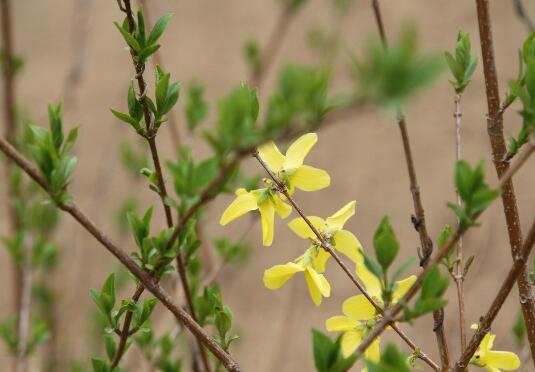
Image: forsythia in bloom
[Common question] What kind of plant is forsythia, and how is it grown?
[Expert answer]
Introduction:
Forsythia is commonly known in Hong Kong, China as "yichuanjin" (a string of gold). It is a deciduous shrub in the genus Forsythia of the family Oleaceae. Forsythia blooms in early spring before the leaves appear. The flowers have a faint, alluring fragrance, and the branches are full of golden yellow, bright and lovely. It is an excellent early-spring ornamental flowering shrub. The plant is about 3 m tall, with clustered branches; the branchlets are yellow, arching and drooping, and hollow. The leaves are opposite, simple or 3-foliolate, ovate or ovate-elliptic, with toothed margins. The corolla is yellow, with 1-3 flowers born in the leaf axils; the fruit is ovoid, ovate-elliptic, or oblong-elliptic, with a beaked, gradually pointed tip and sparsely scattered lenticels on the surface; the fruit stalk is 0.7-1.5 cm long. The flowering period is March-April, and the fruiting period is July-September. It grows in hillside thickets, under forests, or in grass, or in sparse forests in valleys and mountain gullies, at an altitude of 250-2200 m. The fruit can be used as medicine. It is produced in Hebei, Shanxi, Shaanxi, Shandong, western Anhui, Henan, Hubei, and Sichuan in China.
How is forsythia grown? Forsythia cultivation and planting techniques:
1. Site selection and land preparation
For the seedling-raising land, it is best to choose sandy loam with deep soil layers, loose and fertile soil, and good drainage; for cutting seedling-raising land, it is best to use sandy soil (with good permeability, making rooting easy), and it should be close to a water source for convenient irrigation. Choose mountainous land or gently sloping land with thicker soil layers, fertile and loose soil, good drainage, and shelter from wind and sun for block planting, so as to facilitate cross-pollination between different plants and improve the fruiting rate of forsythia. Generally, holes are dug for planting. It can also be planted sporadically in wasteland, roadside, field edges, field corners, in front of and behind houses, and in gaps in courtyards. After the land is selected, before sowing or before final planting, plow the land deeply and apply sufficient base fertilizer, applying 3000 kg of base fertilizer per mu, mainly barnyard manure, evenly scattered on the ground. Plow deeply about 30 cm, level and harrow finely to make beds. The beds are 1.2 m wide and 15 cm high, with a 30 cm wide bed ditch, and the bed surface is shaped like a tile back. The planting holes should be dug in advance. Plant after applying sufficient base fertilizer.
2. Seedling raising
Forsythia can be propagated by methods such as seeds, cuttings, layering, and division. In production, seed and cutting propagation are the main methods.
Seed seedling raising:The seed coat of forsythia seeds is relatively hard. Without pretreatment, if sown directly in the nursery, it takes more than 1 month to germinate and emerge. Therefore, seed germination treatment can be carried out before sowing. Newly introduced areas can use this method. The specific method is: choose mature, plump seeds and soak them in warm water at about 30°C for about 4 hours. After removing them, mix them with 3 times their amount of wet sand, put them in a wooden box or small vat, cover the top with plastic film, and place it in a wind-sheltered, sunny spot. Turn them twice a day and keep them moist often. After more than 10 days, the seeds sprout and can be sown. After sowing, seedlings can emerge in 8-9 days, about 20 days earlier than seeds without pretreatment. If the land is dry, water the bed first, and sow when the water has seeped down and the surface soil is slightly loose. Spring sowing is around "Qingming", and winter sowing is before the soil freezes (the seeds do not need treatment and can emerge the next year). When sowing, on the prepared bed surface, open furrows 1 cm deep at a row spacing of 20-25 cm, mix the seeds with fine sand, evenly scatter them into the furrows, cover with soil, rake level, and press lightly. Seedlings can emerge in 10-15 days. The seeding rate is about 2-3 kg per mu. The soil covering must not be too thick, generally about 1 cm, and then cover with grass to keep it moist. After the seeds emerge, remove the grass immediately. When the seedlings are 10 cm tall, thin them to a plant spacing of 10 cm. In early April of the second year, when the seedlings are about 30 cm tall, they can be transplanted to the field.
Layering propagation:This is done in spring by pressing the drooping branches of the plant into the soil and burying them, then cutting them from the mother plant the following spring for final planting. Generally, cutting propagation is the main method. Seedlings should be planted in fertile soil that is sunny and well drained. If the site is chosen improperly and the soil is barren, growth will be slow and yield low. After flowering each year, dead branches, weak branches, and overly dense or overly old branches should be pruned, and attention should be paid to fertilizing around the roots.
Cutting propagation:Cuttings can be taken after leaf fall in autumn or before germination in spring, but spring is better. Choose robust young branches 1-2 years old, cut them into 20-30 cm long cuttings. The cut at the upper end should be 0.8 cm from the first node, and each cutting must have 2-3 nodes. Then cut the lower end near the node into a flat surface. To improve the survival rate of cuttings, bundle the cuttings into groups of 30-50 and soak the base of the cuttings (at 1-2 cm) for 10 seconds in 500 ppm ABT rooting powder or 500-1000 ppm indolebutyric acid solution, then take them out and let them dry before inserting. In the south, cuttings are mostly taken in the open field in early spring, while in the north they are mostly taken in summer. Before inserting the cuttings, rake the seedbed finely and level it, make a high bed 1.5 m wide, and insert the cuttings obliquely into the bed at a row and plant spacing of 20×10 cm, inserting them 18-20 cm deep into the soil, leaving the topmost node of the branch above the ground, then cover with soil and press firmly. In dry weather, water frequently to keep the soil moist, but not too wet, otherwise the part of the cutting in the soil will turn black and rot. With normal management, the cutting seedling formation rate can be as high as 90%. Strengthen field management, and by autumn the seedlings can reach more than 50 cm in height. They can be dug and planted in holes in the spring of the following year.
Division propagation:After "Shuangjiang" or before germination in spring, dig out the young shoots growing beside trees more than 3 years old with soil and transplant them, or dig out the entire tree and divide it for transplanting. Generally, one plant can be divided into 3-5 plants for planting. The key to using this method is to ensure that each small divided plant has some fibrous roots, so the survival rate is high and results are quick.
3. Final planting
Before planting, first apply fertilizer in the holes, applying decomposed barnyard manure or farmyard manure and an appropriate amount of compound fertilizer per hole (see site selection and land preparation). When planting, make the seedling roots spread out and firm the soil layer by layer. The soil covering the planting point should be higher than the hole surface to prevent the hole soil from sinking after rain, which is unfavorable for survival and growth. To overcome self-incompatibility within the same forsythia plant and improve the pollination and fruiting rate, when planting it is necessary to rationally configure the planting points of long-style-flower and short-style-flower plants. According to relevant reports, plants of these two different flower types growing simultaneously in different environments differ greatly in fruiting rate. Under alternating cultivation (row interplanting) conditions, the fruiting rate is 63.9%, while under natural conditions
in plots with more fruit, the fruiting rate is only 47%. Therefore, changing the same cultivation to mixed planting configuration between plants results in a higher fruiting rate, because mixed planting between plants places long-style-flower plants and short-style-flower plants surrounded by each other. Compared with row interplanting, pollination is less affected by wind direction, slope aspect, and position up or down the slope, and the pollination rate can be significantly improved. In mixed planting between forsythia plants, the configuration of long-style-flower plants and short-style-flower plants in two adjacent rows is different. The two should be staggered vertically and horizontally, that is, the plants configured in single rows with single rows and double rows with double rows are consistent. Except during the flowering period, long-style-flower forsythia plants and short-style-flower plants are not easy to distinguish in appearance, especially seedlings. To meet production needs, when they bloom, they can be propagated separately by methods such as cuttings, layering, and division, among which cuttings are mainly used, because their propagation material has a wide source, high utilization rate, and a large propagation coefficient, and can meet afforestation needs. In this way, the problem of insufficient seedlings for mixed planting of the two different flower types can be solved.
4. Cultivation and weeding
During the seedling stage, loosen the soil and weed frequently. After final planting, cultivate and weed once each winter beside the forsythia trees. Weeds around the plants can be cut down or pulled out by hand.
5. Fertilization
During the seedling stage, apply thin fertilizer frequently, or open furrows between rows. After final planting, apply decomposed barnyard manure, cake fertilizer, or farmyard manure each winter together with loosening the soil and weeding. The amount is 2 kg per young tree and 10 kg per fruiting tree, applied by digging holes or opening furrows beside the forsythia plants, then covering with soil and banking soil around the roots to promote robust growth of young trees and more flowering and fruiting. Where conditions permit, fertilization can be increased once before flowering in spring.
After forsythia trees are pruned, apply 2 kg of plant ash, 200 g of superphosphate, 250 g of cake fertilizer, and 100 g of urea per plant. Apply in a ring-shaped furrow under the canopy, then cover with soil and bank soil to preserve moisture. In the early stage, short-stalk crops can be intercropped between the rows and plants of forsythia.
6. Drainage and irrigation
Pay attention to keeping the soil moist, irrigate by furrow or water in time during dry periods, and open ditches for drainage during the rainy season to avoid root rot from water accumulation.
7. Shaping and pruning
After final planting, when young forsythia trees reach about 1 m tall, after leaf fall in winter, cut off the top shoot at 70-80 cm above the ground on the main trunk. Then in summer, through pinching, encourage more branching. From these, choose 3-4 well-developed lateral branches in different directions and cultivate them as main branches.
Later, choose and retain 3-4 strong branches on the main branches and cultivate them as secondary main branches, and on the secondary main branches, develop lateral branches. Through several years of shaping and pruning, form a natural open-center tree shape with a low trunk and low crown, hollow inside and rounded outside, ventilated and light-transmitting, with sparse small branches, and earlier fruiting.
At the same time, each winter, cut off dead branches, crossing and wrapping branches, overlapping branches, crossing branches, weak branches, as well as vigorous water sprouts and diseased and pest-infested branches. During the growing period, appropriate thinning and short cutting should also be carried out. For fruiting branch groups that have already flowered and fruited for many years and begun to age, short cutting or heavy pruning (that is, cutting off 2/3 of the branch) should also be carried out, which can promote strong branches below the cut and restore tree vigor and increase the fruiting rate.
[Editor's comment] Forsythia does not have strict requirements for soil and is very easy to grow. It is a medicinal plant. Its fruit is used as medicine to clear heat and detoxify, and is mainly used to treat wind-heat common cold, sore throat, acute nephritis, and other diseases. It can also survive on dry land and is cold-tolerant and barren-tolerant. Its only fear is waterlogging, so special attention must be paid to drainage and irrigation to avoid water accumulation causing root rot and other phenomena. The above is the forsythia cultivation and planting techniques and analysis of various key points introduced to you by the First Agricultural Economics editor. We hope it is helpful to you.