How does the flame tree propagate? Mainly by seed propagation
The flame tree (Delonix regia) is a fairly common flowering plant in people's daily lives, with high ornamental value, and many people grow it in various places. As more people grow it, questions about its propagation have also drawn concern. How does the flame tree propagate? What are the propagation methods of the flame tree? Let's take a look below.
I. How does the flame tree propagate? Seed propagation
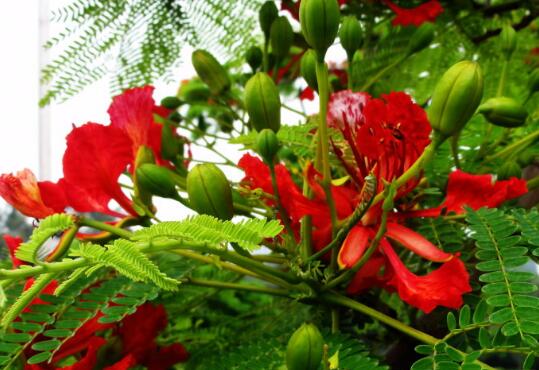
When it comes to how the flame tree propagates, it is mainly by seed propagation. After countless trials by people, this method still has a fairly high survival rate. However, when sowing, there are many points we need to pay attention to, such as the sowing time, the choice of substrate, and the pre-sprouting treatment of the seeds. The details are described in the following text, and interested friends can take a look.
II. Propagation methods of the flame tree
1. Sowing time: sow in spring
When we propagate the flame tree by sowing, choosing a suitable time is very important. Its seeds generally mature around December each year. At this time, we can collect the pods and take out the seeds inside for dry storage, then sow them the following spring.
2. Substrate selection: good drainage is required
Before sowing the flame tree, we must first choose a substrate. In this regard, we need to be careful and choose a substrate suitable for its growth, so that the survival rate will be relatively high. In this respect, it is generally best to choose a loose, fertile sandy loam rich in organic matter as the substrate. This kind of soil has good drainage and air permeability, allowing the plant to absorb nutrients better and making waterlogging less likely.
3. Substrate disinfection: high-temperature disinfection
After choosing the substrate for the flame tree, we also need to disinfect it to prevent pests and diseases from lurking in it. There are two specific disinfection methods. One is that we can break it up and put it under the sun to bake for disinfection. The other is that we can put it in a pot and stir-fry it over high heat, so that any pests and diseases can be scalded to death.
4. Seed pre-sprouting: soak in warm water
If we want the flame tree seeds to germinate faster, we can also pre-sprout the seeds before sowing. First, we can soak the seeds in warm water for 1-2 days, changing the water 1-2 times during that period. When the seeds begin to absorb water and swell, take them out and plant them.
5. Sowing method: germination in 6-7 days
Before planting the flame tree, we must first apply an appropriate amount of base fertilizer into the substrate, then evenly scatter the seeds on the soil surface. After scattering, cover them with 1-2 cm of soil and then water. When watering, make sure to water thoroughly. After that, they will begin to germinate in 6-7 days, and seedlings can emerge in more than 20 days.
What is the flower language of the flame tree? Flame tree prices
Content summary: The flame tree, also known as the shadow tree, fire tree, or red-flowered poinciana, is a tall large tree suitable for growing in tropical environments. In China, it is distributed only in the southern and southwestern regions. So, what is the flower language of the flame tree? How are flame tree prices?
[How are flame tree prices]
The flame tree is cultivated all over the world. Because of its elegant tree shape and beautiful, striking leaf form, it is also known as the most vividly colored tree in the world. For this reason, the cultivation efforts for the flame tree and its market price have also been continuously raised.
▌Price trends
The best propagation methods for the flame tree are mainly grafting and cuttings, but the detailed price of the flame tree needs to be distinguished according to variety and place of origin.
According to the latest market information feedback, the price of a single flame tree has reached as high as 10383.33 yuan, with a tree age of about over a hundred years.
Seeds: The price of a single flame tree is too high, so choosing seed propagation is relatively common. The average market price of flame tree seeds is about 160 yuan per jin, and one jin contains about four hundred seeds.
Seedlings: The planting seedlings sold on the market are generally under 3 years old, with a market unit price of about 10-35 yuan, while according to wholesale market information, the lowest price range is 5-30 yuan.
[The flower language of the flame tree]
Flame tree flower language: parting, youth, fiery passion, passion, four years.
▌Status reflected
➊National tree----The flame tree's best growing environment is tropical. It is relatively common in African regions and is also the national tree of Madagascar, where it has extraordinary significance.
➋City tree----The flame tree also enjoys extraordinary status in China. It is the city tree of Xiamen, Taiwan, China, Panzhihua, Shantou, and other cities, with the quoted meaning of "fiery youth".
➌School tree----National Cheng Kung University in Taiwan, China, and Xiamen University both regard the flame tree as their school tree, implying "the feathers of the phoenix, flying in the blue sky".
▌Special meanings
In the Taiwan region of China, the flame tree blooms in June. When it blooms, the fiery appearance of the flame flowers cleverly complements Tainan City's nickname "Phoenix City", so the flame tree has the beautiful local symbol of "standing alongside the singing of cicadas."
The flame tree was once also the city flower of Panzhihua. Since the Qing Dynasty, the flame tree was planted in large numbers in Panzhihua, and in 1962 it was officially designated the city flower of Panzhihua. But in 1990, more than about 50% of the local flame trees began to grow large numbers of mites, causing a relatively large impact on Panzhihua's economy and ecological environment. They were later cut down manually, and their status as the city tree was also replaced by the kapok tree.
▌Origin of the name
When the flame tree blooms, red flame flowers spread across the entire tree. The bright red or orange-red flowers bloom in tray-like and top-like shapes, giving the overall appearance a feeling of a phoenix soaring. The magnificent scene of the whole tree even has a stunning beauty like a phoenix rising from fire, hence the name flame tree.
Summary: The flame tree is a national first-class protected plant, and it is forbidden to cut it down at will. It is mainly grown for ornamental purposes. The flowering period of the flame flower is June-July. If you want to see its splendor, it is best to go during the flowering period.
How to grow Monilaria moniliforme seeds, propagation methods, pictures of Monilaria moniliforme bunny after growing up
Monilaria moniliforme looks very much like rabbit ears, so many friends are used to calling it the Monilaria moniliforme bunny. Not only is the name cute, but its decorative effect is also good. So how do you grow Monilaria moniliforme? How does Monilaria moniliforme propagate?
How to grow Monilaria moniliforme seeds
1. Sowing time
The main sowing season in China is after September in autumn. Of course, it can also be sown in winter or spring. Generally, the temperature is best controlled at 12 to 15 at night and 24 °C to 27 °C during the day.
2. Sowing pot
Use a 6-8 cm shallow pot for sowing. Either clay pots or plastic pots are fine. Leave a distance of 1-2 cm between the soil and the rim of the pot.
3. Sowing soil
A loose, breathable soil with good water retention should be used. Generally, the main ingredients include nutrient soil, peat soil, akadama soil, kanuma soil, charcoal granules (for aeration), rice husk charcoal (for aeration), and a small amount of plant ash (containing various nutrients and trace elements). Auxiliary ingredients include hard coal cinders, coarse sand, perlite, vermiculite, fine pumice, etc. You can take several of these main and auxiliary ingredients, mix them, and sift them. Put the larger particles at the bottom (not too large) and the fine particles on top. Sprinkle a thin layer of fine particle soil about one millimeter on the surface. For disinfection, use a microwave on medium power and medium temperature for five minutes. You can also use boiling water to soak the pot from the bottom to wet it thoroughly. After the soil is completely soaked, you can sow. (You can use potassium permanganate for soaking the pot, so that the seeds are also disinfected while sowing, though the concentration should be slightly higher.)
4. Sowing
Monilaria moniliforme seeds are very small. When sowing, carefully and evenly scatter them on the soil surface. Do not cover them with soil. The seeds should be sown appropriately densely; never sow only a few seeds in a large pot. After sowing, cover the pot with a piece of glass. During high temperatures in the day, you can lift one corner, and cover it well at night, maintaining humidity at 80 percent. Sowing is best done on sunny days. Do not sow in rainy weather. If continuous rainy weather occurs after sowing, germination will be delayed (you can use a light bulb to irradiate and warm them). After sowing, place the pot in a warm, humid place that can receive sunlight. Above 30 degrees, shade is needed. Seeds generally begin to germinate in 3 days, and some varieties' seeds may take about half a month to germinate. The germination period ends in about one month. After germination, special attention must be paid to management so they can grow well.
5. Seedling-stage management
After the seeds germinate, the glass can be removed. Newly germinated seedlings have a high demand for sunlight, so they should be moved in time to a place with ample but not too intense sunlight. Sunlight can play a role in dwarfing the seedlings. If there is insufficient light during the germination period, the seedlings will become leggy, and at least after the first molting can light be used to dwarf them again. At noon, when the sunlight is strong, shading is needed. (It is not recommended to use fine sand on the surface; if fine sand is used as a top layer, a hard sand crust will form.) After the seeds germinate, the roots of the seedlings are easily exposed outside. They need to be buried into the soil in time. During the one-month germination period, keep the pot soil quite wet. After the seeds have germinated and come up completely, reduce water, but you must ensure the pot soil has moisture. When the pot soil is slightly moist, it needs to be soaked from below (soaking is generally done until thoroughly wet; a certain container can be used for a measured amount). Fertilization is carried out 1-2 months after the seeds germinate. The fertilizer should be extremely dilute and can be used like watering. Apply fertilizer by the soaking method.
Propagation methods of Monilaria moniliforme
1. Seed propagation: Monilaria moniliforme seeds are very small. When sowing, carefully and evenly scatter them on the soil surface. Do not cover them with soil. The seeds should be sown appropriately densely; never sow only a few seeds in a large pot. After sowing, cover the pot with a piece of glass. During high temperatures in the day, you can lift one corner, and cover it well at night, maintaining humidity at 80 percent. Sowing is best done on sunny days. Do not sow in rainy weather. If continuous rainy weather occurs after sowing, germination will be delayed (you can use a light bulb to irradiate and warm them). After sowing, place the pot in a warm, humid place that can receive sunlight. Above 30 degrees, shade is needed. Seeds generally begin to germinate in 3 days, and some varieties' seeds may take about half a month to germinate. The germination period ends in about one month. After germination, special attention must be paid to management so they can grow well.
2. Cutting propagation: Use a small knife to cut off the little bunny ears of Monilaria moniliforme, then insert them into nutrient soil, adding some vermiculite, perlite, etc. After rooting, pay attention to care such as fertilizer, water, and light. Once they have grown, transplant them.
Pictures of Monilaria moniliforme bunny after growing up
Pictures of Monilaria moniliforme bunny after growing up
Pictures of Monilaria moniliforme bunny after growing up
Pictures of Monilaria moniliforme bunny after growing up
Pictures of Monilaria moniliforme bunny after growing up
The above isHow to grow Monilaria moniliformeandMonilaria moniliforme propagation methodsas well as pictures of Monilaria moniliforme bunny after growing up. Friends who like Monilaria moniliforme plants can save them.
Recommended reading:
①Flame flower language, flame flower cultivation methods
②How to grow pomegranate flowers, when do pomegranate flowers bloom
③Is Cuban oregano toxic? How to grow Cuban oregano
④How to grow poinsettia_poinsettia picture appreciation
⑤How to care for Boston ivy