How to propagate a fiddle-leaf fig? A detailed guide to two propagation methods: cuttings and air layering
As a common foliage plant, the fiddle-leaf fig has many benefits: it not only looks good and purifies the air, but also has a positive feng shui effect and is even used in medicine. With a plant like this, it is natural that many plant lovers want to grow it, but rather than buying one to grow, it is better to propagate and plant it yourself. So how do you propagate a fiddle-leaf fig? Next, follow along with the editor to take a look at the propagation methods for the fiddle-leaf fig.
I. How to propagate a fiddle-leaf fig: cuttings / air layering
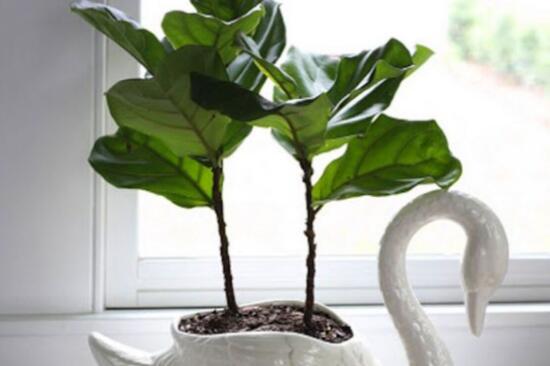
If you are a beginner grower, mastering how to care for a fiddle-leaf fig is enough; but if you are an old hand, then besides knowing how to grow it, you should also know how to propagate it, so as to add to the pleasure of growing it. As for how to propagate a fiddle-leaf fig, the most commonly used methods are cuttings and air layering, and next the editor will introduce the specific steps in detail.
II. The two propagation methods for the fiddle-leaf fig
(1) Fiddle-leaf fig cutting propagation method
1. Cutting time
2. Selection of cuttings
Once the time is set, we then select the cuttings to use for propagating the fiddle-leaf fig. From a potted fiddle-leaf fig, choose a 1-2 year old branch, cut it off 20-30 cm from the potting soil, then cut it into 3-4 stem segments to serve as cuttings.
Cuttings requirements: each cutting should retain only one leaf, with all the rest cut off; in addition, the retained leaf should also have 2/3-3/4 cut away to reduce water evaporation. After the cuttings are selected, soak the wounds in water or coat them with plant ash and the like, to prevent the sap from flowing out.
3. Starting the cuttings
Build a cutting bed for the fiddle-leaf fig from river sand or perlite, then insert the prepared cuttings into the bed. After that, maintain the air humidity around the cutting bed; at a temperature of 25-30°C, roots will form in one month, and by then they can be potted up for growing.
(2) Fiddle-leaf fig air layering propagation method
1. Air layering time
Besides cuttings, air layering can also be chosen as a propagation method for the fiddle-leaf fig. According to the growth habits of the fiddle-leaf fig, it is most active from April to August, so air layering should also be done during this period.
2. Air layering method
On a potted fiddle-leaf fig, select a semi-lignified top branch, leave 3-4 leaves on the upper part, then perform ring barking below them. After that, wrap the wound with moss and the like, then bind it with plastic film; roots will form in about 40 days, and once they grow to about 30 cm, it can be removed for planting in the ground or potting up.
Overall, when propagating the fiddle-leaf fig, whether by cuttings or air layering, it survives very easily, but the most suitable for home propagation is still cuttings. Of course, methods are fixed while people are flexible, so everyone can choose other methods to propagate according to actual circumstances. That is all the editor has to introduce about fiddle-leaf fig propagation methods, and I hope it can be of help to everyone.
How to grow a potted fiddle-leaf fig: propagation methods for the fiddle-leaf fig
The fiddle-leaf fig, also known as the fiddle-leaf rubber tree, is an evergreen tree plant of the Moraceae family and Ficus genus, named for its leaf tips that swell into a fiddle shape. It has a tall stature, is upright and elegant, and has unusual leaves with relatively high ornamental value. It is often used as an ideal foliage plant for large halls, and can also be used to decorate meeting venues or offices. Now let us take a look at how to grow a potted fiddle-leaf fig!
Growth habits of the fiddle-leaf fig
The fiddle-leaf fig is native to the lowland tropical rainforests from Sierra Leone to Morocco in West Africa, and is widely cultivated in the tropics and subtropics, as well as indoors and in greenhouses in temperate regions. In China it is mainly produced in Guangdong, Hainan, Guangxi, Fujian, Hunan, Hubei, Jiangxi, Anhui, Zhejiang and other places. It likes a warm, humid environment with plenty of sunlight; the optimum growing temperature is 25°C to 35°C, it goes dormant at around 15°C, and can overwinter safely above 5°C. Its water requirement is to prefer moisture over dryness.
Propagation methods for the fiddle-leaf fig
1. Cuttings: when taking cuttings of the fiddle-leaf fig, choose a 1-2 year old branch, cut it off 20-30 cm from the potting soil surface, and cut the stem into 3-4 segments to serve as cuttings. Each cutting should retain one leaf, and the leaf should have 2/3-3/4 cut away to reduce water evaporation. First soak the cutting wounds in water or coat them with plant ash and the like, to prevent the sap from flowing out. Insert the cuttings into a cutting bed built from river sand or perlite, and take care to maintain the bed temperature and relatively high surrounding air humidity. At a temperature of 25-30°C, roots can form in about one month.
2. Air layering: air layering propagation of the fiddle-leaf fig can be carried out from April to August. Select a semi-lignified top branch on the mother plant, leave 3-4 leaves on the upper part, then perform ring barking or a tongue cut below them, then wrap it with moss and the like and bind it with plastic film. Roots will form in about 40 days, and once they grow to about 30 cm, it can be removed for planting in the ground or potting up.
How to grow a potted fiddle-leaf fig?
1. Potting soil: when potting a fiddle-leaf fig, choose a pot with a somewhat larger volume, and repot every 2-3 years in spring. Cover the bottom of the pot with a tile piece with the convex side facing up, first put in a layer of old potting soil, then add a new medium mixed from garden soil, peat soil and a small amount of sandy soil; the soil should be slightly acidic.
2. Fertilizing: the fiddle-leaf fig has broad leaves and a relatively high fertilizer requirement, so during the growing season it generally needs liquid fertilizer or granular compound fertilizer every 1-2 weeks, to promote plant growth and deep green leaves; generally no fertilizer is applied in late autumn and winter. From when new leaves unfold until mid-August, apply fertilizer once every 10 days, mainly nitrogen fertilizer. When growth is abundant, more fertilizer can be applied; when growth stops or during dormancy, no fertilizer is applied.
3. Watering: the amount of water for a fiddle-leaf fig should depend on the surrounding ambient temperature. Water demand is greater in spring and summer, and should be reduced during dormancy, keeping the potting soil moist. In summer, it can appropriately be given a light rain shower to help growth; spraying with warm water regularly will make it grow even better, and slightly acidic water is also preferable for watering. Excessive short-term temperature fluctuations or exposure to direct sunlight are both unfavorable for growth. If kept at low temperatures for a long time while the plant is overwatered, it can cause the plant to die.
4. Light: the fiddle-leaf fig has relatively strong adaptability to light and can grow well in bright indirect light. Direct sunlight should be avoided in summer; if placed outdoors it must be shaded, and in winter light should be increased. It is suited to growing in a semi-shaded environment; in summer, avoid direct sunlight so as to prevent scorching the leaves and causing them to lose their luster. But if the light is too weak, the plant will grow thin and weak, so it must be given relatively bright light to help it grow robustly. During the growing season it generally grows better under 50% shading.
5. Temperature: compared with other Ficus plants, the fiddle-leaf fig has relatively weaker cold tolerance. The optimum growing temperature is 25°C to 35°C, it goes dormant at around 15°C, and can overwinter safely above 5°C. To improve its cold tolerance, besides controlling the amount of watering in late autumn and winter, you can apply additional phosphorus and potassium fertilizer about one month before winter arrives.
6. Disease prevention: after a potted fiddle-leaf fig becomes diseased, it should be moved quickly to a ventilated, sunny place with sufficient light; do not spray water on the leaf surface, and cut off severely diseased leaves. For lightly diseased leaves, the diseased spots together with part of the healthy tissue can be cut away, then spray Bordeaux mixture for protection, or spray 80% zineb wettable powder at 500 times dilution, 25% metalaxyl wettable powder at 500-800 times dilution, etc.; note to rotate the chemicals used.
Propagation methods for the fiddle-leaf fig
The fiddle-leaf fig is generally propagated by cuttings or air layering. When taking cuttings, choose a 1-2 year old branch, cut it off 20-30 cm from the potting soil surface, and cut the stem into 3-4 segments to serve as cuttings. Each cutting should retain one leaf, and the leaf should have 2/3-3/4 cut away to reduce water evaporation;First soak the cutting wounds in water or coat them with plant ash and the like, to prevent the sap from flowing out; insert the cuttings into a cutting bed built from river sand or perlite, and take care to maintain the bed temperature and relatively high surrounding air humidity. At a temperature of 25-30°C, roots can form in about one month.
After the plant has been cut back, because its apical dominance has been disrupted, the dormant buds at the stem nodes can sprout new shoots and can form a forked tree shape; after the new shoots have aged, cuttings can be taken from them again.
The air layering propagation method is also a commonly used method for propagating the fiddle-leaf fig; for the specific operation method, refer to the weeping fig.