Cultivation methods and precautions for the Flame Tree: it needs plenty of light
The Flame Tree, also known as Flamboyant, is a plant in the legume family, and it can be seen in many regions of our country. However, if we want to grow it well, there are many things we need to pay attention to. How do you grow a Flame Tree? What are the cultivation methods and precautions for the Flame Tree? Below, the editor will walk everyone through it.
1. How to grow a Flame Tree: understand its habits
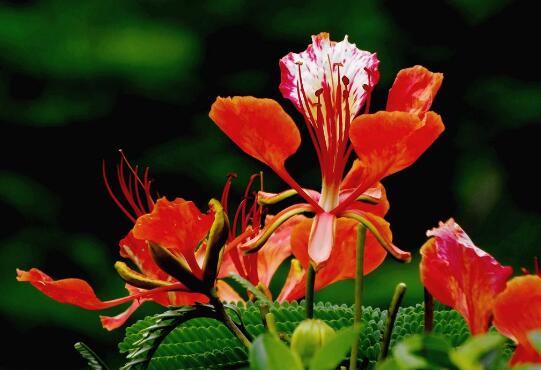
To know how to grow a Flame Tree, we first need to understand its growth habits. This plant likes to grow in warm, humid environments and is quite light-loving, so when cultivating it we should keep it in sufficient light. In addition, daily water and fertilizer management is also something we need to pay attention to. The details are below; let's take a look.
2. Cultivation methods and precautions for the Flame Tree
1. Soil: sandy loam
Before growing a Flame Tree, we first need to choose the soil. This is the step that lays the foundation and is very important. Generally, it is best to choose a loose, fertile sandy loam rich in organic matter. This kind of soil has good drainage and aeration, allows the plant to absorb nutrients better, and is not prone to waterlogging.
2. Temperature: 20-30°C
When growing a Flame Tree, temperature management is also very important. Only when it grows at a suitable temperature can it grow better. The suitable growing temperature for the Flame Tree is between 20-30°C, and it is relatively intolerant of cold. If the growing temperature is below 10°C, it is not good for its growth.
3. Fertilizing: apply base fertilizer before planting
Fertilizer is one of the main nutrients in the Flame Tree's growth process, so fertilizing is an essential part of growing it. First, when planting it, we should apply an appropriate amount of base fertilizer into the soil. Before flowering and after entering the flowering period, we also need to apply additional phosphorus and potassium fertilizer, which can make the flowers bloom more brilliantly.
4. Water: avoid waterlogging
The Flame Tree likes to grow in warm, humid environments, so when growing it we should water frequently to keep the soil somewhat moist, so the plant can grow vigorously. However, when watering, there is one thing we need to pay attention to: this plant is not tolerant of waterlogging, so we need to control the amount of water. If water accumulates, it can easily cause root rot.
5. Light: avoid strong light
The Flame Tree is a light-loving plant. In spring and autumn, when the light is relatively suitable, we can place it outdoors to receive all-day light. However, when summer arrives, because the light is relatively strong, we still need to provide shade to avoid strong light scorching the plant.
6. Pests and diseases: deal with them promptly
When growing a Flame Tree, if we are not careful enough, pests and diseases can easily appear. These problems are very harmful to the plant, so when we discover them we must deal with them promptly. For specific treatment methods, everyone can refer to the article on pest and disease control for the Flame Tree, which has detailed instructions.
How to grow the Brazilwood (Dracaena fragrans): care methods for Brazilwood
Brazilwood, also called Brazil iron tree, Brazil millennium tree, and golden-edged fragrant dragon blood tree, belongs to the genus Dracaena in the Asparagaceae family. Its scientific name is Dracaena fragrans, and it is also an evergreen tree plant in the Asparagaceae family. It is a very famous indoor foliage plant. It generally reaches a height of more than 6 m, while potted plants are 50 cm-150 cm tall. It produces branches, with leaves clustered at the top of the stem, 40-90 cm long and 6-10 cm wide, curved and arching, and the leaves are bright green and glossy. Although its flowers are inconspicuous, they carry a faint fragrance. Its plant shape is very elegant and neat, making it a very popular indoor foliage plant. Therefore, many people want to know the care methods for Brazilwood. Below, the editor will introduce how to grow Brazilwood and the care methods for Brazilwood.
[Growth habits of Brazilwood]
Brazilwood likes to grow in a hot and humid climate. It is highly adaptable to light and can grow normally in slightly shaded sunlight. In spring, autumn, and winter, it should receive more photosynthesis, while in summer it should be properly shaded or placed indoors in a ventilated place for care. Brazilwood has very strong vitality. With only sunlight, air, and a little water, it can grow very well relying on its own potential energy. It is drought-tolerant but not waterlogging-tolerant, and during the growing period it should be watered thoroughly. Brazilwood is afraid of cold and freezing. In winter, it should be placed indoors or in a sunny place for cultivation, and it can grow normally at a temperature between 5-10°C. It is native to western Africa and is distributed in China's Yunnan, Hainan, Guangxi, Thailand, Cambodia, Indonesia, the Americas, and other places.
[How to grow Brazilwood]
The propagation methods for Brazilwood include cuttings and hydroponics, generally carried out from May to August. If a Brazilwood plant grown for many years becomes too large, the leaves on the lower part of the stem will fall off, reducing its ornamental value. You can cut off about 10 cm of the stem in the pot and use it as a cutting. Place coarse sand or vermiculite in a flower pot or wooden bucket to make a cutting bed, then insert the cuttings into it. Spray water frequently to maintain the humidity of the cutting bed. A temperature of 21-24°C is very favorable for Brazilwood cuttings to sprout. Generally, they can take root and become potted plants in 3-4 weeks.
[Care methods for Brazilwood]
Step 1: Temperature and light
In the care methods for Brazilwood, you must pay attention to temperature and light. The temperature is generally 20-28°C. If the temperature is below 13°C, Brazilwood will enter a dormant state. If the temperature is below 5°C, yellow-brown spots will appear on the leaf tips and leaf edges of Brazilwood, or it may even die. If caring for Brazilwood indoors, place it in a spot with sunlight.
Step 2: Water and humidity
In the care methods for Brazilwood, you must pay attention to water and humidity. Brazilwood does not require much water while growing, but it does have some requirements for humidity. When caring for it, we should keep the potting soil moist and can frequently spray water on the leaves to increase air humidity. However, water must not accumulate in the potting soil, otherwise root rot will occur.
Step 3: Soil and fertilizer
In the care methods for Brazilwood, you must pay attention to soil and fertilizer. Brazilwood is suitable for growing in loose, fertile river sand soil. During care, it needs to be repotted once every year to keep the soil sufficiently nutrient-rich. During the growing period, Brazilwood can be given organic fertilizer at the base or edges, and liquid fertilizer once every half month, so as to keep the branches and leaves of Brazilwood growing more luxuriantly.
Step 4: Prevent pests
In the care methods for Brazilwood, you must pay attention to preventing pests. During growth, due to poor handling, low temperature, excessive water, or improper fertilization, some leaves may become scorched and withered. We should improve our care methods, control temperature and humidity well, remove pests promptly, and spray some diluted insecticide.
Summary: Brazilwood is a very popular large indoor potted foliage plant today. It generally appears in spacious living rooms, studies, and sitting rooms, giving people an elegant and simple feeling with a touch of southern charm. Its plant shape is very elegant and neat, and it is a very famous new-generation indoor foliage plant in the world. The above is what the editor introduced to everyone about how to grow Brazilwood and the care methods for Brazilwood. I hope everyone can learn its care methods and let themselves live in an elegant and clean environment every day. Thank you for reading.
More related information: Bletilla striata pictures What varieties of Hypericum are there Flame Tree pictures How to plant Magnolia coco Caesalpinia pulcherrima pictures
Cultivation methods for Jacaranda, and what are the effects and functions of Jacaranda?
Jacaranda is a plant in the genus Jacaranda of the Bignoniaceae family. It is distributed in Argentina, Bolivia, Brazil, as well as China's Guangxi, Hainan, Guangdong, Yunnan, Fujian, and other places. Its crown is tall, 13-14 m high, and can reach up to 20 m. The leaves are bipinnately compound, large, with more than 16 pairs of pinnae, and each pinna has 10-24 pairs of leaflets, feather-like and densely arranged; quite elegant, the leaflets are about 6 mm long. The panicle is borne at the branch tips or in leaf axils; the flower is bell-shaped, 25-35 cm long; light purple, with the flowering period in late spring and early summer. The fruit is a capsule, round and slightly flat, light brown, about 5 cm in diameter. When it blooms, the leaves fall completely. This tree's alias comes from its fern-like leaves; it is also called blue mist tree, and the wood is dark brown.
Cultivation methods for Jacaranda
1. Temperature and light
Jacaranda is native to tropical America and likes a warm, humid, and sunny environment. It is not tolerant of frost or snow. The suitable growing temperature is 22 to 30°C. If the winter temperature is below 15°C, growth stalls, and if it is below 3 to 5°C there is cold damage. If the summer temperature is above 32°C, growth is also inhibited. It likes light and can tolerate partial shade.
2. Soil and fertilizing
It likes fertile, moist sandy loam or loam. When planting, sufficient base fertilizer should be applied. After it survives, topdressing is needed once each in spring and autumn. Pruning and shaping should be done once every year in early spring. Aged plants need heavy pruning. When potted, the trunk can be cut back or grafted for dwarfing, and watering and nitrogen fertilizer application should be controlled.
3. Pest and disease control
Jacaranda has relatively few diseases. The main pest is the longhorn beetle. If reddish-brown frass is found at the base of the trunk, you can use a small knife to pry open the bark and catch the larvae; before adults appear, you can also apply a mixture of 10 parts quicklime, 1 part sulfur, and salt below 80 cm on the trunk base to prevent adults from laying eggs.
Propagation methods for Jacaranda
Seed propagation
The capsule maturity period of Jacaranda is November. After harvesting, place them in a windless place to sun-dry or pile them up. After drying, store them until March of the following year and sow when the temperature is around 20°C, but the seed germination rate is only about 5%.
Cutting propagation
This can be done in both spring and autumn. Choose moderately mature branches as cuttings, and the rooting rate is high.
Tissue culture
Some scientific research units in our country have used the stem tips and stem segments of seedlings as explants and propagated a large number of test-tube plantlets.
Effects and functions of Jacaranda
1. Ornamental value of Jacaranda
Jacaranda is a tall deciduous tree that can reach up to 15 meters. Its leaves are opposite and oval in shape. The calyx of Jacaranda is slender and mostly blue, and the filaments grow in the middle part of the calyx. Jacaranda produces woody capsules, and the flowering period is usually between May and June. Both the leaves and flower shape of Jacaranda are very beautiful, which is the main reason it is an ornamental plant.
2. Jacaranda can be used in landscape construction
Jacaranda is a distinctive tree species that can be appreciated for both its leaves and flowers. It mostly grows in tropical and subtropical regions and can be used as a street tree and landscape tree. It is the most common ornamental tree species in gardens and scenic areas in the south. It blooms once each in summer and autumn. When the flowers are in full bloom, the purple-blue blossoms are especially attractive, and the floral fragrance can drift far.
3. Economic role of Jacaranda
Jacaranda is an economic tree species with high economic value. Its wood can be used for papermaking and can create high economic value. In addition, Jacaranda's wood is yellow-white, relatively light, and has straight grain, making it an ideal material for making furniture. Moreover, after Jacaranda is processed into furniture, it is not easy to deform and can be preserved for a long time, making it very popular in the furniture market.
What is the flower language of Jacaranda?
The flower language of Jacaranda: representing tranquility, profundity, and hesitation, waiting for love in despair. Together with the Flame Tree, which blooms with red flowers, it is called the "Twin Shadows" (the red shadow tree refers to the Flame Tree, and the blue shadow tree is Jacaranda).