How to propagate Ardisia crenata? April cuttings root in 40 days
As a plant prized both for its fruit and its foliage, Ardisia crenata bears bright red little berries that look especially beautiful and festive against its green leaves. But is a single pot of Ardisia crenata too plain? Some people choose to buy another pot, while others plan to propagate it themselves, so how do you propagate Ardisia crenata? Below are two propagation methods for Ardisia crenata, so follow along and learn.
I. How to propagate Ardisia crenata: cuttings/sowing
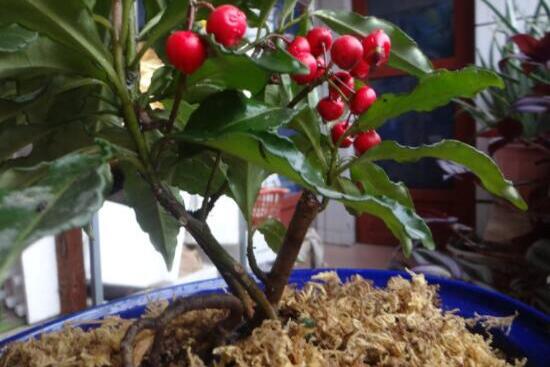
When it comes to propagating Ardisia crenata, the most common methods are undoubtedly cuttings and sowing. Cuttings are the most common; this propagation method is generally carried out in spring, taking hardwood branches of Ardisia crenata as cuttings, inserting them into soil and waiting for them to root. Sowing is also very simple: take plump Ardisia crenata seeds, remove the shells, scatter them over the soil, and wait for them to sprout before transplanting.
II. Two propagation methods for Ardisia crenata
(1) Cutting propagation of Ardisia crenata
1. Cutting time
Ardisia crenata likes a warm environment; spring and autumn are its growing seasons, especially April-May, when the plant is at its most active and the survival rate of cuttings is extremely high.
2. Cutting selection
In cutting propagation of Ardisia crenata, the selection of cuttings is especially important; choose well and the whole cutting process is basically more than half successful. From a potted Ardisia crenata, select one-year-old hardwood branches and cut them into 15-20 cm lengths as cuttings. The cuttings should preferably have 2-3 leaves; then treat the wounds with rooting powder and set them aside for cutting.
3. Starting the cuttings
Insert the cuttings into the soil to a depth of 1/2-2/3 of the branch. After inserting, place the pot in a well-shaded spot, water moderately, and keep the potting soil moist. They generally root in 40-50 days, and after 70 days they are transplanted into pots for cultivation; afterward, care for them according to Ardisia crenata cultivation methods, and they will flower and fruit the following year.
(2) Sowing propagation of Ardisia crenata
How do you propagate Ardisia crenata? Besides cuttings, you can also use the sowing method. With this method, seed selection is especially key; choose seeds that are large and plump, bright red in color, and free of pests and diseases. Because the seed coat of Ardisia crenata is very hard, it does not easily absorb water and germinate. So before sowing, remove the seed coats, then soak the seeds in warm water at 25-30°C for one day.
Sowing method: after selecting Ardisia crenata seeds, prepare a pot filled with a loose, breathable, well-draining growing medium, then scatter the seeds on top, covering with no more than 0.5 cm of soil. Afterward, keep the potting soil moist, with light preferably reduced by 90%; once the seedlings grow true leaves, apply a light fertilizer once, and when the seedlings have 4 to 5 true leaves, they should be transplanted.
Regarding propagation methods for Ardisia crenata, after reading the whole article you should know what to do! If you buy this plant, a single pot costs at least a dozen yuan, and money is money, so save where you can! Moreover, cuttings and sowing of Ardisia crenata are both very simple and have a high survival rate, so flower lovers who are tempted might as well try it themselves!
Flowers that can be planted and propagated in June
Leisurely, June is already half over, and my pace can hardly keep up. The scorching summer always reminds me that if I do not work hard now, I will not even have the northwest wind to drink. Although there are always more than 30 days each month when I do not want to work, I still have to tell you which flowers can be planted and propagated in June.
1. Sowing
Woody flowers that can be sown and propagated in June include: sago palm, Canary Island date palm, leatherleaf mahonia, loquat, wintersweet, and so on.
Herbaceous flowers that can be sown in June include freesia, Chinese primrose, and so on. When sowing loquat, the covering soil should not be too thick, as its seeds have poor ability to push through the soil; just scatter about 2 cm of fine soil over them, then cover with straw to retain moisture.
After wintersweet fruit ripens, the brown seeds come out of its urn-shaped fruit capsule; soak them in cold water for 24 hours, then bury them in wet sand to promote germination. After about 2 weeks, when the seeds crack open and show white, they can be sown in the ground. The sowing row spacing is 15 to 20 cm, the trench width is 10 cm, and the trench depth is 5 to 8 cm; cover with 2 to 3 cm of fine soil, and finally cover with straw to retain moisture. When about 50% of the seeds have emerged, gently remove the covering straw in 2 to 3 rounds.
2. Cuttings
June has high temperatures and high humidity, making it the best time for flower cuttings in the courtyard.
Flowering woody plants suitable for softwood cuttings in summer include: osmanthus, camellia, sasanqua, banana shrub, purple magnolia, Chaenomeles speciosa, snowball viburnum, Chinese snowball viburnum, coral tree, Western azalea, summer azalea, rubber tree, winter jasmine, serissa, pomegranate, rose of Sharon, jasmine, Chloranthus spicatus, gardenia, lantana, bougainvillea, clerodendrum, Buddhist pine, Excoecaria cochinchinensis, Hypericum, hibiscus, oleander, Ardisia crenata, edgeworthia, croton, crape myrtle, Weigela florida, Spiraea thunbergii, leatherleaf mahonia, mahonia, wintersweet, Japanese fatsia, boxwood species, hydrangea, poinsettia, and red-leaf plum.
Courtyard herbaceous flowers suitable for cutting propagation in June include: scarlet sage, globe amaranth, nasturtium, umbrella plant, begonia, coleus, French marigold, African marigold, Alternanthera, chrysanthemum, begonia species, heliotrope, Boston ivy, and so on.
Below, taking sasanqua, Osmanthus fragrans 'Rixianggui', camellia, and others as examples, the summer cutting technique is introduced.
From early to mid-June until the end of July, when the newly grown tender shoots reach semi-lignified stage, cut them as cuttings. Use yellow subsoil, vermiculite, perlite, and so on as the medium; best is a mixed medium of alkaline-leached rice chaff ash and river sand blended evenly in a 2:1 ratio.
Cut the cuttings into segments about 10 to 15 cm long, keeping only the upper 2 to 3 leaves. Soak the lower cut end in a 500 ml/kg No. 1 rooting powder solution for 10 seconds, take them out and let them air briefly, and after the alcohol in the solution evaporates, proceed with cutting.
Generally, insert the cuttings into the soil to a depth of about 1/2 to 1/3 of the cutting length, with plant and row spacing of 3 x 8 cm, so that the leaves do not shade one another.
After watering thoroughly with a watering can, set up bamboo arches over the seedbed, cover with plastic film to retain moisture, press the film down firmly all around with clods of soil, and at the same time build a shade shed for shade. Afterward, keep the bed surface temperature no higher than 30°C and always keep the bed surface moist; on rainy days, promptly drain the accumulated water in the path ditches. After one month, they will root in large numbers.
3. Grafting
In June, in the courtyard, potted wintersweet seedlings can be used as rootstock to approach-graft superior wintersweet varieties. However, it is best not to use Chimonanthus salicifolius as rootstock, because its growth rate is noticeably slower than the scion, which easily leads to the abnormal phenomenon of a thick top and thin bottom.
Use potted white magnolia or purple magnolia seedlings as rootstock to approach-graft white orchid.
Use wild rose seedlings as rootstock to bud-graft superior rose varieties.
At the end of June, use current-year peach seedlings as rootstock to bud-graft red-leaf plum, ornamental peach, purple-leaf peach, longevity peach, and so on.
Use single-petal seedling camellia as rootstock to softwood-graft camellia and sasanqua.
Use seedling bitter orange as rootstock to softwood-graft bitter orange.
Use fringetree as rootstock to approach-graft golden osmanthus and silver osmanthus.
In addition, in June you can also carry out bud-replacement grafting of peony.
4. Layering
In June, in the courtyard, plants that can be propagated by layering include: azalea, hydrangea, Weigela florida, oleander, Aglaia odorata, Chloranthus spicatus, red maple, jasmine, white orchid, rubber tree, wintersweet, osmanthus, camellia, banana shrub, snowball viburnum, Chinese snowball viburnum, Hypericum, winter jasmine, and plum.
5. Division
In June, in the courtyard, flowers that can be propagated by division include: sword fern, calla lily after flowering, umbrella plant, Tradescantia spathacea, Liriope platyphylla, bromeliads, Haworthia, Aspidistra, spider plant, Acorus calamus, Liriope muscari, Liriope spicata, autumn zephyr lily, Caragana, and Hypericum.
At the turn of autumn and winter, which flowers are suitable for propagation and cultivation
The season at the turn of autumn and winter is an adaptation stage for flowers, when their growth is relatively slow, so not all flowers and plants can survive propagation. Below I will introduce which flowers are suitable for propagation and cultivation at the turn of autumn and winter, for flower lovers' reference.
1. Sowing propagation:
Flowers and plants that can be sown in a greenhouse include: nasturtium, gloxinia, tuberous begonia, cyclamen, African daisy, clivia, asparagus fern, hosta, and so on.
Woody plants that can be sown as soon as collected include: Spiraea thunbergii, Ligustrum quihoui, glossy privet, camphor tree, Chinese juniper, Buddhist pine, soapberry, Ardisia crenata, palm, French holly, photinia, and Photinia davidsoniae, and so on.
2. Cutting propagation:
Woody plants that can be cut outdoors but must be covered with plastic film for warmth and cold protection mainly include: red-leaf plum, plum (green calyx, palace pink, and other varieties), rose (free-flowering rose, Elizabeth, and other easy-to-root varieties), Chaenomeles speciosa, and so on.
Woody plants that can be propagated by root cuttings include: red-leaf plum, hall crabapple, Chaenomeles speciosa, Chinese holly, wintergreen, Chinese trumpet creeper, Chinese elm, serissa, and so on. Some of these root cuttings can be used to make small and miniature bonsai.
Woody plants that can be densely cut and propagated in a greenhouse or plastic tunnel include: boxwood, Korean boxwood, large-leaf boxwood, silver-edged boxwood, Pilea cadierei, golden-edged privet, gardenia, Hypericum, Hypericum beanii, mahonia, golden-edged serissa, and so on.
If managed properly, flowers and plants cut in November can grow a complete root system the following spring and can be used for field cultivation to grow ball-shaped greening forms. In winter, in a greenhouse you can also propagate by cuttings: begonia, Begonia masoniana, lotus-leaf begonia, geranium, hibiscus, fuchsia, jade plant, Portulacaria afra, Excoecaria cochinchinensis, Pachystachys lutea, shrimp plant, and so on; after spring begins they can be used for potting and cultivation.
In the Yangtze River basin, you can also cut and store cuttings of cotton rose, Chinese trumpet creeper, grape, and so on, to be cut in the following spring, which can noticeably speed up rooting and increase the cutting survival rate. 3. Grafting propagation:
Use green maple seedlings as rootstock to bag-graft red maple and feather maple indoors; use apricot seedlings and peach seedlings as rootstock to cut-graft plum (with the graft union buried in soil to overwinter); use thick branches of rose (Elizabeth variety) as rootstock-scion, and branches of superior rose varieties as scions; after cleft grafting or cut grafting, carry out cutting, so that the healing of the graft union and the rooting of the lower cut end happen simultaneously, which can speed up the process of cultivating grafted seedlings of superior rose varieties.
4. Layering propagation:
Woody plants that can be propagated by ground layering in November mainly include: Chaenomeles speciosa, gardenia, small-leaf gardenia, pomegranate, camellia, plum, wintersweet, Buddhist pine, Weigela florida, osmanthus, hydrangea, purple magnolia, Chinese cypress, banana shrub, Spiraea thunbergii, snowball viburnum, Chinese snowball viburnum, Spiraea nipponica, and so on.
5. Division propagation:
Woody ornamental plants that can be propagated by division in November include: Chaenomeles speciosa, Spiraea thunbergii, Spiraea nipponica, red-flowered spiraea, Triarrhena, Hypericum, Hypericum beanii, mahonia, butterfly bush, peony, broom, winter jasmine, Forsythia viridissima, jasmine, Chloranthus spicatus, bamboo, and Bambusa multiplex, and so on. South of the Yangtze River basin, you can dig up the underground rhizomes or tubers of dahlia, canna, and large-flowered canna, store them in sand until March of the following spring, then cut and divide them for planting and establishing.
Herbaceous flowers and plants that can be propagated by division include: Bletilla striata, Cymbidium ensifolium, Cymbidium goeringii, Cymbidium faberi, hosta, purple hosta, blackberry lily, iris, ornamental bromeliads, Liriope platyphylla, Rohdea japonica, autumn zephyr lily, lucky bamboo, Aspidistra, and Kalanchoe, and so on.