How to propagate coral tree flowers? Detailed explanation of seed sowing and cutting methods
Coral tree flower is a flowering plant with high ornamental value, and people in every province of our country cultivate it. As more people grow it in various places, questions about its propagation have also attracted people's attention. How do you propagate coral tree flowers? What are the propagation methods for coral tree flowers? Below, the editor will walk everyone through it.
1. How to propagate coral tree flowers, sowing/cutting
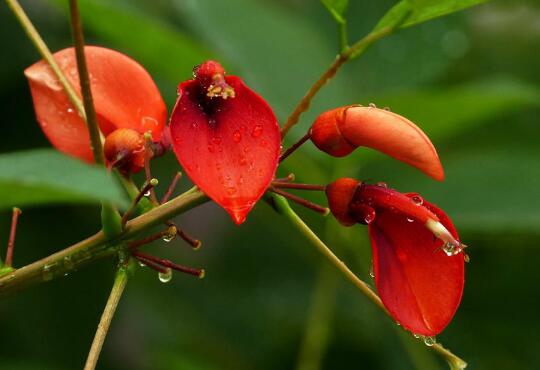
When it comes to how to propagate coral tree flowers, it is mainly divided into two methods: seed propagation and cutting propagation, and both are fairly commonly used, with very high survival rates. As for how these two propagation methods are specifically carried out, there is a detailed introduction below, and interested friends can take a look.
2. Propagation methods for coral tree flowers
First, no matter which propagation method we use, we need to choose a substrate first. This is the step of laying a solid foundation and is very important. Generally, it is best to choose loose, fertile sandy loam as the substrate. This kind of soil has good drainage and also strong air permeability, allowing the plant to absorb nutrients better, and it is not prone to water accumulating in the potting soil.
Seed propagation
Seed germination stimulation: Before sowing and propagating coral tree flowers, it is best to first soak the seeds in warm water at about 40°C for 1-2 days. When the seeds begin to absorb water and swell, take them out. This can stimulate the seeds to germinate and allow them to sprout more quickly after planting.
Sowing method: Before sowing coral tree flowers, first apply an appropriate amount of base fertilizer to the potting soil, then evenly scatter the seeds on the soil surface. After scattering them, cover with 1-2cm of soil, and then you can water. When watering, it is best to use the immersion method, because direct watering can easily wash the seeds away.
Cutting propagation
Cutting selection: Before carrying out cutting propagation of coral tree flowers, we must first select cuttings, and whether the cuttings are good or not will also affect the survival rate. Generally, it is best to choose branches that are relatively robust and free from pests and diseases as cuttings, as the survival rate will be relatively high. If we choose branches that already look rather weak and slender, then it is basically very difficult for them to survive, so everyone should not be too casual when choosing.
Cutting method: Among the propagation methods for coral tree flowers, cutting propagation is considered a relatively simple method. First, before cutting, we can use chopsticks to poke a hole in the substrate, then insert the cutting halfway, and after that water thoroughly. This operation can prevent the cutting from being damaged and is very practical.
Coral tree cultivation methods and coral tree propagation methods
Coral tree is the city flower of Quanzhou, with gorgeous flower colors and an excellent ornamental effect. It is commonly seen in parks, green spaces, and scenic areas for landscaping. So how do you cultivate coral tree? What propagation methods are there? Next, let's look at the cultivation methods of coral tree and the propagation methods of coral tree.
1. Cultivation methods of coral tree
Coral tree potted management is relatively extensive, but before moving it out, the pot should be repotted every other year. The potting soil should preferably use 2 parts pond mud, 1 part compost, and 1 part rice husk ash mixed together. The plant needs heavy pruning. For one-year-old branches with a diameter of less than 1 cm, leave only 1-2 buds; for those with a diameter of more than 1 cm, leave 2-3 buds. After heavy pruning, it will stimulate dormant buds and axillary buds to send out strong new shoots, and after they grow, the whole tree can bloom abundantly. The mulberry branches and weak branches at the roots should be removed in time.
After the coral tree is moved out, it should be given sufficient light, and in midsummer it can be slightly shaded. Watering should follow the principle of alternating dry and wet. After new shoots are sent out, apply cake fertilizer water once every 10 days. After flowering, in addition to normal fertilization, apply phosphorus and potassium fertilizer 2 more times to promote the development and fullness of the branches. Gradually stop fertilizing after October. After moving it indoors at the end of October, place it in a sunny spot and keep the potting soil slightly moist. Water must not accumulate in the pot, otherwise it is very easy to cause the roots of the coral tree to be soaked and rot.
Coral tree is suitable for growing in an environment with sufficient sunlight, high temperature, and good ventilation. It is not cold-tolerant. Move it indoors in late October, and maintain the overwintering temperature at around 15°C; it must not be lower than 4°C, and attention should be paid to controlling moisture. In open-field cultivation, young trees should be pruned regularly to develop a rounded tree shape. For potted plants, choose a slightly larger pot, and for greenhouse potted plants, a large vat can be used. For overly long branches, pinching can be adopted after flowering to control the branch growth.
2. Coral tree propagation methods
1. Seed propagation: Collect the seeds after they are fully mature from October to November each year. Crush the fruit, wash with water, rub off the pulp, select pure seeds by water, dry them in the shade, and store them dry until mid-to-late January of the following year, then take out the seeds to promote germination. First soak the seeds in warm water for 3h, then after taking them out, mix them with 2-3 times their amount of wet sand, place them in a wind-protected, sunny place to raise the temperature and promote germination, cover the outside with plastic film to retain moisture, turn them over frequently, and replenish water to keep them warm. After sowing, seedlings can emerge in 20-30 days. After emergence, remove the agricultural film and thin the seedlings in time.
2. Cutting propagation: Generally, hardwood cuttings in late autumn are mostly used, with a small arched shed or a sunken hotbed to retain moisture and heat. Usually they can take root before the freeze, and in March-April of the following year they sprout and send out branches. After survival, apply urea once a month, 10kg per 667㎡ each time. After the Beginning of Autumn, apply an N-P-K compound fertilizer once to promote thickening and lignification of the seedling stems. In the same year, the seedlings can reach more than 50cm in height. Softwood cuttings can also be carried out in mid-to-late June, and with proper management, the survival rate is also relatively high. In autumn, one-year-old robust and plump branches can also be selected for hardwood cuttings.
The above iscoral tree cultivation methodsand an introduction to coral tree propagation methods. Coral tree flowers are beautiful and can be planted as ornamental trees. Those with the conditions can plant them in their own courtyards.
How long is the flowering period of cockspur coral tree? What propagation methods does cockspur coral tree have?
The appearance of cockspur coral tree resembles a cockscomb, hence the name "cockspur coral tree." Because its flowering period is relatively long, it is quite suitable for landscaping in the center of roads. So when is the flowering period of cockspur coral tree? What propagation methods does cockspur coral tree have? Next, let's learn about them together.
1. Flowering period of cockspur coral tree
Flowering period of cockspur coral tree: April to October.
Cockspur coral tree has papilionaceous corollas and raceme inflorescences. But it is different from the coral tree native to our country. It does not bloom in radially symmetrical tiered tower shapes, but rather blooms laterally symmetrically in branch-like forms upward and forward. Its fruit is a pod, only a few centimeters long. The pod generally contains 4-5 seeds. The seeds are chestnut brown, round-bean-shaped, and sparsely distributed within the pod.
2. Propagation methods of cockspur coral tree
1. Seed propagation: It is best to sow the seeds as soon as they are collected. Soak the seeds appropriately before sowing, and sow them directly in the seedbed. The seedbed soil should preferably be loose sandy loam. After sowing, cover with soil to about twice the height of the seeds, and be careful to spray water to retain moisture. Seedlings can emerge in about 10 days, and after 1 month, when the seedlings grow to 20 cm, transplant them.
2. Cutting propagation: Cut off semi-lignified branches, about 20-40 cm long, and insert them into a sand bed or loose seedbed, keeping them moist. They can take root and sprout in about 15 days, and become seedlings in 1-2 months. In the coastal areas of South China, long-branch cuttings are commonly used, and they can take root after 1-2 months.
The above isthe flowering period of cockspur coral treeand an introduction to the propagation methods of cockspur coral tree. I hope it is helpful to everyone. Cockspur coral tree flowers are gorgeous and very suitable for viewing.