How to grow a blood lily in a pot? Growing methods and temperature control tips
The blood lily is a flowering plant native to Africa that was later introduced to China, and today it can be seen in many parts of the country. However, growing it well is not easy, and there are many points to pay attention to. How do you grow a blood lily in a pot? What are the growing methods and precautions for the blood lily? Let's take a look below.
1. How to grow a blood lily in a pot: understand its habits
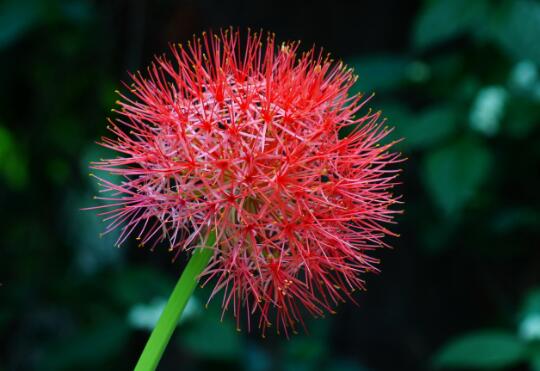
To know how to grow a blood lily in a pot, we first need to understand its growth habits. This plant likes to grow in a warm, humid, semi-shaded environment and is not tolerant of strong light, so we need to provide shade when the light is strong. In addition, daily water and fertilizer management are also points we need to pay attention to. The details are described below, so let's take a look.
2. Growing methods and precautions for the blood lily
1. Soil: sandy loam
Before growing a blood lily, we first need to choose the soil. Just like laying the foundation for a house, this is the step of building a good base, so we must choose soil suitable for its growth. This plant likes loose, fertile sandy loam; this kind of soil has good drainage and aeration, allowing the plant to absorb nutrients better.
2. Temperature: 10-20°C
When growing a blood lily, the ambient temperature is also something we need to pay attention to, because only when it grows at a suitable temperature can it grow better. The suitable growing temperature for the blood lily is between 10-20°C, and the optimal temperature for the overwintering dormant period is 8-10°C.
3. Fertilizing: once every two weeks
Fertilizer is one of the main nutrients in the blood lily's growth process. Especially after it enters its growing period, its demand for fertilizer is very high, and basically we need to fertilize it once every two weeks so that it can grow robustly. However, before fertilizing, there is one thing we should note: the fertilizer should not be too concentrated; apply a thin cake fertilizer, otherwise it is very easy to burn the plant.
4. Water: water when dry, let dry between waterings
Watering is an essential part of the blood lily's growth process. When watering it, we should maintain the principle of "do not water if not dry, and water thoroughly when watering," and try not to water heavily, because this plant is not tolerant of waterlogging. If water accumulates, it can easily cause its roots to rot. Generally, in summer we can water more, while during the winter dormant period we should not water.
5. Light: avoid strong light
The blood lily likes shade and is not tolerant of strong light, so when growing it we should avoid direct sunlight. In spring and autumn, when the light is relatively suitable, we can grow it outdoors in a spot with scattered sunlight. After summer arrives, because the light is relatively strong, we should move it indoors to a semi-shaded spot to grow it, so the plant is not scorched by strong light.
6. Pests and diseases: control them promptly
In the process of growing a blood lily, if we are not careful enough, pests and diseases can easily take advantage of the situation. These kinds of problems are very harmful to the plant, so when we find them we must deal with them promptly. For specific treatment methods, you can refer to the article on pest and disease control for the blood lily, which has detailed instructions.
Growing methods and precautions for the blood lily
Growing methods for the blood lily
Soil
For a potted blood lily, you can choose loose, fertile soil with good drainage. You can add some fine sand to the growing medium to increase aeration. At the bottom of the flower pot, first add a layer of coarse sand or crushed stones as a drainage layer.
Light and temperature
The blood lily likes a semi-shaded growing environment and is afraid of direct sunlight. In spring and autumn, the blood lily can be placed in a semi-shaded spot for care. When the summer sun is strong, the blood lily needs to be moved to a cool, ventilated spot for care, with proper shading to avoid scorching the leaves.
The suitable temperature for blood lily growth is between 16°C and 26°C, and at night it should be between 10°C and 12°C. The overwintering temperature in winter cannot be lower than 5°C, otherwise the blood lily plant will be frostbitten. During the blood lily's flowering period, the blood lily can be placed in a cooler spot for care to extend the flowering period.
Watering and fertilizing
For the blood lily, usually pay attention to keeping the potting soil moist. Do not water too much, otherwise water will accumulate in the pot and cause the rhizome to rot. In autumn, as the temperature gradually drops, the blood lily's leaves begin to turn yellow and it enters the dormant period; reduce watering and finally stop watering. When growing a blood lily, fertilize reasonably. At planting time, apply a certain amount of cake fertilizer as a base fertilizer. During the growing season, you can apply a thin fertilizer solution once every half month.
Propagation methods
The blood lily is mostly propagated by bulb division and seed sowing.
Precautions for growing the blood lily
Pests and diseases
During the blood lily's growth process, if the potting soil is too wet it will cause rot, and nematodes and slugs may also appear as pests. Pay attention to daily care and promptly kill insects.
Repotting
As the plant grows, the blood lily needs repotting. Each spring, you can divide the offsets while repotting.
Blood lily illustrated guide: growing methods and precautions for the blood lily
Chinese scientific name: blood lily
Latin name: Haemanthus multiflorus
Chinese scientific name: blood lilyAlso known as: tennis ball lilyKingdom: PlantaePhylum: AngiospermsClass: MonocotyledonsFamily: AmaryllidaceaeGenus: HaemanthusSpecies: blood lilyDistribution area: native to tropical Africa; wild distribution also occurs in Yunnan, ChinaA perennial herbaceous plant of the genus Haemanthus in the Amaryllidaceae family. Native to the tropics, it likes warm, humid and semi-shaded environments, is afraid of heat and severe cold. It has been introduced and cultivated in China for ornamental purposes.1. Morphological characteristics
Perennial herb. Bulb spherical, 4-7 cm in diameter. Leaves 3-4, oblong, 15-30 cm long, with 6-8 longitudinal veins on each side of the midrib, and dense, oblique fine transverse veins; petiole short, sheath-like. Flower stem upright, solid, slightly flattened, 30-90 cm tall, emerging before the leaves, pale green or with red spots; umbel with many flowers, densely arranged, 7-15 cm in diameter; flowers red; perianth tube cylindrical, 6-12 mm long, perianth lobes linear, about 2 times as long as the perianth tube; filaments red, extending beyond the perianth, anthers yellow. Berry bright red. Flowering in summer. Native to tropical Africa.2. Growth
Characteristics
Perennial herb, bulb relatively large, oblate-spherical. Leaves broadly lanceolate, petiole base extending downward into a sheath. Leaves emerge from the short stem above the bulb, 3-6 clustered together. Flower stem upright, emerging before the leaves; umbel terminal; flowers small, up to 30-100, blood-red. Berry spherical. Flowering from June to July.Habits
Likes warm, humid and semi-shaded environments. Likes well-drained sandy loam. Relatively drought-tolerant, not cold-tolerant. In Nanjing, Shanghai, Hangzhou and other places it cannot overwinter outdoors; in winter the bulb enters the dormant period and must be cultivated indoors. The suitable temperature during the growing period is 20-30°C, and the overwintering temperature should be kept above 5°C. The soil should be loose, fertile and well-drained.Origin and distribution
The blood lily is native to tropical Africa, and wild distribution also occurs in Yunnan, China. It likes warm, humid and semi-shaded environments. It likes well-drained sandy loam. It is not cold-tolerant; in the middle and lower reaches of the Yangtze River it must be cultivated indoors, and in winter the bulb enters the dormant period.3. Key cultivation points
Basic introduction
Plant every spring. During the sprouting and leaf-unfolding period, fertilize once every ten days. When the light is too strong in summer, place it in a semi-shaded spot for care. During the summer flowering period, place it in a cool spot to extend the flowering period. In autumn the leaves begin to turn yellow; reduce watering, and as the bulb enters the dormant period, stop watering, keep the soil dry, and dig out the bulb to store indoors.