How to grow variegated greater periwinkle? Detailed guide to cultivation methods and precautions
Variegated greater periwinkle, flower lovers should have heard of it. It is a common green plant that is not only good-looking, but also has strong vitality, and more importantly, is very easy to grow! It is precisely because of this that more and more people are now starting to cultivate them. So do you know how to grow variegated greater periwinkle? In this regard, follow the editor to take a look at the cultivation methods and precautions for variegated greater periwinkle.
1. How to grow variegated greater periwinkle, understand its habits
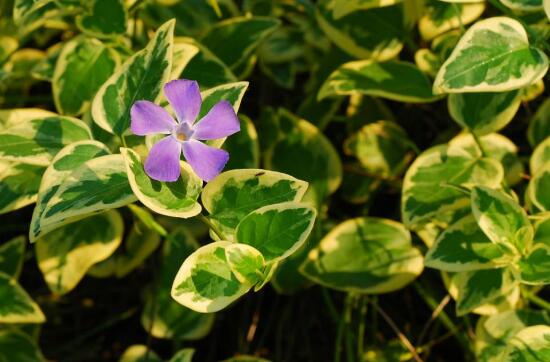
Variegated greater periwinkle likes a warm environment. Although it likes light, it can also tolerate shade. Not only that, it is also cold-resistant and relatively drought-tolerant, so how do you grow variegated greater periwinkle? It is very simple. We just place it in a place with plenty of diffused light and take careful care of it. As for the growing medium, it is best to use loose, sandy loam rich in humus.
2. Cultivation methods and precautions for variegated greater periwinkle
1. Soil
How to grow variegated greater periwinkle? The editor believes everyone should give it its favorite soil. According to the growth habits of variegated greater periwinkle, although it is not strict about soil requirements, if you want it to grow more beautifully, it is best to give it loose, sandy loam rich in humus. In this regard, the editor recommends using a mixture of leaf mold and river sand as the substrate.
2. Light
In the cultivation methods for variegated greater periwinkle, light is an extremely important point, because sufficient light can make its leaves more emerald green. However, variegated greater periwinkle is also shade-tolerant. If conditions are suitable, staying evergreen all year round is not a problem at all. It is just that in relatively shady places, the yellow patches on the leaves of variegated greater periwinkle will become lighter, thereby affecting the overall ornamental value.
3. Temperature
How to grow variegated greater periwinkle? Adjusting the temperature in a timely manner is also very necessary. Variegated greater periwinkle likes a warm environment. It is cold-resistant, and the most suitable growth temperature is around 20°C. In winter, if the temperature can remain above zero, they can continue to overwinter outside without affecting their growth and development.
4. Watering
In the cultivation methods for variegated greater periwinkle, watering is an indispensable part. It is the key to plant growth. However, variegated greater periwinkle is relatively drought-tolerant, so moderate watering is enough in daily care. It should not be watered too much. Wait until the soil is completely dry before watering. During the growing season, water can be sprayed on the leaves to increase humidity.
5. Fertilizing
How to grow variegated greater periwinkle? After talking about watering, let's talk about fertilizing, which is also indispensable in the growth of variegated greater periwinkle. Although variegated greater periwinkle does not have high fertilizer requirements, during its growing season, applying liquid fertilizer 1-3 times a month can ensure rapid growth of branches and vines and dense, glossy green leaves.
6. Pruning
During the growth process of variegated greater periwinkle, for the sake of the plant's appearance, we should prune it in a timely manner: pinching variegated greater periwinkle in time can allow the plant to grow more adventitious roots, so it can multiply quickly and look more beautiful!
How to propagate variegated greater periwinkle: cultivation methods for variegated greater periwinkle
Variegated greater periwinkle is evergreen in all seasons, with green leaves and bright flowers, and is very ornamental, so it is often used as an ornamental potted plant and is very popular among people. Today, I will introduce the propagation methods of variegated greater periwinkle, as well as the cultivation methods for variegated greater periwinkle.
How to propagate variegated greater periwinkle
Variegated greater periwinkle is easy to propagate and can be propagated by cuttings, division, and layering, with cutting propagation as the main method. Below is a brief introduction to the cutting propagation method for variegated greater periwinkle:
Cutting time: before sprouting in spring; during the plum rain season; September-October are all suitable for cuttings.
Cutting method: Choose robust branches that are one year old or current-year growth, cut them into cuttings about 10 cm long with 2-3 pairs of buds for cutting. The plant and row spacing is 10 cm x 10 cm. After cutting, water thoroughly, and set up a shed with a shade net to protect from sun. Keep the soil moist. After they survive, they can be transplanted to the field.
Potted variegated greater periwinkle should be pinched in time to promote branching. During the growing season, keep the potting soil moist and fertilize once every half month. In summer and autumn, prune appropriately to control the growth of branches and vines. When planted in the open ground, it is generally green and evergreen all year round.
Cultivation methods for variegated greater periwinkle
1. Temperature:
Variegated greater periwinkle likes warmth. The most suitable growth temperatures are: 18-20°C from April to August, and 13-18°C from September to March of the following year. Variegated greater periwinkle is relatively cold-resistant and can endure low temperatures of around 10°C. Moving variegated greater periwinkle indoors allows it to overwinter safely. Even if the aboveground parts die from frost damage, they can still sprout and grow branches the following spring. But potted plants are best kept at a temperature of around 5°C.
2. Light:
Variegated greater periwinkle is shade-tolerant. As long as there is diffused light, it can grow healthily. From October to April of the following year, if variegated greater periwinkle can be given sufficient light, it is more conducive to the growth of variegated greater periwinkle. Variegated greater periwinkle avoids strong direct sunlight, otherwise it easily causes the leaf tips and leaf margins to scorch, so shade should be provided from May to September.
3. Watering:
Variegated greater periwinkle likes a moist environment and can tolerate water and moisture. During the growing period, water should be supplied fully to keep the potting soil moist, and water should also be sprayed on the leaves to increase the humidity of the growing environment for variegated greater periwinkle. During overwintering, watering needs to be controlled to keep the potting soil relatively dry.
4. Fertilizing:
Because variegated greater periwinkle grows rapidly, it needs timely supplementation of the nutrients required for growth. A fertilizer combining nitrogen, phosphorus, and potassium should be applied 1-2 times a month to promote vigorous growth of variegated greater periwinkle and make the variegation colors on the leaves vivid. After autumn begins, nitrogen fertilizer should be stopped and phosphorus and potassium fertilizer should be increased to help improve the cold resistance of variegated greater periwinkle. Stop fertilizing in winter.
5. Pruning:
Young variegated greater periwinkle plants should be pinched 1-2 times, and given good fertilizer and water management, so that variegated greater periwinkle can quickly form an ideal crown width. When the tips of the branches of variegated greater periwinkle grow too long, the length can be controlled by pinching and tipping to encourage more luxuriant growth of variegated greater periwinkle. For variegated greater periwinkle whose growth vigor has weakened, heavy pruning can be carried out in spring together with repotting to adjust growth vigor and restore variegated greater periwinkle to normal growth.
The above are the propagation methods for variegated greater periwinkle and the cultivation methods for variegated greater periwinkle introduced to everyone. Do you all understand now? For more home knowledge, please follow.
Precautions for growing variegated greater periwinkle
1. Variegated greater periwinkle likes light and is shade-tolerant, and is also tolerant of low temperatures. Under a temperature condition of -7°C, open-ground planting also shows no frost damage.
2. Variegated greater periwinkle is evergreen in all seasons. The vines produced by division and the violet-colored small flowers that bloom in March cover the ground like a flower-studded green carpet, creating a very spectacular scene. It is a relatively ideal groundcover material for both foliage and flower appreciation. It has strong adaptability, is not strict about soil requirements, and grows quickly.
3. Variegated greater periwinkle often suffers from wilt disease, canker disease, and leaf spot disease, which can be prevented and controlled by spraying an equal-part Bordeaux mixture.
4. The pests of variegated greater periwinkle include scale insects and root-knot nematodes. For scale insects, spray with 25% phosmet emulsifiable concentrate at 1000 times dilution to kill them. For root-knot nematodes, use 3% carbofuran granules for control.
The above is an introduction to the cultivation methods and precautions for variegated greater periwinkle. If you want to learn more about variegated greater periwinkle, please follow Four Seasons Plant Network!