What to do when Diamond Jade gets pests? First confirm the pest species, then remove leaves and spray
Diamond Jade - at first hearing, you might think it refers to diamond and jade, but actually it is a plant, also called White-veined Peperomia, and it grows very beautifully, as gorgeous as diamond and jade. During cultivation, Diamond Jade, like other plants, can also get pests, so what should be done about pests on the Diamond Jade plant? Today the editor will help everyone solve this problem.
I. Pests on the Diamond Jade plant
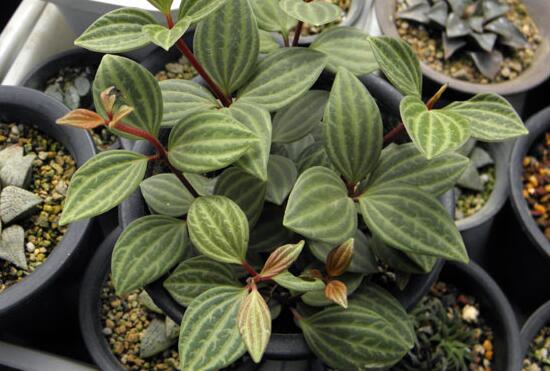
Generally speaking, the Diamond Jade plant is not prone to pests, but during growth, due to improper care, a poor environment and other reasons, it will inevitably get scale insects, red spider mites and sugarcane borers. The appearance of these pests will cause poor plant growth, not only damaging its ornamental value, but also endangering its life, so once discovered, pesticide should be sprayed immediately for control.
II. Prevention and control of Diamond Jade pests and diseases
1. Red spider mite
When talking about Diamond Jade pests, the first to consider should be the red spider mite, because it is the common enemy of foliage plants. This pest mainly pierces its mouthparts into the leaves of Diamond Jade to suck sap, damaging the plant's chlorophyll, causing yellowing of leaves in mild cases and even leaf drop in severe cases, seriously affecting its ornamental value.
Control method: when individual leaves are affected, the infested leaves can be removed; when more leaves are affected, propargite, dimethoate, Huachongjing, fenvalerate and other pesticides should be sprayed early for control.
2. Scale insects
When the environment is not ventilated and care is improper, besides red spider mites, Diamond Jade occasionally suffers from scale insect damage. This pest sucks sap from leaves and small branches with its piercing-sucking mouthparts, and if left unnoticed for a long time, Diamond Jade will drop its leaves.
Control method: when there are few scale insects, remove them promptly by hand, or wash them off with water; when there are many scale insects, pesticide spraying is needed, and the agent can be Kuangshajie 800-1000 times solution; generally one application can achieve the control effect.
3. Sugarcane borer
Among Diamond Jade pests, the sugarcane borer is one everyone needs to consider; this pest is an insect with great potential danger. After being attacked by the sugarcane borer, the fleshy part under the epidermis of Diamond Jade is completely eaten away and replaced with insect frass, and with further damage, the plant will face death.
Control method: after discovering the sugarcane borer, a fast-killing agent such as jusha emulsifiable concentrate can be poured onto the damaged part of the stem, and trichlorfon can be made into poisonous soil and scattered on the surface soil in the flower pot.
4. Anthracnose
Besides pests, Diamond Jade can also get diseases, among which anthracnose is one that requires great attention. This disease easily occurs in rainy seasons, when indoor ventilation is poor, and when humidity is too high. If Diamond Jade shows blackened leaf tips and yellow spots on the leaves, it has probably contracted anthracnose.
Control method: after confirming it is anthracnose, spray 75% chlorothalonil 600 times solution or 50% thiram wettable powder 500 times solution, spraying once every 7-10 days, and 3 consecutive sprays will show effect.
5. Blight
Yet another Diamond Jade disease; it mainly harms the plant's leaves and the area at ground level, causing diseased leaves to develop water-soaked spots, which then quickly expand and become dark brown rotting patches and cause leaf drop; sometimes there is a thin white mold layer on the affected leaf surface.
Control method: promptly cut off diseased leaves and burn them in a concentrated way or bury them in soil to reduce the source of disease. When the disease occurs, spray 72.2% propamocarb aqueous solution 600-700 times solution for control.
That is all the editor has to introduce about the prevention and control of Diamond Jade pests and diseases. I believe everyone should know what to do when Diamond Jade gets pests or becomes sick! Overall, the cultivation method of Diamond Jade is not difficult; as long as everyone cares for it carefully, pests will not come knocking. Finally, may everyone's Diamond Jade grow beautifully~
How to propagate Diamond Jade, the propagation methods of Diamond Jade (stem cutting/leaf cutting)
Diamond Jade, also called White-veined Peperomia, is a foliage plant introduced to our country only in recent years; its leaves have the white of diamond and the green of jade, looking extremely beautiful. In daily life, many flower lovers want to grow Diamond Jade, but compared with buying one, propagating it yourself is more exciting, so how do you propagate Diamond Jade? Next, follow the editor to take a look at the propagation methods of Diamond Jade.
I. How to propagate Diamond Jade, cuttings
When it comes to propagating Diamond Jade, the most common method is still cuttings. Cuttings are divided into leaf cuttings and stem cuttings, that is, inserting a leaf or a branch into soil and waiting for it to take root. As for seed propagation, Diamond Jade can also use it, but the survival rate of Diamond Jade seeds after sowing is low, so it is not considered.
II. Propagation methods of Diamond Jade
(1) Leaf cutting propagation of Diamond Jade
1. Cutting time
Diamond Jade likes a warm environment, so cuttings are best taken in spring and autumn, and April to June is even better; at this time the leaf activity of Diamond Jade is high, and the survival rate of cuttings is higher.
2. Starting the cuttings
From a potted Diamond Jade, cut off healthy and plump leaves, with a portion of the petiole as the cutting. After drying it for one day, insert it straight or obliquely into a flower pot filled with coarse sand or vermiculite, with the insertion depth about 1/2 to 1/3 of the petiole.
3. Care after cutting
After cutting, keep the pot soil moist and maintain the room temperature at 20-25°C. After 2-3 weeks, adventitious buds will grow; after 5-6 weeks, the adventitious buds grow out of the soil surface, dig them out and pot them together with the old leaves, thus becoming a new plant, and afterward just care for it according to the cultivation method of Diamond Jade.
(2) Stem cutting propagation of Diamond Jade
1. Selecting cuttings
For the cutting propagation of Diamond Jade, besides leaf cuttings, stem cuttings can also be chosen, that is, using Diamond Jade branches as cuttings. The time for stem cuttings is also best chosen in April to June; you can cut off healthy, pest-free branches from the potted plant, preferably with the growing tip, with a length of 7-10 cm.
2. Starting the cuttings
Insert the selected cuttings directly into the growing medium, place them in a ventilated spot with scattered light, keep the soil slightly moist, do not cover with glass or plastic film; generally they will take root in half a month. After the new roots have grown for some time, they can be transplanted, and then just wait at home for them to fill the pot!
Overall, if you buy this plant Diamond Jade, one pot costs at least a dozen yuan, and money is money after all, so save where you can! Moreover, the cutting propagation method of Diamond Jade is very simple, and the survival rate of cuttings is high, so flower lovers who are tempted might as well try it themselves! When propagation succeeds, you will not only get a beautiful potted plant, but also harvest the joy of success!
How to cultivate Jade The cultivation method of the plant Jade
The plant Jade is a green plant with high ornamental value; it is suitable for making potted plants for hanging display, and is a common ornamental plant in modern homes. So how should the plant Jade be grown? How can it be grown well? In a moment I will write out the cultivation method of the plant Jade, and friends who like growing the plant Jade can focus on understanding it.
The cultivation method of the plant Jade1. Light for the plant Jade
Usually when growing the plant Jade, its light management is very important. It is a plant that likes sunlight, but it cannot be placed under scorching sun for exposure. So in the three seasons of spring, autumn and winter, the plant Jade can be placed in sunlight all day; after entering summer, it must be given necessary shading treatment, and the plant Jade must be placed in a ventilated environment.
2. Temperature for growing the plant Jade
Usually when growing the plant Jade, temperature is also very important. It is a plant with particularly poor cold tolerance; in winter its growing environment cannot be lower than ten degrees, and the pot soil should be kept dry, so that the plant Jade can safely pass the winter. If the outside temperature is lower than ten degrees, then the plant Jade may very likely die due to low temperature.
3. Fertilizer and water management for the plant Jade
To grow the plant Jade well, fertilizer and water management is also very important. This plant has relatively strong drought tolerance, so it does not need frequent watering; master the principle of not watering when not dry, and watering thoroughly when watering. Excessive watering will cause root rot, especially in the high-temperature weather of summer, when watering should be even less; otherwise the pot soil will become too wet and cause leaves to fall off. In addition, during the cultivation period the plant Jade also needs timely fertilization; in the peak growing season, fertilize once every half month, and after entering the dormant period, stop fertilizing.