A detailed guide to growing potted bamboo, making your home more cultured
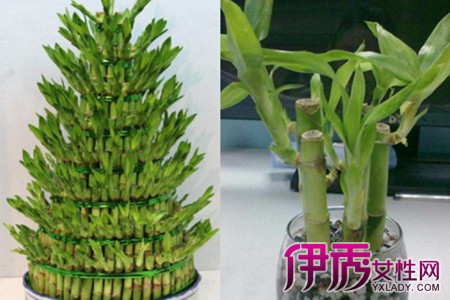
If you want to know how to keep potted bamboo alive well, you should first know which kind of bamboo you are growing. Different bamboo varieties have different habits, so they cannot all be treated the same. Below we share the most typical methods for growing several kinds of potted bamboo, hoping to help friends who love bamboo.
The most common one in ordinary homes is lucky bamboo (Dracaena sanderiana), so let's talk first about how to grow lucky bamboo. Lucky bamboo is mostly grown in water; if it is water-cultured, you must change the water every day. In summer you should also add water once during the day, and lucky bamboo should be given nutrient solution once every half month, otherwise it will stop growing after a long time.
In many areas of the south, some people like to grow fernleaf hedge bamboo (Bambusa multiplex). Next we will talk about fernleaf hedge bamboo. Because it is usually grown as a potted plant, and bamboo is generally fairly tall and sturdy, it needs relatively more water and fertilizer. Under normal conditions, fernleaf hedge bamboo should be watered every day and fertilized once every half month, and ferrous sulfate should also be added so that the large green leaves will not turn yellow.
Buddha belly bamboo (Bambusa ventricosa) is also a fairly famous type of bamboo, so lastly we will talk about it. Buddha belly bamboo has higher requirements for water and temperature than the other types of bamboo; it likes a slightly warmer environment and especially fears lack of water. Usually, less than three hours after the soil dries out, its leaves will curl, so friends growing Buddha belly bamboo must water it and give it sun on time.
Can lucky bamboo be placed in the bedroom? Growing methods for lucky bamboo
Lucky bamboo is also known as Wanshou bamboo, Juhua Wanshou bamboo, Kaiyun bamboo, Fugui tower, and so on. It is a perennial evergreen herbaceous plant of the genus Dracaena in the family Asparagaceae, native to Cameroon in western Africa. It has now been widely introduced into China for ornamental use, is a common ornamental plant in China, and is also quite popular on the international market. Now let's take a look at whether lucky bamboo can be placed in the bedroom!
Can lucky bamboo be placed in the bedroom?
Lucky bamboo can be placed in the bedroom. Lucky bamboo is easy to keep alive, is non-toxic, and also helps increase air humidity. Placed in the bedroom, it can make the resting environment more beautiful and peaceful. There is no need to worry that lucky bamboo releases carbon dioxide at night and competes with people for oxygen, affecting your sleep, because the effect of potted plants on indoor air is almost negligible. Moreover, lucky bamboo can help improve air quality in rooms that are not often ventilated, and it also has a disinfecting function, so placing it in the bedroom is also a very good choice.
What uses does lucky bamboo have?
1. Feng shui use: lucky bamboo represents wood, that is, plants, and can also stand in for a brush. Placing lucky bamboo (water-grown) at the wealth position in the home can activate the wealth position and achieve a wealth-enhancing effect. It can also be placed at the Wenchang position, because the Wenchang position governs studies, culture, work, and so on. Generally people can place four writing brushes or a Wenchang pagoda there, and some also place lucky bamboo, because lucky bamboo looks like a writing brush, so water-grown lucky bamboo especially energizes the qi field of that position.
2. Artistic appreciation: lucky bamboo is suitable as a small potted plant, used to decorate rooms, studies, living rooms, and other places. It can be placed on a desk, coffee table, or tabletop. It is elegant and refined, delicate and distinctive, with very good ornamental value. Moreover, the stems of lucky bamboo are highly malleable and can be bent into single-stem shapes according to people's needs, or cut into sections and combined into shapes. At present there are also many shaped bonsai of lucky bamboo on the market, and many of the shapes are very distinctive, with a rich artistic atmosphere.
3. Beautifying the environment: placing some bamboo in home decor gives people a fresh feeling, and bamboo has always been used to show moral integrity. Placing bamboo can show the owner's taste, style, and noble pursuits.
Growing methods for lucky bamboo
1. Soil culture: cut a sturdy stem of lucky bamboo at least 10 cm long, with leaves, cut the cut end at a slant to help aerial roots form, insert it into a sand bed, and keep the temperature at around 25 degrees; it will take root and survive in one month.
2. Water culture: for water-culture propagation of lucky bamboo, also first cut a sturdy stem of 10 cm, with leaves, cut it at a slant, then insert it into water. Note that one third of the whole plant should be submerged in water, and because the nutrients in water are scarce, nutrient solution needs to be added to raise the survival rate.
3. Bottle culture: bottle culture of lucky bamboo is arguably the method with the greatest ornamental value, and most people use this method. However, with this method you need to note that the nutrients in water are not as rich as in soil, so nutrient solution must be added, otherwise yellow leaves will appear.
4. Temperature: lucky bamboo is a southern plant and likes high temperatures. The temperature suitable for lucky bamboo growth is 20-28 degrees. As for low temperatures, lucky bamboo also has extremely strong adaptability; generally it can tolerate low temperatures of 2-3 degrees.
5. Humidity: lucky bamboo likes shade and moisture and tolerates waterlogging. Water it frequently. Soil-cultured plants must not be allowed to dry out and should be watered in time; water-cultured plants should have their water changed often to ensure the water's nutrients.
6. Soil: lucky bamboo needs good permeability. Loosen the soil and fertilize often. It is best to sprinkle on a little sand, and an appropriate amount of fallen leaves can be added as organic fertilizer.
7. Light: lucky bamboo likes a semi-shaded environment and is not strict about light, but it must not be exposed to strong light for a long time, otherwise yellow leaves and slow growth will occur.
Care methods for lucky bamboo: how do you grow lucky bamboo?
Lucky bamboo is a perennial evergreen small tree foliage plant. Its leaves are long and lance-shaped, like bamboo, and the leaves are deep green. It has umbel inflorescences, bell-shaped corollas, and purple flowers. Placing a pot of lucky bamboo in the living room adds a very eye-catching green. So how should lucky bamboo be grown and cared for? Below, the editor will introduce it to everyone.
Methods for water-growing lucky bamboo:
First,Temperature requirements:
Lucky bamboo is relatively cold-tolerant, and the relatively suitable growth temperature is 20-28°C. It can tolerate low temperatures of 2-3°C, but in winter it must be protected from frost. Too low a temperature will cause cold damage, leading to withering.
Second, light conditions:
Lucky bamboo is a shade-loving plant with excellent shade tolerance. It is suitable for placement in a semi-shaded place. Never place it under strong light for direct sun exposure, otherwise it will cause lucky bamboo to turn yellow, grow slowly, and so on.
Uses of lucky bamboo:
1、Artistic appreciation.
Lucky bamboo is suitable as a small potted plant, used to decorate rooms, studies, living rooms, and other places. It can be placed on a desk, coffee table, or tabletop. It is elegant and refined, delicate and distinctive, with very good ornamental value. Moreover, the stems of lucky bamboo are highly malleable and can be bent into single-stem shapes according to people's needs, or cut into sections and combined into shapes. At present there are also many shaped bonsai of lucky bamboo on the market, and many of the shapes are very distinctive, with a rich artistic atmosphere.
2、Beautifying the environment.
Placing some bamboo in home decor gives people a fresh feeling, and bamboo has always been used to show moral integrity. Placing bamboo can show the owner's taste, style, and noble pursuits.
What to do if lucky bamboo turns yellow
The reasons soil-grown lucky bamboo turns yellow are: too much watering, insufficient watering, strong sun exposure, lack of light, too much fertilizer, insufficient fertilizer, being next to a TV or similar, improper shaping, and so on.
The reasons water-grown lucky bamboo turns yellow are: water quality problems, light that is too strong or too dim, too much or too little fertilizer, being next to a TV, refrigerator, or similar, improper shaping, and so on.
That is all for the introduction to growing and caring for lucky bamboo. Everyone is welcome to keep following Duorou Huapu to learn more about caring for home gardening flowers.