Anthurium growing methods and precautions: keeping the plant healthy and beautiful is simple
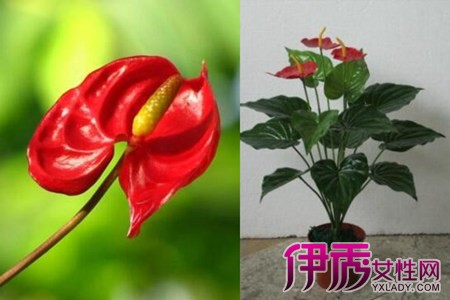
The anthurium plant prefers sunlight, but it also fears being scorched by overly strong sun. So growers must be careful not to place it in the very center of a balcony in summer; it's best to place it to one side so it receives sunlight in the morning or evening. In winter, it can be placed in the very center of the balcony, which ensures both light and warmth.
Anthurium likes moisture, but its roots are not very large, so it cannot store too much water. You must water less but more often. The flowerpot must not hold too much water, otherwise the roots will rot. In summer, you can spray its leaves with a spray bottle every morning and evening; in winter, you can spray its leaves at noon. Because the seasons and climate change, watering and spraying must be adapted accordingly.
Anthurium needs fertilizing, especially before the flowering period. Normally, it should be fertilized once every half month. You can use flower nutrient solution mixed with a small amount of ferrous sulfate to water the roots. After the anthurium forms flower buds, it should be given one additional fertilizing; after it blooms, do not fertilize for one month, which helps ensure a longer flowering period.
Although anthurium is not prone to aphids, because the potting soil stays moist for a long time, fungus easily grows in the pot, and this fungus turns into the little black bugs we see in the pot. If there are too many of these little black bugs, they will hinder the plant's growth, so once discovered they must be dealt with promptly. You can use juice pressed from garlic mixed with water to water the plant; this can drive the little black bugs away for one to two months, but it cannot eradicate them.
Learn the water-culture method for anthurium: growing flowers while saving space is just this simple
Growing anthurium in water is undoubtedly a very space-saving method, because we only need a few pretty glass containers. However, growing anthurium in water requires an acclimation process, because plants have their own characteristics, and suddenly changing their growing environment will certainly make it hard for them to adapt for a while. Below we'll introduce the acclimation process and growing method for water-cultured anthurium, hoping it can help friends in need.
Step one of water-culturing anthurium: acclimation. We can first dig the anthurium out of the flowerpot, then remove the leaves near the roots, cut off excess rotten roots, and wash the roots clean with water. The roots of a newly dug-up anthurium are very afraid of sunlight, so try not to put it in a transparent container; if it is a transparent glass container, you can cover the container with a black plastic bag. Acclimation generally takes one week, and during this time the water must be changed at least three or four times a day.
Step two of water-culturing anthurium: increasing nutrition. After one week of water culture, the anthurium will be acclimated, and after that there is no need to change the water so frequently; changing it once every one to two days is enough. But every time you change the water, you must add nutrient solution, which helps the anthurium take root and develop.
Step three of water-culturing anthurium: replacing the hydroponic basket. After twenty days, the anthurium can grow normally, and at this time you should replace it with a proper hydroponic container. The hydroponic basket is best in white, and the container must be chosen according to how big your anthurium's roots are. When placing it into the hydroponic basket, be careful not to damage the main roots, so as to ensure the anthurium can continue to grow healthily.
Anthurium growing methods and precautions: the feng shui role of anthurium
When arranging home feng shui, sometimes you will find some unfavorable feng shui positions, and placing a pot of anthurium in these positions can help resolve them. So what are the growing methods and precautions for anthurium? Friends who like anthurium should pay attention to building up their knowledge. Anthurium is a flower variety relatively sensitive to salt. What should be noted when growing anthurium at home? Below we'll look at the growing methods and precautions for anthurium. Before understanding the growing methods and precautions for anthurium, let's first look at its characteristics: anthurium belongs to the genus Anthurium in the family Araceae, a perennial evergreen herbaceous plant. It is a typical semi-succulent fibrous-root plant and has aerial roots. The stem is extremely short, nearly stemless. It can bloom year-round; generally, once the plant grows to a certain stage, flower buds can emerge from each leaf axil and bloom.When growing anthurium at home, pay attention to the following aspects:1. Humidity
Normal growth of anthurium requires about 70% air humidity, which is generally very hard to achieve in ordinary home growing. You can use a clean wet towel to wipe the leaves moist several times a day, or spray water around the plant regularly to increase air humidity. (But be sure not to sprinkle water on the flowers, so as not to affect their ornamental quality.)
2. Watering and fertilizing
Under normal growth conditions, water the growing medium by letting it dry and become moist alternately each week. Generally follow the principle of not watering until the soil surface is dry, and watering thoroughly when you do. In spring, autumn and winter, the frequency and amount of watering can be appropriately reduced. Every half month, apply 7-8% special nutrient solution or fertilizer water diluted 500 times along with watering.
3. Pruning
Under normal circumstances, during the growth of anthurium, the leaf stalks at the base gradually degenerate; when the stipules become dry, they can be cut off promptly. After flowering, when the flower stalk turns yellow, it should also be cut off as soon as possible from the base, leaving a 2 cm protective stub.
4. Temperature
When growing anthurium at home, ensure the temperature as much as possible. The optimum growing temperature for anthurium is 16-24°C, and the minimum temperature should be kept above 12°C. If an ordinary household has heating facilities, this condition is easy to meet. But at the same time, note that the flowerpot must not be placed on a radiator or too close to one. When the summer temperature exceeds 30°C, the plant must be moved to a relatively north-facing room in a ventilated position, and water can be sprayed around the plant to lower the temperature.
5. LightNormal growth of anthurium requires sufficient scattered light. For home growing, generally note: in summer avoid direct strong light on leaves and flowers; in autumn and winter, when conditions permit, move it near a window to increase light. The plant also needs to be rotated regularly to ensure it receives even light and to promote a full, rounded crown shape.
In addition to the above conditions, when learning the growing methods and precautions for anthurium, you should understand the growing medium suitable for anthurium. The growing medium must have strong water- and fertilizer-retaining capacity, good permeability, no water accumulation, no toxic substances, and the ability to hold the plant in place. Before planting, the medium must also be thoroughly sterilized to kill pests and diseases and maintain normal growth.
Many friends will find that although they have cared for it very carefully, the anthurium still develops many problems. A common one is that anthurium leaves rot easily. How should rotten anthurium leaves be handled? Generally speaking, the cause of rotten anthurium leaves is excessive humidity; when the temperature is high and there is no ventilation, fungal damage is likely to occur, mostly fungal infection. Using fungicides can achieve a relatively good control effect, and combined with careful water and fertilizer management, diseased plants can generally recover to healthy growth.
Anthurium is a tropical flower that likes shade and avoids sun exposure, likes moisture and avoids drought, and likes high temperatures while fearing cold. When caring for it at home, according to its habits, be careful not to expose it to strong sun, but it also must not be placed in a dim room for a long time. It should be placed where there is scattered light, with some sunlight in the morning and evening. Generally, the growing medium for anthurium uses peat, which is loose and airy. When the temperature is suitable, the potting soil should be kept moist, or water should often be sprayed on the leaf surface to increase air humidity. Now that the weather is turning cooler, if the temperature cannot be kept above 12°C in winter, watering should be controlled to improve the anthurium's cold resistance. The minimum temperature must not be lower than 8°C, otherwise it is very easy for it to freeze and be damaged.
The role of anthurium
Clever home use of anthurium: it absorbs benzene and trichloroethylene, which are harmful to the human body, and has a healthy air-purifying effect.
When flowers of the Araceae family bloom, the flowers have mild toxicity, so it is best to move them outdoors to grow. Anthurium, peace lily, red gem and green gem all belong to the Araceae family. The representative of the Euphorbiaceae family is the poinsettia, also called Christmas red. This flower is also toxic; as long as it is not eaten by mistake, there will be no problem. Wash your hands each time after pruning branches and leaves. Its toxicity mainly comes from the sap, so with a little care there is nothing to worry about.
The value and uses of anthurium
Ornamental value
Its flowers are unique, being spathes, with bright and gorgeous colors and rich color variations, and it is a precious flower in the world. The flowering period is long; as a cut flower in water it can last up to 1.5 months, and the cut leaves can be used as supporting foliage in flower arrangements. It can be grown as a potted plant, and a single flowering period in a pot can last 4-6 months. It can bloom year-round.
Economic value
Anthurium is an important tropical cut flower, with a spadix inflorescence. Its spathe is large, thick and fleshy with a waxy texture, and its colors include red, pink, white, green, bicolor and so on. With bright colors, unique shapes, wide application range and high economic value, it is currently a high-grade tropical cut flower and potted flower with rapid global development and relatively large demand.Feng shui role
As an ornamental potted plant, anthurium also has its own unique feng shui role. The main features of anthurium are: slender stems, green and thick leaves, flowers red like fire, and a golden-yellow spadix. The red flower grows on top (above the head), carrying the meaning of "great fortune ahead." Among the red flowers and leaves there is also a golden-yellow strip-shaped spadix, implying "gold (money) in hand." Who doesn't need either great fortune ahead or money in hand? Of course, these are merely some sayings; in fact, its real feng shui use still lies in the fact that it can transform the five elements, thereby resolving some unfavorable factors.
Feng shui cannot be separated from the five elements. The generation and restraint of the five elements is also a key factor in judging the success or failure of feng shui and good or bad fortune. According to five-element theory: green represents wood, red represents fire, and yellow represents earth. The basic characteristics of anthurium include wood generating fire and fire generating earth. If in a residence there is a place belonging to earth in the five elements and it is restrained by wood energy, placing a pot of anthurium can play a transforming role by draining wood and generating earth.
According to the image theory of the eight trigrams, slender stems represent the Xun trigram, and leaves with palms facing upward, like the Zhen trigram's upward-facing bowl, represent the Zhen trigram. The five elements of the Zhen and Xun trigrams belong to wood. Among them, the Zhen trigram represents movement, activity, action and so on, while the Xun trigram represents wealth luck, work, business, inspiration, wisdom and so on. Red is the Li trigram, representing beauty, prettiness, brightness, open-mindedness, enthusiasm, seeing and meeting, vision and so on. Then the yellow spadix in the middle is shaped like a gold bar, implying money and wealth, and its bright yellow color also represents the Kun trigram. The people and matters represented by the Kun trigram include the mistress of the house, the mother, elderly women and so on, and it also represents bearing hardship without complaint, gentleness, patience and so on.
When arranging home feng shui, the positions in the house belonging to earth include the Kun position in the southwest and the Gen position in the northeast. From a feng shui perspective, the earth field (the static qi field inside the residence) and the heaven field (the nine stars flying in by year, month, day and hour) - if the Kun position and Gen position encounter stars belonging to wood in the five elements flying into these two positions, this will bring negative effects to the people and matters represented by these two trigram positions, and in serious cases there may be some disasters. At this time, placing a pot of anthurium in the Kun position can play a resolving role.
If the mistress, mother or wife in the house has poor health or bad luck, the anthurium can be placed in the southwest Kun position of the living room and bedroom. In this way, the red flower resolves the Kun earth that restrains [representing the mistress, mother and wife], and the red color can also generate and support Kun earth. From the perspective of image, it also represents that the woman in the house can hold the economic power.