Bougainvillea Bonsai Cultivation Methods and Watering Techniques Explained
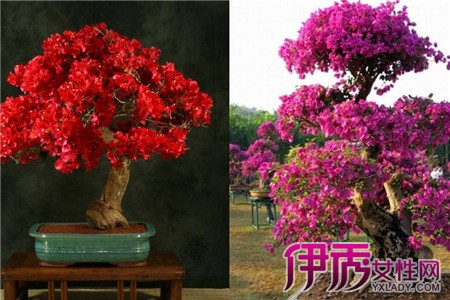
Bougainvillea generally blooms in spring and at the turn of spring and summer. In some places this flower is also called "winter jasmine." Bougainvillea grown outdoors usually forms a beautiful landscape as it grows. Many thoughtful flower lovers in particular build a canopy or pavilion and let the bougainvillea twine over it; when it blooms, many people are drawn to stroll and chat under the pavilion, because chatting beneath the flowers is truly blissful. Growing bougainvillea as a bonsai indoors is also a very charming thing to do.
If bougainvillea bonsai is grown indoors, be sure to prune the flowering branches regularly to keep its original shape; whether the shape resembles a Huangshan pine or a rockery, it must be maintained regularly. Also pay attention to regular fertilizing, generally once a week, and not too much; excessive fertilizing makes the soil crust, so the roots in the soil cannot carry out photosynthesis well, which is bad for the growth of the bougainvillea. Also, after pruning the branches in August, no further pruning is needed, because as the weather turns cold their growth slows down.
Bougainvillea is a plant that greatly loves sunlight, so bougainvillea bonsai must have plenty of direct sunlight. When growing bougainvillea, choose a spot that receives direct sunlight so you do not have to move it back and forth; besides, if the pot is too large and heavy it is not easy to move. Second, be sure to refresh the soil, preferably once a year.
Watering is also something to pay special attention to. After you stop pruning the flowering branches, you should strictly control how often you water; water only when you see the leaves drooping, and do not overwater. During flowering you need to increase the frequency of watering, but it is best to choose morning and evening, and do not water onto the flowers.
Bougainvillea Bonsai Cultivation Techniques, Bougainvillea Bonsai Care Methods
Bougainvillea habits: bougainvillea likes a warm, humid climate and is not cold-tolerant; it can overwinter safely only above 3°C, and can bloom only above 15°C. It likes ample light. It is not demanding about soil; it grows well in heavy loam that drains well and is rich in minerals, and it tolerates poor soil, alkali, and drought, dislikes waterlogging, and tolerates pruning. Bougainvillea (leaf flower) originated in Brazil in South America and was only introduced to Europe for cultivation around the 1830s; it is now cultivated in various parts of our country. It likes a warm, humid environment with plenty of sunlight and is not cold-tolerant; apart from southern regions of our country where it can be grown outdoors and overwinter, in other areas it requires pot culture and greenhouse cultivation. Soil that is well-draining sandy loam is most suitable. Bougainvillea is commonly propagated by cuttings, and raising seedlings is easy: in May and June, cut mature woody branches 20 cm long, insert them into a sand pot, cover with glass, keep moist, and they will root in about a month; after two years of cultivation they can bloom.
Bougainvillea Bonsai Cultivation Methods
1. Choosing a pot: Bougainvillea is not demanding about soil, tolerates poor and dry conditions, and dislikes waterlogging. A sandy soil rich in humus, loose, fertile and highly permeable is best; avoid clay. For potting, use one part each of leaf mold, peat soil, sand and garden soil, and add a small amount of decomposed cake residue as base fertilizer, mixing them into a growing medium.
2. Temperature: The suitable growing temperature is 15—30°C, of which May—September is 19—30°C and October to April of the following year is 13—16°C. In summer it can withstand high temperatures of 35°C; when the temperature exceeds 35°C, appropriate shading or measures such as misting and ventilation should be taken. In winter the ambient temperature should be kept no lower than 5°C. Blooming requires a temperature above 15°C; to prolong the flowering period, move it indoors for care in good time before the cold snap arrives in early winter.
3. Light: Bougainvillea likes light. During the growing season, insufficient light will weaken the plant's growth and affect bud formation and flowering. Therefore, throughout the year, except that newly potted young seedlings should first be placed in partial shade. In winter it should be placed by a south-facing window, and the light duration must not be less than 8 hours, otherwise heavy leaf drop easily occurs. It is a short-day flower; by controlling the daily light duration to about 9 hours, bougainvillea will form buds and bloom after a month and a half.
3. Soil: Bougainvillea grows quickly, has a well-developed root system and very many fibrous roots, so it needs repotting once a year. Because of long-term watering, fertilizing and rain washing, the potting soil of bougainvillea easily becomes compacted, so it needs regular loosening, and at the same time weeds in the pot should be cleared. Otherwise the compacted, waterlogged potting soil can easily cause root rot or poor growth in bougainvillea.
4. Choose varieties that bloom freely, have variegated leaves and a plant shape that is easy to regulate, such as Double Red, Yijin, and Orange Yellow; Variegated Red and Silver-edge White; single-petaled Green-leaf Water Red, Orange Red, Cherry Red, etc.; in Hangzhou they generally can produce 2-3 batches of flowers a year.
5. Cutting propagation and selection of seedlings: For miniature bougainvillea bonsai, cutting propagation is fast and convenient. In Hangzhou in May-June, choose short-jointed, 0.3-1 cm diameter one-year-old woody or semi-woody branches; the cuttings should be 6-8 cm long with 3-4 nodes. Keep the front two leaves (or half-leaves) and insert them into a sterilized substrate, keep moist and give light during care, apply foliar fertilizer after about 20 days, and gradually expose them to strong light for hardening after rooting. After 45-60 days of cutting, move them early with a small amount of substrate into miniature pots; after 2-3 days of recovering they enter routine management. For miniature bougainvillea seedlings you can also directly look for small multi-year-old short-trunked, twisted-branched stumps, trim the roots and branches and pot them; they can also be obtained by air layering old, zigzagging branches wrapped in bags.
6. Goals and measures of early-stage care. Early-stage care is the foundation; the goal is shaping and cultivating the crown. All measures revolve around short nodes and branches, a compact plant shape, and a concise, flowing form. Branches may be curved or bent, but do not deliberately pursue winding twists; generally one or two bends on the main trunk and two or three branches are enough. The branches and leaves should be somewhat more numerous than those of other woody miniature bonsai types, but should not be too dense, so as to benefit the overall balance of metabolism; design the plant form and composition according to the original features of the pot and the material, and give different emphasis to the direction of branches and leaves and their layout, so that the branches and leaves are orderly in density and pleasingly staggered. The crown should be about 1.5 times the diameter of the pot.
a. Watering and fertilizing: The pot is small in volume with little soil, so avoid heavy watering and concentrated fertilizer. The soil should be on the dry side; do not water until it is dry. On sunny days in spring and late autumn, water in the morning; in summer and early autumn, water at both ends of the day, watering a little in the evening to moisten the soil so the leaves can escape wilting, and watering thoroughly in the morning. For fertilizing, every few days mix a little weak fertilizer water into the water used for watering; the first few times mainly nitrogen with phosphorus and potassium as a supplement, and afterward mainly phosphorus and potassium. To prevent excessive rain from causing leggy growth, if conditions permit, it can be kept under a sunny rain shelter.
b. Pinching, topping, wiring and pruning: Determine the timing of topping and pinching according to shaping needs; generally pinch and top once there are 4-5 leaves, to lower the plant height and lower the branching position. After one round of branching has formed, pinch again to form secondary branching.
Wiring should be done early, as soon as the plant has been established and resumed growth. Use aluminum wire 0.6-0.8 mm in diameter; insert one end into the soil and wind the other end around the branch in a spiral at about a 45-degree angle, from the main trunk to the young branches, from bottom to top. When winding, the aluminum wire should hug the branch closely and be moderately spaced; after winding, bend the branch into the desired form, and finally use the aluminum wire to press down the leaf axil of the top young leaf, prompting the young branch's internodes to elongate and form natural bends. Wiring should be carried out promptly as the branches grow. You can also use plastic wrapping tape to bind thicker aluminum wire together with young branches and then bend them into shape. When growth is vigorous and branches are too long, timely moderate pruning is also needed; short-cutting and cutting back promote another round of branching, and at the same time remove overlapping branches and other surplus branches.
c. Spraying growth retardant: When new branches appear, start spraying 0.5% daminozide, once every 7-10 days. If spraying 20-50 PPM paclobutrazol, be careful to control the dosage and extend the interval.
d. Bougainvillea is a strongly sun-loving plant that tolerates heat and is not afraid of sun; it should be kept in direct light and generally needs no shading. Semi-cascade and cascade styles can be placed tilted or inverted.
e. When the branches and crown have initially formed, some flowering-promoting measures must be taken: for example, widening the spacing between pots, placing them high for ventilation, increasing phosphorus and potassium fertilizer, controlling the amount of watering, and continuing wiring to regulate the plant shape.
7. Flowering-period management: About two months after planting, flower buds may appear; at this point pause wiring. For each branch, leave 3 or 4 inflorescences for double-petaled varieties and 6 or 7 inflorescences for single-petaled varieties, then pinch. Concentrate the nutrients so that double-petaled flowers bloom into balls and single-petaled flowers are large and vivid in color. During the flowering period, appropriately increase the amount of watering in the evening, and continue watering with weak fertilizer water mainly containing phosphorus and potassium; to prevent severe wilting, a small amount of water can be added at noon, and the water temperature should be close to the soil temperature.
8. Post-flowering management: With proper management, miniature bougainvillea bonsai can bloom three batches a year; new plants raised from May cuttings may also bloom twice in the same year. After flowering, cut back and short-cut promptly to maintain the plant shape and avoid branches becoming too long; apply weak fertilizer water mainly of nitrogen with phosphorus and potassium as a supplement; wire new branches early and spray growth retardant, etc.
9. Overwintering: Because the pot is small it is greatly affected by changes in outside temperature and is prone to cold damage in winter, so it is best placed on a sunny windowsill indoors, or in a warm cabinet, and strive to keep it no lower than 8°C. If it suffers cold and drops leaves, keep the potting soil on the dry side and let it go dormant; when it is too dry, pour a small amount of lukewarm water around the edge of the pot. If the temperature is high and the sunlight good so that it does not drop leaves and can even bloom normally, then it needs normal maintenance and management.
10. Later-stage care: After 1-2 years of growing a miniature bonsai, repot, change the soil, trim the roots and prune the branches; or partially change the soil, raise the roots, and take measures to make the main trunk look old and gnarled. After a year of care the rudimentary form begins to appear. Moving from an ordinary miniature bonsai to an artistic bonsai or miniature bonsai still requires a shaping process over many years that is mainly pruning with wiring as a supplement.
Precautions for Bougainvillea Bonsai Cultivation
1. When pruning bougainvillea, grasp the principle of "short, heavy, thin," that is, short-cut horizontal branches and heavily prune new shoots. Thin out dense branches and weak branches. Red bougainvillea has weaker growth and is pruned about once a year in March—April. Bougainvillea needs comprehensive pruning twice a year: the first in March—April before budding, and the second in November-December after the flowers fade and before new branches grow, to ensure vigorous blooming year after year.
2. The common pests of bougainvillea are mainly leaf beetles and aphids, and the common diseases are mainly tip blight. Usually strengthen loosening the soil and weeding, promptly remove dead branches and diseased leaves, and pay attention to ventilation to reduce the spread of disease sources. Strengthen disease inspection and deal with problems promptly when found; solutions such as dimethoate and thiophanate can be used for control. In ordinary care and management work, take care of its growth with more attention.
Bougainvillea Cultivation Methods Bougainvillea Cultivation Methods, Bougainvillea Bonsai Picture Appreciation
In early summer, the ordinary and unassuming bougainvillea can be seen everywhere in many cities; it symbolizes enthusiasm, perseverance and a tenacious, striving spirit. With the passage of time, this bougainvillea, which originated in South America and has high ornamental value, has been gradually introduced and cultivated in large quantities by people all over the country and has become one of the widely used ornamental flowering trees and shrubs. Below, the editor will talk about bougainvillea cultivation methods together with bougainvillea bonsai pictures.