A Detailed Guide to Growing Anthurium in Water: Saving Space and Growing Flowers Is This Simple
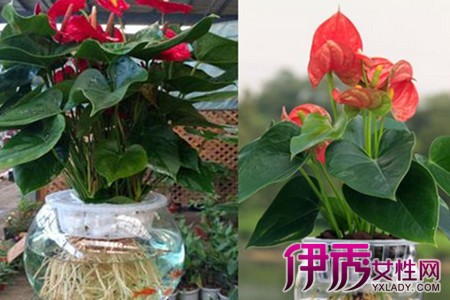
Growing anthuriums in water is undoubtedly a very space-saving approach, because all we need are a few pretty glass containers. However, growing anthuriums in water requires an acclimation process, since plants have their own characteristics, and abruptly changing their growing environment will surely make it hard for them to adapt for a time. Below we will introduce the acclimation process and growing method for anthuriums in water, hoping it can help friends who need it.
Step one of growing anthuriums in water: acclimation. We can first dig the anthurium out of its pot, then remove the leaves near the roots, cut off the excess rotten roots, and wash the roots clean with water. The roots of a freshly dug-up anthurium are very afraid of sunlight, so try not to put it in a transparent container; if it is a clear glass container, you can cover the container with a black plastic bag. Acclimation generally takes a week, and during this time the water must be changed at least three or four times a day.
Step two of growing anthuriums in water: adding nutrients. After a week in water, the anthurium will be acclimated, and after that the water does not need to be changed too frequently; changing it once a day to once every two days is enough. But nutrient solution must be added every time the water is changed, as this helps the anthurium take root and develop.
Step three of growing anthuriums in water: switching to a hydroponic basket. After twenty days the anthurium can grow normally, and at this point they should be moved into a proper hydroponic container. The hydroponic basket is best in white, and the container must be chosen according to how big your anthurium's roots are. When placing it into the hydroponic basket, be careful not to damage the main root, so as to ensure the anthurium can continue to grow healthily.
What Are the Advantages of Hydroponic Flowers? What Are the Common Hydroponic Flower Plants?
Flower Bonsai Network introduction: Hydroponic flowers are clean and hygienic, and are a way many people like to grow flowers. Today, the editor of Flower Bonsai Network shares an article about the advantages of hydroponic flowers. Let's take a look.
Hydroponic flowers are a common modern form of flower care, and they have many advantages, which is why so many people like them. So what are the advantages of hydroponic flowers?
Hydroponic flowers have a unique ornamental appeal
Compared with flowers grown in soil, hydroponic flowers have a unique ornamental appeal. Besides being able to admire the stems, leaves and flowers of the plant, hydroponically grown plants also let you admire their root system, especially beautifully shaped roots; their various colors and forms give them excellent ornamental value as well.
Secondly, in terms of ornamental appeal, hydroponic flowers look more elegant and light. Soil-grown flowers, because of the pot plus the soil, look rather bulky overall and give a dull impression, while hydroponic flowers are different: placing hydroponic flowers in an office or on furniture in a room feels much fresher.
Hydroponic flowers make the flower-growing process simple
Hydroponically grown flowers actually simplify the process of growing flowers. The operations involved in growing flowers in soil are rather tedious, and many people cannot master the method of watering when growing flowers, which leads to all kinds of problems. But with hydroponic flowers, you do not need to worry about when to water or how many times to water; you simply grow them in water, and the operation is fairly simple.
Basically, with hydroponic flowers you just need to change the water regularly; even if you need to go out, the growth of hydroponic flowers will not be greatly affected.
Hydroponic flowers save space
In fact, hydroponic flowers have very simple requirements for containers; even a glass cup or a small vase can be used for hydroponics, which can save a great deal of space. Because they take up little space, they can also be placed on a desk or beside a computer, expanding the space that flowers can beautify.
Hydroponic plants actually have so many benefits?
Growing hydroponic plants indoors has many benefits. Everyone, hurry up and get started!
1. Purifying the air and benefiting health.
Scientific research shows that plants can absorb harmful gases and attach them to the surface of their leaves, and the root systems of hydroponic plants in particular have an even stronger adsorption capacity. They can incorporate harmful gases and dust into their metabolic processes and remove their toxicity during the material transformation. Because of their plant characteristics and their ability to bind with minerals, hydroponic plants have a particularly good filtering effect on improving indoor air, specifically including:
(1) Noticeably adsorbing harmful substances: hydroponic plants mainly absorb harmful substances through their roots. Some plant species can remove up to 90% of formaldehyde, benzene or carbon monoxide from a room.
(2) Absorbing nicotine: Now people have already recognized which plants can best restrain which harmful substances. For example, pothos used in a room where people smoke can clean the air very well, because its leaves and roots can noticeably absorb and fix more nicotine.
(3) Absorbing formaldehyde: The weeping fig can also effectively absorb large amounts of this toxic gas attached to its leaves; within 1-2 days, it can bring 90% of the harmful substances into its metabolic process, thereby producing sugars, energy and other clean natural substances.
2. Clean and hygienic, with few pests and diseases.
Hydroponic plants eliminate the trouble of finding soil and managing it when mixing various potting soils for soil-based potted plants, and they suit the high-efficiency, fast-paced characteristics of modern society.
3. Releasing moisture and maintaining air humidity.
If an office can be greened to a large extent, you often no longer need artificial air conditioning. Large areas of hydroponic plants are the most effective temperature regulators, and they help form ecologically beneficial air purification indoors. Growing hydroponic plants in large workspaces can noticeably reduce the rate of employee illness. The dry air produced by ordinary air conditioning harms people's respiratory tracts, but after bringing in green plants, the number of illness cases can be reduced by about 40%.
4. Beautifying the environment and lifting the mood.
Hydroponic plants are elegant in style and highly ornamental. Hydroponic flowers let you admire the leaves, stems and flowers, and also admire their ever-changing root systems, increasing the decorative appeal of the flowers. You can use the ever-changing forms and colors of flowers to freely arrange and lay out several kinds of flowers, thereby achieving an artistic effect similar to flower arranging.
5. Easy to maintain and easy to care for.
Every plant needs five basic growth factors to grow healthily and lushly. They are: light, air, suitable temperature, water and nutrients. If any one of these is missing, the plant will quickly wither and die, and no amount of the others can make up for it. Soilless-grown plants already possess three of these factors themselves:
(1) Air: laying small granular ceramsite with good breathability over the plant's roots can ensure balanced air permeability for the roots.
(2) Water: the plant's water needs are set at the water level hole, and the container can maintain a certain water reserve, thus saving the trouble of constantly watering.
(3) Nutrients: hydroponic plants come with enough fertilizer to sustain plant growth when purchased, so they can survive on their own for as long as three months.
(4) Light and suitable temperature: only these two factors depend on external conditions.
So, if you want to kill a hydroponic plant, it is not an easy thing to do. Types of hydroponic plants: pothos, arrowhead plant, Monstera deliciosa, peace lily, anthurium, Chinese evergreen, aloe, lucky bamboo, Schefflera octophylla, pennywort, umbrella plant, and so on.
What Are the Common Hydroponic Plant Flowers?
There are many types of plants on the market now, and hydroponic plants are one of them. Next, let me introduce them to you.
What Hydroponic Plants Are There
Lucky bamboo
Lucky bamboo, Latin scientific name: Dracaena sanderiana. Formerly called: Dracaena sanderiana, with aliases bamboo banana, evergreen bamboo, longevity bamboo, Dracaena sanderiana, lucky bamboo, wealth tower, bamboo tower, tower bamboo. When placed in the Wenchang position it is also called Wenchang bamboo (usually 4 stalks are placed). It belongs to the family Ruscaceae, genus Dracaena. It is native to Cameroon in western Africa. It is a perennial evergreen herbaceous plant, with a plant height of up to 4 m; it likes shade and humidity, and its stems and leaves are thick. Its varieties include green leaves, green leaves with white edges (called silver edge), green leaves with yellow edges (called gold edge), and green leaves with a silver center (called silver center), and it is kept in water. Because its stems and leaves closely resemble bamboo leaves, placing it on a windowsill, desk or shelf gives people a sense of upright elegance and free-spirited ease.
Pothos
Pothos belongs to the Araceae family and is a large evergreen climbing plant. It grows in tropical regions, often climbing on rocks and tree trunks in rainforests. It has strong twining ability and well-developed aerial roots, and can be grown hydroponically.
On mature branches, the petiole is thick and strong, 30-40 cm long, slightly enlarged at the base, with an upper joint 2.5-3 cm long and slightly thickened, with a broad groove on the ventral side, and a long leaf sheath; the leaf blade is thinly leathery, emerald green, usually (especially on the leaf surface) with many irregular pure yellow patches, entire, asymmetrical ovate or ovate-oblong, with a short acuminate apex and a deep heart-shaped base, slightly thick, and slightly raised on both sides.
Spider plant
Spider plant, also known as: creeping stem grass, hanging orchid, fishing orchid, orchid grass, folding crane orchid; in Western Europe it is also called spider grass or airplane grass. Its roots are fleshy and its leaves are slender, resembling an orchid. The stolons that emerge from the leaf axils of the spider plant can be about a chi long, both firm and soft; the leaves clustered at the top of the stem droop outward from the edge of the pot and flutter in the wind, resembling a crane spreading its wings and leaping. Therefore, the spider plant was called folding crane orchid in ancient times. The plant has the effect of purifying the air, and the whole plant can be used as medicine.
Characteristics of hydroponic plants
Clean and hygienic: hydroponic flowers grow in clear, transparent water, with no soil and no traditional fertilizer, so they do not breed viruses, bacteria or mosquitoes, and have no peculiar smell. They can be widely used in enterprises, hotels, restaurants, government offices, hospitals, shops, homes and various other settings. Such hydroponic flowers are bound to be very popular in the market.
Highly ornamental: the product achieves the co-cultivation of flowers and fish, with red flowers and green leaves above, trailing fibrous roots below, and fish swimming freely in the water, a three-dimensional planting method that makes the product novel. Such hydroponic flowers are bound to be very popular in the market.
Convenient care: growing hydroponic flowers is especially simple; change the water once every half a month or a month, add a few drops of nutrient solution, and that is enough. Moreover, one box of nutrient solution can last one to two years. Saves time, effort, money and worry! Such hydroponic flowers are bound to be very popular in the market.
Easy to combine: various hydroponic flowers can be freely combined and grown like cut flowers, and they grow for a long time, forming exquisite works of art. Plants of different colors and different flowering periods can also be combined into four-season bonsai.
Precautions for growing hydroponic plants
Plants need sunlight, so when cultivating indoor hydroponic plants, pay attention to choosing the growing environment for the hydroponic plants according to the different types of plants.
Another technique for growing hydroponic plants is to pay attention to changing the water regularly. Plant growth also needs oxygen, and the oxygen their roots need for respiration can only be drawn from the water; only fresh water contains plenty of oxygen.
In addition, nutrient solution must be added to hydroponic plants. When preparing the nutrient solution, be sure to follow the instructions on the nutrient solution, taking care not to overdose and not to shorten the interval between each addition of nutrient solution. Before preparing it, first let tap water sit for a few hours to release the chlorine in it and bring the water temperature to the same as the room.
The above is an introduction to hydroponic plants. I hope you enjoy it.