What to Do When Anthurium Leaves Turn Yellow? Find the Root Cause and Treat It Accordingly
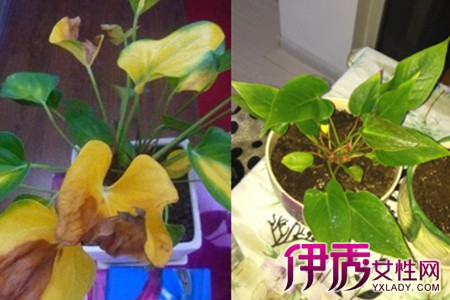
If you want to know why anthurium leaves turn yellow, you should first understand the growing habits of the anthurium. If the care methods are wrong, yellowing leaves are the plant's way of telling its owner that it has already started to sicken. At this point you need to learn how to find the cause of the anthurium's illness, and also how to deal with these problems.
Reason 1 for yellowing anthurium leaves: too much watering. Although the anthurium does not have the extensive root system that lets many flowers store water, it still does not need to be watered too much. Overwatering causes root rot in the anthurium, and yellowing leaves are the early sign of root rot. The way to deal with it is to remove all the yellowed leaves, then place the anthurium in a well-ventilated spot and loosen the soil for it; this way it can slowly recover in about a week.
Reason 2 for yellowing anthurium leaves: too much light. The anthurium is a sun-loving plant, but it does not like direct sunlight. It is especially afraid of being scorched at noon in summer; when exposed to the blazing sun, its leaves will turn yellow. In this case, you can move the anthurium to a spot with partial sunlight and let it slowly recover on its own.
Reason 3 for yellowing anthurium leaves: improper fertilizing. The anthurium does not need much fertilizer, and it rather prefers acidic soil. So if you want to fertilize the anthurium, you only need to water it once every twenty days with ferrous sulfate, or add a few drops of white vinegar to the water you use on it. Do not give it flower fertilizer regularly; too much fertilizer will burn the roots and the leaves will turn yellow. When this happens, you must replace half of the soil in the pot, and be careful not to damage the roots when changing the soil.
The above covers the various reasons that cause anthurium leaves to turn yellow and the ways to handle them, and I hope it helps friends who have anthuriums at home. Growing flowers can delight the mind and nurture the character, and it can also improve the air quality in our homes. Flowers like the anthurium that can purify the air are especially good companions in our lives. As long as you grow it the right way, it will add endless color to our lives.
What to Do When Anthurium Leaves Turn Yellow: Causes and Solutions for Yellowing Anthurium Leaves
Gardeners who have grown anthuriums will all have run into the situation of anthurium leaves turning yellow. Below, let me introduce the causes and solutions for yellowing anthurium leaves.
Cause 1 of yellowing anthurium leaves: metabolism
If you notice an anthurium leaf turning yellow, pay attention to the condition of the other leaves. If the leaves are fresh tender yellow-green while the flowers are growing well, this shows that new leaves are growing, and it is normal for old leaves to turn yellow and drop off.
Cause 2 of yellowing anthurium leaves: unsuitable soil
Most areas in the north have growing media and water with a high content of salt and alkali. Because the medium lacks the soluble iron that the plant needs to absorb, the leaves will gradually lose their green color and turn yellow.
Solution: treat the growing medium and the water used for watering with oxalic acid, etc.
Cause 3 of yellowing anthurium leaves: overwatering
When the anthurium's new leaves turn yellow while the old leaves remain normal, this is generally because too much water, given too frequently, keeps the medium in the pot wet for a long time or even waterlogged, which causes some of the fibrous roots to rot, hindering normal respiration and nutrient uptake, and causing the leaves to gradually turn yellow and drop off.
Solution: water normally.
Cause 4 of yellowing anthurium leaves: dry air
When the air indoors is too dry in winter when growing flowers, the leaf tips often dry up and turn yellow, or the leaf margins scorch, or the leaves develop scorched spots and curled edges.
Solution: according to the anthurium's growing characteristics, appropriately increase the air humidity.
Cause 5 of yellowing anthurium leaves: too much shading
If the anthurium is kept for a long time in a shaded spot or a place with insufficient light, its growth will weaken, the leaves will be thin and yellow, and it will not bloom or will bloom very little.
Solution: according to the anthurium's growing characteristics, appropriately increase the light intensity.
Cause 6 of yellowing anthurium leaves: unsuitable temperature
If the indoor temperature is too low in winter, the leaves will turn yellow; if the room temperature is too high, the plant transpires excessively, and the roots cannot supply enough water and nutrients, which will also make the leaves turn yellow.
Solution: keep the temperature in the greenhouse relatively stable.
Cause 7 of yellowing anthurium leaves: uneven fertilizing
Too little fertilizing, or not repotting or changing the soil for a long time, leads to a lack of nitrogen and other nutrients in the soil, so the branches and leaves become weak and the leaves thin and yellow. In addition, over-fertilizing will also cause new leaves to be thick and bumpy, while the old leaves dry at the tips and turn scorched yellow and drop off. At this point you should immediately stop fertilizing, increase watering, remove part of the old soil, replace it with new potting soil, and carry out normal care.
Causes of yellowing anthurium leaves, and what to do when anthurium leaves turn yellow?
The anthurium has become a must-have ornamental plant for many homes and businesses. Most homes and businesses that keep anthuriums simply buy them from the flower market and grow them themselves; another option is to rent them directly, for example for business events and wedding ceremonies, and some businesses keep them on long-term rental in their offices. The anthurium is much loved for its bright flowers and excellent symbolism! But in many homes and businesses, after the anthurium has been kept for a long time, its leaves turn yellow and drop off. What exactly is going on? Below, let me introduce the methods for dealing with yellowing anthurium leaves and the four-season care methods for the anthurium.
Causes of yellowing anthurium leaves
Many friends who like anthuriums do not care for them attentively, let alone grow them with scientific methods, which leads to frequent problems of all kinds. Once we have found the specific causes of yellowing anthurium leaves, we can find the corresponding solutions.
1. Overwatering
[Cause of yellowing]Too much water, given too frequently, keeps the soil in the pot wet for a long time or even waterlogged, which causes some of the fibrous roots to rot, hindering normal respiration and nutrient uptake, and causing the leaves to gradually turn yellow and drop off.
2. Insufficient light
[Cause of yellowing]The anthurium likes light. If it is kept for a long time in a shaded spot or a place with insufficient light, its growth will weaken, the leaves will be thin and yellow, and it will not bloom or will bloom very little.
3. Uneven fertilizing
[Cause of yellowing]Too little fertilizing, or uneven fertilizing, or even never repotting or changing the soil, leads to a lack of nitrogen and other nutrients in the soil, so the branches and leaves become weak and the leaves thin and yellow. In addition, over-fertilizing will also cause new leaves to be thick and bumpy, while the old leaves dry at the tips and turn scorched yellow and drop off.
4. Dry air
[Cause of yellowing]When the air indoors is too dry in winter, the leaf tips often dry up and turn yellow, or the leaf margins scorch, or the leaves develop scorched spots and curled edges.
5. Unsuitable temperature
[Cause of yellowing]In summer, if the room temperature is too high, the plant transpires excessively, and the roots cannot supply enough water and nutrients, which will also make the leaves turn yellow. If the indoor temperature is too low in winter, the leaves will turn yellow.
6. Poor soil
[Cause of yellowing]In some areas of our country, the soil and water have a high content of salt and alkali. Because the medium lacks the soluble iron that the plant needs to absorb, the leaves will gradually lose their green color and turn yellow.
What to do when anthurium leaves turn yellow
1. Overwatering
[Solution]Water moderately; when you water, water thoroughly; water normally, and do not let water accumulate.
2. Insufficient light
[Solution]The anthurium likes light, so appropriately increase the light intensity. It needs at least 4-5 hours of light a day.
3. Uneven fertilizing
[Solution]Keep fertilizing correct and balanced, and avoid over-fertilizing. If you have over-fertilized, immediately stop fertilizing and increase the frequency of watering to dilute the accumulated fertilizer at the roots, making sure there is no root rot or root burn.
4. Dry air
[Solution]Appropriately increase the air humidity. You can use a spray nozzle to spray a little mist around the anthurium to increase the humidity of its growing environment.
5. Unsuitable temperature
[Solution]Keep the indoor temperature relatively stable. In summer, put it out on the balcony more; in winter, keep it indoors more.
6. Poor soil
[Solution]Use acidic soil as much as possible. Also promptly remove part of the old soil and replace it with new potting soil.
Summary: The above is our editor's compilation of the causes of yellowing anthurium leaves and the corresponding measures, and I hope it helps everyone understand the causes of yellowing anthurium leaves.