When is the flowering period of cyclamen? Care methods matter more
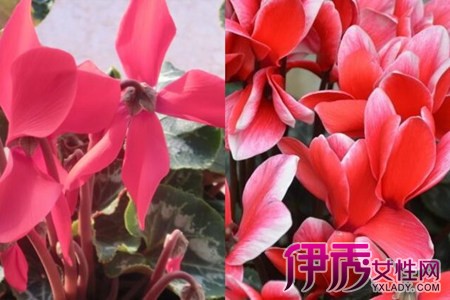
Speaking of when the flowering period of cyclamen is, the flowering period of this flower is actually very long; with good care it will bloom all year round. The editor keeps a few pots at home and they do very well, blooming year-round and looking beautiful, and placed on a windowsill they make quite a different kind of scenery. What's more, growing cyclamen is not hard at all; the main thing is to master cyclamen's habits.
Cyclamen does not have high requirements for its pot; a normal pot with a diameter of 20 cm will do. Do not use too shallow a pot; a slightly deeper pot is of great help to root growth, and when choosing soil do not use ordinary loess from the ground. Loess is not suitable for cyclamen's growth and will seriously affect the flowering period; choose soft black soil, which is more beneficial to cyclamen's normal growth.
You can go into a pine forest and collect the soft, rotted soil from decomposed branches and leaves under the trees; this is of great help to cyclamen's growth. This kind of soil is rich in nutrients, can supply cyclamen's normal growth, and only then can cyclamen's flowers bloom more vibrantly.
Also pay attention to cyclamen's growing temperature. Many northern cities are very cold in winter, so cyclamen must never be placed outdoors. The temperature suitable for cyclamen's growth should be kept between 18-24 degrees, so that cyclamen's flowers can open normally; if placed outdoors, it may very likely freeze to death.
Another point is to pay attention to cyclamen's humidity. Many people do not pay attention to how to water when growing flowers, causing yellowing of the leaves. Cyclamen's water amount can be about once every 3-5 days; as long as the soil in the pot is not dry there is no problem. Do not water excessively, as root rot can occur.
Care methods during cyclamen's flowering period
Cyclamen's flowering period is long-lasting, generally from December each year to May of the following year, with high ornamental value. During cyclamen's flowering period, paying attention to care measures can extend the time the flowers stay open. Care during the flowering period mainly involves the following points:
Ensure sufficient light
Cyclamen likes light, so the pot should be placed in a spot with sufficient light. Because overlapping leaves will block light and affect the growth of new leaves and flower buds, the leaves at the center of the leaf cluster should be pulled outward, or some of the leaves that are too numerous and seriously block sunlight should be thinned out.
Maintain an appropriate temperature
When cyclamen is below 5-6 degrees C, it cannot bloom normally, so good insulation work should be done.
Moisture retention
In cyclamen's place of origin, the flowering period is exactly the warm, humid season, so relatively high air humidity is needed for normal blooming. You can spray water around the plant or put a plastic bag over the outside of the pot at night; this not only retains moisture but also keeps it warm.
Replenish water in time
After cyclamen enters the flowering period, it needs more water; avoid the pot soil running out of water, otherwise the flower stems will quickly lose water and fall over sideways, the leaves will dehydrate and wilt, and some leaves will turn yellow and withered. Although watering can restore the original state, it will cause some leaves to turn yellow and delay flowering, and at the same time the flower stalks will bend, affecting the ornamental effect.
Cyclamen care during the flowering period and seed-saving methods
Cyclamen (Cyclamen persicum Mill.), also known as radish begonia, rabbit ear flower, rabbit flower, yipin crown, bonfire flower and fan-petal lotus, is a perennial herbaceous plant of the genus Cyclamen in the primrose family. The leaves emerge from the top of the tuber and are heart-shaped, ovate or kidney-shaped; the leaves have fine serrations, the leaf surface is green with white or gray mottling, the leaf underside is green or dark red, and the petioles are relatively long and red-brown. Cyclamen is a commonly grown fresh flower, suitable for growing in indoor pots, while in winter it needs greenhouse cultivation. Some cultivated varieties of cyclamen have a rich fragrance, while others have a faint or no fragrance. Cyclamen generally breaks dormancy from late August to early September. At this time it should be placed in a cool, ventilated place for care, and as the leaves grow, gradually increase light, watering frequency and watering amount. From the early bud stage of cyclamen until the flower stalk elongates to 1 cm, use a sprayer to spray a 1ppm—5ppm gibberellin solution directly on the young buds to promote earlier flowering. The gibberellin concentration should not be too high; otherwise the flower stalks will grow leggy and droop, and deformed flowers will increase. Cyclamen's flowering period is generally from October to May of the following year. During flowering, keeping the room temperature at 12 degrees C—15 degrees C and the relative humidity at 60%—75% can prolong the flowering period; a single flower can stay open for more than 20 days, and one pot of flowers can bloom for 4 months—6 months. If the room temperature is higher than 18 degrees C, the tall stalks will grow leggy, the flowers will droop, and the flowering period will shorten; if the room temperature is lower than 10 degrees C, growth will slow and the flowers will be small. During flowering, watering should be appropriately controlled; keeping the pot soil moist is enough. Too much watering and the flowers tend to fade early. When watering, do not splash water on the flower buds and tender leaves, so as to avoid causing rot. Fertilization should be stopped during flowering; otherwise it will cause the flowers to fade early. Also pay attention to frequently turning the pot position so that the leaves and flowers receive light evenly, ensuring a neat and graceful plant shape. Cyclamen is generally propagated by sowing. If you want to save seeds, during the full flowering period (January—February) select plants with excellent, pure varieties that are robust and bloom profusely, keep only 8—9 flowers per plant, and remove all the remaining flowers and flower buds, and place the pot in a ventilated, sunny spot. To increase the seed-setting rate, artificial supplementary pollination can be carried out. On a clear morning 2 days—3 days after cyclamen blooms, rub the pistils and stamens of two flowers against each other, or use a writing brush to pollinate. If you want to breed new varieties through artificial hybridization, you can select two different excellent varieties as the male parent and female parent respectively. Before the stamens and anthers of the female parent mature, remove the stamens with tweezers and then bag them. When the anthers of the male parent mature, vibrate the base of the petals by hand up and down or left and right to make the pollen fall off, and catch it with a small container. Then remove the bag covering the female parent, dip the tip of a writing brush in pollen to pollinate, and bag it again immediately after pollination. After the ovary is fertilized, the flower stalk naturally droops, the petals gradually fall off, and the calyx closes around the outside of the fruit. At this time remove the bag, raise the pot so that the formed capsule does not touch the ground, and pay attention to shading at noon; the pot soil should not be too wet. During the seed-setting period, apply a phosphorus-potassium fertilizer once to make the fruit large and the seeds plump. From the flowering period to fruit maturity takes about 75 days—90 days. When the capsule turns yellow and soft and the top of the fruit cracks slightly, pick the fruit and take out the seeds. Generally each capsule sets 30 seeds—40 seeds, and at most more than 100 seeds. After drying the seeds in a ventilated, shady place, store them under dry, ventilated, cool conditions, and they can maintain germination capacity for 3 years.