How to grow anthuriums at home so they stay healthy and lush
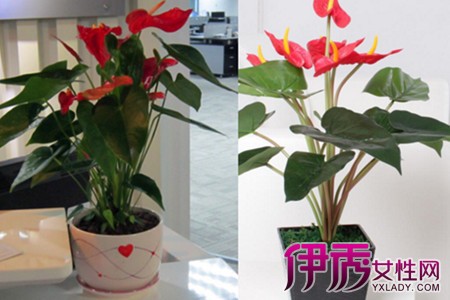
When buying anthuriums from a flower market, we must choose mature plants with vivid colors, and the pot should not be a cheap simple one. This is because simple pots cannot support long-term healthy growth of anthuriums, and after bringing them home you would still need to repot them yourself. This makes it very hard to guarantee the anthurium's survival, so choosing a healthy anthurium and a slightly larger pot made of good material is very important.
Before we bring anthuriums home, we must first understand their habits. Anthuriums like moisture but their roots are not particularly large, so the roots must not be constantly soaking in water. The best method is to place a water-filled tray under the pot, so that when the anthurium's soil needs water it can absorb it on its own. You can mist the anthurium's leaves daily with a spray bottle, which both prevents the leaves from drying out and enhances its ornamental appeal.
Anthuriums do not need much fertilizer, but they like acidic soil. About every twenty days you can water them with ferrous sulfate, or you can water the roots with white vinegar diluted in water. Normally do not fertilize anthuriums, as it easily burns the roots and also easily causes the leaves to grow excessively.
Although this plant's roots are not very large, it will grow many fine fibrous roots. If these fibrous roots are not trimmed, the anthurium will grow smaller and smaller and appear unhealthy, so every spring they must be repotted. Repotting can be combined with division: separate the side shoots from the mother plant and replant them into other pots, but be careful not to damage the main roots.
How to grow anthuriums? A care guide for anthuriums with environmental benefits
Anthurium is also known as Anthurium andraeanum, flamingo flower, and fire crane flower. Common varieties include 'Jin Fen', 'Pink Champion', 'Alabama', 'Candy', 'Arizona', 'Antalore', and others. A while ago the editor talked about the care techniques for peace lilies, and many gardening friends asked whether anthuriums are the same. Below, the editor of Huinong Net talks with you about the anthurium care guide.
1. Growth characteristics
Anthurium plants are 50-80 cm tall, with fleshy rhizomes. Long-stalked heart-shaped leaves emerge from the rhizome, the leaf surface is bright green, the veins are sunken, and the flowers are mostly bright red, though there are also white or pink varieties.
2. Environmental benefits
Anthuriums have a strong ability to absorb harmful gases such as formaldehyde, benzene, xylene, and trichloroethylene, and have a certain ability to absorb helium. They can purify the air and improve environmental quality.
3. Care guide
(1) Choosing soil
Anthuriums prefer sandy loam with good drainage, looseness, good air permeability, strong fertilizer retention, and rich humus.
(2) Light
Anthuriums like warmth and partial shade, and dislike direct sunlight. In spring, summer, and autumn, provide appropriate shading.
(3) Temperature
The suitable temperature for anthuriums is 20-30°C, and the minimum must not be lower than 13°C.
(4) Watering
Anthuriums like moisture. During the growing period, water once every 3 days and mist the leaves regularly. In winter, follow the principle of "do not water until dry" when watering.
(5) Fertilizing
Anthuriums do not like fertilizer. During the growing period, fertilize once a week with anthurium-specific fertilizer or alum fertilizer water.
(6) Propagation
Anthuriums can be propagated by division. First place a layer of crushed stone 4-5 cm in diameter at the bottom of the pot, then add 2-3 cm of growing medium. Place a side shoot with 3-4 true leaves and aerial roots in the center of the pot, spread out the rhizome, and continue adding growing medium until it is 2-3 cm from the pot rim.
(7) Pruning
Anthuriums should not have too many leaves; keeping only 4 leaves per plant is enough. In addition, yellowed and withered old leaves should be cut off promptly.
(8) Placement and display
Medium and large potted anthuriums can be placed on windowsills or side tables in the living room or bedroom, while small potted ones can be placed on shelves, desks, computer desks, and similar spots kept at a distance from the head of the bed.
How to grow anthuriums? Cultivation methods and precautions for anthuriums
How to grow anthuriums? What are the cultivation methods and precautions for anthuriums? Friends who like growing anthuriums will first have such questions. Everyone should note that among all flowers, anthuriums are very sensitive to salt, so some precautions are needed when cultivating anthuriums.
Anthurium belongs to the Araceae family, genus Anthurium, and is a perennial evergreen herbaceous plant. It has a typical semi-succulent fibrous root system and also has aerial roots. The stem is extremely short, nearly stemless. It can bloom year-round; generally, once the plant reaches a certain stage, flower buds can emerge from each leaf axil and bloom.
Cultivation methods and precautions for anthuriums. When growing anthuriums at home, pay attention to the following aspects:
1. Humidity
Normal growth of anthuriums requires about 70% air humidity, which is generally very difficult to achieve in ordinary home cultivation. You can wipe the leaves several times a day with a clean damp towel, or regularly mist around the plant to increase air humidity. (But be sure not to sprinkle water on the flowers, as this may affect their ornamental quality.)
2. Watering and fertilizing
Under normal growth conditions, water the growing medium weekly, alternating between allowing it to dry somewhat and keeping it moist. Generally follow the principle of not watering until the soil surface is dry, and water thoroughly when you do. In spring, autumn, and winter, appropriately reduce the frequency and amount of watering. Every half month, apply a 7-8% special nutrient solution or fertilizer water diluted 500 times along with watering.
3. Pruning
Generally, during the growth of anthuriums, the basal petioles gradually degenerate, and when the stipules dry out they can be cut off promptly. After flowering, when the flower stalk turns yellow, it must also be cut off as soon as possible from the base, leaving a 2 cm protective stub.
4. Temperature
When growing anthuriums at home, keep the temperature as stable as possible. The optimal growing temperature for anthuriums is 16-24°C, and the minimum temperature should be kept above 12°C. In ordinary households with heating facilities, this condition is easy to meet. But at the same time, be careful not to place the flowerpot on a radiator or too close to one. When the summer temperature exceeds 30°C, move the plant to a ventilated room relatively toward the north side, and you can mist around the plant to lower the temperature.
5. Light
Normal growth of anthuriums requires sufficient scattered light. For home cultivation, generallynote: In summer, avoid strong light shining directly on the leaves and flowers; in autumn and winter, when conditions permit, move the plant near a window to increase light. Also rotate the plant regularly to ensure it receives even light and to promote a full, rounded crown shape.
Finally, Aiyouwo Decoration Network also needs to remind everyone that when learning the cultivation methods and precautions for anthuriums, you must master the growing medium for anthuriums. The growing medium must have strong water and fertilizer retention, good permeability, no water accumulation, no toxic substances, and the ability to hold the plant in place. You also need to pay attention to air humidity, moisture, and temperature, otherwise the phenomenon of rotten anthurium leaves will occur.