How to grow wax begonias so your home blooms in all four seasons
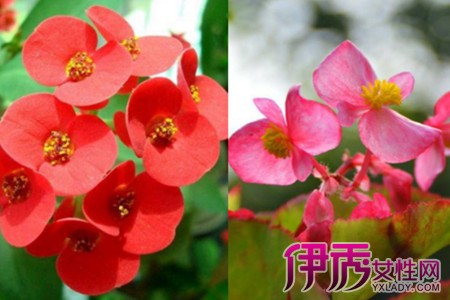
The growing method for wax begonias is not complicated; as long as you understand the habits of wax begonias you can grow them successfully. Today we will explain how to grow wax begonias at home, hoping to help more flower-loving friends fulfill their wish of growing wax begonias at home.
Wax begonia is the most afraid of cold, so after buying it you must place it in a warm environment. In summer it can be placed in a well-ventilated spot, which prevents them from attracting aphids. In winter you must keep it warm; if the room temperature is not warm enough they will not bloom. In northern regions, if the home temperature is not warm enough, you can wrap the flower in plastic film for the few days when the temperature drops, then open it once the temperature rises.
Wax begonia likes humid air, but the roots must not sit in water often. So the most sensible way to grow it is to mist the leaves, and place a tray filled with water under the flowerpot, so the flower will neither be too waterlogged nor short of water. In winter you should water once a day between 11 a.m. and 3 p.m., and in summer you should water in the morning and evening.
Because wax begonia blooms all year without stopping, it must have ample light and nutrients. This flower especially loves sun and is not afraid of strong exposure; just place it on a windowsill where it can get sun and also have ventilation. Every two months you should fertilize it once; flower nutrient solution or flower organic fertilizer sold on the market will do. When fertilizing, the ratio must be mixed with water according to the instructions, otherwise fertilizer that is too concentrated will burn the roots.
The above is the method for growing wax begonias. As long as you make sure to follow these correct methods, wax begonias can successfully bloom beautifully in your own home. A pot of beautiful flowers adds a lot of color to our lives; as long as the grower is careful and patient enough, they can enjoy this beautiful, gorgeous color.
An introduction to 6 kinds of potted flowers that bloom all four seasons! Blooms in all four seasons is no problem
In recent years, to improve the home environment and make family members healthier, many friends have started growing potted plants at home. Potted plants can be divided by ornamental part into foliage plants, flowering plants and fruiting plants, and among them flowering plants are especially popular. I believe all friends who grow flowers hope their flowers can bloom in all four seasons, so which potted flowers bloom all four seasons? Let's learn about them together.
Image: Moss rose
1. Moss rose
Moss rose is also called pine-leaf peony, and is even called “the unkillable one,” simply because its vitality is truly too strong. At the same time, moss rose also has a very long flowering period, and can keep blooming from the end of April all the way to November. In ordinary care, you just need to give it plenty of sun and water it when the soil is dry and let it dry between waterings, about once every 5-6 days.
Image: Periwinkle
2. Periwinkle
Periwinkle has a very long flowering period and can bloom almost all year round. Even friends in the north, as long as they grow it indoors with heating, can still enjoy continuous blooms. In ordinary care, give it plenty of sun; under the sun periwinkle can grow very well. Watering about once every 3-5 days is enough. At the same time, after flowering, periwinkle can be pruned appropriately, leaving about 4 pairs of leaves on each branch, so the plant shape of periwinkle will be fuller.
Image: Bougainvillea
3. Bougainvillea
Bougainvillea can bloom all year round as long as the temperature is suitable. Moreover, getting bougainvillea to bloom is very simple; you just need to control water, watering about once every 10-15 days, repeating this cycle 3-4 times, and then you can see flower buds on the branches of the bougainvillea. However, note that the temperature must be kept above 15°C.
Image: Kalanchoe
4. Kalanchoe
Although the flowering period of kalanchoe is not as long as that of periwinkle, because in summer's high temperatures kalanchoe enters a dormant period. But in the other seasons it blooms continuously. During care, after kalanchoe blooms you should promptly prune the branches and cut off all the faded flowers. At the same time, pay attention to pinching; some kalanchoe have only just passed the dormant period, and at this time you should pinch off the tender buds at the top, which can promote the sprouting of side branches.
Image: Crown of thorns
5. Crown of thorns
The flowering period of crown of thorns is generally 3-4 months, and some can even reach 6 months. If the temperature and light conditions are suitable, it can even bloom all year round! During care, note that crown of thorns likes a warm, humid environment with ample light. If this environment can be maintained continuously, crown of thorns can keep blooming continuously.
Image: Rose
6. Rose
Everyone is surely familiar with roses; as long as the right variety is chosen, blooming for three seasons is no problem. During care, note to fertilize more; for example, during the growing season of roses, you can water with fishy water or soybean cake water about once every 10 days. At the same time, give it plenty of sun, mainly to avoid diseases such as rose powdery mildew.
[Editor's concluding remarks]Moss rose, periwinkle, bougainvillea and others are all common flowers in daily life. As long as they are cared for properly, blooming in all four seasons is no problem. Go ahead and grow a few pots quickly.
Create a mini garden that blooms in all four seasons
Rooftops are windy, dry and sun-scorched, making it very difficult to cultivate flowers and trees, so creating a microclimate environment and choosing the types of flowers and trees is key. After building some planting facilities on the rooftop according to local conditions, first plant some flowering shrubs suitable for growth, then, in view of the local microclimate they form, choose and plant various flowers suitable for growth, and through them form a mini garden landscape.
Necessary facilities
Taking the author's own rooftop as an example, after overall consideration some facilities were first built, specifically:
(1) Using the existing walls along the south, west and north sides of the rooftop, build long strip-shaped flower beds of varying height and width with bricks, faced with gray bricks and capped with black marble, and leave 15cm outside the flower beds along the paving as a drainage ditch.
(2) For ground treatment, the terrain is higher in the north and lower in the south to facilitate drainage. Pave the ground with a combination of gray bricks and white (a small amount of black) pebbles. Fresh and elegant, seeing the large within the small, with even more charm of a traditional garden. Fill the drainage ditch outside the flower beds with pebbles up to ground level, then spread white stones on top.
(3) According to the length of the flower bed, reserve corresponding drainage holes at the bottom and apply waterproof coating to the inner walls of the flower bed for waterproofing. First lay a layer of ceramsite at the bottom of the flower bed as a filter layer, cover it with non-woven fabric, then backfill lightweight culture soil up to the mouth of the flower bed. The lightweight culture soil is made by mixing rice husk ash, sawdust, nutrient soil and a small amount of garden soil. After the plants are planted, spread a layer of white stones on the surface of the flower bed, which can both retain water and create a beautiful effect.
(4) Combined with the actual situation, several lattice panels of anti-corrosion wood and moso bamboo were set up for plants to climb on.
Selection of plant types
On the roof of a high-rise building, light is strong, wind is heavy, humidity is dry, and the soil layer is not deep, so some plants suitable for growing on the roof were planted first, and through their growth a local small environment was created.
First, choose sun-loving flowering shrubs such as: cherry blossom, rose of Sharon, pomegranate, Japanese euonymus, rose; drought-tolerant small coniferous plants, such as Buddhist pine, Japanese black pine; plants that climb walls, such as Boston ivy, honeysuckle; ornamental grasses that add dynamic movement to the landscape, such as dwarf pampas grass, Chinese pennisetum, Briza maxima... After planting, these flowers and trees are relatively easy to survive, require extensive management, and can adapt to growth in the rooftop environment.
With the "help" of the above plants, some perennial flowers can then be added, such as verbena, iris, blanket flower, coneflower, rosemary; aquatic plants such as lotus, water lily, Japanese iris; fruit- and foliage-ornamental plants, such as red maple, coralberry, nandina and camellia. When planting, carefully choose their respective planting spots, and through plant size, reasonable pairing, and giving each its proper place in sun or shade, dry or wet, they form scenery for each other through spring, summer, autumn and winter. In addition, some small accessories such as Taihu stones and pottery urns can be used to combine with these plants to form groups of small scenes.
The author's mini rooftop garden has been completed for more than 3 years, with daily watering, pruning, weeding and fertilizing, and great joy in it. When the garden's small gate is pushed open in early spring, the cherry branches are already full of cloud-like blossoms, intoxicating; in summer, drinking a cup of honeysuckle tea that you picked, washed and sun-dried yourself makes a day's irritability vanish; in mid-autumn, the abundant fruit of coralberry and nandina is delightful to the eye, with vitality rushing at you; in winter, facing the verdant pines and the new buds waiting to sprout, one increasingly senses the tenacity and greatness of life.