How can you care for indoor flowering plants to instantly turn your home into a garden kingdom?
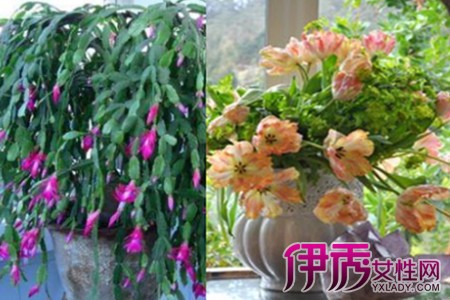
If you want to grow indoor flowering plants well, you should first understand what these flowers have in common. No matter what season or month they bloom, these indoor flowering plants all like warmth and humidity. So water should be sufficient, but the roots must not be constantly soaked in water. Flowering plants usually do not have very large roots and do not have much water-storage capacity. Too much watering will cause root rot, and too little watering will make the flowers wilt.
Many people like to spray water on flowers after they bloom with a spray bottle, but this practice is actually very ill-advised. Because the flowers are delicate, frequent spraying will cause scale to attach to the flowers, and this makes the flowers more likely to fade early. After the flowers bloom, do not spray water on the flowers again. You can wipe the leaves with a clean, damp towel, which can keep the leaves humid.
Plants that usually bloom need more fertilizer than those that only grow leaves, because after the flowers open they need a large supply of nutrients. However, after blooming it is not suitable to fertilize the flowers too much, so the base fertilizer should be applied generously when the buds are forming. Only in this way can you ensure a longer flowering period and more delicate, colorful flowers after they bloom.
During the flowering period, flowering plants are most likely to attract aphids or whiteflies, and if these small insects are not controlled, they will deal a fatal blow to the flowers. So you should deworm the flowers before the flowering period arrives. In seasons when they are not blooming, deworm once a month. Deworm once when the buds are forming, and after blooming do not deworm again. Because flowers are much more delicate than leaves and can hardly withstand the effects of insecticides, deworming during the flowering period will make the flowers fade prematurely.
The above are the cultivation methods and precautions for growing indoor flowering plants. I hope everyone can use the correct methods to grow flowers. Keeping a few more pots of flowers in the home not only looks good visually, but also lifts the spirits and adds vitality to the home. As long as you take good care of these flowers with more care, they will repay you by recalling their most beautiful posture.
How much is green grape a jin?
The price of green grapes also varies slightly depending on the place of origin. On average, green grapes generally sell for about 10 yuan a jin, and the slightly more expensive ones may sell for 20-30 yuan a jin, which is not especially expensive. But one kind is unreasonably expensive, namely Japanese green grapes, which cost almost more than 200 per jin. Japanese green grapes are mainly grown at the foot of Mount Fuji, an important fruit-producing region in Japan known as the "kingdom of fruit trees." Thanks to the geographical advantage, every green grape grown here is very crystal-clear and plump, with thin skin and lots of flesh, crisp and tender texture, and plenty of juice and sweetness. Although the price is not low, it is still very popular.
Visiting the fresh flower exhibition area of the Yunnan Plateau Characteristic Modern Agriculture Exhibition and Promotion Fair: many varieties in the flower kingdom
Yunnan is a veritable flower kingdom. Thanks to excellent natural conditions such as sunshine and soil, the total flower planting area reaches 105 mu, and wild flower resources reach more than 4,000 species, making it a world-famous natural base for flower production. On December 10, Beijing was cold and bleak, but the fresh flower exhibition area of the Yunnan Plateau Characteristic Modern Agriculture Exhibition and Promotion Fair was colorful and fragrant.
“Really no need to water it either?” Ms. Wang, a resident, repeatedly confirmed whether the “preserved flower” in the box was really as magical as its name. At the booth of the Mengzhicao company, colorful roses, Chinese roses, and hydrangeas were packed in boxes of different sizes. “We specialize in indoor preserved flowers. We replace the cell sap of the fresh flowers with nutrient solution to preserve them, so when placed in a glass box, they will not wither for one or two years,” the staff member introduced. When smelled closely, the flowers still had waves of delicate fragrance, and when touched gently with a finger, the petals were soft and tender.
Fresh flowers are delicate and beautiful, and can also be used in food. The “Hua Zhidao” company, which specializes in growing edible flowers, brought jasmine juice, rose sugar, and petal jam. “You can add a little when cooking porridge, or spread it directly on bread. Our Yunnan climate is good, and the fresh flowers have a unique color, aroma, and taste,” said Hu Shen, the person in charge, while introducing and handing them to passing residents to taste.
“I knew fresh flowers can be eaten and brewed as tea, but this form is the first time I have seen it,” said Ms. Guo, a resident, referring to the flower tea cakes at the neighboring booth. These flower tea cakes are shaped like round discs. The yellow ones are calendula, the pink ones are Chinese roses, the red ones are golden-edged roses, and there is also a colorful “Hua Qiangu” that mixes all edible flower teas together. Standing on the shelf, it is a work of art.
“Tea cakes are a Yunnan specialty, and fresh flowers are also a Yunnan specialty. If Pu'er tea can be sold this way, flower tea certainly can too. We started making this two years ago. In the past it sold out without even leaving Kunming city. This promotion fair is the first time the flower tea cakes have flown to Beijing,” said Chen Zhixing of Hongzhihua Horticulture Company humorously.
Ms. Guo, nearly 70 years old, bought 8 in one go. “This can be enjoyed and also drunk. The holiday is coming soon, and I was just worrying about what to give the younger generation. This is very interesting.”
In addition to flower tea cakes, the seven-colored roses, seven-colored carnations, and seven-colored chrysanthemums on the booth attracted the curiosity of many residents. “Is the color of each petal different because it grows that way directly, or because of later processing?” “We use biological dyes and artificially control aspects such as temperature, moisture, light, and pH. Before the flowers open, we can already decide the color of the petals,” Chen Zhixing answered very confidently.
“The key to the dye is not harming the petal cells and ensuring the length of the vase life, that is, the time from harvest to withering. This determines the ornamental value and commercial value of the flowers,” Chen Zhixing said. The dye developed by their company together with Japan can keep the vase life of fresh flowers at about one month.
Because of this, when seven-colored fresh flowers were launched last year, a single stem once sold in Yunnan for a high price of 198 yuan. “Now the market has returned to rationality. A single seven-colored chrysanthemum is priced at about 25 yuan, while ordinary chrysanthemums can only sell for 3 jiao on the Kunming flower market,” Chen Zhixing said. Now the technology has achieved striped and grid-like dyeing. “If a promotion fair is held again next year, Beijing residents will be able to see even more distinctive seven-colored fresh flowers.”
Exhibitors are displaying flower tea cakes.