Learn to grow spider plants in empty drink bottles, easily DIY a simple indoor bonsai
Spider plant is a relatively easy-to-grow plant in the orchid family. It is suitable for surviving in an environment of 15-25 degrees, so placing it indoors is very good. Moreover, spider plant grows relatively fast and is easy to manage, so it can often be seen in many people's homes.
Among them, hydroponic spider plants are loved by everyone because of their elegant appearance and easy-to-grow characteristics, and the materials needed are also very simple. You can easily DIY a hydroponic spider plant using surplus materials around you. For example, an empty drink bottle can be used as the container for a hydroponic spider plant. Below, I will introduce how to make a hydroponic spider plant using an empty drink bottle.
1. Prepare the DIY materials.
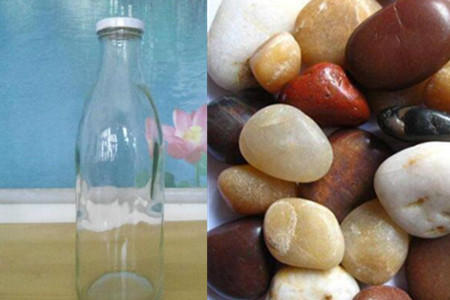
1. First prepare an empty drink bottle, some pebbles, and one spider plant branch.
2. Use a tool to remove the upper part of the drink bottle, and wash the pebbles clean. Remove the excess old roots and leaves from the spider plant.
2. Start making the hydroponic spider plant.
1. Put water into the empty bottle. If using natural water directly, do not put the spider plant in directly, because natural water usually contains bleaching powder and some microorganisms and bacteria, which will affect the growth of the spider plant. If using tap water, it needs to be left to stand for about half a day.
2. Put the washed pebbles into the bottom of the bottle. This not only improves the ornamental value, but also brings a good living space for the spider plant. After the above steps are completed, put the spider plant into the water.
3. Later management is also very important.
1. After the spider plant pot is made, what is more important is later management. Pay attention to changing the water regularly and keeping the container clean. Changing it once every three days is preferable.
2. After new roots grow out, remove the old roots in time, and do not soak all the roots in water, as they are prone to rot. Putting two-thirds in is enough. Place the spider plant in a place where sunlight cannot shine directly, and it can grow very well.
Appreciation of spider plant pictures
The effects of spider plant
According to research, spider plant has the function of absorbing toxic gases. Generally, if a pot of spider plant is grown in a room, the formaldehyde emitted in the air by smoking and building materials can be almost completely absorbed, playing a role in purifying the air and also protecting the human body.
The roots and whole plant of spider plant can be used as medicine, with effects such as clearing the lungs, relieving cough, cooling the blood, and stopping bleeding. Spider plant is a perennial herbaceous plant with slender drooping branches. It blooms small white flowers in summer, with yellow stamens, and can be used for potted ornamental display.
Appreciation of spider plant pictures
Dendrobium cultivation techniques, appreciation of Dendrobium pictures
DenMost plants in the Dendrobium genus have medicinal properties, such as the famous Dendrobium officinale and Dendrobium nobile, but they also have ornamental value. Dendrobium is divided into two types: one is spring Dendrobium, which blooms in spring; the other is autumn Dendrobium, which blooms in autumn. When cultivating them, they should be treated separately according to the differences between the two.
Dendrobium cultivation techniques, appreciation of Dendrobium pictures
——————————————————————————————————————————————
[Plant profile]
——————————————————————————————————————————————
Chinese name:Dendrobium
Scientific name:Dendrobium nobile
Alias:Dendrobium, Shilan, spider plant flower, Dendrobium nobile, Fengdou
Family:Orchidaceae
Genus:Dendrobium genus Dendrobium
Origin and distribution:Distributed in various parts of Asia, Taiwan, the Philippines, Borneo, Australia, New Guinea and New Zealand and many other ecological environments.
Morphological characteristics:Stem erect, fleshy and thickened, slightly flattened cylindrical, upper part somewhat folded and curved, base obviously narrowed, unbranched, with many nodes; flowers large, white with light purple tips, sometimes entirely light purplish red or white except for 1 purplish red patch on the lip disk; flowering period April-May.
Dendrobium cultivation techniques
——————————————————————————————————————————————
● Potted Dendrobium needs light, well-drained and breathable substrates such as fern roots, peat moss, bark blocks and charcoal. To facilitate root development, place more tiles or crushed brick crumbs at the bottom of the pot. A cultivation environment with sufficient light is more favorable for the growth and flowering of Dendrobium. Spring and summer are the growing seasons for Dendrobium. Sufficient watering can accelerate the growth of pseudobulbs. After September, reduce watering so that the pseudobulbs gradually mature, which can promote flowering.
● During the growing season of Dendrobium, fertilize once every ten days, reduce it in autumn, and stop completely during the pseudobulb maturation period and winter dormancy period. For Dendrobium cultivated for more than 2-3 years, the root system fills the pot and it should be repotted in time. Whether evergreen or deciduous Dendrobium, repot after flowering. Note that when repotting, damage the roots as little as possible, otherwise the leaves will turn yellow and fall off in low temperatures.
● Dendrobium is commonly propagated by division, cuttings and tissue culture.
① Division propagation
Conduct in spring together with repotting. Take the densely growing mother plant out of the pot, damage the roots and leaves as little as possible, gently separate the orchid seedlings, and choose 3-4 plants to plant in a 15 cm pot, which is conducive to shaping and flowering.
② Cutting propagation
Choose pseudobulbs that have not flowered and are full-grown, cut them off from the rhizome, then cut them into sections of 2-3 nodes each, insert them directly into peat moss or wrap the base of the cuttings with sphagnum moss, keep moist, keep the room temperature at 18-22°C, and roots can grow 30-40 days after insertion. Once the roots are 3-5 cm long, pot them.
● Dendrobium often suffers from black spot disease and viral disease, and can be sprayed with 1000 times diluted 10% antiseptic 401 acetic acid solution. For pest damage, there is scale insect damage, which can be killed by spraying with 2000 times diluted 40% omethoate emulsifiable concentrate. Control methods:
① Clean the orchid garden: The few diseased leaves appearing in the orchid garden should be cut off, and the fallen leaves collected during the winter disease period should be burned.
② Greenhouse environment management: During the high-temperature period in summer, the temperature in the greenhouse often reaches as high as 40°C, so ventilation and cooling should be provided to avoid poor growth of orchid plants. During the low-temperature period in winter, watering should preferably be chosen at noon on a sunny day with sunlight, and part of the plastic sheeting should be opened to increase ventilation so as to reduce indoor relative humidity.
[More plant encyclopedia]
Agave Canna Lycoris radiata Forget-me-not Dandelion Dendrobium officinale Taxus chinensis Kapok Osmanthus Begonia Hydroponic plants
Home feng shui plants Bedroom feng shui plants Plum blossom Aloe Jasmine Radiation-proof plants Copper coin grass Potted plants Bonsai making Drug plants
Mistletoe Indoor flowers Money tree Evergreen Potted plant making Anthurium Mint Lithops Geranium Garden Christmas cactus Peace lily