How to care for a purple bromeliad after it turns green? One trick to make you a master gardener
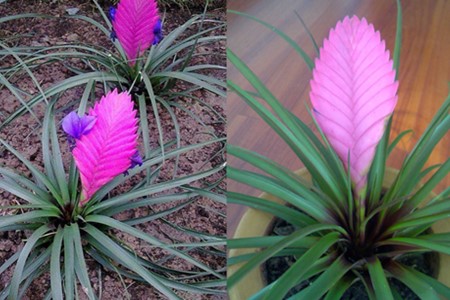
I. Growing environment and morphological characteristics of the purple bromeliad
1. It generally prefers a warm, humid environment, so it usually grows in southern China, where the climate is milder and rainfall is plentiful.
2. But it cannot tolerate direct sunlight; direct sunlight makes its flowers fade very quickly.
3. Its appearance is extremely beautiful: slender green leaves with a purple, feather-like flower in the center. Many people are drawn to its lovely appearance.
4. Its flowering period is very long, so many people grow it as a potted plant.
II. Reasons why the purple bromeliad turns green
1. Turning green may be due to direct sunlight in summer, so it should be placed in a more shaded spot.
2. It may be due to lack of water; it is a plant that likes humidity, so it must be watered regularly.
3. Sometimes pest or disease problems can also cause it to turn green, so it needs to be treated with insecticide.
4. The soil should not be too alkaline either; too much alkalinity can also make it turn green.
5. Also, when it is about to fade, it will turn green and then black, but this is a natural phenomenon.
III. How to care for it after it turns green
1. If it turns green because it is about to fade, cut off the green part, and it will send out new shoots and bloom again.
2. If it is due to pests or disease, you need to treat it with insecticide promptly; if it is not too serious, it can be saved.
3. If it is caused by direct sunlight or lack of water, you need to place it in a shaded spot and water it more; generally this can make it turn purple again.
The beautiful purple bromeliad has high ornamental value; placing one in your home or office will make you feel happy and relaxed. After reading this introduction, you must have some understanding of how to care for a purple bromeliad after it turns green.
What are the uses of the bromeliad? How do you grow a bromeliad?
The bromeliad is also known as pineapple, wild pineapple, and pandanus fruit. The bromeliad is rich in nutrients, such as sugars, vitamins, organic acids, and nicotinic acid, with vitamin C being the highest in content. Its unique effects of relieving summer heat and quenching thirst, and aiding digestion and stopping diarrhea, make it an excellent fruit for both medicine and food in summer, and people call it one of the four famous fruits of Lingnan.
The bromeliad is a plant of the genus Ananas in the family Bromeliaceae, native to Brazil. It was introduced to China in the 16th century and has more than 70 varieties. Today China is one of the top ten pineapple-producing countries, mainly distributed in hotter regions such as Guangdong, Hainan, Guangxi, Fujian, and Yunnan. Beyond the sweetness the bromeliad leaves in people's mouths, its leaves are verdant and its inflorescence is gorgeous. Grown in pots and displayed in halls, on windowsills, and other places for viewing, it is a good choice for both flower and foliage appreciation, and it is favored by many people. Therefore, let me introduce the uses and cultivation methods of the bromeliad.
Uses of the bromeliad
There are many ways to eat bromeliad, and it is delicious no matter how it is eaten. Besides being eaten as a fresh fruit, it can also be made into canned goods, juice, candied fruit, and more. The bromeliad tastes sweet and slightly sour, and is neutral in nature. It has the effects of quenching thirst and relieving restlessness, strengthening the spleen and quenching thirst, reducing swelling, removing dampness, and sobering up while boosting energy. It can be used for indigestion, enteritis and diarrhea, summerheat, fever with thirst and restlessness, and can also be used as an auxiliary treatment for hypertension and dizziness, and weakness and fatigue of the hands and feet. Do you believe it? Bromeliad can also help with weight loss. The secret lies in its rich juice, which can effectively break down fat. You can effectively include pineapple in your food daily or drink pineapple juice; this is undoubtedly the weight-loss method people enjoy most. The protease contained in bromeliad can effectively break down protein in food and increase gastrointestinal motility. Friends who often suffer from constipation can eat a slice of fresh pineapple every morning and will see good results.
The aroma and sourness of the bromeliad, when used in cooking, best stimulate appetite and relieve fatigue. The discarded pineapple peel, used as a deodorizer in the refrigerator, can eliminate odors with quite good results. The bromeliad truly makes full use of every part.
The bromeliad's effect on the home environment
We know that the bromeliad as a fruit is sweet and sour and delicious, but do you know what is so amazing and fascinating about the ornamental bromeliad flower? What kind of color can it add to our lives? The bromeliad is also called pineapple. In the bromeliad family, there are varieties whose flowers are not beautiful but which can produce pineapples; people call them edible bromeliads. There are also varieties whose flowers and leaves are both unusual and novel but which cannot bear fruit; people call them ornamental bromeliads or pineapple flowers.
Ornamental bromeliads were introduced to China since the 1980s and have been welcomed by many people. Currently popular ornamental bromeliads in China include the urn plant, earth star, Aechmea, silver vase bromeliad, and painted feather bromeliad. Their plants have clustered grass-like stems, and the stems are generally short. The leaves are narrow and long, sword-shaped or in various band forms, and most leaf margins have serrations. The leathery leaves are brilliantly colorful. The flowers they produce are even more varied in form. Both their flowers and leaves seem coated with a waxy layer, soft yet firm and full of luster. Therefore they have become famous indoor foliage and flowering plants. Placed as a living room decoration, they are both warm and reserved, giving people a warm and comfortable feeling.
The leaves of the urn plant are narrow and long like swords, verdant and glossy. From winter to early spring, a bright red columnar inflorescence emerges from the tender green leaf tube, about 30 cm tall; at the top are 6-12 small flowers, with 3 petals, pale yellow-green, with blue edges, curling outward after opening. When in full bloom, strings of blue-green flowers, set off by the red bracts, look especially gorgeous and eye-catching, and the viewing period can last up to two months. Can such a pot of bromeliad flowers in your living space keep you in a good mood at all times?
The earth star, also known as the small bromeliad, is most suitable for potted viewing. Its leaves are firm and slender, with wavy edges, and colors include creamy yellow, red, or purplish red. The leaf surface has long vertical stripes radiating like a crab shape, and the flowers are white or light green, growing among the leaf clusters to form a disc. Fresh and elegant yet full of vitality, it can create a faintly warm atmosphere for us.
Aechmea, also known as beautiful-leaf silver vase and spotted pink pineapple, has leaf tips that are bluntly rounded and turned outward, blue-green, with the surface coated in a silvery white layer, and the leaf surface forms irregular stored color and dark green horizontal stripes and patches. The dense small flowers are blue when they first open, then turn rose red, like a dragonfly spreading its wings in flight, giving a feeling of vitality and movement and sparking our thoughts and inspiration.
The leaves of the silver vase bromeliad are sword-shaped, curling outward, crisp and glossy. The front of the leaf is dark green, the edges are yellow-green, and some leaves also gradually show varying yellow-green stripes in the middle. The back of the leaf is light green, with the same yellow-green hidden stripes as the leaf surface. In spring and summer, a cylindrical flower bud emerges from the leaf tube, with 25-30 sepals wrapping from bottom to top like bamboo shoot shells into a column from deep red to pink, closely resembling a red bamboo shoot set into the leaf tube. Over two or three weeks, the columnar flower bud splits open, sending out a straight flower stem, on which more than a dozen small flowers bloom, each small flower showing three colors from bottom to top: yellow, red, and purple. In a single pot of flowers, different scenes are presented, with a distinctive flavor.
The painted feather bromeliad, also called the torch, is a hybrid. The leaf edges are smooth and have no serrations. From the center emerges an upright flower stem, with a spike inflorescence at the top, and the flower spike is branched. The flower bracts are deep red, thick and glossy, and the entire inflorescence looks like a blazing torch. The flowering period can reach three months, and it is also a favorite among ornamental bromeliads.
Some people use bromeliad flowers as a template to make wall murals, giving a distinctive flavor.
These different varieties of bromeliad flowers each have their own merits and can create different home atmospheres for you. There is always a flower that blooms for you; choose the suitable one, the one you love, and her beauty will exist for you.
The feng shui role of the bromeliad
When it comes to feng shui in the home, people always think of certain plants and flowers. People place flowers and plants at home not only to improve air quality and make people feel comfortable, but also to use them as decorations to boost luck. Different people prefer to choose different plants, such as spider plant, clivia, cactus, and Guzmania, which are all people's first choices. Hearing "Guzmania," many people think it is an idiom, or the name of some film or TV drama. In fact, "Guzmania" here is a kind of bromeliad flower, named "Guzmania" because of its bright red flower core. So how exactly does this "Guzmania" bromeliad flower bring good luck to people?
Guzmania is native to the Andes Mountains, and in places such as Guangdong and Shanghai in China it is grown and cultivated in greenhouses. We know that bromeliad is pineapple, a perennial herbaceous plant of the family Bromeliaceae. Their homeland is the Caribbean coast and various parts of South America. In the bromeliad family, there are varieties that have flowers but are not beautiful yet can grow pineapples; we call them edible bromeliads. There are also varieties whose flowers and leaves are both unusual and novel but which cannot bear fruit; we call them ornamental bromeliads or pineapple flowers. Guzmania is an ornamental bromeliad. Both its flowers and leaves seem coated with a waxy layer, soft yet firm and full of luster, with dewdrops crystal clear on them. Therefore it has become a famous indoor foliage and flowering plant. As a living room decoration, it is quite a beautiful sight.
The flower language of the bromeliad flower is perfection. For Guzmania, the flowers open at the top or middle of the plant, with luxuriant flowers and leaves and bright red flowers, which can bring a festive atmosphere. The leaves are broad and band-shaped, appearing dark green. The spike inflorescence is similar to a cone shape, with densely growing bracts, and the tips are yellow. Because this bromeliad plant has bright red flowers all over its top, it is vividly named with the idiom "Guzmania," meaning good luck. In people's eyes, Guzmania is an auspicious and noble flower.
The most striking feature of Guzmania is the bright red flower core in the middle. Red things can instantly add warmth to the home, like dancing elves letting people feel a festive atmosphere.
And we Chinese have had a "red" culture for thousands of years, symbolizing prosperity. Placing a pot of Guzmania at home can bring visual beauty and also elevate one's taste. Its name also implies good fortune; so-called Guzmania means good luck arriving by your side. In addition, Guzmania is a perennial herbaceous plant with a relatively high survival rate and a price that is not very expensive. Placed at home, it appears elegant and refined, making it a home flower that many people are happy to buy.
Many feng shui masters believe that Guzmania is suitable for placement in the living room, with the meaning of gathering wealth and bringing prosperity. In addition, it also likes environments with higher humidity, so it can be placed in the bathroom to absorb stale air and purify the air. Of course, if the bathroom is both spacious and bright and has air conditioning, using a gorgeous plant like Guzmania can decorate a bathroom that is somewhat monotonous. However, Guzmania should also be allowed to absorb some sunlight appropriately. So if the balcony at home is relatively empty, you can consider growing a pot of such a brightly colored flower with evergreen leaves; sometimes it can even have the feng shui effect of promoting prosperity and dissolving negative energy.
Guzmania can be considered the most popular indoor foliage plant today. As home gardening ornamentation, it is very tasteful. How about it? Placing a pot of Guzmania in your living space can add a share of "good luck" to your home. Pleasing to the eye and the mind, it is truly the best choice.
The role of bromeliads in matching home styles
We all know a truth that seems simple but is profound: things reverse when they reach an extreme. Nothing is absolutely good or bad. Appearing at the right time in the right place means it is the right existence. This is exactly how flowers and our home design work.
We like potted plants, but at the same time we should also pay attention to matching the potted plants with the home style. Sometimes a bright, eye-catching flower can make the whole home lively and lovely; sometimes a fresh flower can make family members feel physically and mentally comfortable. How to place them and how to arrange them is especially important; this is the so-called finishing touch. Flowers serve the home layout, and the home design can at the same time reflect the beauty of the flowers. The two exist in mutual response rather than as independent individuals. So how can bromeliad flowers complement the home beautifully?
Flowers play a decorative role, and their placement is closely connected to the decoration style of the owner's home. According to the owner's preferences, the home will be laid out in different styles, such as minimalist, European and American, the retro style of older people, and the non-mainstream style of young people, and so on. As a leader among bromeliad flowers, Guzmania, with its bright red flower core and very beautiful and special rosette leaves, can suit European, Chinese, or minimalist decoration styles, giving the home a natural touch. Pair a corner of the living room with a pot of gorgeous Guzmania to make your living room appear more lively, especially the red flower in the middle, which attracts everyone's eyes, giving a feeling of "a touch of red among a vast expanse of green." Guzmania can increase indoor humidity, beautify the environment, and also produce oxygen, relieving nervous tension and visual fatigue. When you feel mentally tired, you can look at the Guzmania beside you to open up your thoughts and relax tense nerves. Guzmania likes a semi-shaded environment and is suitable for places such as halls, desks, living rooms, offices, and meeting rooms. Imagine being able to admire such an appealing flower in your leisure time; your mood will naturally feel relaxed.
The earth star's colors include creamy yellow, red, or purplish red. The leaf surface has long vertical stripes radiating like a crab shape, and the flowers are white or light green, growing among the leaf clusters to form a disc. Fresh and elegant yet full of vitality, it can create a faintly warm atmosphere for us. Placing such a plain and elegant earth star on the bedroom balcony will help you relax, relieve stress, rest well, and adjust your mood.
The flower bracts of the painted feather bromeliad are deep red, thick and glossy, and the entire inflorescence looks like a blazing torch. The flowering period can reach three months. Place a pot on the living room balcony, and when sunlight falls on it, it will give people a feeling that life is full of hope. Of course, we value quality over quantity; a touch is enough, giving beauty without creating a messy appearance. Different flowers have different moods; the key is how you read them.
We say that growing flowers can cultivate the mind and character, eliminate worries, relax the mood, and also provide a moderate amount of physical activity. Moreover, if you have a brilliant touch, it will bring a different flavor to your home life, bringing yourself good luck while also bringing a good mood.
Cultivation methods for bromeliads
1. Since bromeliads like sunlight, you must ensure they live at suitable temperatures. In summer the suitable temperature is 25-30°C, and in winter the suitable temperature is 15-18°C. The lowest temperature must not be below 12°C. When the temperature is high, you can spray water on the plant; soft sunlight makes the leaves more beautiful. If it is in the growing season, you can water heavily, and at the same time pour some water into the rosette leaf tube. After each watering, wait until the potting soil is relatively dry before watering a second time.
2. You must ensure the nutrients necessary for bromeliad growth and pay attention to timely fertilization. May to September is the vigorous growth period for bromeliads, so fertilize once every two weeks. In addition, phosphorus and potassium fertilizer should be applied twice more.
3. Bromeliads like a loose soil environment with good air permeability. Therefore, repotting should be done at the appropriate time. The potting medium should not only be rich in humus and fertile, but more importantly should be loose, well aerated, well drained, and slightly acidic. You can buy a prepared mixed cultivation medium; of course, for people living in cities, this is the most likely option.
4. Ensure reasonable pruning. After flowering, cut off the remaining flowers, which can extend the flowering period. In order to avoid excessive consumption of nutrients by the plant, leggy branches, overlapping branches, crossing branches, radiating branches, and diseased branches should be pruned at any time.
The above is a sharing of the uses and cultivation methods of the bromeliad. I hope everyone can understand something from it. For more home plants, please stay tuned.
Matching bromeliads with home styles
Click the image to go to the next page>>
We all know a truth that seems simple but is profound: things reverse when they reach an extreme. Nothing is absolutely good or bad. Appearing at the right time in the right place means it is the right existence. This is exactly how flowers and our home design work.
We like potted plants, but at the same time we should also pay attention to matching the potted plants with the home style. Sometimes a bright, eye-catching flower can make the whole home lively and lovely; sometimes a fresh flower can make family members feel physically and mentally comfortable. How to place them and how to arrange them is especially important; this is the so-called finishing touch. Flowers serve the home layout, and the home design can at the same time reflect the beauty of the flowers. The two exist in mutual response rather than as independent individuals. So how can bromeliad flowers complement the home beautifully?
Flowers play a decorative role, and their placement is closely connected to the decoration style of the owner's home. According to the owner's preferences, the home will be laid out in different styles, such as minimalist, European and American, the retro style of older people, and the non-mainstream style of young people, and so on. As a leader among bromeliad flowers, Guzmania, with its bright red flower core and very beautiful and special rosette leaves, can suit European, Chinese, or minimalist decoration styles, giving the home a natural touch. Pair a corner of the living room with a pot of gorgeous Guzmania to make your living room appear more lively, especially the red flower in the middle, which attracts everyone's eyes, giving a feeling of “a touch of red among a vast expanse of green.” Guzmania can increase indoor humidity, beautify the environment, and also produce oxygen, relieving nervous tension and visual fatigue. When you feel mentally tired, you can look at the Guzmania beside you to open up your thoughts and relax tense nerves. Guzmania likes a semi-shaded environment and is suitable for places such as halls, desks, living rooms, offices, and meeting rooms. Imagine being able to admire such an appealing flower in your leisure time; your mood will naturally feel relaxed.
The earth star's colors include creamy yellow, red, or purplish red. The leaf surface has long vertical stripes radiating like a crab shape, and the flowers are white or light green, growing among the leaf clusters to form a disc. Fresh and elegant yet full of vitality, it can create a faintly warm atmosphere for us. Placing such a plain and elegant earth star on the bedroom balcony will help you relax, relieve stress, rest well, and adjust your mood.
The flower bracts of the painted feather bromeliad are deep red, thick and glossy, and the entire inflorescence looks like a blazing torch. The flowering period can reach three months. Place a pot on the living room balcony, and when sunlight falls on it, it will give people a feeling that life is full of hope. Of course, we value quality over quantity; a touch is enough, giving beauty without creating a messy appearance. Different flowers have different moods; the key is how you read them.
We say that growing flowers can cultivate the mind and character, eliminate worries, relax the mood, and also provide a moderate amount of physical activity. Moreover, if you have a brilliant touch, it will bring a different flavor to your home life, bringing yourself good luck while also bringing a good mood.