How to grow a wisteria bonsai? Six easy steps to get it done
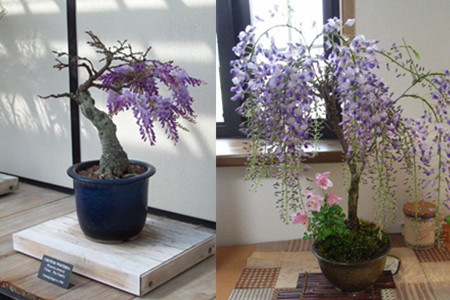
Wisteria is named for its color and shape, has high ornamental value, and is deeply loved by many friends. I had heard many people praise it before, and after seeing a wisteria bonsai, I also became one of its admirers. So, how exactly should a wisteria bonsai be grown? Below, let me share with you the cultivation methods for a wisteria bonsai.
Choosing the seedling is very important when growing a wisteria bonsai. Actually, any method can be used for selecting the seedling, but in most households the bonsai seedling is bought directly from a flower shop as a grown plant, which also gives a relatively high survival rate. But a small number of "experts" like to start growing from seed.
1. Seedling source.
Sowing and cutting propagation can be used. Sowing can be done in early spring, with the temperature required to be between 10°C and 13°C. If using cutting propagation, it can be done in autumn.
2. Making a wisteria bonsai.
1. Potting.
In spring, that is, in February to March, planting is better. For the potting soil, we should use a relatively fertile, well-drained mix of leaf mold and soil. Good flowers need a good pot. We can choose some relatively deep pots that look more imposing; the shape is up to you, and it can be angular or round.
2. Shaping.
We mainly use pruning and tidying, with tying and binding as secondary, so as to fully show the plant's simple and beautiful natural form. When pruning, the branches should be well staggered to avoid monotony, but the layers should not be many. The forms of wisteria bonsai we commonly see are various. In this respect you can use your imagination and create a good-looking shape.
3. Watering.
We will find that it actually consumes a lot of water, but even so we cannot water it often. If it is only wet and never dry, that is not good for flowering. As for watering, do not water if it is not dry, and water thoroughly when you do water. Especially in August, watering should be appropriately reduced. By September, normal watering can be resumed.
4. Fertilizing.
Applying thin fertilizer frequently is a key point for making wisteria bloom abundantly and grow lush leaves, so remember this. During the plant's growing period, you can water according to the situation, and for fertilizing we can apply a relatively low-concentration cake fertilizer once every half month, stopping fertilization only in July to August, and then continuing fertilization again in September. However, both the frequency and the concentration should be appropriately reduced. Before flowering, the frequency of applying phosphorus and potassium fertilizer can be appropriately increased depending on the situation.
5. Pruning.
When wisteria sprouts tender buds in spring, the dense buds should be appropriately removed. When the new branches grow to more than 20 cm, we can cut off the overly long part of the new branches. September is the period when old wisteria leaves tend to age and droop; because this affects the appearance, we can remove the old leaves to speed up the sprouting of new leaves. The sprouted new leaves are relatively tender, which can effectively delay leaf fall and extend the bonsai's ornamental period.
6. Repotting.
For the repotting time, it is better to choose before budding in early spring. After that, repotting once every two to three years is enough.
3. Pest and disease control.
Compared with growing other flowers, wisteria has fewer pests. But pests are everywhere, and aphids and leaf moths are wisteria pests. Our main control method for this is to use insecticide solutions such as trichlorfon and emulsified dimethoate for spraying and killing.
The above is all my sharing on growing a wisteria bonsai. After reading it, was there anything that could help you?
How to grow a wisteria bonsai
How to grow a wisteria bonsai
Wisteria has a deep main root and few lateral roots. It likes sunlight, tolerates slight shade, tolerates cold, tolerates drought, and has strong adaptability; it likes deep, fertile, loose, well-drained soil.
The old tree stumps used for making wisteria bonsai are mostly dug from the mountains in spring, and according to the shaping needs, the main trunk and main root are cut short to form bare trunks and bare roots, then processed into curved-down style or slanting-down style, weeping-branch style, cliff-hanging style, etc. The tree stump is planted in a relatively deep, slightly larger training pot, placed in a cool place for a week, and then moved to a place where it can get morning sunlight. After 1 year of cultivation, the root system becomes well developed, many lateral roots grow, and the branches and vines grow vigorously, which is good for raising the roots, pruning, and repotting. In the second spring, before the tree stump buds, repot it and transplant it into an ornamental pot. After shaping again. With care, it can then be enjoyed.
For the ornamental pot, it is better to choose a relatively deep round or square Yixing zisha pot or Foshan bonsai pot. For the potting soil, use sun-dried pond mud, vegetable garden soil, or leaf mold.
When repotting, the tree stump should be pruned once, the vine stems cut short, the overly dense vine branches on the trunk thinned out, and the transition point between the top branches and the trunk properly handled. When potting, the roots can be appropriately raised, and after potting, place it in a place with plenty of sunlight.
Wisteria likes fertilizer. During the growing period, often apply thin, well-rotted organic fertilizer; except during the flowering period, apply liquid fertilizer once a month. Water often to keep the potting soil moist. Pay attention to controlling water after autumn to prevent autumn shoots from sprouting and growing excessively, making the tree too vigorous and the branches and leaves too many, which makes it difficult to flower.
For shaping, use a combination of bud removal, pinching, and pruning with tying and binding. After sprouting in spring, keep 2 to 3 buds per branch, and when the new shoot grows to 15 cm, pinch it to promote the formation of flowering branches, so that flowers form at the top of the new shoot, and when it blooms it is a profusion of flowers. During the dormant period, the branches should be cut back to adjust the distribution structure of the branches and maintain a beautiful form. Usually, prune vigorous shoots, overly dense branches, and overly long weeping branches so that nutrients are concentrated in the flowering branches.
When the flowers fade, promptly cut off the flower spikes and cut the flowering branches short. Repot and change the soil once each year, and repotting should be done before the branches bud in early spring. While repotting, also cut off old roots and overly long roots, replace half of the old soil, and add loose, fertile soil and base fertilizer. Through repotting and changing the soil, nutrients can be increased, the tree's vigor enhanced, and nutrients accumulated to encourage more flowering.
Wisteria tender shoots are easily harmed by aphids; when found, spray with 40% dimethoate at 800 times dilution. When leaf damage by noctuid moths is found, spray 50% dichlorvos at 1000 times dilution in the evening.
Under sufficient sunlight, as long as water and fertilizer are supplied in time, pinching and bud removal are done promptly, and pruning after flowering and during the dormant period is done well. With soil changing, root trimming, and base fertilizer added every year, a properly shaped and well-cared-for wisteria will bloom every year.
Wisteria bonsai
Wisteria bonsai